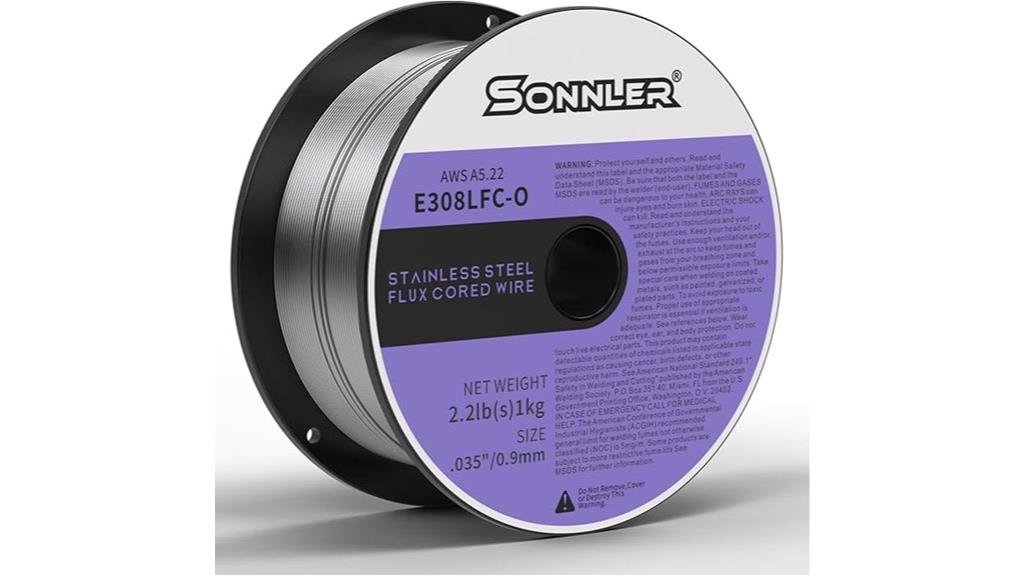
The E308LFC-O welding wire is presented as a reliable gasless MIG option for stainless steels like 304 and 308L, offered in 0.035″ diameter on a 2 lb vacuum-sealed spool. It delivers low spatter, consistent bead profile, good fusion, predictable slag coverage, and works well for small projects and field repairs. What welding parameters, joint preparation, and shielding choices optimize results for your application—keep going to see practical specs and tests.
Key Takeaways
- E308LFC-O is a 0.035″ (0.9 mm) stainless flux-cored wire, sold on a 2-pound vacuum-packed spool for corrosion resistance.
- It performs well gasless on stainless alloys 304, 304L, 308, 308L, 321, and 347 with low spatter and stable arc.
- Recommended operating range is about 80–120 A with moderate, steady travel speed for good fusion and predictable bead shape.
- Packaging is waterproof and vacuum-sealed, preventing contamination and extending shelf life for occasional users.
- Best for small projects and fieldwork; consider bulk options for high-volume users despite competitive per-spool value.
Product Specifications and Compatibility
Because compatibility and specs determine whether a wire meets a project’s needs, the E308LFC-O .035″ (0.9 mm) stainless flux-cored wire is presented with clear, practical details for the reader to assess fit.
What is it?
– 0.035″ (0.9 mm) diameter, 2-pound vacuum-packed spool.
Which welding applications?
– Gasless MIG projects on 304, 304L, 308, 308L, 321, 347 stainless; compatible with HF, Forney, Lincoln.
What about wire materials?
– Stainless flux-cored composition tailored for corrosion-resistant joints.
Practical considerations:
– Check welder settings, wire feed speed, joint design, and shielding needs before use.
Performance and Welding Results
Assessing the E308LFC-O .035″ (0.9 mm) stainless flux‑cored wire shows consistent, workshop‑ready performance across common stainless alloys, with particular strengths in low spatter, stable arc behavior, and reliable slag coverage.
The reviewer notes predictable bead shape, good fusion at typical MIG settings, and gasless convenience for field work.
Practical considerations include amperage range, travel speed, and joint fit‑up.
How does it perform? Measured welds on 304 and 308L exhibit sound fusion and minimal cleanup.
- Amperage: 80–120 A for 0.9 mm, adjust by material thickness.
- Travel speed: moderate, steady for best slag control.
- Material compatibility: 304–347 validated, suited to varied welding techniques.
Packaging, Support, and Value
Having confirmed reliable welding performance on 304 and 308L, attention shifts to how the product arrives, the support behind it, and whether it represents good value for money.
The 2-pound spool is vacuum packed, waterproof, moisture-proof; packaging quality prevents corrosion and contamination, extends shelf life.
What support exists? 24/7 customer assistance, technical engineers with 20+ years, phone and email guidance.
Practical considerations: 0.035″ (0.9mm) diameter, 2 lb weight, gasless operation for fieldwork.
Is it good value? For small projects and occasional use, yes—competitive price, reduced cleanup, reliable specs; for high-volume users, evaluate bulk options.
Frequently Asked Questions
Does This Wire Require Special Storage After Opening the Vacuum Pack?
No, it does not require special storage beyond common precautions. The responder recommends dry, low-humidity storage conditions to preserve wire longevity, using sealed containers or desiccants and avoiding direct moisture, contaminants, and extreme temperatures for best results.
Can It Be Used With Flux-Cored Pulsed MIG Settings?
Yes, it can be used with pulsed settings. The reviewer notes the wire adapts well to pulsed settings, enhancing control and reducing spatter; recommended welding techniques include careful parameter tuning and practice to optimize bead appearance and penetration.
Is It Suitable for Outdoor Welding in Windy Conditions?
Yes. The wire provides reliable wind resistance and strong outdoor performance for gasless MIG welding, reducing spatter and slag concerns; however, very high winds may still affect bead quality, so shielding or wind breaks are recommended.
How Does It Perform on Dissimilar Metal Joints?
Around 70% greater dilution risk occurs when welding dissimilar metals; the wire shows cautious dissimilar joint performance, reducing metal compatibility issues when proper root gap, heat control, and filler selection are used, though brazing may be preferable.
Are There Any Safety Precautions Unique to This Wire?
Yes. He notes common welding safety practices apply, plus careful wire handling to avoid moisture contamination; gasless stainless fumes require ventilation, PPE, and proper spool storage. Inspect feed path and use anti-spatter measures consistently.
Conclusion
Like a reliable compass in a field kit, the E308LFC-O welding wire guides stainless repairs with steady, predictable performance. It measures 0.035″ diameter on a 2 lb vacuum-sealed spool, fits gasless MIG setups for 304 and 308L, and delivers low spatter, consistent bead shape, and good slag coverage. Practical for small projects and fieldwork, it pairs solid weld quality, 24/7 support, and clear value—questions about compatibility or parameters are answered by specs and testing.