Disclosure: As an Amazon Associate, we earn from qualifying purchases. If you click a link on this page and make a purchase, we may receive a small commission at no extra cost to you.
TIG welding aluminum and steel on a tight budget often forces you to choose between underpowered portable units and bulky, expensive industrial machines. The ARCCAPTAIN TIG200PACDC aims to solve this dilemma by offering a full 200A AC/DC output, high-frequency pulse controls, and multi-process versatility in a 26.5-pound package. If you need precise low-amp heat control for thin aluminum sheet metal or steady power for structural steel, this machine promises shop-grade capability without locking you into a dedicated workstation. This assessment breaks down its real-world performance, digital controls, material limits, and long-term value to help you decide if it belongs in your shop.
Quick Verdict
Rating: 9.1/10 (Highly Recommended)
Best For: Metal fabricators, home shop owners, and mobile welders needing an affordable AC/DC TIG unit for aluminum and steel.
Bottom Line: The ARCCAPTAIN TIG200PACDC delivers exceptional feature density, offering precise MCU pulse controls and clean AC square wave cleaning for aluminum at a portable 26.5 lb weight. While foot pedal compatibility requires model-specific matching, its 60% duty cycle at 200A and 5-year warranty make it an outstanding value.
| Specification | Detail |
|---|---|
| Brand | ARCCAPTAIN |
| Model | TIG200PACDC (7-in-1 Multi-Process) |
| Output Amperage | 10A – 200A AC/DC |
| Duty Cycle | 60% at 200A |
| Welding Processes | AC TIG, DC TIG, AC Pulse, DC Pulse, Stick (MMA), Spot, 2T/4T |
| Aluminum Capacity | 0.5mm – 5.0mm (AC Mode) |
| Steel & Iron Capacity | 0.5mm – 10.0mm (DC TIG / Stick) |
| Control Display | MCU Microprocessor with High-Visibility LED Display |
| Machine Weight | 12 kg (approx. 26.5 lb) |
| Dimensions | 17″ × 7″ × 13″ (Compact steel chassis) |
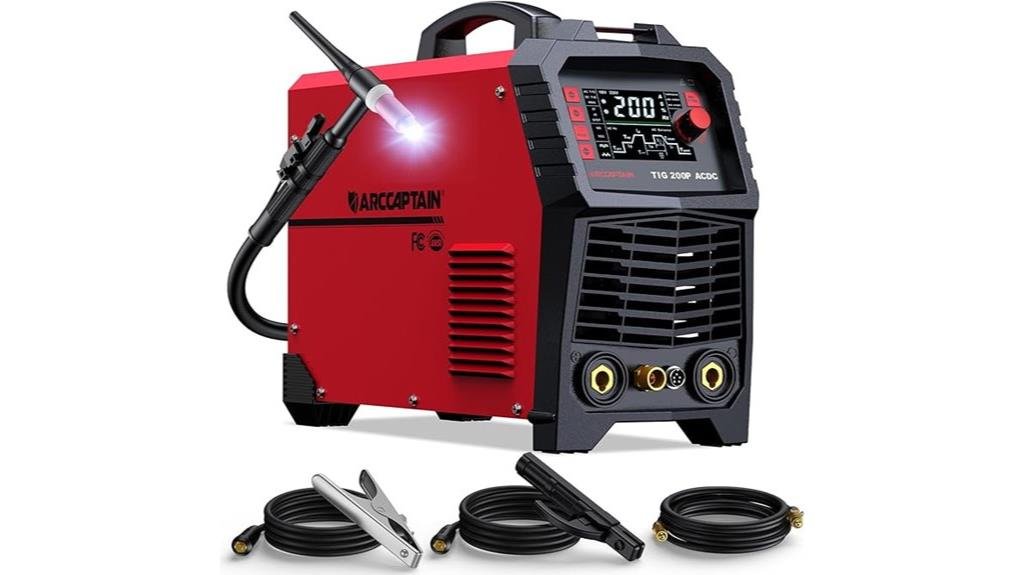
| Included Accessories | WP-26 TIG Torch, Ground Clamp, Electrode Holder, Gas Hose, Argon Regulator, Cable, Manual |
| Warranty & Support | 5-Year Quality Service Warranty (Covers MCU & Electronics) |
What Is the ARCCAPTAIN TIG200PACDC Welder?
The ARCCAPTAIN TIG200PACDC is a multi-process welder engineered for home workshop fabrication, mobile repair jobs, and light industrial projects. Powered by advanced MCU digital inverter technology, it delivers clean AC and DC TIG arc performance alongside stick (MMA) and spot welding modes. This versatility allows operators to handle paper-thin 0.5mm sheet metals as well as heavy 10mm steel plates without swapping power sources.
Unlike standard DC-only welders, this power source features dedicated AC square wave and AC pulse modes explicitly tuned for aluminum alloys and magnesium. By granting full control over AC balance, pulse frequency, peak/base current, and slope timings, it brings the precision parameter control of high-end industrial machines into a lightweight 12 kg metal chassis. Reinforced rubber corner bumpers and a sturdy top carry handle make it practical for moving between shop stations or remote job sites.
Who Should Buy It?
Best For
- Auto restorers and fabricators working with aluminum bodywork and stainless exhausts.
- Mobile repair technicians requiring a full 200A AC/DC welder under 30 pounds.
- DIY welders seeking digital parameter storage for quick, repeatable setups.
Skip If
- You require continuous, heavy-duty production welding on thick 1/2-inch structural steel.
- You expect universal plug-and-play foot pedal compatibility with generic 5-pin pedals.
Performance Across Materials and Welding Modes
1. Aluminum and Magnesium Alloys (AC TIG & Pulse)
Welding aluminum requires breaking through tough surface oxide layers without overheating the base metal underneath. The ARCCAPTAIN handles this through its AC square wave and AC pulse functions. Adjusting the AC balance allows you to set the exact proportion of cleaning action versus penetration depth. For delicate aluminum sheet down to 0.5mm, enabling pulse mode minimizes heat input, prevents blow-through, and leaves neat “dime” weld beads.
2. Stainless Steel, Carbon Steel, and Copper (DC TIG Mode)
For steel and copper alloys, DC TIG mode delivers smooth, stable arc characteristics starting as low as 10 amps. The digital micro-processor controls pre-flow and post-flow gas timings, protecting the molten weld puddle from atmospheric contamination during arc start and torch lift. The result is discoloration-free welds on stainless steel exhaust headers and tubing.
3. Stick (MMA) and Spot Welding Capabilities
When working outdoors in windy conditions where shielding gas blows away, switching to Stick mode allows reliable repairs on carbon steel plate up to 10mm thick. The machine also supports a dedicated Spot welding mode, which provides precise short-duration arc pulses ideal for tacking sheet metal panels prior to final welding.
Before You Buy: Remote foot pedal compatibility is model-specific. Standard generic TIG foot pedals will not work without confirming the exact pinout wiring, connector configuration, and resistance protocol required by ARCCAPTAIN.
Advanced Digital Controls and MCU Parameters
The front panel centers around a bright, high-contrast LED display driven by an MCU microprocessor. Rather than relying on approximate analog dials, you can fine-tune individual wave parameters step-by-step:
- Pre-Flow & Post-Flow Time: Controls gas shield timing before arc ignition and after arc termination (0–10 seconds).
- Peak & Base Current: Sets heat differentials for pulse welding thin sheet metals.
- AC Frequency & Balance: Adjusts arc cone focus (50–250 Hz) and oxide cleaning action (15–50%).
- Up-Slope & Down-Slope Time: Prevents crater cracking by smoothly ramping amperage up at the start and down at the end.
- 2T / 4T / Spot Modes: Choose between standard press-and-hold torch triggering (2T), latching mode for long weld passes (4T), or timed spot welds.
Pro Tip: When TIG welding thin aluminum, set your AC balance toward penetration (around 30–35% cleaning) and bump the AC frequency to 100–120 Hz. This narrows the arc cone, increases puddle control, and prevents burn-through.
Portability, Build Quality, and Ergonomics
At 12 kg (26.5 lb), the ARCCAPTAIN TIG200PACDC is significantly lighter than traditional transformer machines that often weigh over 80 pounds. The protective outer steel casing features rubberized corner bumpers that absorb jobsite bumps, while rubber pads on the base keep the unit firmly planted on slick workbench surfaces or pickup tailgates.
The internal cooling fan features intelligent thermal management. It operates quietly during low-amp TIG fit-up tasks and spins up to full power only when internal heat levels rise during sustained high-amp welding passes. Control spacing on the front panel is wide enough for easy adjustment while wearing thick leather welding gloves.
How It Performs in Real Use
Scenario 1: Thin Aluminum Sheet Fabrication (0.5mm – 3mm)
In thin aluminum applications like intake piping, fuel tanks, or bodywork, the AC pulse mode excels. Setting peak current for penetration and a lower base current allows the weld puddle to cool rapidly between pulses, eliminating panel warping and edge burn-through.
Scenario 2: Stainless Steel Exhaust and Tube Repairs (1.5mm – 6mm)
When fabricating stainless steel headers, DC TIG mode provides crisp arc ignition without tungsten sticking. Setting a 5-second post-flow gas window preserves the tungsten tip and protects the cooling weld crater from oxidation, leaving bright metallic finishes.
Scenario 3: Mobile Field Repairs and Farm Duty
Loading the 26.5 lb power source into a truck bed for field repairs is simple. When working on dirty or rusty structural steel outdoors, swapping to Stick mode with E7018 electrodes delivers deep penetration on 10mm steel plates without needing shielding gas tanks.
Scenario 4: High-Amperage Workshop Sessions
Running continuous passes at 150A to 180A demonstrates the effectiveness of the internal cooling system. With a 60% duty cycle at its full 200A limit, the machine handles extended shop production schedules without tripping thermal overload warnings.
Setup Tips and Safety Guidance
To ensure optimal weld quality and safe operation, keep these practical setup practices in mind:
- Shielding Gas Requirements: Always use 100% pure Argon gas for TIG welding aluminum and stainless steel. Set flow rates between 12 and 20 CFH depending on cup size and ambient drafts.
- Tungsten Electrode Selection: Use 2% Ceriated (grey) or Lanthanated (gold) tungsten electrodes for both AC and DC TIG. Avoid pure tungsten (green) on digital inverter machines, as square wave AC can cause pure tungsten to ball excessively.
- Generator Safety: When operating off portable power, verify that your generator supplies a clean sine wave with a minimum continuous output of 5.5 kW to handle high-amperage AC spikes safely.
- Post-Weld Cooling: Allow the main cooling fan to run for 3 to 5 minutes after heavy welding sessions before switching off the main power breaker. This dissipates residual heat from the internal MCU inverter board.
Pros and Cons
Pros
- True 200A AC/DC output handles thin 0.5mm sheet metal up to 10mm steel plate.
- Advanced MCU controls offer full pulse, AC balance, frequency, and slope customization.
- High 60% duty cycle at maximum 200A amperage for extended shop work.
- Compact 12 kg (26.5 lb) metal chassis with protective rubberized corners.
- Backed by a 5-year quality service warranty covering major electronics.
Cons
- Foot pedal connectivity requires proprietary or specifically matched pinout pedals.
- Stock TIG torch cable length may require extension for large vehicle projects.
- Digital parameter menu presents a minor learning curve for first-time TIG operators.
Check Latest Price on Amazon →
Is It Worth the Price?
When evaluated against comparable AC/DC TIG welders, the ARCCAPTAIN TIG200PACDC provides outstanding value for home fabricators and small shop owners. Industrial-grade AC/DC TIG welders with full digital wave controls often cost two to three times as much, making this unit an accessible choice for high-quality aluminum welding without sacrificing arc control.
The combination of a 60% duty cycle at 200A, an included accessory package with regulator and torch, and a comprehensive 5-year service warranty provides peace of mind that budget welders rarely offer. For fabricators who frequently work on aluminum and stainless steel projects, the time saved in setup and portability easily justifies the purchase price.
How It Compares to Alternatives
Compared to basic entry-level DC-only TIG welders, the ARCCAPTAIN TIG200PACDC stands out immediately due to its AC square wave capability, which is necessary for penetrating aluminum oxide layers. Traditional transformer-based TIG machines are significantly heavier (frequently exceeding 80 lbs) and lack the digital micro-processor precision needed to adjust pulse frequency or slope times.
If you only weld heavy carbon steel and never touch aluminum, a dedicated DC Stick/TIG inverter may save you money. However, if your shop handles varied metal repairs, intercooler pipes, marine fittings, or custom steel brackets, the 7-in-1 capability of the ARCCAPTAIN provides far broader utility in a single machine.
Frequently Asked Questions
Can this welder run on a generator or inverter power source?
Yes. The welder can operate off a stable generator or inverter power source, provided it generates a clean sine wave with sufficient wattage. Ensure your generator provides at least 5.5 kW of continuous output and adequate surge capacity to prevent voltage drops during arc initiation.
What thickness of aluminum can the ARCCAPTAIN TIG200PACDC weld effectively?
In AC TIG mode, it handles aluminum sheet metal from 0.5mm up to 5.0mm (approx. 3/16 inch) in a single pass. For thicker aluminum stock, pre-heating or beveling joints allows clean multi-pass penetration up to 1/4 inch.
Are spare consumables and replacement torch parts easy to find?
Yes. The included TIG torch uses industry-standard WP-26 style consumable fittings. Replacement collets, ceramic gas cups, collet bodies, and back caps are widely available from welding supply stores and online retailers.
Is remote foot pedal connectivity standardized or model-specific?
Foot pedal compatibility is model-specific. While the unit fully supports remote pedal control for amperage adjustment, you must use an ARCCAPTAIN-compatible foot pedal that matches the machine pinout and resistance specification.
How quiet is the cooling fan during low-power TIG work?
The digital MCU control features smart fan management that modulates cooling based on internal temperature. During light duty or low-amp TIG work, the fan operates at lower speeds with modest, unobtrusive noise levels.
Does it include built-in thermal and overcurrent safety features?
Yes. The welder is equipped with automatic thermal overload protection, overvoltage safety sensors, and overcurrent shutoffs. An indicator light illuminates on the LED panel if duty cycle limits are exceeded, safely pausing output until internal components cool down.
What is covered under the 5-year service warranty?
The 5-year quality service covers factory manufacturing defects, internal MCU control board failures, and major electrical component malfunctions. Normal consumable wear items like nozzles, collets, and user-inflicted damage or misuse are excluded.
The Bottom Line
The ARCCAPTAIN TIG200PACDC stands out as a highly capable 200A AC/DC TIG welder that delivers professional-grade parameter control in a compact, 26.5-pound frame. Its ability to weld aluminum clean and ripple-smooth using customizable AC pulse wave settings makes it an ideal choice for home fabricators, auto restorers, and field repair technicians. While you need to ensure proper foot pedal selection, its rugged build, 60% duty cycle, and 5-year warranty make it a standout value in its class.
Ready to Upgrade Your Shop Setup?
Check the latest price, package bundles, and real buyer reviews on Amazon before you decide.