
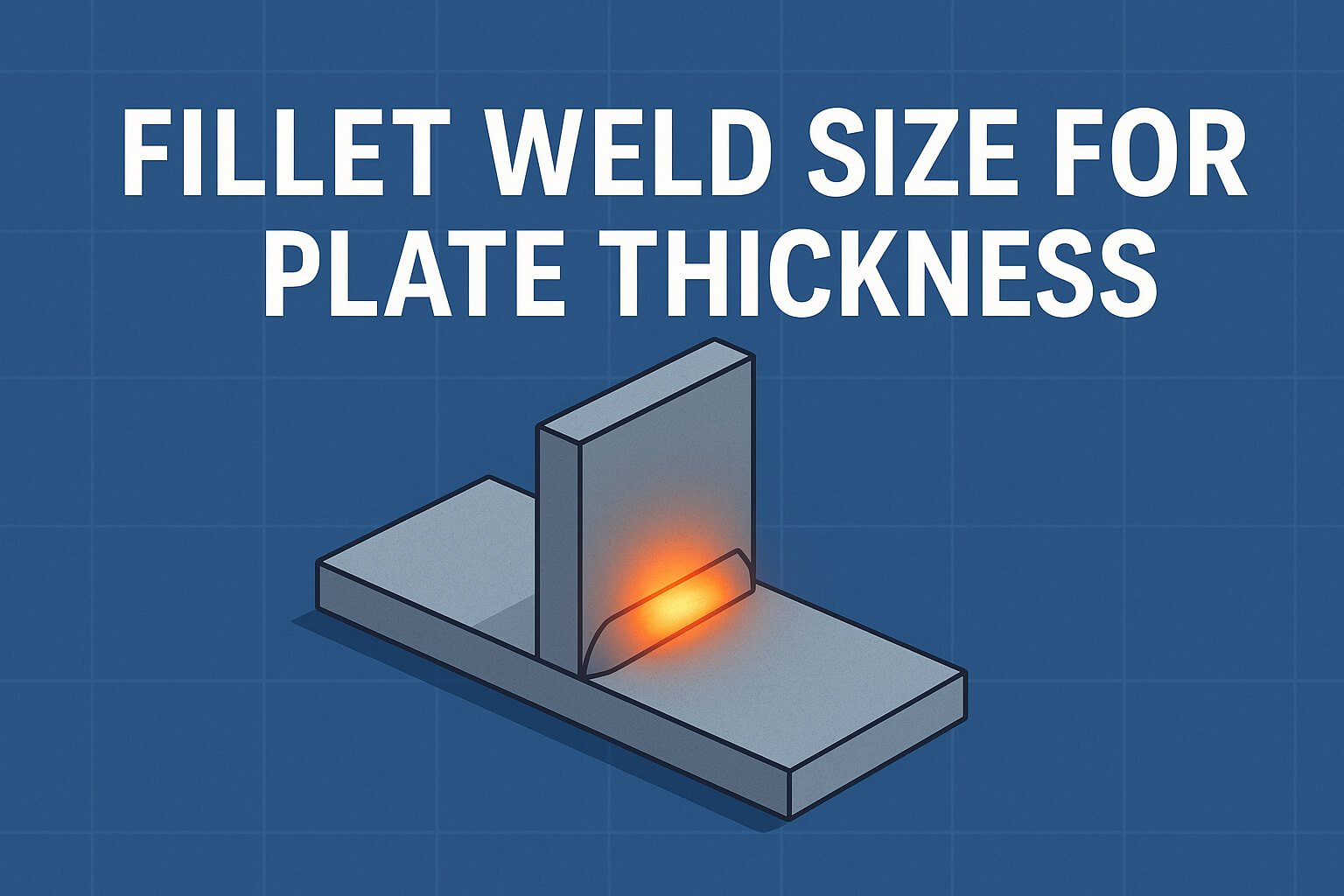
When we join two metal plates with a fillet weld, one of the main questions is:
What fillet weld size should we use for this plate thickness?
If the weld is too small, it may crack or fail.
If the weld is too big, we waste time, money, and may create distortion or other problems.
So it is important to choose a weld size that is strong enough but also reasonable and economical.
In this article, we will talk about fillet weld size in simple English, covering:
What a fillet weld is
How weld size is defined
Basic rule: weld size vs plate thickness
Minimum weld size
Maximum weld size
Single-sided and double-sided fillet welds
Practical examples
Common mistakes and tips
1. What is a fillet weld?
A fillet weld is a weld with a roughly triangular shape in cross-section. It is used to join two metal parts that meet at an angle, usually around 90°.
Common joints using fillet welds are:
T-joint – one plate stands on another like the letter “T”
Lap joint – one plate overlaps another plate
Corner joint – two plates meet at an edge, forming a corner
Fillet welds are very common in structural steel, frames, brackets, machine parts, and many welded products, because they are simple, fast, and usually do not need special edge preparation.
2. What is fillet weld size?
For a normal equal-leg fillet weld, the weld size is the length of one leg of the weld triangle.
Imagine the weld in cross-section:
One leg lies along one plate
The other leg lies along the other plate
The sloping side is the face of the weld
If both legs are the same length, we say it is an equal-leg fillet weld, and that leg length is the weld size. For example, if both legs are 6 mm, it is a 6 mm fillet weld.
There is another important value called the throat thickness. The throat is the shortest distance from the root of the weld (the sharp corner where plates meet) to the face of the weld. For an equal-leg fillet with a flat face, the theoretical throat is:
Throat ≈ 0.7 × weld size
So, if you have a 6 mm fillet weld, its throat is about 0.7 × 6 = 4.2 mm.
This is important because the strength of the weld is linked to the throat area. A bigger throat means more weld metal in the load path and usually a stronger weld.
3. Basic rule: weld size vs plate thickness
A very common practical rule is:
Fillet weld size ≈ 0.7 × thickness of the thinner plate
This rule comes from the idea that the weld should be able to carry about the same load as the thinner of the two parts being joined. There is no reason to make a weld stronger than the weaker plate, because the plate would fail first.
Example 1 – 10 mm to 16 mm plates
You weld a 10 mm plate to a 16 mm plate:
Thinner plate = 10 mm
0.7 × 10 = 7 mm
So you might choose a 7 mm fillet weld as a starting point.
Example 2 – 6 mm to 6 mm plates
You weld two 6 mm plates in a T-joint:
Thinner plate = 6 mm
0.7 × 6 = 4.2 mm
You might pick a 4 mm or 5 mm fillet depending on design, standards, and how conservative you want to be.
This rule is a good first estimate, but you still need to respect minimum and maximum weld sizes, and follow any welding code (AWS, EN, ISO, etc.) used for the project.
4. Minimum fillet weld size
Welding standards usually give a minimum weld size for a given plate thickness. The minimum size is not just about strength. It also helps:
Ensure proper fusion with the base metal
Avoid very tiny welds that cool too fast
Improve durability and toughness
Exact values depend on the code, but a typical idea for steel is:
Plate up to about 3–6 mm thick → minimum weld size around 3–4 mm
Plate 6–12 mm → minimum around 4–5 mm
Plate 12–20 mm → minimum around 5–6 mm
Plate over 20 mm → minimum around 6–8 mm or more
So, even if your design calculation says you only need a 2 mm weld, the code may say you must use at least 3 or 4 mm. This is normal and is done to keep weld quality high.
5. Maximum fillet weld size
Why don’t we just make the weld huge “for safety”?
Because oversized welds cause problems:
More weld metal = more cost and more time
More heat input = more distortion and residual stress
Risk of welding defects like undercut or excessive reinforcement
In many codes, when welding along the edge of a plate without any edge preparation, the maximum fillet weld size is limited to a little less than the plate thickness. A common rule is:
Maximum fillet size at an edge ≈ plate thickness − 1.5 or 2 mm
For example, for a 10 mm plate:
Max fillet size ≈ 10 − 2 = 8 mm
If you need more strength than an 8 mm fillet can provide, you usually:
Use double-sided fillet welds (weld on both sides of the joint), or
Prepare the edges (bevel or groove) and use a partial penetration or full penetration butt weld.
6. Single-sided vs double-sided fillet welds
You can weld a joint on one side only, or on both sides.
A single-sided fillet weld is simpler but may not give enough strength or may cause more distortion on one side.
A double-sided fillet weld can use smaller weld sizes on each side and still provide a large total throat.
Example 3 – 8 mm plate, T-joint
You weld a vertical 8 mm plate to a horizontal 8 mm base plate.
Using our rule:
Thinner plate = 8 mm
0.7 × 8 = 5.6 mm
You have two options:
Single-sided fillet: one 6 mm fillet on one side
Double-sided fillet: two 4 mm fillets (one each side)
The double-sided option gives similar or even more effective throat, spreads the load better, and often reduces distortion, even though each weld is smaller.
7. Simple step-by-step way to choose weld size
Here is a straightforward method you can follow:
Find the thinner plate thickness
Call it t (in mm)
Estimate the weld size
Start with weld size = 0.7 × t
Check minimum size
Compare your weld size to the minimum size required by your code or company standard.
If your weld size is smaller than the minimum, increase it to the minimum.
Check maximum size
If your weld is near a plate edge, check that it does not exceed (plate thickness − 1.5 or 2 mm).
If it is too big, reduce the size or consider welding on both sides.
Adjust weld length if needed
If you have a fixed weld size (for example, standard shop size like 6 mm), you can sometimes increase or decrease the length of the weld to match the required strength.
This method gives you a practical answer even if you do not want to do full structural formulas.
8. Common mistakes and useful tips
a) Ignoring the thinner plate
Always design the weld based on the thinner part. The joint cannot be stronger than its weakest member.
b) Over-welding
Many people make welds larger than needed. This increases cost and may create warping or cracking. Use the size you need, not the biggest one possible.
c) Not respecting edge limits
If you put a large fillet right at the edge of a thin plate, you can easily cause undercut and reduce the net section of the plate.
d) Poor continuity
In important structures, continuous welds along the full required length are often safer than many small intermittent welds, unless the design specifically allows intermittent welding.
e) Ignoring the welding code
Always follow the code or standard for your project (AWS D1.1, EN, ISO, etc.). The rules in this article are for understanding and quick practice, not a replacement for official standards.
9. Short summary
A fillet weld is a triangular weld used in T-joints, lap joints, and corner joints.
Weld size usually means the leg length of the fillet.
The throat thickness is about 0.7 times the weld size for an equal-leg fillet.
A useful rule of thumb is:
Fillet weld size ≈ 0.7 × thickness of the thinner plate
There are minimum weld sizes to ensure good fusion and quality.
There are maximum weld sizes, especially near plate edges, to avoid excessive heat and defects.
Double-sided fillet welds can give more strength with smaller welds on each side.
Avoid over-welding; it wastes money and can damage the structure.

[…] Fillet weld size chart (Sellysell) […]