Disclosure: As an Amazon Associate, we earn from qualifying purchases. If you click a link on this page and make a purchase, we may receive a small commission at no extra cost to you.
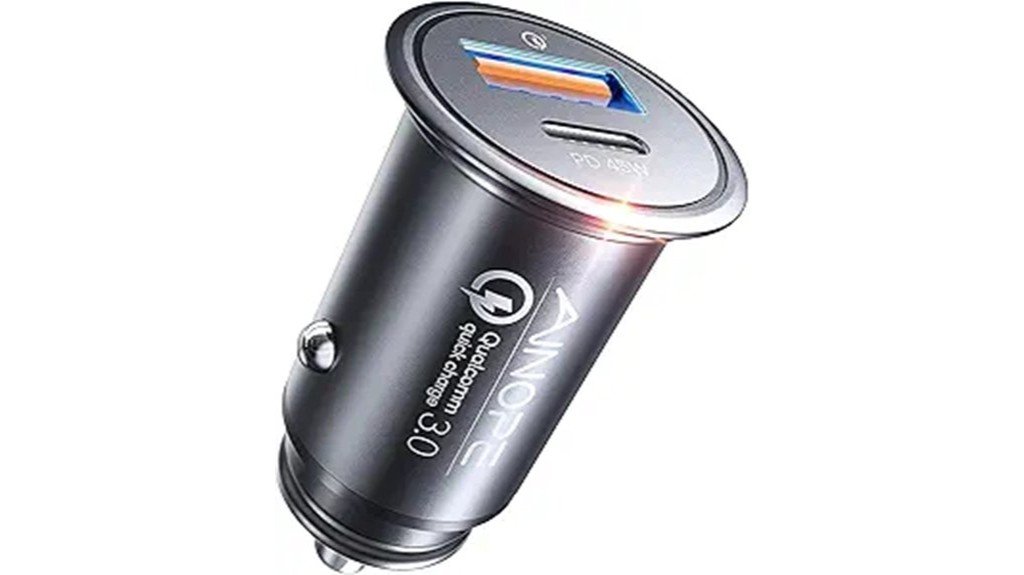
Charging two devices during a drive can be frustrating when your car has only one power outlet. The AINOPE 67.5W Car Charger offers a compact solution with a USB-C Power Delivery port and a USB-A Quick Charge port. Its zinc alloy body and advertised 67.5W combined output make it appealing for phones, tablets, and some smaller laptops. However, actual charging speeds depend on your device, cable, and supported power profiles, so this review explains what the charger offers and which limitations you should check before buying.
Quick Verdict
Rating: Recommended with caveats
Best For: Drivers who want compact, dual-port charging for a smartphone and another small device.
Bottom Line: The AINOPE charger combines two useful USB ports in a small metal housing. Its main limitations are the lack of a second USB-C port, the need for compatible cables, and some uncertainty in the published maximum-output specifications.
AINOPE 67.5W Car Charger Specifications
| Specification | Detail |
|---|---|
| Brand | AINOPE |
| Product | 67.5W Super Mini Car Charger |
| Amazon ASIN | B08HYQLH1C |
| Selected Version | Black – Standard |
| Product Type | Vehicle power-socket USB charging adapter |
| Advertised Total Output | Up to 67.5W combined |
| USB-C Port | 1 × USB-C, advertised PD 45W maximum |
| USB-A Port | 1 × USB-A, advertised QC 22.5W maximum |
| Charging Protocols | USB PD, QC, PPS and other protocols listed by the manufacturer; support varies by port and device |
| Input Voltage | 10.8V to 32V listed; intended for 12V/24V vehicle systems |
| Material | Zinc alloy exterior shell |
| Listed Dimensions | Approximately 1.8 × 0.8 × 1 inches |
| Listed Weight | Approximately 1.76 ounces |
| Device Compatibility | Compatible iPhones, Samsung Galaxy phones, Google Pixel phones, tablets, and certain USB-C laptops |
| Package Contents | 1 car charger in the selected Standard listing; confirm cable inclusion separately |
| Safety Features | Manufacturer-listed over-current, over-voltage, short-circuit, and temperature protections |
| Best Use | Charging up to two compatible devices while driving |
Specifications are based on the current product listing and manufacturer-published information. Advertised peak output has not been independently measured for this review.
What Is the AINOPE 67.5W Car Charger?
The AINOPE 67.5W Super Mini Car Charger is a plug-in adapter that turns your vehicle’s cigarette lighter or 12V accessory socket into two USB charging ports. It does not have its own battery. Instead, it draws electricity from your vehicle’s power system.
The USB-C port is advertised to support up to 45W USB Power Delivery, while the USB-A port supports up to 22.5W Quick Charge. These ports make the charger useful when you need to charge a newer USB-C device alongside an older accessory that still uses USB-A.
Its small zinc alloy body is another selling point. Unlike large multiport adapters, this model is designed to sit neatly in the vehicle’s socket without taking up much space around the dashboard.
Key Takeaways
- Two USB ports: One USB-C PD port and one USB-A QC port support charging two devices at once.
- Advertised 67.5W output: AINOPE claims up to 45W through USB-C and 22.5W through USB-A, although actual output depends on supported charging profiles.
- Zinc alloy construction: The metal body offers a compact, sturdy housing rather than a large plastic enclosure.
- 12V/24V vehicle support: The charger is marketed for compatible cars, trucks, and RV power sockets.
- Check the package: The linked ASIN selects the Black – Standard version, not the separate cable-bundle option.
- Important limitation: You get only one USB-C port, and the published voltage/current table does not fully explain the advertised peak power ratings.
Who Should Buy It?
Best For
- Drivers who need to charge a smartphone and a second device during commutes.
- Families who share one vehicle outlet between USB-C and USB-A devices.
- Travelers who prefer a compact adapter over a larger charging hub.
Skip If
- You need two or more USB-C ports for modern devices.
- You require a guaranteed high-wattage laptop charging solution.
- You want an adapter that includes extra features such as a voltage display or multiple additional charging ports.
Before You Buy: Check your device’s charging requirements and the exact Amazon variant. The Standard version is listed separately from a 3.3-foot cable option. Also, the manufacturer’s published voltage/current examples do not clearly establish the full advertised 45W USB-C and 22.5W USB-A peak outputs. Do not assume those headline figures are available with every device.
Design and Build Quality
Compact Metal Construction
The AINOPE charger uses a zinc alloy exterior rather than a fully plastic housing. Its metal surface gives it a more solid feel and can help conduct heat away from internal components.
According to the manufacturer’s published specification table, the adapter measures approximately 1.8 × 0.8 × 1 inches and weighs about 1.76 ounces. Its small body makes it easy to carry between vehicles or store in a travel bag.
The low-profile shape is useful when your vehicle’s accessory socket is near the gear selector or inside a narrow storage compartment. However, the amount of exposed housing depends on your socket’s depth and surrounding trim.
Daily Durability
The zinc alloy shell should handle normal insertion, removal, and storage better than a fragile exterior, but the material alone does not prove long-term electrical reliability. The internal circuitry, contacts, and socket fit also matter.
Repeatedly pulling the adapter out by its connected charging cable can strain the port or loosen the connection. Remove it by holding the charger body whenever possible.
Charging Performance
USB-C Power Delivery
The USB-C port is advertised with a maximum output of 45W. USB Power Delivery allows a compatible device to negotiate an appropriate charging voltage and current with the adapter.
That makes this port suitable for many recent smartphones, tablets, and some smaller USB-C laptops. However, not every connected device can request or receive 45W.
A phone designed to accept less power will normally draw only what its charging system allows. Charging can also slow when the battery approaches full capacity or gets too warm.
USB-A Quick Charge
The second port supports Quick Charge technology with an advertised maximum output of 22.5W. This is helpful when you still own USB-A charging cables or devices that support compatible fast-charging methods.
Older phones may charge at their standard USB rate rather than at the port’s maximum. A device that does not support the required fast-charging protocol will not automatically receive the highest advertised power.
What About the Charging-Speed Claims?
AINOPE advertises figures such as charging up to 10 times faster than a basic charger and reaching 80% battery in approximately 35 minutes under certain conditions. These are marketing claims, not universal results for every phone.
There is also a technical point worth checking. The manufacturer’s published output-profile table lists USB-C voltage/current examples that reach 36W, and USB-A examples that reach 18W. Those examples do not fully explain the higher headline ratings.
Other supported charging profiles may affect the results, but the listing does not provide enough detail to confirm every peak-output combination. For a buyer who needs an exact wattage, this uncertainty matters.
Dual Device Charging Capability
One of the charger’s most useful features is its ability to supply power through USB-C and USB-A at the same time. AINOPE advertises a combined maximum output of 67.5W and describes its design as allowing both ports to maintain fast charging without conventional power splitting.
In practical terms, you can connect a smartphone to USB-C while someone else uses the USB-A port for another phone, earbuds, or a small accessory.
However, simultaneous charging does not mean both devices will always use the full advertised maximum. The actual distribution depends on device demand, cable compatibility, and the charger’s supported output modes.
Why the Two-Port Layout Matters
- You can keep a USB-C cable connected for a newer phone.
- You can use an existing USB-A cable for a second device.
- Both passengers can charge without swapping cables.
- The adapter uses one vehicle accessory socket instead of requiring two.
The main tradeoff is that the adapter has only one USB-C port. If you routinely charge two USB-C laptops or tablets, a dual-USB-C charger may be more convenient.
Compatibility and Versatility
iPhone Compatibility
AINOPE lists compatibility with several iPhone generations, including models in the iPhone 15, 16, and 17 families. The USB-C port can provide USB Power Delivery charging when paired with the correct cable.
For iPhones with a USB-C connector, use a compatible USB-C to USB-C cable. For older Lightning models, use a suitable USB-C to Lightning cable.
Your phone’s own charging limits determine its maximum speed. The charger cannot force an iPhone to accept more power than it supports.
Samsung Galaxy and Google Pixel
The adapter is also marketed for Samsung Galaxy and Google Pixel smartphones. The manufacturer’s specification table lists support for USB PD and PPS-related charging modes.
However, some Samsung fast-charging features require specific PPS voltage and current profiles. Simply supporting USB-C PD or advertising 45W does not guarantee a particular Samsung Super Fast Charging mode.
Check your exact Galaxy or Pixel model and the charger’s supported profiles if reaching the highest possible charging speed is important to you.
Tablets and Smaller Laptops
The USB-C output can be useful for compatible iPads, tablets, and USB-C laptops that accept moderate charging power. It may help maintain battery level or provide a slower charge on certain computers.
A laptop designed for 65W, 90W, or higher input may charge slowly or continue losing battery during demanding tasks. The AINOPE should not be treated as a guaranteed replacement for a high-wattage laptop power adapter.
Vehicle Compatibility
AINOPE markets this charger for 12V and 24V vehicle electrical systems. Its published specifications list a nominal input range of 10.8V to 32V.
That covers many compatible car, truck, and RV accessory sockets. Still, make sure your vehicle’s socket is in good condition and supports the charger before use.
For international driving, the key issue is the vehicle outlet’s electrical system and socket design, not the country’s household wall-plug standard.
Safety Features and Customer Support
Electrical Protection
AINOPE advertises several built-in safety protections, including over-current, overcharging, and temperature-related protection. Its published technical information also mentions over-voltage, under-voltage, and short-circuit safeguards.
These features are useful in a car, where input voltage and electrical conditions may vary. However, protective circuits reduce risk rather than making an electronic product completely fail-safe.
The manufacturer also refers to safety certifications, but the available product information does not provide enough independently confirmed detail to identify every certification for this exact variant.
Heat Management
The zinc alloy housing can help transfer heat away from internal components. That does not mean the charger will remain cool during high-output operation.
Some warmth can occur when two devices are charging. If the adapter becomes excessively hot, smells unusual, shows visible damage, or repeatedly stops charging, disconnect it when safe and stop using it.
Avoid covering the charger with loose items, placing liquids near the socket, or using a damaged cable.
Warranty and Support
The original product description refers to a two-year customer service guarantee. However, that exact term could not be confirmed for the linked Amazon variant.
AINOPE’s website states a 12-month warranty for products purchased through its own store. Amazon purchase terms may differ by seller, region, or order date.
Before purchasing, review the warranty and support terms displayed for the exact seller. Keep your order receipt in case you need assistance.
How It Performs in Real Use
The following scenarios explain how the listed features may help during normal use. They are practical buying assessments, not results from independent road, power-output, or temperature testing.
1. Daily Commuting
During a commute, the compact adapter allows you to keep your phone connected for charging without taking up much dashboard space.
If your phone supports USB PD, the USB-C port can provide a more capable charging connection than a basic low-power USB adapter. Actual speed still depends on battery level, navigation use, and phone temperature.
2. Family Road Trips
On longer drives, two charging ports can reduce arguments over the only vehicle outlet. One passenger can use USB-C while another uses USB-A.
This works especially well when the two devices use different cable types. The limitation is that you cannot connect three devices directly without another charging solution.
3. Work and Business Travel
If you use a phone for navigation, calls, or work apps, a USB-C PD charger can help replenish battery power between stops.
The second port can charge a separate accessory at the same time. For business travelers who carry a laptop, check the laptop’s minimum power requirement before relying on this adapter.
4. Use Across Multiple Vehicles
The small housing is convenient when you move between a personal vehicle, rental car, and compatible truck. You can carry the adapter without needing much storage space.
Its stated 12V/24V compatibility adds flexibility, but you should still confirm that the accessory socket is compatible and supplies power.
Setup Tips Before First Use
- Check the vehicle socket. Make sure the accessory outlet is clean, dry, undamaged, and compatible with the charger’s input range.
- Insert the adapter firmly. It should sit securely without needing excessive force.
- Choose the right port. Use USB-C for a compatible device that supports USB Power Delivery. Use USB-A for an accessory or cable that needs that connection.
- Use a suitable cable. The cable must support the charging method and power level required by your device.
- Connect one device first. Confirm charging works before adding a second device.
- Check for unusual heat or interruptions. Stop using the charger if it becomes excessively hot or shows signs of damage.
Pro Tip: If your phone charges slowly, test the USB-C port with only that phone connected. Use a known-good cable and check whether the phone reports fast charging. Then connect the second device and compare the results. This can help you identify cable, device, or shared-output limitations without assuming the charger is defective.
Common Mistakes to Avoid
- Assuming every USB-C phone will charge at 45W.
- Using a cable that does not support the required charging mode.
- Confusing the Standard version with the separate cable-bundle variant.
- Expecting full laptop charging performance from every USB-C computer.
- Leaving a damaged adapter connected to an active power outlet.
Pros and Cons
Pros
- Compact zinc alloy housing with a low-profile design.
- One USB-C PD port and one USB-A QC port.
- Can supply power to two compatible devices at once.
- Marketed for both 12V and 24V vehicle systems.
- Manufacturer-listed electrical and temperature protections.
Cons
- Only one USB-C port limits modern dual-USB-C setups.
- Published output profiles do not fully clarify the advertised peak wattages.
- Cable inclusion and warranty coverage require checking the selected seller and variant.
Is It Worth the Price?
The AINOPE 67.5W Car Charger is worth considering as a compact everyday charging accessory. It combines a metal housing, two different USB port types, and advertised fast-charging support without taking up much dashboard space.
Its value is strongest when you regularly charge a smartphone and a second small device. You may not need to pay more for a larger multiport charger if two ports are enough for your routine.
However, buyers who need precise laptop power delivery, two USB-C connections, or independently documented charging performance may get better value from a different model. Compare the current selling price and the exact included package before deciding.
How It Compares to Alternatives
The Anker 535 Car Charger (67W) is a useful alternative if you want three charging ports, including two USB-C connections. It takes a different approach to power sharing, so check its output limits when multiple devices are connected. The Belkin BoostCharge Dual Car Charger with PPS (37W) offers a lower combined output, with a 25W USB-C port and a 12W USB-A port, making it worth comparing for less demanding phone charging.
The AINOPE’s main appeal is its simple two-port layout and compact zinc alloy construction. If you prioritize small size and already use one USB-C and one USB-A cable, it may suit your needs better than a larger adapter.
Frequently Asked Questions
Is the AINOPE Car Charger suitable for international use?
Yes, in compatible vehicles. AINOPE lists support for 12V and 24V vehicle systems, which are common in cars and commercial vehicles in many countries. Check the local vehicle’s accessory socket rather than assuming compatibility based on the country alone.
Does the AINOPE 67.5W Car Charger come with a warranty?
Warranty terms depend on the seller and purchase channel. AINOPE states a 12-month warranty for purchases through its own website, but this does not confirm the terms for the linked Amazon product. Check the current seller’s policy before ordering.
Can I charge a phone without removing its protective case?
Usually, yes. This is a wired charger, so the phone case does not normally affect power delivery if the cable connector fits securely. A thick case that blocks the phone’s charging port may need adjustment or removal.
How does the charger perform in extreme temperatures?
AINOPE lists temperature-related protection, but independent extreme-temperature performance data was not available for this review. Avoid leaving the charger in excessive heat or exposing it to moisture. If the adapter becomes unusually hot, disconnect it and allow it to cool.
Does the AINOPE charger make noise while charging?
The charger is not advertised as having a cooling fan or other moving parts. It would normally be expected to operate quietly, but no measured noise test is available here. Loud buzzing, crackling, or other unusual sounds are reasons to stop using the adapter.
Can both ports fast charge at the same time?
AINOPE advertises simultaneous fast charging through its USB-C and USB-A ports, with a combined headline rating of 67.5W. Actual charging speeds depend on the devices and negotiated power profiles. The published output details do not fully establish every claimed maximum-output combination.
Does the Standard version include a USB-C charging cable?
The selected Amazon variant is Black – Standard, with the included components listed as one car charger. A separate 3.3-foot cable option is also shown. Do not assume a cable comes with the Standard version unless the current package description confirms it.
Can this charger power a MacBook or another USB-C laptop?
It may charge compatible laptops that accept the available USB Power Delivery profiles. However, the advertised USB-C maximum is 45W, and the published output examples need clarification. A laptop that requires 65W or more may charge slowly or lose battery during heavy use.
The Bottom Line
The AINOPE 67.5W Car Charger is recommended with caveats for drivers who want a compact metal adapter with USB-C and USB-A charging in one vehicle socket. Its dual-port design is convenient for phones and everyday accessories, but buyers who need two USB-C ports, guaranteed high-power laptop charging, or fully documented peak output should consider alternatives. Check the exact product variant, included accessories, and seller support terms before purchasing.