Disclosure: As an Amazon Associate, we earn from qualifying purchases. If you click a link on this page and make a purchase, we may receive a small commission at no extra cost to you.
Klein Tools RT390 Circuit Analyzer Review
An outlet can show normal voltage and still have a weak connection, excessive voltage drop, or a protection device that does not behave as expected. The Klein Tools RT390 gives you more detail than a basic three-light receptacle tester by combining wiring checks, line-voltage readings, AFCI and GFCI tests, and load testing. Its large color LCD makes results easier to read, but the tool is limited to indoor North American 120V grounded outlets. This review explains where the RT390 earns its place in a professional kit and where a simpler or more specialized tester makes more sense.
Quick Verdict
Rating: 8.7/10
Best For: Electricians, home inspectors, remodelers, and experienced DIY users who need wiring, AFCI, GFCI, line-voltage, and voltage-drop information from 120V grounded receptacles.
Bottom Line: The RT390 combines a clear color display with 12A, 15A, and 20A load tests, trip-time readings, and common wiring-fault detection. It is larger and more expensive than a simple outlet tester, and it cannot confirm every possible wiring defect or ground-quality problem.
| Specification | Detail |
|---|---|
| Brand | Klein Tools |
| Model | RT390 |
| Product Type | Circuit analyzer with AFCI, GFCI, wiring-fault, voltage, and load-test functions |
| Outlet Compatibility | North American 120V AC, 3-wire grounded outlets |
| AC Voltage Range | 30.0 to 150.0V AC, 2% ±2 digits |
| Operating Frequency | 45 to 64Hz |
| Load Testing | 12A, 15A, and 20A voltage-drop tests |
| Voltage-Drop Range | 0.1% to 99.9%, 3% ±2 digits |
| GFCI Trip Current | 6.0 to 9.0mA, 1% ±0.2mA |
| GFCI Trip Time | 0.0 to 6.0 seconds, 1% ±10ms |
| 30mA Ground-Fault Test | 26.0 to 38.0mA trip-current range |
| AFCI Trip Time | 0 to 400ms, 1% ±20ms |
| Material | ABS plastic, overmold, and electronic components |
| Dimensions | 7.1 × 2.7 × 1.5 inches |
| Weight | About 10.9 oz. including batteries |
| Power | 3 × 1.5V AAA alkaline batteries |
| Auto Power-Off | After 5 minutes of inactivity when not connected to an energized circuit |
| Detachable Cord | 14AWG, 15A, 12-inch NEMA 5-15P to IEC 320 C13 |
| Operating Conditions | Indoor use, 32°F to 122°F, below 85% non-condensing humidity, up to 6,562 ft. |
| Drop Protection | 6.5 ft. (2m) |
| Ingress Protection | IP40 dust resistant, indoor use only |
| Safety Rating | CAT III 135V |
| Standards | Conforms to UL 1436 and certified to CSA C22.2 No. 160 |
| Included | Circuit analyzer, 3 AAA batteries, instructions, and pouch |
| Warranty | Two years from purchase for electrical test and measurement tools; batteries are excluded |
What Is the Klein Tools RT390?
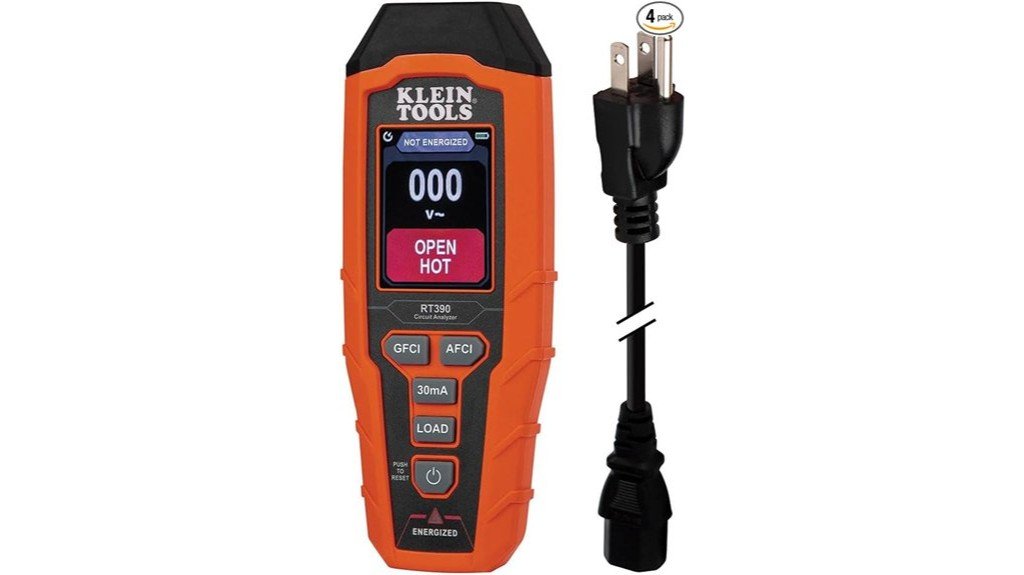
The Klein Tools RT390 is a handheld circuit analyzer for standard North American 120V AC, 3-wire grounded receptacles. It displays line voltage, labels common wiring conditions, tests AFCI and GFCI protection, measures trip time and trip current, and applies 12A, 15A, and 20A test loads to calculate voltage drop.
The main advantage is consolidation. Instead of carrying a simple wiring tester, a separate voltage reader, and a basic protection-device tester, you can collect several useful results from one color screen. The RT390 is still a screening and diagnostic tool, not a complete substitute for a multimeter, insulation tester, ground-impedance instrument, or a qualified electrician’s investigation.
The supplied 12-inch detachable cord also separates it from rigid plug-in testers. It helps you reach low, recessed, or furniture-adjacent outlets, while the included pouch keeps the analyzer, cord, and batteries together.
Who Should Buy It?
Best For
- Electricians who want quick wiring, voltage, protection-device, and load-test information at a receptacle.
- Home inspectors who need readable on-screen results for line voltage, trip behavior, and voltage drop.
- Remodelers and experienced DIY users who regularly check 120V grounded outlets and know when to stop and call a licensed professional.
Skip If
- You only need an occasional pass/fail GFCI check and do not need voltage-drop testing.
- You work with non-North-American outlets, circuits above the tester’s rating, or wet outdoor locations.
- You need ground-quality measurement, data logging, report export, or a full electrical diagnostic instrument.
Before You Buy: The RT390 is made only for North American 120V AC, 3-wire grounded outlets and indoor conditions. It does not identify every possible wiring fault, confirm ground quality, or make an unsafe outlet safe to test.
Key Features and Everyday Benefits
Large Color LCD and Clear Wiring Labels
The color LCD shows line voltage, wiring condition, test type, trip time, trip current, battery status, and voltage-drop percentage. Clear labels reduce the need to decode small combinations of red, amber, or green lamps while you are standing at an outlet.
The RT390 identifies correct wiring, open ground, open neutral, open hot, reversed hot and ground, reversed hot and neutral, and a dual open neutral/open ground condition. After you remove it from a receptacle, the display holds the last result for about 10 seconds, which helps when the outlet is behind furniture or close to the floor.
The limits matter as much as the fault list. The tester does not indicate ground quality, two hot conductors, reversed neutral and ground, or most combinations of multiple defects. A correct-wiring message also does not prove that every part of the branch circuit is safe.
AFCI, GFCI, and 30mA Ground-Fault Testing
The RT390 tests standard GFCI protection with a 6.0 to 9.0mA trip-current range and shows the measured trip time. It also provides a 30mA ground-fault test for compatible devices and simulates a parallel arc condition when you initiate an AFCI test.
The stated GFCI trip-time range is 0.0 to 6.0 seconds, while AFCI trip time is measured from 0 to 400ms. These are the tester’s measurement ranges and accuracy specifications, not universal pass limits for every breaker or receptacle. You still need to compare the result with the protection device’s instructions and applicable electrical requirements.
AFCI testing needs extra care. Powered equipment should be removed or switched off before the test, and Klein instructs you to wait 20 seconds between successive AFCI tests. Some AFCI devices may also fail to trip from a test point more than 100 ft. from the breaker, so cable length and line impedance can affect what you see.
12A, 15A, and 20A Voltage-Drop Testing
The load-test function is the strongest reason to choose the RT390 over a basic receptacle tester. Pressing the load button displays voltage and percentage voltage drop at 12A, 15A, and 20A test levels, which can reveal behavior that an unloaded voltage reading misses.
A receptacle may show acceptable line voltage with no meaningful load, then sag when current demand rises. A high result can point you toward further investigation of connections, splices, conductor size, circuit length, or other causes of excessive impedance. The RT390 changes the display background to red when measured voltage drop exceeds 5%, making the result easy to notice.
The analyzer may need a cooling period after load or AFCI testing. It disables another test until the cooldown message clears, so it is better for deliberate checks than rapid repeated testing across many receptacles without pauses.
Build, Cord, Batteries, and Jobsite Handling
The housing combines ABS plastic, overmold, and electronic components, with a listed 6.5 ft. drop-protection rating. At roughly 10.9 oz. with batteries, it is heavier and bulkier than a pocket receptacle tester, but the larger body supports the color screen and separate test controls.
The detachable 14AWG, 15A cord improves positioning and storage. It also creates one more component to inspect, clean, and keep with the tester. Klein specifies using the supplied NEMA-rated cord, so a random computer-style cord is not an appropriate substitute even when the connector appears similar.
Three AAA alkaline batteries power the screen and controls. The tester shuts off after five minutes of inactivity when it is not connected to an energized circuit, while auto power-off remains disabled during an energized connection.
How to Use It Correctly
- Inspect the tester and cord. Do not use either part if the housing, plug, insulation, or connector appears damaged.
- Verify operation first. Test the RT390 on a known live, correctly wired receptacle before relying on a new reading.
- Disconnect equipment on the branch circuit. This reduces interference and is required before an AFCI test on that circuit.
- Check the wiring result before other tests. Do not start AFCI, GFCI, 30mA ground-fault, or load testing when the screen reports incorrect wiring.
- Allow required cooldown time. Wait at least 20 seconds between AFCI tests and wait for any cooldown message to disappear before another AFCI or load test.
- Treat abnormal results as a reason to investigate. Stop and consult a qualified electrician when wiring, voltage, trip behavior, or voltage drop appears unsafe or unclear.
Pro Tip: Photograph the LCD while the result is displayed, or use the 10-second hold period after unplugging the tester. The RT390 does not save or export readings, so a simple photo can help you document the outlet location and result.
Compatibility and Safety
The CAT III 135V rating matches the RT390’s intended work on 120V building circuits, but it does not make the tester suitable for every energized system. Never connect it to a higher-voltage supply, an incompatible outlet, or a wet location. The IP40 rating provides dust resistance but no meaningful water protection.
Only begin AFCI, GFCI, 30mA ground-fault, or load testing after the tester reports correct wiring. Incorrect wiring can disable those buttons, and trying to work around that protection creates unnecessary risk. The RT390 has no user-serviceable internal parts.
Battery replacement also requires a disconnected tester. Remove it from every voltage source before opening the battery cover, confirm polarity when installing the three AAA cells, and secure the cover before use.
How It Performs in Real Use
During a Home Inspection
The RT390 gives an inspector several readings from one connection: wiring condition, line voltage, protection-device behavior, and voltage drop. The color screen is easier to explain to a client than a coded lamp pattern, while the 10-second hold function helps with hard-to-see receptacles.
On a Troubleshooting Call
The 12A, 15A, and 20A tests help separate a normal no-load voltage reading from a circuit that drops sharply under demand. The result does not identify the failed connection by itself, but it gives you a stronger reason to inspect upstream devices, splices, terminations, and conductor sizing.
After Remodeling or Receptacle Replacement
For a remodeler or electrician, the RT390 can provide a quick final check after outlet work, provided all normal safety procedures have already been followed. It can flag common conductor mistakes and confirm that AFCI or GFCI protection responds to the tester, but it does not replace required code testing or a full commissioning process.
For Advanced DIY Checks
An experienced homeowner can use the clear display to decide when a result needs professional attention. The safest value is not proving that an outlet is perfect, but recognizing incorrect wiring, abnormal voltage, a failed trip event, or excessive drop and stopping before the problem gets worse.
Cleaning and Storage
Turn the RT390 off and wipe it with a clean, dry, lint-free cloth. Do not use abrasive cleaners or solvents, and do not expose the tester or cord to moisture.
Remove the batteries before long storage to reduce the risk of leakage. Keep the tester within its stated storage range, away from high humidity, and allow it to return to normal operating conditions after exposure to extreme temperatures.
Pros and Cons
Pros
- Large color LCD shows line voltage, wiring condition, trip data, and voltage-drop results in plain language.
- 12A, 15A, and 20A load tests reveal circuit behavior that simple unloaded testers cannot show.
- AFCI, GFCI, and 30mA ground-fault functions include trip-time and current information.
- Detachable 12-inch cord reaches awkward outlets and stores separately in the included pouch.
- CAT III 135V rating, UL 1436 conformity, CSA certification, and 6.5 ft. drop protection support regular field use.
Cons
- Limited to indoor North American 120V AC, 3-wire grounded outlets.
- Cannot confirm ground quality, every mixed wiring fault, data logs, or the exact source of a voltage-drop problem.
- Larger than a basic receptacle tester, and AFCI or load tests may require cooldown pauses.
Is It Worth the Price?
The RT390 sits above basic receptacle testers because it combines a color display, protection-device tests, and three load levels in one tool. It offers strong value for the price when outlet diagnostics are part of your regular work and the load-test readings can save you from switching between several instruments during an initial check.
Electricians and inspectors get the most value because speed, readable results, and repeat use justify the larger body and higher cost. An occasional homeowner may be better served by a simpler tester unless voltage drop and AFCI testing are specific needs.
Its value also depends on understanding the limits. You may still need a multimeter, clamp meter, insulation tester, ground-testing equipment, or deeper circuit tracing to find the root cause after the RT390 flags a problem.
How It Compares to Alternatives
The Klein RT250 is the simpler choice when you need line voltage, common wiring-fault identification, GFCI trip-time information, and a more compact body. It does not test AFCI devices or provide the RT390’s 12A, 15A, and 20A voltage-drop load tests.
The Klein RT310 adds AFCI and GFCI testing in a lighter outlet tester with a flexible cord, but it gives visual wiring indications rather than the RT390’s full color readout and load-test results. The RT390 makes the most sense when voltage drop, measured trip information, and one-screen diagnostics matter more than minimum size.
Frequently Asked Questions
Can the Klein Tools RT390 test international outlets?
No. It is designed for North American 120V AC, 3-wire grounded receptacles. Do not use an adapter to connect it to a different outlet format or a higher-voltage supply.
Does the RT390 measure voltage drop under load?
Yes. It displays voltage and percentage voltage drop at 12A, 15A, and 20A test levels. The background turns red when the measured drop exceeds 5%.
Can the RT390 diagnose every wiring problem?
No. It detects several common faults, including dual open neutral/open ground, but it does not confirm ground quality, two hot wires, reversed neutral and ground, or most combinations of multiple defects. Treat any abnormal result as a starting point for qualified troubleshooting.
What should you do before running an AFCI or load test?
Verify the tester on a known live and correctly wired outlet, disconnect equipment on the circuit, and confirm that the RT390 reports correct wiring. Do not start AFCI, GFCI, 30mA ground-fault, or load testing on an incorrectly wired receptacle.
Why might an AFCI device fail to trip during testing?
The breaker may be miswired, faulty, incompatible with the test condition, or affected by high line impedance. Klein also notes that some AFCI models may not trip when the cable run from the test location to the breaker exceeds 100 ft.
Can you replace the detachable cord with any IEC C13 cord?
You should use the supplied NEMA-rated 14AWG, 15A cord specified for the tester. A cord with a similar connector may not have the correct construction or rating for this safety-related use.
Does the RT390 save or export test results?
No data logging or report-export function is listed for the RT390. The screen holds a result for about 10 seconds after removal, so you can record it manually or take a photo.
What warranty covers the Klein Tools RT390?
Klein Tools lists electrical test and measurement tools under a two-year limited warranty from the date of purchase. Proof of purchase is required, batteries are excluded, and the full warranty terms control any claim.
The Bottom Line
The Klein Tools RT390 earns its 8.7/10 rating for combining common wiring-fault detection, a readable color LCD, AFCI and GFCI trip information, and 12A, 15A, and 20A load testing in one field tool. It is a strong choice for electricians, inspectors, remodelers, and experienced DIY users who regularly evaluate 120V grounded outlets. Skip it when you only need a basic GFCI check or require international compatibility, wet-location use, ground-quality testing, data logging, or a full diagnosis from one instrument.