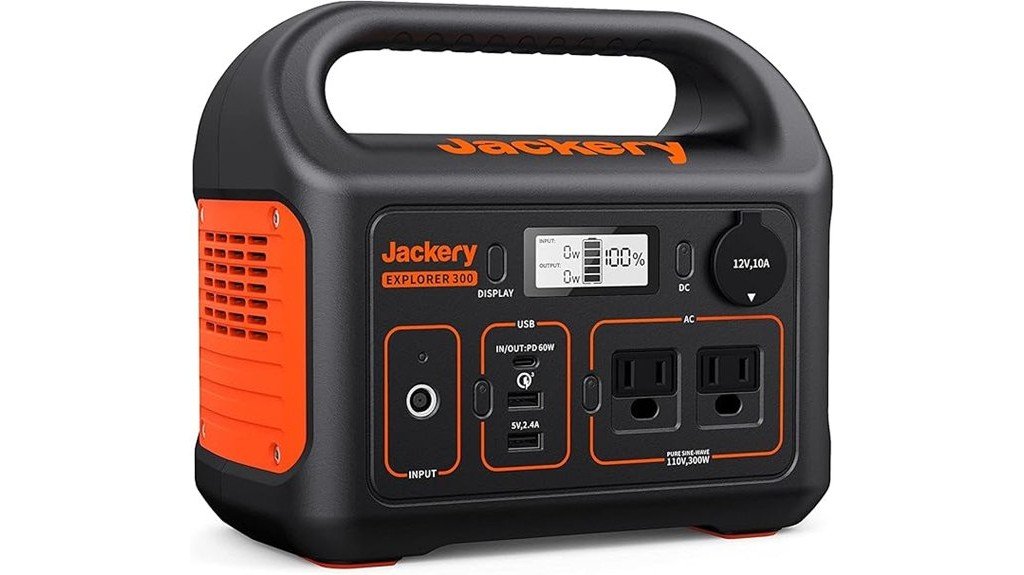
The Jackery Portable Power Station Explorer 300 is presented as a compact, 293Wh unit that weighs 7.1 lb, aimed at campers and emergency planners who need reliable, portable power. It charges to 80% in about 2 hours via 60W USB‑C PD, supports MPPT solar input, and offers two pure sine AC outlets plus multiple USB ports for phones, laptops, and small appliances. What real-world runtimes and tradeoffs should a buyer expect next?
Key Takeaways
- 293Wh capacity and 300W continuous (500W peak) output suitable for laptops, phones, small appliances, and low-watt CPAPs.
- Fast recharge: reaches 80% in about 2 hours using a 60W USB-C PD plus AC combo; AC wall is fastest.
- Portable and durable: 7.1 lb, compact 15.1×10.6×12.1 in shell with integrated handle for single-person carry.
- Includes versatile ports: 60W PD USB-C (in/out), USB-A, QC3.0, car port, and two pure sine AC outlets.
- Solar-ready with MPPT controller; pairs with SolarSaga 100 but real solar output varies with conditions.
Design and Portability
The Explorer 300 balances portability with usable capacity, making it a practical choice for weekend camping, road trips, and emergency kits.
It measures 15.1L x 10.6W x 12.1H inches and weighs 7.1 pounds. Design aesthetics emphasize a compact rectangular shell, integrated handle, and clear LCD.
How portable is it? Very—single-person carry, fits car trunks, and stores on RV shelves.
What about balance? Weight distribution centers near the handle, reducing strain when lifting.
Practical considerations: dimensions, 7.1 lb weight, durable casing, ventilation clearance, and pack placement for stability during transport.
Charging Performance and Recharge Options
Charging performance is a strong point for the Explorer 300, offering fast, flexible recharge methods that suit weekend trips and emergency readiness.
The unit reaches about 80% in 2 hours using a 60W PD USB-C plus AC combo, demonstrating notable charging speed and solid charging efficiency via its MPPT controller with solar.
What recharge options exist? AC wall, car outlet, USB-C PD, and Jackery SolarSaga 100.
Practical notes: 293Wh capacity, 7.1 lb weight, 15.1 x 10.6 x 12.1 inches.
How long to full from solar? Depends on sun, typically longer than AC.
Recommendations: prioritize PD for speed.
Output Options and Real-World Use Cases
Portability and versatile ports define how the Explorer 300 performs in real-world scenarios, offering a compact 293Wh battery in a 7.1 lb package with dimensions of 15.1 x 10.6 x 12.1 inches.
The unit supplies 300W continuous power via 2 pure sine AC outlets, a 60W PD USB-C (in/out), USB-A, QC3.0, and a car port.
Delivers 300W continuous power through two pure sine AC outlets plus USB-C PD 60W, USB-A, QC3.0, and car port
What can it run? Small appliances, laptops, phones, CPAPs (low-watt models), and camera gear—match device power requirements to the 300W rating.
Practical tips: list device draw, add safety margin, consider simultaneous charging limits, and note run-time estimates per device.
Solar Compatibility and MPPT Efficiency
Many users find that a compact solar setup paired with an MPPT controller improves charging speed and efficiency for the Explorer 300. The unit accepts panels like the SolarSaga 100; MPPT optimizes input, boosting solar paneling benefits and off grid efficiency.
How fast? A 100W panel yields roughly 30–50W effective, variable by sun angle, temperature, wiring.
Practical considerations: panel VOC, cable gauge, connector type, placement.
Questions and answers:
- Can it parallel panels? Yes, within voltage/current limits.
- Is MPPT necessary? Recommended for best throughput.
- Weight impact? Adds about 5–12 lbs for typical panels and mounts.
Specs, Warranty, and Value Assessment
Value assessment begins with a clear look at the Explorer 300’s specifications, warranty, and real-world utility. The unit offers 293Wh capacity, 300W output (500W peak), weighs 7.1 lb, and measures 15.1 x 10.6 x 12.1 in. Warranty details: 90 days limited; buyer should consider extended coverage. For value comparison, compare capacity, recharge speed (80% in 2 hrs via 60W PD), and ports.
| Spec | Measure | Note |
|---|---|---|
| Capacity | 293Wh | Lithium-ion |
| Output | 300W / 500W peak | 2 AC outlets |
| Weight | 7.1 lb | Portable |
Q: Is it worth it? A: Good for camping and short outages.
Frequently Asked Questions
Can the Explorer 300 Be Used Mid-Flight on an Airplane?
No; it cannot be used mid-flight. Airline regulations prohibit operating large portable batteries onboard; the Explorer 300 must be carried as checked/carry-on luggage per carrier rules, with capacity and packaging limits observed.
Is the Battery Replaceable by the User?
No; the battery is not user-replaceable. Like a sealed heart, it limits user maintenance to charging and careful use. Battery longevity depends on cycles and care, so professional service is required for replacement.
Does It Support Pass-Through Charging While Powering Heavy Loads?
Yes, it supports pass-through charging, though power management limits may reduce output under heavy loads. Charging efficiency remains good, but sustained high-draw use can throttle charging and prioritize device supply over rapid battery recharge.
Are There Smartphone App Controls or Bluetooth Connectivity?
No, it lacks smartphone compatibility or app functionality; the device offers no Bluetooth or companion app. The user must monitor and control outputs directly on the unit, relying on physical buttons and the built-in display.
What Safety CErtifications Does the Unit Have (Ul, CE, FCC)?
The unit includes safety features and meets common certification standards such as CE and FCC; however, it does not list UL certification in official materials, so users should verify exact certifications with the manufacturer before purchase.
Conclusion
In conclusion, the Jackery Explorer 300 is a compact, 293Wh unit weighing 7.1 lb that balances portability, fast 60W PD charging (80% in ~2 hours), and versatile outputs for small appliances and devices. For example, a camper powered a mini-fridge (40–60W), phone, and LED lamp overnight with solar-topping via MPPT. Is it right for you? Consider device wattages, needed runtime, and access to a 60W PD charger or compatible solar panel before purchasing.