Disclosure: As an Amazon Associate, we earn from qualifying purchases. If you click a link on this page and make a purchase, we may receive a small commission at no extra cost to you.
A winch may have a high pull rating and still be the wrong choice for your truck. Your bumper mount, battery, recovery points, and trail conditions matter just as much. The VEVOR 13,500 lb Electric Truck Winch SC13500 offers a 12V motor, 80 ft synthetic rope, and wired plus wireless controls. This review helps you judge its capacity, installation needs, and the limits of its IP55 water protection before you buy.
Quick Verdict
Editorial Rating: 8.2/10, recommended with caveats (specification-based assessment)
Best For: Pickup, Jeep, and SUV owners who want a high-capacity 12V recovery winch with synthetic rope and two control options.
Bottom Line: The VEVOR SC13500 combines a 13,500 lb line-pull rating, 80 ft synthetic rope, and two remote options. However, safe use requires a rated mount and recovery gear, sound wiring, and realistic expectations of its IP55 protection.
| Specification | Detail |
|---|---|
| Brand | VEVOR |
| Model | SC13500 |
| Amazon ASIN | B08B3GPVCM |
| Product type | 12V DC electric vehicle-recovery winch |
| Rated line pull | 13,500 lb / approximately 6,100 kg (manufacturer rating) |
| Motor | 12V DC, 6.6 HP copper motor |
| Gear system | 3-stage planetary system with a 265:1 gear ratio |
| Rope | 3/8 in x 80 ft, 12-strand synthetic rope |
| Control modes | Wireless remote and wired remote |
| Remote ranges | 65.6 ft wireless remote and 9.8 ft wired remote |
| Main materials | Alloy steel, aluminum, and plastic |
| Finish | Painted |
| Protection rating | IP55 dust and water-spray resistance |
| Winch dimensions | 21.2 x 6.3 x 8.6 in, according to the listing’s product description |
| Net weight | 50.4 lb, according to the listing’s product description |
| Conflicting listing entry | Amazon technical details also show 25 x 14 x 13 in and 53.4 lb, so confirm measurements before installation |
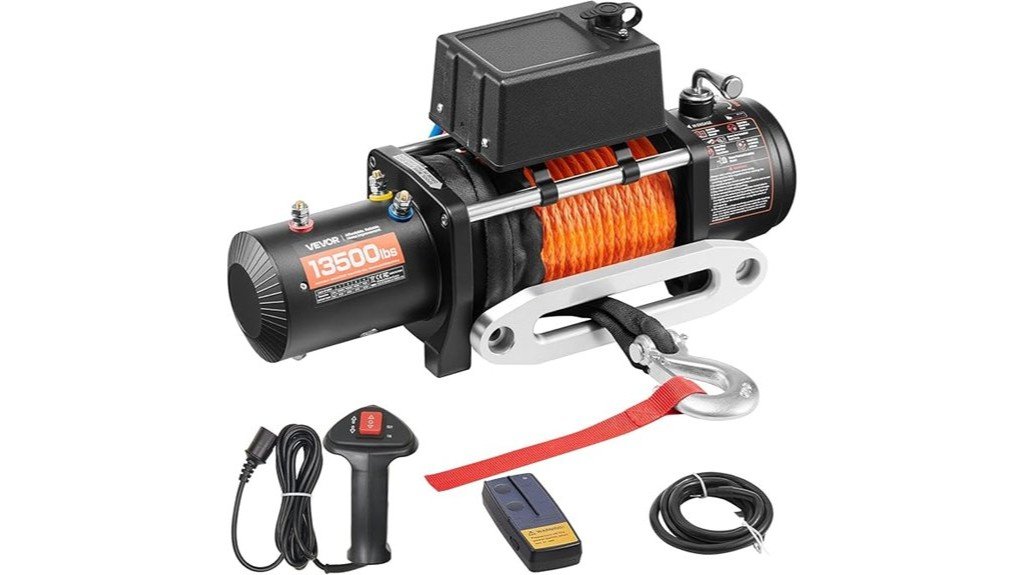
| Included accessories | Winch, aluminum fairlead, hook, power cables, wired remote, and wireless remote |
| Mounting requirement | Requires a compatible, load-rated bumper or winch plate |
| Warranty note | Specific coverage was not confirmed for this ASIN; request terms from the seller or manufacturer |
| Version distinction | This linked ASIN has the 80 ft rope and IP55 rating; a separate newer 92 ft, IP68 variant is listed |
| Safety limitation | Not for lifting people, overhead hoisting, or dynamic towing |
| Best use | Controlled vehicle recovery and utility pulling within the limits of the winch, mount, electrical system, and recovery equipment |
What Is the VEVOR 13,500 lb Electric Truck Winch?
The VEVOR SC13500 is a hardwired 12V DC winch designed for vehicle recovery and controlled utility pulling. Its main components include a 13,500 lb rated line pull, 6.6 HP motor, and 265:1 3-stage planetary gear system.
The linked version uses an 80 ft synthetic rope and aluminum fairlead instead of steel cable and a roller fairlead. It also includes a wireless remote for operating from farther away and a wired remote for direct backup control.
The linked ASIN B08B3GPVCM identifies the 80 ft, IP55 configuration. Amazon also lists a different 92 ft version with IP68 protection. How this review was assessed: We compared the linked Amazon listing with VEVOR’s published SC13500 specifications and winching-safety guidance. The 8.2/10 score is an editorial judgment, not a hands-on load-test result.
Before You Buy: The listing shows two different dimension and weight sets. Measure your bumper or winch plate carefully, confirm the mounting pattern, and check clutch-handle clearance before ordering or beginning installation.
Who Should Buy It?
Best For
- Truck, Jeep, and SUV owners who need substantial capacity for controlled off-road recovery.
- Drivers who prefer lightweight synthetic rope over steel cable.
- Buyers who want both wired and wireless controls without moving into a premium winch tier.
Skip If
- You regularly cross deep water and need an IP68-rated winch.
- Your bumper, mounting plate, battery, or recovery points are not rated for winching loads.
- You want a factory-supported premium winch with clearly stated long-term warranty coverage.
Pulling Capacity and Vehicle Sizing
The 13,500 lb rated line pull puts the SC13500 in the range many Jeep, SUV, and pickup owners compare for recovery use. This is a published capacity rating, not a promise that every stuck 13,500 lb vehicle can be pulled free. Mud suction, slopes, loaded weight, damaged tires, and the pull angle can raise demand.
Use your vehicle’s loaded weight and gross vehicle weight rating as sizing references, then allow for the conditions you expect. Line-pull capacity also changes with the rope layer on the drum, so the headline rating is not available in every setup.
The mount, bumper, shackles, straps, anchor point, and recovery points must also support the load. A 13,500 lb winch does not make an unrated tow hook, bumper tab, or light-duty mounting plate safe.
Motor, Gearing, and Pulling Performance
The SC13500 uses a 12V DC 6.6 HP copper motor connected to a 265:1 planetary gear system. This combination prioritizes controlled pulling torque rather than quick unloaded line movement.
The 265:1 gearing helps the motor trade speed for pulling force. As the drum fills with rope, the effective pulling force drops. Recovering a vehicle uphill or through deep mud also takes more work than moving a rolling vehicle on firm ground.
Use short, controlled pulls. Stop if you notice unusual noise, heat, slipping rope, or damaged wiring. A properly rigged double-line pull can reduce the load on the winch, but it changes forces on the anchor, pulley, and connection points. Use only rated equipment and follow the winch and rigging instructions.
Synthetic Rope and Fairlead
The included line is a 3/8 in x 80 ft, 12-strand synthetic rope. It weighs less than steel cable, does not develop sharp wire splinters, and is generally easier to carry toward an anchor point.
Synthetic rope still requires careful maintenance. Abrasion, heat, embedded dirt, chemical exposure, and contact with sharp bumper edges can weaken it. Inspect the full line before each recovery and replace it when you find cuts, severe fuzzing, melted fibers, flat sections, or other damage.
The aluminum fairlead helps guide the rope through the bumper opening. Check that its surface remains smooth because burrs, dents, or damaged edges can abrade the rope during a loaded pull.
IP55 Weather Protection
The linked SC13500 carries an IP55 rating. That level of protection is intended for dust exposure and water spray, making it more suitable for rain, muddy roads, and normal off-road use than an unprotected electrical device.
IP55 is not a submersion rating. Do not assume this winch can sit underwater during creek crossings. A more highly sealed IP68 model is worth comparing if deep-water exposure is common, although you must still follow that model’s stated immersion limits and maintenance instructions.
Keep electrical terminals tight and protected from corrosion. After wet or salty trips, clean the exterior, inspect the connections, check the rope, and test the clutch and controls before the next recovery.
Wired and Wireless Controls
The listing specifies a 65.6 ft wireless remote range. This can help you choose a safer viewing position, but the stated range is not a guaranteed operating distance in every setting. Stay clear of the loaded rope, anchor, and vehicle path, even when using wireless control.
The 9.8 ft wired remote provides a useful backup when the wireless remote has a weak battery, experiences interference, or does not respond. Test both controls at home before relying on the winch on a trail or job site.
Do not leave the wireless remote where another person can activate the winch unexpectedly. Disconnect or secure the controls when the winch is not being used.
Pro Tip: Before your first trip, spool the synthetic rope under the controlled tension specified in the manual, test both remotes, and confirm the clutch moves fully between freespool and engaged positions. It is easier to correct a wiring or spooling problem at home than during a recovery.
Fit, Mounting, and Compatibility
VEVOR describes the winch as suitable for many pickups, SUVs, and Jeeps, but universal wording does not guarantee a direct fit. You still need a vehicle-specific or compatible winch plate with the correct bolt pattern and enough space for the body, control components, clutch handle, fairlead, and rope path.
The product description lists the winch at 21.2 x 6.3 x 8.6 inches and 50.4 lb. Amazon’s technical-details section separately lists 25 x 14 x 13 inches and 53.4 lb. Because those fields conflict, do not design a mount or bumper opening around one set of measurements without checking the current documentation and physical clearance.
Confirm that the rope passes through the fairlead without touching bumper edges. You also need enough access to engage the clutch and inspect the electrical terminals after installation.
Electrical Installation
A high-capacity winch places a heavy demand on a vehicle’s 12V electrical system. Follow the supplied instructions for cable routing, terminal connections, grounding, and control-box placement.
Route power cables away from exhaust parts, steering components, suspension travel, and sharp metal edges. Use suitable protection where cables pass near the frame or through openings, and secure them so vibration cannot wear through the insulation.
Start with a healthy battery and charging system. Loose terminals, corrosion, poor grounding, damaged cables, or an undersized electrical setup can reduce performance and create excessive heat.
Use a qualified installer if your vehicle needs custom bumper work, changes to the control-box position, or electrical modifications you cannot complete safely. After installation, inspect cable protection and test both controls before the winch is needed for recovery.
Recovery Safety and Rated Hardware
Do not attach the winch hook to a transport tie-down, steering part, or an unapproved tow point. Check the working-load limits of the anchor, recovery point, shackles, straps, and any pulley. A tree protector can help protect an appropriate tree anchor; do not wrap the winch rope around a tree and hook it back to itself.
Keep people outside the recovery area. Never step over a tensioned line or touch the hook, rope, or clutch while the winch is pulling. Follow the SC13500 manual for the minimum number of rope wraps that must stay on the drum, and never use the winch for overhead lifting or to secure a load in transit.
Setup Tips Before First Use
- Measure twice: Confirm the mounting pattern, bumper opening, fairlead position, clutch clearance, and cable path.
- Use rated hardware: Mount the winch only to a plate or bumper designed to carry winching loads.
- Check rope direction: Confirm the correct drum rotation and the minimum wraps that must remain on the drum, as stated in the supplied manual.
- Pre-tension the line: Spool the synthetic rope under the controlled tension specified by the manufacturer. Do not attempt this by holding a powered rope in your hands.
- Test every function: Check freespool, engagement, wired control, wireless control, braking, and rope direction.
- Prepare recovery equipment: Carry rated shackles, straps, gloves, and other gear suitable for your vehicle and expected conditions.
How It Performs in Real Use
The following are practical use-case assessments based on the published specifications. They are not claims from a hands-on recovery test.
For Mud and Soft-Ground Recovery
The 13,500 lb rating offers more nominal capacity than a smaller winch, but mud suction and buried wheels can demand far more force than vehicle weight alone. Favor a straight line, avoid shock loading, and stop if rope begins stacking against one side of the drum.
For Jeep and SUV Trail Use
The 80 ft synthetic line can make it easier to reach an approved anchor along a narrow trail than a shorter rope. You also avoid the sharp wire splinters of steel cable. The wireless remote may give you a better view, as long as you remain outside the danger zone.
For Full-Size Pickups
A full-size pickup with passengers, tools, and cargo can be much heavier than its curb weight. The SC13500 is a more relevant capacity class than an 8,000 lb model for many larger trucks, but proper sizing still depends on the fully loaded vehicle and expected terrain.
For Trailers and Utility Pulling
For controlled trailer positioning, first check the trailer’s movement path, ground slope, and every rated attachment point. This is a pulling winch, not a brake, lifting hoist, towing rope, or cargo restraint. Avoid setups where a trailer could roll free if tension is lost.
Maintenance and Long-Term Care
Inspect the winch after demanding pulls and wet trips. Check the rope, hook, fairlead, mounting bolts, power terminals, control wiring, and clutch operation.
Clean dirt from synthetic rope with methods approved by the manufacturer, then allow it to dry before tightly storing or covering it. Do not apply oils or harsh chemicals unless the rope manufacturer specifically permits them.
Operate the winch periodically even when you have not needed a recovery. A short function test can reveal a weak remote battery, corrosion, a sticking clutch, or an electrical problem before an emergency.
Common Mistakes to Avoid
- Sizing from curb weight alone: Cargo, passengers, terrain, slope, and suction can increase recovery demand.
- Using an unrated attachment point: Bumper tabs, suspension parts, and transport tie-downs may not be safe recovery points.
- Standing in the rope path: Keep people clear of the loaded line, hook, anchor, and vehicle movement area.
- Allowing uneven spooling: Rope piled against one drum flange can bind, crush lower layers, or damage the line.
- Side-loading the fairlead: Sharp pulling angles increase stress on the rope, mount, and fairlead.
- Ignoring battery condition: A weak battery or poor connection can reduce pulling performance and create heat.
- Treating IP55 as submersible: The linked model is protected from water spray, not repeated underwater operation.
- Using the winch for lifting: Vehicle-recovery winches are not substitutes for rated hoists or lifting equipment.
Pros and Cons
Pros
- 13,500 lb rated pull provides useful capacity for many trucks, Jeeps, and SUVs.
- 6.6 HP motor and 265:1 planetary gearing support controlled heavy pulling.
- 80 ft synthetic rope is lighter and easier to handle than steel cable.
- Wireless and wired remotes provide two ways to operate the winch.
- Fairlead, hook, power cables, and controls are included with the core winch package.
Cons
- IP55 protection is not intended for repeated submersion or frequent deep-water crossings.
- The listing contains conflicting dimensions and weight figures, which complicates fitment planning.
- Installation still requires a compatible rated mount, careful wiring, and vehicle-specific clearance checks.
Is It Worth the Price?
The VEVOR SC13500 sits in the value-focused part of the vehicle-recovery market. It gives you a high rated capacity, synthetic rope, two remote-control methods, and the main accessories needed to complete a basic winch installation.
You get the strongest value when your vehicle already has a compatible winch bumper or mounting plate and you are comfortable completing the electrical work correctly. A custom mount, upgraded battery, professional installation, and separate recovery equipment can raise the total cost.
It is worth considering for occasional trail recovery, rural driving, and utility pulling. It is less convincing for expedition vehicles that regularly encounter deep water or buyers who prioritize premium support and clearly defined long-term warranty terms.
How It Compares to Alternatives
A newer VEVOR 13,500 lb variant is listed with a 92 ft synthetic rope and IP68 protection. It is a separate product version, not the one sold through the link in this review. Compare that version if water exposure or longer rope reach matters more to you.
The WARN VR EVO 12-S has a 12,000 lb rating, 90 ft synthetic rope, IP68 protection, and published mechanical and electrical warranty terms. The Smittybilt X2O Gen3 12K Synthetic also lists 12,000 lb capacity and IP68 protection. The SC13500 is worth considering if you favor its higher stated pull rating over those alternatives’ sealing and support details.
Frequently Asked Questions
Is the VEVOR 13,500 lb winch strong enough for a truck?
It has enough nominal capacity for many pickups, SUVs, and Jeeps, but you must compare the rating with the vehicle’s loaded weight and expected recovery conditions. Mud, slopes, damaged tires, and poor pulling angles can require much more force than the vehicle’s curb weight suggests.
Does it include wired and wireless controls?
Yes. The linked version includes a wireless remote listed with a 65.6 ft range and a 9.8 ft wired remote. Test both controls after installation and before each trip.
Is the IP55 rating waterproof enough for off-road use?
IP55 covers dust protection and water-jet exposure under rating test conditions. It does not cover submersion. If your winch is likely to go underwater, compare a properly specified IP68 version and follow its limits.
Will it fit any Jeep, SUV, or pickup?
No universal winch fits every bumper without checks. Fit depends on your mounting plate, bolt pattern, bumper opening, clutch clearance, fairlead position, control-box location, and cable routing.
What are the correct dimensions and weight?
The listing’s product description shows 21.2 x 6.3 x 8.6 inches and a 50.4 lb net weight. Amazon’s technical-details section also shows 25 x 14 x 13 inches and 53.4 lb, so verify the current documentation and available space before mounting it.
Does the package include a vehicle-specific mounting plate?
The listing identifies the winch, fairlead, hook, power cables, and wired plus wireless controls as included components. You should expect to supply a compatible vehicle-specific bumper or rated winch plate unless your current setup already has one.
Is synthetic rope better than steel cable?
Synthetic rope is lighter, easier to handle, and does not form sharp wire splinters. It is more vulnerable to abrasion, heat, dirt, and sharp edges, so regular inspection and proper fairlead alignment remain essential.
Can you use this winch for lifting or towing?
Use it for controlled pulling and vehicle recovery only. Do not use it for overhead lifting, supporting people, securing cargo, or dynamic towing that can create sudden shock loads.
The Bottom Line
The VEVOR 13,500 lb Electric Truck Winch SC13500 earns a qualified recommendation for owners who want a high rated pull, 80 ft synthetic rope, and wired plus wireless controls without a premium-brand purchase. Its drawbacks are IP55 protection, conflicting published measurements, and the need for a rated mount and careful electrical work.
Choose it only after checking fit, recovery gear, and battery health. If you often submerge the winch or want clearly published warranty coverage, compare a more highly sealed alternative.
Ready to Buy?
Confirm the current variant, measurements, warranty details, and included components before you decide.