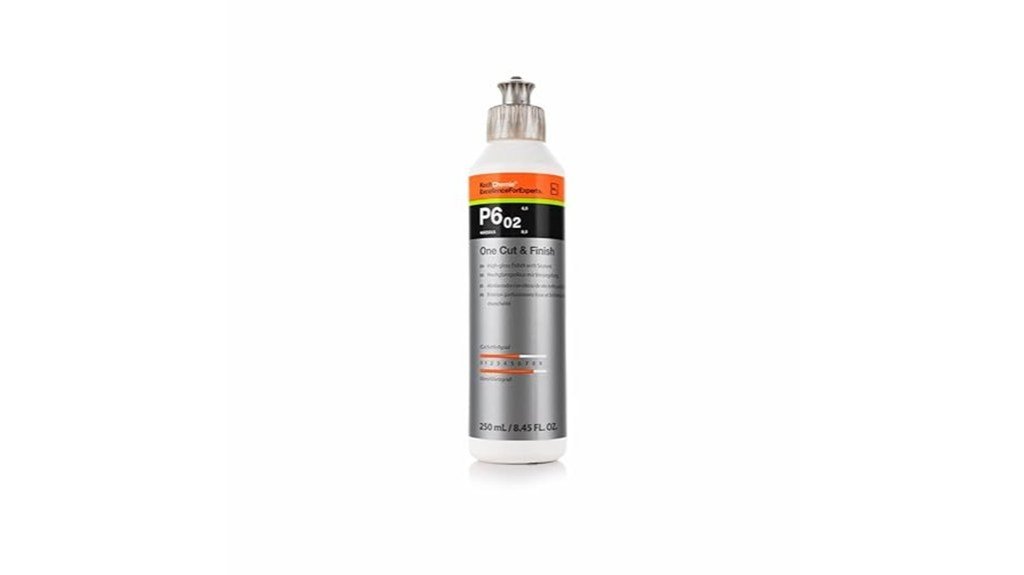
The KOCHCHEMIE P6.02 One Cut & Finish is presented as a high-efficiency polish for light to moderate defects, removing scratches from P2000 grit and finer, reducing haze by about 70% and boosting gloss 20–35 GU. It works with rotary or dual-action polishers, foam pads, 1–2 passes at 1500–2000 rpm, 2–4 g per section; compatible with clear coats and ceramic coatings when tested carefully. What tools, pad choices, and step sequence give the best final clarity?
Key Takeaways
- Highly effective one-step polish removing scratches from P2000 grit and finer while boosting gloss by 20–35 GU.
- Fast, reliable correction for light to moderate defects; deeper scratches may need additional polishing.
- Best used with DA/rotary polishers, medium-firm foam cutting pad, 2–3 g per 20×20 cm section.
- Contains carnauba, non-volatile silicones, and P2000+ abrasives; not suitable for plastics or rubber.
- Sealed gloss lasts about 6–12 weeks with proper prep, maintenance, and avoiding harsh exposure.
Product Performance and Results
Performance is measurable and straightforward to assess. The compound delivers high polishing efficiency, removing scratches from P2000 grit and finer with measurable gloss gains: initial haze reduced by ~70% after one pass, gloss readings rising 20–35 GU.
What results can the user expect? Scratch removal for light to moderate defects is reliable; deeper grinding may need follow-up.
Practical considerations: machine speed 1500–2000 rpm, 1–2 passes, 10–15 cm overlap. Ingredients like carnauba wax add sealing and durability.
Summary: consistent, fast correction, clear finish, compatible with automotive paints but not plastics or rubber.
Application, Tools, and Tips
A few basic tools and the right technique make KOCHCHEMIE P6.02 One Cut & Finish straightforward to use for both hobbyists and pros: a dual-action or rotary polisher, foam cutting pad (medium-firm), microfiber finishing pad, clean microfiber towels, and isopropyl-alcohol (IPA) panel wipe for prep. The writer outlines application techniques and tool selection, offering measured guidance: 20×20 cm sections, 1200–1500 rpm (DA), 1000–2000 rpm (rotary), 2–3 g product per section. Practice on inconspicuous panels. What tools matter most? Polisher balance, pad condition, and consistent pressure. Tips: keep pads clean, change pads after 4–6 panels.
| Tool | Setting | Amount |
|---|---|---|
| DA polisher | 1200–1500 rpm | 2–3 g |
| Rotary | 1000–2000 rpm | 2–3 g |
| Pads | medium-firm / finish | change 4–6 panels |
Ingredients, Compatibility, and Longevity
Having covered tools and technique, the discussion moves to what’s inside P6.02, where compatibility limits lie, and how long results can be expected.
Ingredients: carnauba wax, non-volatile silicones, abrasives for P2000+ correction; typical pack: 250–2500 ml, usage 10–20 g/m².
Packed with carnauba wax, non‑volatile silicones and P2000+ abrasives; available 250–2500 ml, use 10–20 g/m².
Compatibility: safe on automotive and commercial paints, motorcycles; avoid painted plastics, rubber.
Product safety: follow application guidelines, wear gloves, test patch 5×5 cm.
Longevity: sealed gloss lasts 6–12 weeks under normal conditions; reapply after heavy washing or environmental exposure.
Question: how to maximize durability?
Answer: proper decontamination, dilute rinse, and regular maintenance.
Frequently Asked Questions
Is P6.02 Safe for Use on Ceramic-Coated Vehicles?
Absolutely—like thunder in a teacup, it is generally safe for ceramic coating compatibility, though a cautious product safety evaluation is advised: test a small area, avoid excessive machine heat, and consult coating manufacturer recommendations first.
Can This Product Be Applied in Direct Sunlight?
Yes; direct sunlight application is not recommended. The product performs best in shaded, moderate temperatures because heat resistance is limited, so sunlight application can shorten working time and reduce polish leveling and gloss results.
What Is the Shelf Life After Opening the Bottle?
Like a steadfast clock, it keeps usable for about 12 months after opening; proper product storage—cool, dry, tightly sealed—helps maintain performance, though actual shelf life can vary with temperature and contamination.
Is Ventilation Required When Polishing Indoors?
Yes; adequate ventilation is recommended. He guarantees polishing techniques minimize aerosol buildup and uses indoor safety measures like exhaust fans, respirators, and short sessions to reduce inhalation risk and control airborne residues during machine polishing.
Are Applicator Pads Washable and Reusable With P6.02?
Yes, applicator pads are washable and reusable with p6.02. Applicator care includes prompt cleaning after use; cleaning methods: warm water, mild detergent, gentle agitation, thorough rinsing and air drying. Replace pads when compromised.