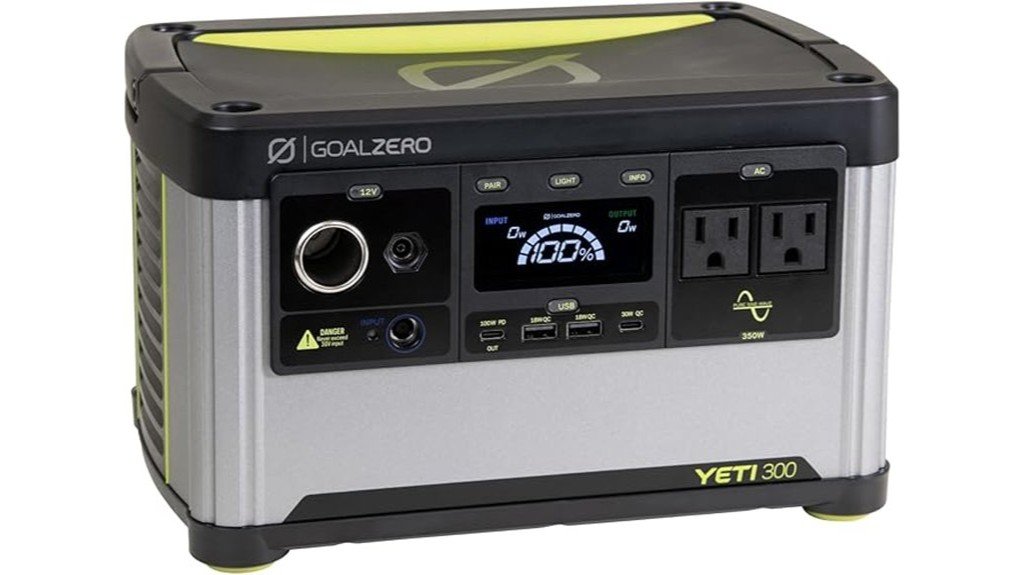
The Goal Zero Yeti 300 is a compact, transportable power station that balances capacity, durability, and usability. It measures 11.3 x 7.7 x 6.7 inches, weighs 13.7 pounds, and houses a 297 Wh LiFePO4 battery rated for 4,000+ cycles. What outputs and recharge options matter most—AC inverter, USB-C, solar input, or 50-minute fast recharge—and how will its runtime match your devices and trip length?
Key Takeaways
- Compact, 13.7 lb unit with 297 Wh LiFePO4 battery offers excellent portability for camping, tailgating, and emergency use.
- Continuous 350 W (600 W surge) AC output powers small appliances, laptops, and multiple device cycles reliably.
- Fast 0–100% recharge in about 50 minutes, with a high-speed mode for quicker turnaround between uses.
- Built for durability: IPX4 splash resistance, UL2743-tested dust and extreme temperature resilience, and a solar-ready port.
- Rated for over 4,000 cycles, the long-lasting battery and versatile features justify its value for frequent users.
Design, Durability, and Build Quality
A compact workhorse, the Goal Zero Yeti 300 combines practical design with rugged construction to suit outdoor and home use.
It measures 11.3L x 7.7W x 6.7H inches and weighs 13.7 pounds, offering portability without sacrificing durability.
How water resistant is it? IPX4-rated for splashes; how tough? UL2743-tested, dustproof, and built to handle extreme temperatures.
IPX4 splash-resistant, UL2743-tested, dustproof, and built to withstand extreme temperatures for reliable, rugged performance.
What freedom does it provide? Solar-ready port, clean off-grid power for camping, tailgating, emergency use.
Considerations: carry ease, storage footprint, and access to ports.
The build invites confident transport, dependable protection, and long-term use.
Performance, Charging, and Runtime
Having covered the Yeti 300’s compact, rugged build and outdoor-ready features, attention now turns to how it actually performs in the field and at home.
The Yeti 300 delivers 350 W continuous, 600 W surge, with a 297 Wh LiFePO4 battery rated 4,000+ cycles.
How fast does it recharge? 0%–100% in about 50 minutes, plus a high-speed mode; solar input allows renewable top-ups.
What runtime can be expected? Phone and laptop recharges last multiple cycles; small appliances run hours depending on draw.
Practical notes: weight 13.7 lb, IPX4 water resistance, consider panel output and real-world losses.
Use Cases, Portability, and Value
Several practical scenarios benefit from the Yeti 300’s balance of power, weight, and fast charging: weekend car-camping, tailgating, short off-grid workdays, emergency home backup for essential devices.
The unit weighs 13.7 pounds, measures 11.3 x 7.7 x 6.7 inches, and outputs 350 W AC (600 W surge).
Who is it for? Travelers seeking freedom, remote workers needing reliable juice, and households wanting quick device backup.
What to evaluate: 297 Wh LiFePO4 capacity, 4,000+ cycles, 50-minute fast charge, IPX4 protection, solar input.
Value judgment: strong longevity, high portability, price justified for long-term independence.
Frequently Asked Questions
Does the Yeti 300 Support Pass-Through Charging While Powering Devices?
Yes. It allows pass-through charging, enabling simultaneous charging and powering of devices. This empowers users to remain self-reliant, harnessing renewable inputs and continuous output without interruption, sustaining freedom from grid constraints during use.
Can the Battery Be Replaced or Upgraded by the User?
No—the battery cannot be user-replaced; ironically, freedom from plugs still demands factory service. The company advises professional replacement or warranty service, preserving safety and longevity while limiting do-it-yourself upgrades for independent-minded users.
What Accessories and Cables Are Included in the Box?
The box contains a 297Wh Yeti 300, an AC charging cable, a 12V car charging cable, a solar input cable adapter, a quick-start guide, and warranty papers—tools enabling independent, off-grid power freedom and resilient self-reliance.
Is the Yeti 300 Compatible With Third-Party Solar Panels?
Yes. The device accepts third-party solar panels via its solar input, enabling users to harness diverse panels for freedom from grids. Compatibility depends on panel voltage, connector type, and proper adapter use to guarantee safe charging.
How Does Goal Zero Handle Repairs and Warranty Claims?
By telegram, Goal Zero processes warranty claims via online support and authorized service centers; they offer a 30-day return policy and standard warranty, guiding users to repair options, parts replacement, or unit exchange to reclaim autonomy.
Conclusion
The Yeti 300 balances compact design, durable LiFePO4 chemistry, and practical capacity: 11.3 x 7.7 x 6.7 inches, 13.7 lb, 297 Wh, 4,000+ cycles. It recharges quickly (50 minutes), powers small appliances, charges devices via AC, USB, and 12V, and suits camping, tailgating, and emergency backup. Who should buy it? Travelers and remote workers needing reliable, portable power. Who should not? Heavy users needing multi-kWh runtime. Practical, portable, purpose-driven.