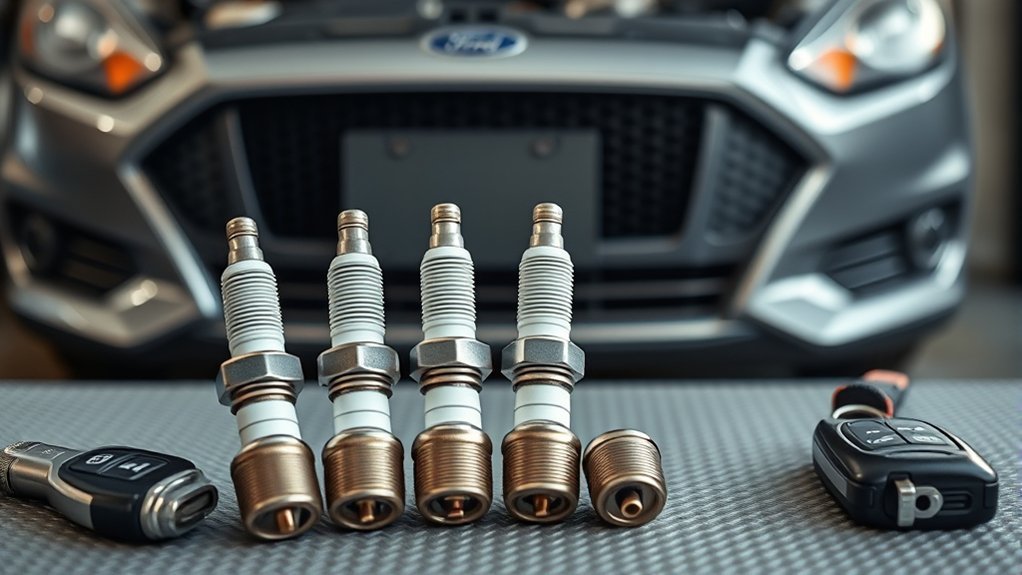
If you own a 2014 Ford Focus SE, the most important part of choosing spark plugs is not finding the most aggressive-sounding upgrade. It is matching the plug to the correct 2.0L GDI engine specification. Generic Ford 2.0L listings can include naturally aspirated and turbocharged engines that use different spark plugs and different gaps.
For the 2014 Focus 2.0L GDI engine, Ford lists a spark-plug gap of approximately 0.035 inch, with a tolerance of ±0.001 inch, and identifies Motorcraft SP535 (CYFS12Y1) as the applicable Motorcraft reference. Use that specification, your VIN, and a current manufacturer fitment catalog as your starting points before buying replacement plugs.
Quick Verdict
For a stock 2014 Ford Focus SE with the 2.0L GDI engine, prioritize exact OE-equivalent fitment over generic “2.0L Ford” compatibility.
Start with the Ford-listed SP535 / CYFS12Y1 specification or an aftermarket equivalent specifically cataloged for your exact 2014 Focus SE engine. Do not assume a plug or coil-and-plug bundle intended for a 2.0L EcoBoost, Focus ST, 2.3L turbo engine, or another Ford 2.0L application is interchangeable.
Key Takeaways
- The 2014 Focus SE 2.0L GDI engine uses a spark-plug gap of about 0.035 ± 0.001 inch.
- Ford lists Motorcraft SP535 (CYFS12Y1) for the 2.0L GDI application.
- The 2.0L turbocharged Focus ST uses a different spark-plug application, so ST-oriented plugs should not automatically be used in an SE.
- Ford’s normal maintenance schedule calls for spark-plug replacement at approximately 100,000 miles.
- Replacing spark plugs does not automatically mean all four ignition coils need replacement.
- Always verify the exact year, trim, engine, plug part number, heat range, seat style, reach, and gap before installation.
Before You Buy Spark Plugs for a 2014 Ford Focus SE
Fitment checklist:
- Confirm that your vehicle is a 2014 Ford Focus SE.
- Confirm the engine is the 2.0L GDI application rather than the 2.0L GTDI turbo engine used in the Focus ST.
- Cross-check the replacement plug against SP535 / CYFS12Y1 or the current equivalent specified for your VIN.
- Confirm the plug’s thread, reach, seat design, heat range, and electrode configuration.
- Confirm a final installed gap of approximately 0.035 ± 0.001 inch, unless updated service information for your exact vehicle says otherwise.
- Do not rely only on a seller title that says “fits Ford Focus” or “fits Ford 2.0L.”
Why Exact Engine Fitment Matters
The 2014 Focus lineup included different engine applications. That makes a broad product title such as “Ford 2.0L spark plug” insufficient for confirming fitment. A plug designed around a turbocharged 2.0L application can have a different heat range, electrode design, gap, or OE reference from the plug intended for your Focus SE’s naturally aspirated 2.0L GDI engine.
The same caution applies to ignition-coil-and-spark-plug bundles. A coil may physically resemble the correct part while the spark plugs supplied in the same kit are intended for another engine. Verify both components independently before installing a bundled tune-up kit.
Factors to Consider When Choosing Spark Plugs for a 2014 Ford Focus SE
Compatibility With the 2.0L GDI Engine
Compatibility should be your first filter. For the stock 2014 Focus SE 2.0L GDI application, use Ford’s listed specification or a replacement plug that the manufacturer specifically catalogs as an equivalent for that engine.
Do not assume that a plug fits simply because the package mentions Focus, Fusion, Escape, Edge, Explorer, Mustang, or another Ford model with a 2.0L engine. Ford used several different 2.0L engine families and calibrations, including turbocharged applications with different ignition requirements.
Correct Spark-Plug Gap
For the 2014 Focus 2.0L GDI engine, the factory specification is approximately 0.035 ± 0.001 inch, or about 0.9 ± 0.05 mm.
An incorrect gap can contribute to hard starting, unstable idle, misfires, poor combustion, or excess ignition-system demand. Do not copy a smaller gap from a Focus ST, EcoBoost engine, or another turbocharged application simply because the engine displacement is also 2.0 liters.
Many fine-wire plugs arrive pre-gapped, but shipping and handling can still affect the electrode. Check the gap carefully using a suitable gauge and follow the plug manufacturer’s instructions before attempting to adjust a fine-wire electrode.
OE Reference and Cross-Reference Numbers
Ford lists Motorcraft SP535 (CYFS12Y1) for the 2.0L GDI application. That reference gives you a useful baseline when checking aftermarket catalogs.
An aftermarket plug does not have to carry the Motorcraft name to work correctly, but it should be explicitly cross-referenced to the proper 2014 Focus SE application and meet the required physical, electrical, and thermal specifications.
Heat Range Selection
The spark-plug heat range controls how efficiently heat moves away from the plug tip. A plug that is too cold can be more prone to deposits under normal driving, while a plug that is too hot can operate at excessive tip temperatures.
For a stock Focus SE, stay with the heat range specified for the original engine application. A different heat range should not be treated as a routine performance upgrade. Modified engines may require different recommendations, but those decisions should be based on the specific tune, hardware, fuel, and engine builder or tuner guidance.
Electrode Material
Iridium and other fine-wire precious-metal plugs are commonly used in modern long-service-interval ignition systems because they resist electrode wear well. The important point, however, is correct application, not simply choosing the most expensive electrode material.
A properly specified plug helps the ignition system operate as designed. Installing an incorrect iridium plug is not an upgrade just because the electrode material sounds more advanced.
Longevity and Service Interval
Ford’s normal maintenance schedule calls for spark-plug replacement at approximately 100,000 miles (160,000 km). That is a scheduled-maintenance baseline, not a promise that every plug will remain perfect until that mileage.
Earlier inspection can make sense if you experience a persistent misfire, difficult starting, abnormal idle, damaged coil boots, oil or moisture in a plug well, or other ignition-related symptoms. Diagnose the problem rather than automatically replacing parts based on mileage alone.
Ignition-Coil Pairing
Your Focus uses a coil-on-plug ignition system, but new spark plugs do not automatically require four new ignition coils.
If the existing coils are operating correctly, the connectors and boots are undamaged, and there is no evidence of an ignition fault, replacing only scheduled spark plugs can be reasonable. If you have a cylinder-specific misfire, inspect and diagnose the coil, boot, connector, wiring, plug, injector, and related engine condition before buying a full coil set.
Diagnostic tip: A misfire code tells you which cylinder is having a combustion problem; it does not prove that the ignition coil is the cause. Avoid replacing a complete ignition system without diagnosis.
Fuel-Economy Impact
Correctly functioning spark plugs support consistent combustion, but a new set of plugs should not be marketed as a guaranteed fuel-economy upgrade. If the old plugs are badly worn, fouled, damaged, or causing misfires, replacing them with the correct specification may restore performance that was being lost.
If your existing plugs are still functioning correctly, changing to another electrode material alone should not be expected to create a dramatic MPG increase.
Installation and Torque
Work on a cool engine and keep dirt away from the open spark-plug wells. Start each new plug carefully by hand so it threads into the cylinder head correctly.
Use the applicable Ford service information or the spark-plug manufacturer’s installation specification for tightening torque. Do not assume one torque number applies to every replacement plug because seat design, plug construction, lubrication instructions, and service procedures can affect installation requirements.
Also follow the plug manufacturer’s guidance on thread compounds. Do not automatically apply anti-seize or other lubricants unless the manufacturer specifically calls for them, because lubrication can change the clamping force produced by a given torque value.
Common Spark-Plug Buying Mistakes
- Buying by engine displacement alone: A 2.0L turbo Ford application is not automatically the same as your 2.0L GDI Focus SE.
- Using the Focus ST gap: The turbocharged ST has a different ignition application.
- Trusting a broad marketplace title: Verify the actual manufacturer part number and engine fitment.
- Replacing every ignition coil without diagnosis: New plugs do not automatically require new coils.
- Assuming performance claims are guaranteed: Correct plugs maintain proper operation; they do not automatically add horsepower or dramatically improve fuel economy.
- Ignoring the final gap: Even a plug sold as pre-gapped should be checked according to the manufacturer’s handling instructions.
Frequently Asked Questions
What Spark Plug Does a 2014 Ford Focus SE Use?
For the 2.0L GDI application, Ford lists Motorcraft SP535 (CYFS12Y1). An aftermarket equivalent may also be suitable when its manufacturer specifically catalogs it for your exact year, trim, and engine and it meets the required Ford specifications.
What Is the Spark-Plug Gap for a 2014 Ford Focus SE?
The 2.0L GDI engine specification is approximately 0.035 ± 0.001 inch, or about 0.9 ± 0.05 mm.
Can I Use Focus ST Spark Plugs in a Focus SE?
Do not assume so. The Focus ST uses a turbocharged 2.0L GTDI engine with a different Ford spark-plug reference. Match the plug to your SE’s 2.0L GDI engine unless a qualified manufacturer specifically catalogs another plug for your exact application.
Should I Replace All Four Ignition Coils When I Change the Spark Plugs?
Not automatically. Replace or service coils when diagnosis shows they are failing, damaged, contaminated, or otherwise outside specification. If the coils are functioning correctly, routine spark-plug replacement does not by itself require a new set of coils.
How Often Should Spark Plugs Be Replaced?
Ford’s normal scheduled-maintenance interval for the 2014 Focus calls for spark-plug replacement at approximately 100,000 miles (160,000 km). Inspect or diagnose the ignition system earlier when symptoms suggest a problem.
Will Iridium Spark Plugs Improve Fuel Economy?
Not automatically. Correct new plugs may restore lost efficiency if old plugs are worn or misfiring, but electrode material alone does not guarantee better MPG. Exact fitment, correct gap, proper engine condition, and normal maintenance matter more.
What Can Cause a Misfire After Installing New Spark Plugs?
Possible causes include an incorrect plug, incorrect gap, damaged electrode, loose or improperly seated coil connector, damaged coil or boot, contamination in a plug well, injector problems, wiring faults, intake leaks, or mechanical engine problems. Recheck the installation and diagnose the affected cylinder rather than immediately replacing more parts.
Are Aftermarket Spark Plugs Safe to Use?
They can be when the manufacturer specifically catalogs them for the 2014 Focus SE 2.0L GDI and the plug meets the required physical, thermal, and electrical specifications. Ford advises using Motorcraft or equivalent plugs that meet its material and design requirements.
Final Recommendation
For a stock 2014 Ford Focus SE, buy by exact engine specification—not by a generic “Ford 2.0L” product title.
Use the SP535 / CYFS12Y1 application and the approximately 0.035 ± 0.001-inch gap as your baseline for the 2.0L GDI engine. Cross-check your VIN and the current plug manufacturer’s catalog before ordering.
If your Focus has a misfire or rough running problem, diagnose the ignition system instead of assuming that all four coils need replacement. Correct fitment and proper installation matter more than marketing terms such as “high performance,” “upgrade,” or “turbo compatible.”
Conclusion
Choosing spark plugs for a 2014 Ford Focus SE becomes much easier once you separate the 2.0L GDI application from turbocharged Focus and EcoBoost listings. Ford’s specifications give you a clear starting point: SP535 / CYFS12Y1, an approximately 0.035-inch gap, and a normal replacement interval of about 100,000 miles.
Verify the exact replacement plug before buying, use the correct installation procedure, and diagnose ignition-coil problems rather than replacing parts unnecessarily. That approach gives you a more reliable tune-up and greatly reduces the chance of installing a plug intended for the wrong Focus engine.