A concise assessment of 6 AWG gauge wire highlights its suitability for marine, battery, and heavy-duty DC applications. It carries roughly 55–75 amps depending on insulation and environment, measures about 0.205 inches in diameter for single conductor, and often features tinned, high-strand copper for flexibility and corrosion resistance. What’s included: cables, annealed copper lugs, heat-shrink tubing. How to install: correct lug crimping, appropriate fuse sizing, and moisture protection—more practical guidance follows.
Key Takeaways
- 6 AWG wire handles heavy loads (typically 55–75 A) suitable for inverters, battery banks, and high-current circuits.
- High-strand tinned copper construction improves flexibility, corrosion resistance, and ease of routing in tight installations.
- Kit includes two 6.5 ft leads, multiple 3/8″ and 5/16″ pure-copper lugs, and 3:1 adhesive heat-shrink for turnkey connections.
- Proper installation—strip 3/4″–7/8″, crimp with calibrated dies, and torque lugs to ~50–60 in-lb—ensures low resistance and safety.
- Use dielectric grease, route away from chafe/heat, and inspect regularly to maximize durability and prevent corrosion.
Why 6 AWG Is a Great Choice for Marine and Battery Power
When selecting wire for marine or battery-powered systems, 6 AWG often strikes the best balance between capacity, flexibility, and durability. The writer notes it carries substantial current—typically 55–75 A depending on insulation and ambient temperature—while remaining bendable for tight routing in boats and vehicles.
Why choose it?
Why choose it? Because 6 AWG balances capacity, flexibility, and corrosion resistance for reliable marine and battery use.
- Capacity: supports common inverter and battery bank loads.
- Flexibility: high strand count eases installation.
- Corrosion resistance: tinned conductors and annealed copper lugs enhance longevity in wet environments.
Practical tip: use correct lug size, secure crimps, and 13.1 ft run planning to minimize voltage drop.
What’s in the Kit: Cables, Lugs, and Heat Shrink Details
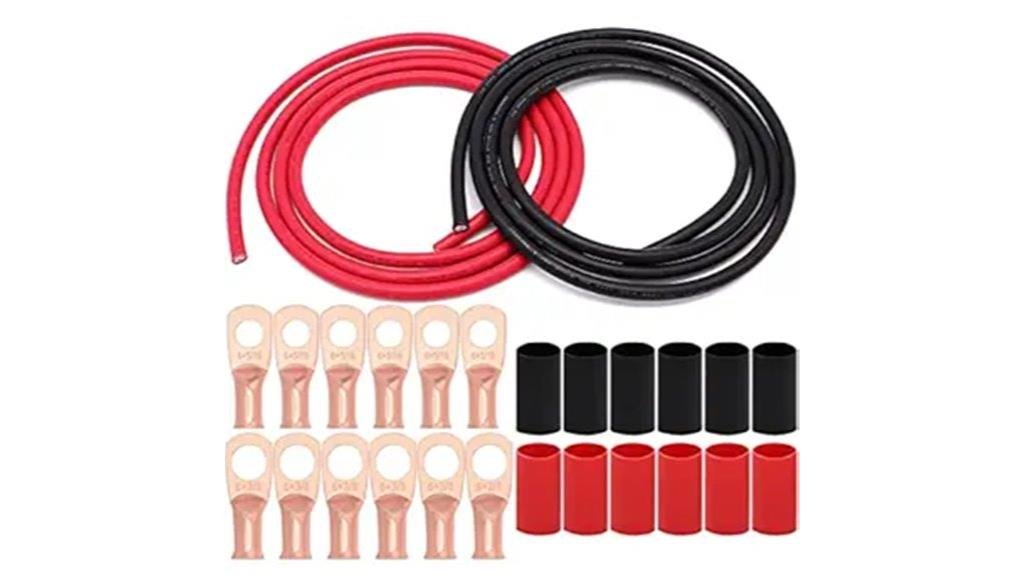
The kit delivers a ready-to-install set of components tailored for marine and battery-power runs: two 6 AWG UL1015 tinned copper cables (total 13.1 ft — 6.5 ft red, 6.5 ft black), six 3/8″ and six 5/16″ annealed pure-copper lugs, plus twelve 3:1 adhesive-lined polyolefin heat-shrink tubes rated to 600 V and -55°C to +125°C.
The contents reflect clear cable specifications, high strand-count tinned conductors and PVC insulation for moisture and chemical resistance.
What else comes in the box? Consider these essentials:
- Two 6 AWG tinned copper cables, UL1015/CSA Ft1
- Twelve color-matched heat-shrink tubes, adhesive-lined
- Six 3/8″ copper lugs (annealed, closed end)
- Six 5/16″ copper lugs (flared barrel, corrosion protection)
Installation Tips and Best Practices for Durable Connections
Because reliable terminations depend on proper preparation and technique, installers should follow a few disciplined steps to ensure durable, low-resistance connections for 6 AWG battery and marine runs.
Prepare: strip 3/4″ to 7/8″ insulation, tin or flare strands, select matching 6 AWG lugs (3/8″ or 5/16″ bolts).
Prepare: strip 3/4″–7/8″ insulation, tin or flare strands, and use 6 AWG lugs sized for 3/8″ or 5/16″ bolts.
Connection techniques: crimp with a calibrated die, then solder if desired; inspect for full barrel fill.
Corrosion prevention: use tinned copper lugs, apply dielectric grease, heat-shrink with 3:1 adhesive tubing.
Questions? Verify torque, 50–60 in-lb typical, and route away from chafe and heat.
Frequently Asked Questions
Can 6 AWG Wire Be Used for Inverter Systems Above 3000W?
Yes. He notes 6 AWG wire can serve inverter capacity above 3000W for short runs, provided wire gauge, ambient temperature, and installation meet ampacity requirements; long runs or higher surge demands may require larger conductors.
How Does Tinned Copper Perform Compared to Pure Copper Over Decades?
Tinned copper outlasts pure copper in corrosive, marine, or moist environments: tinned benefits include superior corrosion resistance, easier soldering, and long-term reliability, while pure copper retains marginally better conductivity over decades.
Are These Cables Safe for Direct Burial Without Conduit?
No; the cables are not recommended for direct burial without conduit. The reviewer notes burial depth requirements and insulation types matter—UL1015 PVC lacks direct-burial rating, so conduit or rated burial cable and proper depth are required.
Can I Weld Directly Onto the Tinned Copper Cable Ends?
Yes. He can weld directly onto the tinned copper cable ends, but proper welding techniques are required to avoid overheating the tinning; doing so preserves cable durability and conductivity when performed with controlled heat and flux.
Do These Wires Comply With ABYC Marine Wiring Standards?
Absolutely compliant, like a fortress defending boats: the cables meet UL1015 and CSA Ft1 approvals but users must verify specific ABYC marine safety wiring compliance for vessel installations, accounting for tinned copper, lugs, heat shrink, and environment.
Conclusion
In summary, 6 AWG delivers reliable 55–75 amp capacity, flexibility from high strand counts, and corrosion resistance with tinned conductors and annealed lugs. One sailor likened swapping a corroded shore cable to replacing a clogged hose—flow restored, devices happy—illustrating how proper materials matter. What should readers check? Cable length, voltage drop, terminal torque specs, and heat-shrink fit. Follow torque values, use proper crimp dies, and test continuity and voltage under load for durable, safe installations.