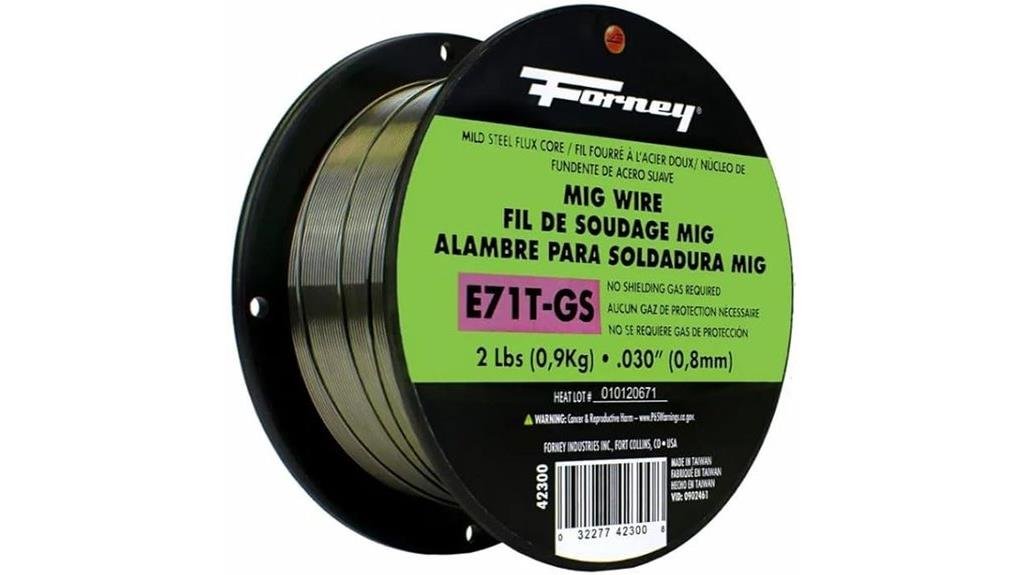
The Forney 42300 Flux Core MIG Wire is presented as a practical, all-position 0.030‑inch self‑shielded filler for outdoor and maintenance work, offering E71T‑GS chemistry, higher travel speeds, and tolerance for lightly rusted or painted mild steel. The reviewer addresses compatibility, amperage ranges, spatter levels, and weld profile in clear terms, lists pros and cons, and answers common setup questions—useful for welders who want speed and robustness rather than cosmetic finishes, but the full assessment raises a few tradeoffs to consider.
Key Takeaways
- Forney 42300 is a 0.030″ self-shielded flux‑core wire on a 2 lb spool, alloy E71T‑GS.
- It runs hotter than solid wire, enabling travel speeds of about 6–12 in/min at 75–95 A.
- Best for outdoor structural repairs, farm equipment, fencing, and mildly rusted or painted steel.
- Pros: self‑shielding works in windy conditions and requires minimal cleaning; cons: more spatter and limited finish.
- Use with standard spool guns/feeders, adjust voltage/travel for penetration, and expect heavier slag and limited continuous duration.
Product Specifications and Compatibility
The Forney 42300 Flux Core MIG Wire is a 0.030‑inch diameter, 2‑pound spool of E71T‑GS mild steel wire designed for flux‑cored welding.
It suits all-position flux core applications, compatible with mild steel, including rusty, dirty, or painted material types.
What are the specs?
- Diameter: 0.030 in
- Weight: 2 lb
- Alloy: E71T-GS
- Shielding: self-shielded.
Practical considerations: ideal for single-pass work, higher travel speeds, outdoor use in wind.
Welding techniques: recommended for flux-core MIG methods, works with standard spool guns and feeders.
Who should use it? Fabricators, maintenance, hobbyists seeking versatility.
Field Performance and Welding Characteristics
Assessors note that the Forney 42300 E71T‑GS flux‑core wire delivers predictable field performance for short‑run, single‑pass work, particularly on mild steel that is rusty, painted, or otherwise unprepared.
Assessors praise Forney 42300 E71T‑GS flux‑core for reliable short‑run, single‑pass performance on mildly rusted or painted mild steel
It runs hotter than solid wire, enabling travel speeds of 6–12 in/min with 0.030″ wire on 75–95 A, 18–24 V.
Which welding techniques suit it? Fast stringer beads, short‑arc weaving, and accelerator travel for fillets.
What about material preparation? Minimal cleaning, remove grease, clamp to reduce gaps.
Practical considerations: 2 lb spool limits continuous work, expect heavier slag, adjust contact tip at 0.030″ for consistent feed.
Pros, Cons, and Best Use Cases
Many welders will find Forney 42300 flux‑core wire especially useful for quick, tough outdoor jobs, single‑pass beads, and repairs on mildly contaminated steel.
Pros: good for windy conditions, self‑shielded, 0.030″ diameter, 2 lb spool, runs hotter for faster travel, tolerant of rusty/painted surfaces.
Cons: more spatter, limited aesthetic finish, not ideal for thin sheet metal, fixed flux chemistry limits stainless/mild variations.
Best use cases?
Q: When to choose it?
A: Outdoor structural repairs, farm equipment, fencing, general maintenance.
Practical notes: preheat thicker pieces, basic material preparation, adjust travel speed and voltage for penetration.
Frequently Asked Questions
Is This Wire Suitable for Use With Gas-Shielded MIG Machines?
No — it is flux core and designed for self-shielded operation, so it is not intended for gas shielding in gas-shielded MIG machines. Using it with external gas can produce improper welds and contamination, risking poor performance.
Can I Use It for Welding Stainless Steel or Aluminum?
“Don’t bite off more than you can chew.” He states plainly: this wire is not suitable for stainless steel welding or aluminum welding; it’s formulated for mild steel flux‑core applications and dissimilar metals require appropriate alloys or filler.
What Is the Storage Life Once the Spool Is Opened?
Opened spools generally last several months if kept dry; the responder notes that proper storage conditions (airtight container, low humidity, minimal temperature swings) significantly improve wire longevity and prevent rust or flux contamination.
Is Flux Core Wire Compatible With Automotive Bodywork Panels?
Like a brisk rain sealing a tin roof, one welder found flux core tames rusty panels quickly. It can be used for automotive bodywork panels, but attention to welding techniques and metal thickness is crucial to avoid burn-through.
Does This Spool Fit Standard Small Hobby MIG Wire Feeders?
Yes, the spool fits most standard small hobby MIG wire feeders. Observers note wire compatibility depends on feeder spindle size and drive rolls; proper welding techniques and tension adjustments ensure smooth feeding and consistent arc performance across setups.
Conclusion
Forney’s 42300 Flux Core MIG wire performs like a workhorse: 0.030 in diameter, E71T‑GS self‑shielded alloy, suited for all‑position welding on mildly rusted or painted mild steel. It enables fast travel speeds, outdoor use in wind, and minimal pre‑cleaning, but increases spatter and yields a rougher finish. Who should buy it? Practical repairers, farmers, and maintenance crews. Who shouldn’t? Finish‑critical fabricators and thin‑gauge sheet metal specialists. Consider amperage, wire feed, and joint fit‑up.