Disclosure: As an Amazon Associate, we earn from qualifying purchases. If you click a link on this page and make a purchase, we may receive a small commission at no extra cost to you.
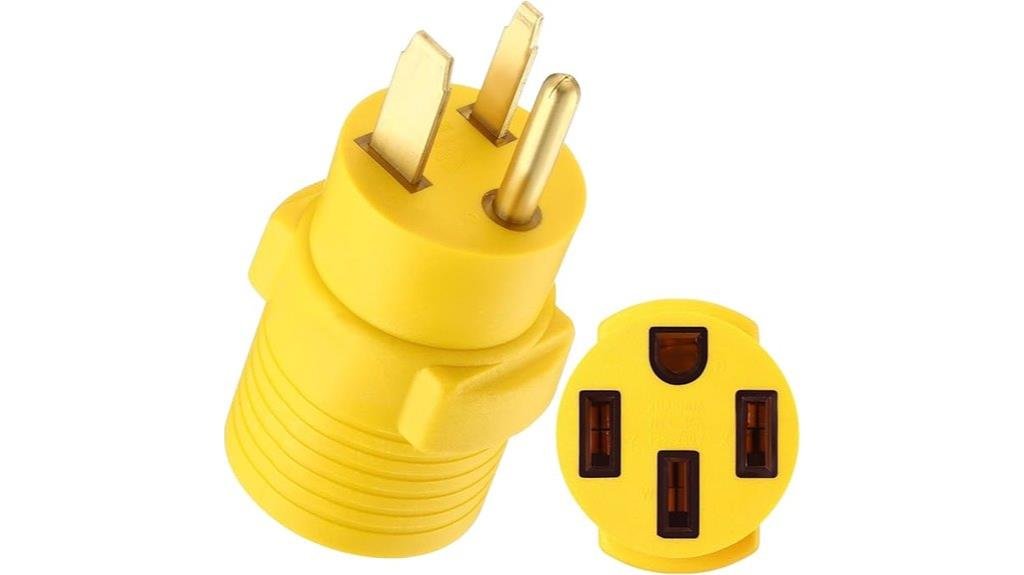
A NEMA 14-50 charger plug will not fit a NEMA 6-50 wall outlet, even though both are commonly associated with 50A circuits. The Kanayu EV Charger Adapter bridges that specific plug mismatch with a compact 6-50P-to-14-50R design. It does not provide the neutral conductor a standard 14-50 receptacle normally has, and the available technical documentation leaves important safety questions open. Here is how to judge compatibility, set a safe charging limit, and decide when a direct manufacturer-approved connection is better.
Quick Verdict
Editorial rating: 7/10, recommended only with strict compatibility checks
Best For: EV owners with a professionally checked NEMA 6-50R circuit and a 14-50P plug-in charger whose maker permits this type of adapter and confirms that neutral is unnecessary.
Bottom Line: Its one-piece shape can solve a narrow plug mismatch without replacing the outlet. However, the missing neutral, unconfirmed listing details, and unknown continuous-duty rating make written charger compatibility and electrician review essential.
Key Takeaways
- The adapter’s NEMA 6-50P male plug goes into a NEMA 6-50R wall receptacle.
- Its NEMA 14-50R female receptacle accepts the NEMA 14-50P plug attached to a compatible EV charger.
- A NEMA 6-50 circuit supplies two hot conductors and ground, but it does not provide neutral.
- Use it only if your EVSE maker allows an external adapter and confirms that neutral is not needed.
- A 50A connector label does not confirm a 50A continuous load rating; 40A is a typical ceiling on a properly rated 50A branch circuit, not a guaranteed adapter limit.
- Never use it with RVs, neutral-dependent appliances, worn outlets, extension cords, or a chain of plug adapters.
| Specification | Detail |
|---|---|
| Brand | Kanayu |
| ASIN | B0CWNW1K4F |
| Product Type | Compact, rigid EV charging plug adapter |
| Wall-Outlet Side | NEMA 6-50P male plug |
| Required Wall Outlet | NEMA 6-50R receptacle |
| Charger Side | NEMA 14-50R female receptacle |
| Compatible Charger Plug | NEMA 14-50P, when the EV charger does not require neutral |
| Connector Class | Advertised as 50A; continuous-duty rating not independently established |
| Neutral Connection | None, because the NEMA 6-50 supply does not include neutral |
| Intended Use | Compatible North American 240V Level 2 EVSE, where manufacturer permits adapter use |
| Not Intended For | RVs, campers, dryers, ranges, neutral-dependent appliances, or general-purpose conversion |
| Color | Yellow |
| Charging Current | Never above the lowest documented continuous-duty limit for the circuit, receptacle, adapter, EVSE, and vehicle |
| Certification Status | No traceable UL/ETL listing number verified from accessible product information |
| Required Checks | EVSE manual, adapter documentation, breaker/wiring, outlet condition, and local code |
| Main Limitation | No neutral, narrow fit, and incomplete publicly verifiable specifications |
Before You Buy: You need a NEMA 6-50R wall outlet and a NEMA 14-50P EVSE plug, not the reverse. The 14-50R face does not provide neutral. If your charger maker disallows third-party conversion adapters or you cannot verify the adapter’s continuous-duty rating and electrical safety listing, choose another connection method.
What Is the Kanayu EV Charger Adapter?
The Kanayu EV Charger Adapter is a rigid plug adapter for a specific Level 2 EV charging setup. Its three-prong NEMA 6-50P side fits a matching NEMA 6-50R wall receptacle, often found in workshops and some older charging installations.
The other side is a four-slot NEMA 14-50R connector for a portable EV charger or plug-in EVSE with a 14-50P plug. This is an outlet adapter, not the vehicle-side charging connector and not a voltage converter.
The adapter changes only the plug arrangement. Your charger must work from two hot conductors and equipment ground without neutral, and its maker must permit this connection method. The shape of the plug alone cannot confirm either requirement.
Connection Design and Electrical Function
Its main feature is the fixed NEMA 6-50P to NEMA 14-50R layout. For a compatible charger, it may avoid installing a different receptacle just to match the plug. That convenience does not replace a check of the actual circuit.
The connection works only in one direction. The male 6-50P end receives power from the wall outlet. The female 14-50R side supplies that power to the charger plug. It cannot be reversed, and it is not a universal adapter.
A normal NEMA 14-50 outlet has two hot legs, neutral, and ground. A 6-50 outlet has only two hot legs and ground. As a result, this adapter has no neutral supply to pass on; ground must never be used as a substitute for neutral.
Two plugs fitting together does not prove the connection is safe. Equipment that needs a 120V neutral supply is incompatible with a NEMA 6-50 source.
Who Should Buy It?
Best For
- You have a NEMA 6-50R outlet and an electrician has confirmed that its circuit is suitable for EV charging.
- Your charger has a NEMA 14-50P plug, needs no neutral, and its maker allows a separately purchased outlet adapter.
- You prefer a compact backup connection at a known indoor location and can verify the adapter’s documentation.
Skip If
- You need to power an RV, camper, dryer, range, or other equipment that may use neutral.
- Your charger manufacturer prohibits or does not approve third-party outlet adapters.
- You cannot confirm a suitable continuous-current rating, safety listing, or protection from moisture.
Fit and Compatibility
Start with the printed NEMA markings, not the look of the slots. Your wall outlet must be a 6-50R, not a 6-30R, 10-50R, 14-30R, or similar receptacle. The EVSE must have a 14-50P plug. Do not force or alter any blade to make it fit.
Next, read your EVSE manual. Some 240V Level 2 units need only two hot legs and equipment ground, but you must confirm that your exact model does not use neutral and permits an outlet conversion adapter.
Finally, verify the breaker, branch wiring, outlet condition, adapter rating, EVSE settings, and vehicle limit. Ask an electrician to inspect the setup if any part is unknown. An oversized breaker or worn receptacle is not made safe by an adapter.
Tesla Mobile Connector Compatibility
Tesla offers a dedicated NEMA 6-50 outlet adapter for the Gen 2 Mobile Connector. Use that manufacturer-supplied option instead of placing the Kanayu adapter between a 6-50 outlet and a Tesla 14-50 input adapter. Check your exact Mobile Connector instructions, since approval for third-party conversion adapters must not be assumed.
Tesla specifies a maximum 32A charging output with either of those outlet adapters on a suitable 50A supply. A separate adapter labeled 50A cannot increase that 32A Mobile Connector limit.
Tesla Wall Connector Compatibility
This plug adapter cannot convert a hardwired Tesla Wall Connector into a portable charger. Tesla directs owners to have a qualified electrician install the Wall Connector according to its instructions and local code.
Build Quality and Documentation
The yellow, one-piece housing is easy to identify in a charging bag. Its short shape is convenient for storage, but a rigid adapter can transfer the weight and movement of a thick EVSE cable directly to the wall receptacle.
Available product descriptions do not establish a verified conductor gauge, ingress-protection rating, maximum continuous-duty current, or traceable UL/ETL listing. A claim to meet a standard is not the same thing as a searchable independent certification.
This matters because EV charging can keep a connector under load for hours. Seek written ratings and a verifiable listing before purchase, particularly for routine charging. If you cannot get that information, select a charger-approved direct plug or an electrician-installed alternative.
Setup and Ease of Use
There is no app, switch, or setup menu in the adapter. Safe use depends on the outlet and EVSE, so complete these checks before connecting anything.
- Confirm the wall receptacle: Check the NEMA 6-50R marking and have grounding and circuit suitability verified.
- Check the branch circuit: Have a qualified electrician confirm the breaker, wire size, receptacle condition, and any required protective devices.
- Read the EVSE manual: Confirm that neutral is not used and third-party plug adapters are allowed.
- Set the correct current: Use the lowest verified continuous-duty limit; do not default to 50A.
- Inspect before each use: Reject cracked plastic, bent blades, discoloration, residue, or loose contacts.
- Seat the plugs fully: Poor contact can cause overheating, even below the circuit breaker rating.
- Support the cable: Keep EVSE weight from twisting or pulling the rigid adapter. Stop charging before disconnecting.
Pro Tip: Add a clear “EV charging only, NO NEUTRAL” label to the storage pouch. That warning helps prevent someone from mistaking the four-slot face for a general-purpose 14-50 outlet.
Charging Current and Electrical Safety
“50A” describes the advertised connector class, not a proven 50A continuous charging capacity. EV charging is treated as a continuous load. Under a typical 125% branch-circuit sizing rule, a properly installed 50A EV circuit can support at most 40A of charging, provided every component is rated for it. This Kanayu adapter’s own allowable continuous load is not independently confirmed.
A 32A EVSE remains limited to 32A even on a 50A circuit. A suitable 30A EV circuit would normally require a limit no higher than 24A. Do not use those examples to choose a setting for an unknown installation: verify both the circuit and the adapter before charging.
The receptacle can be the weak point. Worn 6-50R contacts may overheat even if the breaker is correctly sized. Stop using any outlet with a loose grip, scorch marks, cracking, a burned smell, or signs of past heat damage, and have it examined by an electrician.
Do not connect this product through a splitter, extension cord, or second adapter. Each added contact raises the chance of a poor connection, and many EVSE makers expressly prohibit those arrangements.
Why It Is Not for RVs
A 50A RV connection uses 120V loads connected between each hot leg and neutral. A NEMA 6-50 supply has no neutral, so this adapter cannot reproduce the supply an RV expects.
Never use the 14-50R face to power an RV, camper, range, dryer, or other neutral-dependent equipment. Such use can damage appliances or create a fire or shock hazard. Do not attempt to bond neutral to ground to make it work.
How It Performs in Real Use
How this review was prepared: This is a documentation-based assessment of the product description, NEMA connector arrangement, electrical safety principles, and EVSE-maker guidance. We did not load-test the Kanayu adapter or confirm its long-term durability.
For Home Garage Charging
At a dry garage outlet, the compact body avoids a loose cord on the floor. However, a stiff charging cable can pull on the wall socket. Keep the cable supported, and use the setup only after the electrician and EVSE maker have approved it.
For charging every night, a direct manufacturer-approved 6-50 connector or a properly installed hardwired EVSE is the clearer long-term choice.
For Driveway or Semi-Outdoor Use
No reliable outdoor or ingress-protection rating was found for this product. A molded plastic housing does not make the connection to the wall outlet or EVSE rainproof.
Avoid exposed driveways, wet sockets, runoff, and snow. Follow the outlet, EVSE, and local electrical requirements; choose a documented weather-rated installation for outdoor charging.
For Travel or Backup Use
This shape is easy to pack as a backup, but an unknown destination is not a reason to improvise. A workshop outlet may look like a 6-50R while being worn, incorrectly wired, or unsuitable for extended charging.
Before travel, get the outlet type and circuit details from the host, obtain permission, and verify the EVSE and adapter limits. If you cannot confirm them, do not charge through this adapter.
For Long-Term Use
Repeated plugging can wear receptacle contacts. Inspect the adapter and outlet before each session, avoid sharp side loads, and store the product dry with the metal blades protected from damage.
Stop charging for unusual heat, crackling, a burning smell, discoloration, melting, or repeated interruptions. Let the equipment cool and have the full connection inspected before trying again.
Common Setup Mistakes to Avoid
- Trusting the slot shape: Confirm the full NEMA 6-50R marking and have wiring verified.
- Assuming neutral is present: A four-slot adapter face does not add a neutral conductor.
- Setting charging to 50A: The advertised connector class is not an approved EVSE setting.
- Using a worn workshop outlet: A loose receptacle may overheat during hours of charging.
- Hanging a heavy cable: Give the rigid connection mechanical support.
- Leaving joints in the rain: No verified weather rating is available for this adapter.
- Mixing adapters: Do not stack conversion plugs or use an extension cord.
Pros and Cons
Pros
- Matches a 6-50R wall outlet to a compatible 14-50P EVSE plug.
- Compact shape takes less storage space than a long adapter cable.
- Yellow housing is easy to identify in a garage or charging kit.
- Simple physical connection needs no software or app.
- May save an outlet change when the circuit and charger are already approved for this use.
Cons
- No neutral, so RVs and many 14-50 appliances cannot use it.
- Continuous-current capability, conductor gauge, and safety listing remain unverified.
- Rigid housing can increase strain on wall contacts when a heavy EVSE cable hangs from it.
Is It Worth the Price?
This is a niche accessory, not a general-purpose electrical upgrade. It may offer value when you already own a suitable 6-50R outlet and a compatible 14-50P portable charger, and the missing documentation can be resolved before use.
It is less appealing if your charger maker sells a direct 6-50 input adapter. The correct original accessory usually offers a clearer fit and charging-current limit, without a separate conversion plug.
For everyday home charging, compare the total cost with having an electrician install a suitable dedicated receptacle or hardwired EVSE. Do not let a low adapter price outweigh uncertain listing details or a questionable outlet.
How It Compares to Alternatives
First check for an official NEMA 6-50 plug option for your EVSE. Tesla offers one for its Gen 2 Mobile Connector, with a specified maximum of 32A on a suitable circuit. That is preferable to a generic adapter added to Tesla’s NEMA 14-50 input.
A short flexible 6-50P-to-14-50R cord may reduce leverage on the outlet, but only if its ratings and certifications are verified and your EVSE maker approves it. For a permanent setup, a correctly installed plug or hardwired charger removes the conversion point entirely.
Frequently Asked Questions
Which end plugs into the wall?
The three-prong NEMA 6-50P male end plugs into a NEMA 6-50R wall receptacle. The four-slot NEMA 14-50R female side accepts the NEMA 14-50P plug attached to a compatible EV charger.
Can I charge continuously at 50A with this adapter?
Do not assume so. A suitable 50A EV branch circuit normally supports no more than 40A continuous charging, and some EVSE units are capped at 32A. The Kanayu adapter’s own continuous rating has not been verified, so confirm it before choosing a current setting.
Does the adapter provide a neutral connection?
No. A NEMA 6-50 supply has two hot conductors and equipment ground, but no neutral. The neutral position on the adapter’s 14-50R side cannot supply neutral-dependent equipment.
Can I use it to power an RV or camper?
No. A 50A RV uses neutral for its 120V loads, while this adapter receives power from a 6-50 circuit with no neutral. Using it with an RV can damage equipment and create a fire or shock hazard.
Should I use it with a Tesla Mobile Connector?
Tesla offers a direct NEMA 6-50 plug adapter for its Gen 2 Mobile Connector. Choose that official adapter rather than adding the Kanayu adapter to Tesla’s 14-50 plug, unless Tesla expressly authorizes your setup.
Can it connect a Tesla Wall Connector to an outlet?
It is not intended to convert a hardwired Tesla Wall Connector into a plug-in device. Install a Wall Connector according to Tesla’s instructions and applicable electrical requirements.
Can I leave the adapter outdoors?
No verified outdoor or ingress-protection rating was found for this adapter. Do not expose its connections to rain or standing water; use a weather-rated charging setup specified for outdoor use instead.
What should I do if the adapter becomes hot?
Stop charging for excessive heat, a burned smell, discoloration, melting, or repeated interruptions. Let the connection cool and have the outlet, adapter, and EVSE inspected before trying again.
The Bottom Line
The Kanayu EV Charger Adapter offers a compact fix for a NEMA 6-50R wall outlet and a 14-50P EVSE plug, but only when your charger maker permits the setup and an electrician has approved the circuit. Its main tradeoffs are the absent neutral, outlet strain, and unverified continuous-load and certification details.
Consider it only after those checks and written adapter ratings are available. Otherwise, especially for daily charging, choose a manufacturer-approved connector or a professionally installed charging outlet.
Ready to Buy?
Check the current product documentation, safety listing, outlet type, and EVSE approval before you buy.