Disclosure: As an Amazon Associate, we earn from qualifying purchases. If you click a link on this page and make a purchase, we may receive a small commission at no extra cost to you.
A plug adapter can make two connectors fit while still being wrong for the electrical equipment behind them. The Kanayu EV Charger Adapter is designed to let an EV charger with a NEMA 14-50P plug connect to an existing NEMA 6-50R wall outlet. Its compact design is convenient, but it does not supply the neutral connection normally present at a NEMA 14-50 outlet. This review explains the correct connection direction, charging limits, compatibility concerns, and situations where you should choose another solution.
Quick Verdict
Rating: 7/10, recommended with caveats
Best For: EV owners with an inspected NEMA 6-50R outlet and a compatible plug-in charger that has a NEMA 14-50P plug and does not require neutral.
Bottom Line: The Kanayu adapter provides a simple, compact connection for one narrow EV-charging situation. Its lack of neutral, limited documentation, and unconfirmed third-party certification details mean you must verify your charger, circuit, and outlet before using it.
Key Takeaways
- The adapter’s NEMA 6-50P male plug goes into a NEMA 6-50R wall receptacle.
- Its NEMA 14-50R female receptacle accepts the NEMA 14-50P plug attached to a compatible EV charger.
- A NEMA 6-50 circuit supplies two hot conductors and ground, but it does not provide neutral.
- The adapter is intended only for EV charging equipment that does not use neutral.
- A 50A connector label does not mean you can charge continuously at 50A.
- You should not use it with RVs, neutral-dependent appliances, damaged outlets, extension cords, or stacked adapters.
| Specification | Detail |
|---|---|
| Brand | Kanayu |
| ASIN | B0CWNW1K4F |
| Product Type | Compact EV charging outlet adapter |
| Wall-Outlet Side | NEMA 6-50P male plug |
| Required Wall Outlet | NEMA 6-50R receptacle |
| Charger Side | NEMA 14-50R female receptacle |
| Compatible Charger Plug | NEMA 14-50P, when the EV charger does not require neutral |
| Connector Description | Seller describes it as a 50A adapter |
| Neutral Connection | None, because the NEMA 6-50 supply does not include neutral |
| Intended Use | Compatible 240V Level 2 EV charging equipment |
| Not Intended For | RVs, campers, dryers, ranges, neutral-dependent appliances, or general-purpose conversion |
| Color | Yellow |
| Charging Current | Limited by the lowest-rated part of the circuit, outlet, adapter, EVSE, vehicle, and local code requirements |
| Certification Status | A traceable UL or ETL listing number was not confirmed in the accessible product information |
| Main Limitation | Very narrow compatibility and no neutral pass-through |
Before You Buy: Confirm the direction carefully. You need a NEMA 6-50R wall outlet and an EV charger with a NEMA 14-50P plug. This adapter does not convert a NEMA 14-50 wall outlet for equipment with a NEMA 6-50 plug.
What Is the Kanayu EV Charger Adapter?
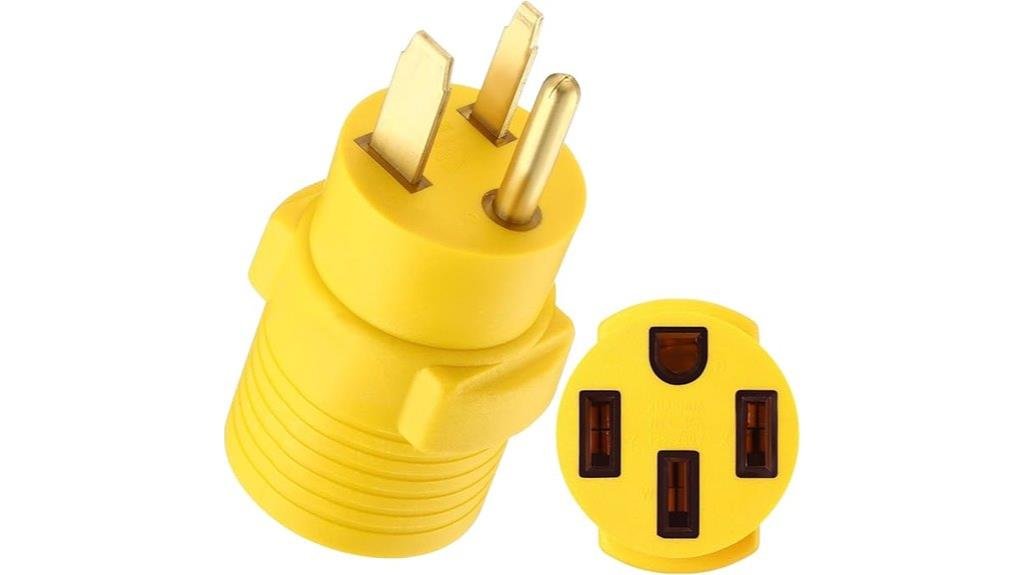
The Kanayu EV Charger Adapter is a compact electrical adapter for a specific Level 2 charging mismatch. Its three-prong NEMA 6-50P end plugs into a matching NEMA 6-50R wall receptacle, which is commonly associated with welders and some EV charging installations.
The adapter’s other side is a four-slot NEMA 14-50R receptacle. That receptacle accepts the NEMA 14-50P plug attached to a compatible portable EV charger or plug-in EVSE.
The adapter changes the physical connector arrangement, but it does not create a neutral conductor. Your charger must operate from two hot conductors and equipment ground without using neutral. You should verify that requirement in the charger manual rather than assuming compatibility from plug shape alone.
Connection Design and Electrical Function
The adapter’s main benefit is its fixed NEMA 6-50P to NEMA 14-50R layout. It may save you from replacing a usable NEMA 6-50R outlet when your portable EV charger has a NEMA 14-50P plug.
The connection works only in one direction. The male 6-50P end receives power from the wall outlet. The female 14-50R side supplies that power to the charger plug. It cannot be reversed, and it is not a universal adapter.
A NEMA 14-50 connection normally includes two hot conductors, neutral, and ground. A NEMA 6-50 connection includes two hot conductors and ground. In this adapter arrangement, the neutral position on the 14-50R side does not receive a neutral supply.
The adapter can provide the 240V conductors used by compatible EV charging equipment, but it cannot support equipment that expects 120V through a neutral conductor.
Who Should Buy It?
Best For
- You already have a professionally installed and inspected NEMA 6-50R outlet.
- Your plug-in EV charger has a NEMA 14-50P plug and its manual confirms that neutral is not required.
- You want a compact adapter for an occasional, known charging location rather than a long conversion cord.
Skip If
- You need to power an RV, camper, dryer, range, or other equipment that may use neutral.
- Your charger manufacturer prohibits third-party outlet adapters.
- You need a product with clearly documented wire gauge, enclosure rating, or traceable third-party certification.
Fit and Compatibility
Compatibility is the deciding factor with this product. Your wall receptacle must be a NEMA 6-50R, not a 6-30R, 10-50R, 14-30R, or another similar-looking outlet. The charger plug must be a NEMA 14-50P.
You must also check the electrical requirements inside the EVSE. Many Level 2 chargers use only the two hot conductors and ground, but the plug shape alone does not prove that yours works without neutral.
The outlet, branch-circuit wiring, breaker, adapter, EVSE, and vehicle all have limits. Your charging setting must not exceed the lowest safe limit among those components.
Tesla Mobile Connector Compatibility
Tesla offers a dedicated NEMA 6-50 adapter for its Gen 2 Mobile Connector. Using the manufacturer’s matching adapter is generally a cleaner option than attaching a NEMA 14-50 Mobile Connector adapter to a second third-party outlet adapter.
Tesla lists a maximum 32A output for both its NEMA 6-50 and NEMA 14-50 Mobile Connector adapters. Therefore, placing a “50A” adapter between the outlet and Mobile Connector does not raise the Mobile Connector’s charging limit.
Tesla Wall Connector Compatibility
This Kanayu adapter is not a connection solution for a hardwired Tesla Wall Connector. A Wall Connector should be installed according to Tesla’s instructions and applicable electrical codes by a qualified installer.
Build Quality and Documentation
The compact yellow body is easier to notice on a garage floor or inside a charging bag than a dark adapter. Its one-piece layout also takes up less storage space than a long adapter cord.
However, accessible product information does not clearly establish the internal conductor gauge, a weatherproof enclosure rating, or a traceable UL or ETL listing number. Phrases such as “UL-spec” or “made to UL standards” are not the same as an independently verified product listing.
For a device that may carry a continuous electrical load for several hours, documentation matters. Buyers who need a permanently used adapter may prefer a model that publishes its conductor gauge, maximum continuous current, temperature rating, and certification file number.
Setup and Ease of Use
The Kanayu adapter does not require an app or configuration process. Correct setup depends on confirming every component before you connect the charger.
- Identify the wall receptacle: Confirm that it is a NEMA 6-50R and that it is properly grounded.
- Check the breaker: Confirm the branch-circuit rating and do not assume the breaker size from the outlet face.
- Read the EVSE manual: Verify that the charger can operate without neutral and that an external adapter is permitted.
- Set the correct current: Configure the EVSE to stay within the circuit and equipment limits.
- Inspect the contacts: Do not use the adapter with bent blades, cracks, discoloration, looseness, or debris.
- Insert both connections fully: A partially seated plug can create resistance and excessive heat.
- Support the charger cable: Avoid allowing cable weight to pull sideways on the outlet or adapter.
Pro Tip: Label the adapter “EV only, no neutral” before storing it. This reduces the chance that another person will mistake the 14-50R side for a safe RV or appliance connection.
Charging Current and Electrical Safety
The listing’s 50A description refers to the connector class, not a guaranteed continuous charging rate. EV charging is a continuous load, so a typical 50A branch circuit supports no more than 40A continuous charging. Some portable chargers have lower built-in limits.
Never raise the EVSE setting simply because the adapter says 50A. The safe current may be 40A, 32A, 24A, or lower depending on the breaker, wiring, outlet, charger, and installation.
A worn 6-50R receptacle can be a weak point even when the breaker and wiring are correctly sized. Loose contacts create resistance, and resistance creates heat. Have the outlet inspected if the plug does not fit firmly or if you see dark marks, cracking, or signs of previous overheating.
Do not daisy-chain this adapter with another outlet adapter, splitter, travel adapter, or ordinary extension cord. Every additional connection adds another possible loose or overheated contact point.
Why It Is Not for RVs
A 50A RV connection uses both 120V legs and neutral to operate lights, receptacles, air conditioners, and appliances. A NEMA 6-50 supply has no neutral, so this adapter cannot provide the full electrical arrangement an RV expects.
Connecting an RV or neutral-dependent appliance through this adapter can damage equipment and create a serious electrical hazard. The four-slot appearance of the 14-50R side does not make it an RV power source.
How It Performs in Real Use
Editorial note: This assessment is based on connector standards, available listing information, and charger documentation. It does not claim laboratory load testing or long-term hands-on testing of this adapter.
For Home Garage Charging
In a garage with a correctly installed 6-50R outlet, the compact body avoids the extra length and floor clutter of an adapter cable. It works best when the outlet is positioned so the EVSE cord does not hang heavily from the adapter.
For daily charging, a dedicated charger plug or manufacturer-approved 6-50 adapter may provide better documentation and fewer connection points.
For Driveway or Semi-Outdoor Use
The available listing information does not provide a verified enclosure or ingress-protection rating. Do not assume that the yellow molded body makes every connected joint weatherproof.
Use it only in a location that meets the outlet, EVSE, and local installation requirements. Keep the connection away from standing water, direct runoff, snow buildup, and unsupported cable strain.
For Travel or Backup Use
The adapter is small enough to keep in an EV charging kit, but it is useful only when you already know that the destination has a compatible 6-50R outlet. You should not rely on plug appearance after arriving.
Confirm the receptacle type, breaker size, charger settings, and property owner’s permission before connecting at a workshop, rental property, or another person’s garage.
For Long-Term Use
Repeated use can wear receptacle contacts and expose the adapter to dirt, moisture, drops, and cable strain. Inspect it before every charging session and store it with the contacts covered or protected.
Stop using it if the connection becomes loose, repeatedly interrupts charging, develops a burned smell, shows discoloration, cracks, melts, or becomes unusually hot.
Setup Tips Before First Use
- Verify the full NEMA code: Similar-looking high-voltage outlets are not interchangeable.
- Confirm neutral requirements: The charger must work from two hots and ground without neutral.
- Use a dedicated circuit: Follow the charger manual and local electrical requirements.
- Check the receptacle grip: The plug should seat firmly without wobbling or falling outward.
- Set the EVSE current correctly: Never exceed the lowest-rated component in the charging path.
- Avoid unsupported weight: Use cable management so the charger cord does not twist the adapter.
- Do not stack adapters: Use one direct connection between the outlet and compatible EVSE.
- Keep it clean and dry: Protect the contacts during storage and transportation.
Pros and Cons
Pros
- Solves a specific NEMA 6-50R outlet to NEMA 14-50P EVSE mismatch.
- Compact shape takes less storage space than a long adapter cable.
- Yellow housing is easy to identify in a garage or charging kit.
- Simple plug-in design has no controls, software, or configuration menu.
- May let you use an existing inspected 6-50R circuit with a compatible EV charger.
Cons
- No neutral connection, which makes it unsafe for RVs and neutral-dependent equipment.
- Accessible listing data does not clearly document conductor gauge or a traceable certification number.
- Compact rigid adapters can place more mechanical strain on an outlet than a flexible short adapter cord.
Is It Worth the Price?
The Kanayu EV Charger Adapter is worth considering only when you need this exact connector arrangement. Its value comes from avoiding a longer adapter cord or immediate outlet replacement when the existing 6-50R circuit and your EVSE are already compatible.
The product offers less value when you can buy a dedicated 6-50 input adapter directly from the charger manufacturer. A manufacturer-approved connector usually provides clearer current limits and equipment-specific compatibility.
It is also not the best choice when you want a permanently installed charging solution with detailed certification records. In that situation, an electrician-installed receptacle, correct charger plug, or hardwired EVSE may provide a cleaner long-term setup.
How It Compares to Alternatives
A charger-manufacturer NEMA 6-50 adapter is the first alternative to check. Tesla, for example, offers a direct NEMA 6-50 adapter for its Gen 2 Mobile Connector, removing the need to connect a 14-50 adapter through another conversion device.
A flexible 6-50P to 14-50R adapter cord can reduce leverage on the wall receptacle, but you should compare conductor gauge, cord rating, certification, and maximum continuous current. A qualified electrician can also replace or reconfigure the outlet when the circuit and local code permit it.
Frequently Asked Questions
Which end plugs into the wall?
The three-prong NEMA 6-50P male end plugs into a NEMA 6-50R wall receptacle. The four-slot NEMA 14-50R female side accepts the NEMA 14-50P plug attached to a compatible EV charger.
Can I charge continuously at 50A with this adapter?
Do not assume so. A typical 50A EV branch circuit supports up to 40A of continuous charging, and many portable EV chargers are limited to 32A. Follow the lowest limit stated for your circuit, outlet, adapter, charger, and vehicle.
Does the adapter provide a neutral connection?
No. A NEMA 6-50 supply has two hot conductors and equipment ground, but no neutral. The neutral position on the adapter’s 14-50R side cannot supply neutral-dependent equipment.
Can I use it to power an RV or camper?
No. A 50A RV uses neutral for its 120V loads, while this adapter receives power from a 6-50 circuit with no neutral. Using it with an RV can damage equipment and create a fire or shock hazard.
Should I use it with a Tesla Mobile Connector?
Tesla sells a dedicated NEMA 6-50 adapter for the Gen 2 Mobile Connector. That direct manufacturer adapter is usually preferable to connecting Tesla’s 14-50 adapter through a separate third-party conversion adapter.
Can it connect a Tesla Wall Connector to an outlet?
It is not intended to convert a hardwired Tesla Wall Connector into a plug-in device. Install a Wall Connector according to Tesla’s instructions and applicable electrical requirements.
Can I leave the adapter outdoors?
A verified outdoor enclosure or ingress-protection rating was not confirmed. Follow the charger and outlet instructions, keep connections away from standing water and direct runoff, and use a properly protected installation.
What should I do if the adapter becomes hot?
Stop the charging session if you notice unusual heat, a burned smell, discoloration, melting, crackling, looseness, or repeated charging interruptions. Do not continue using the setup until the outlet, adapter, and EVSE have been inspected.
The Bottom Line
The Kanayu EV Charger Adapter can be useful when you have an inspected NEMA 6-50R outlet and a compatible EV charger with a NEMA 14-50P plug. Its compact size and straightforward connection are the main benefits, while the missing neutral, narrow compatibility, and limited technical documentation are the main drawbacks.
Buy it only after confirming the outlet, circuit, EVSE requirements, and charging-current setting. Skip it for RVs, neutral-dependent appliances, hardwired chargers, stacked-adapter setups, or any installation with a damaged or questionable receptacle.
Ready to Buy?
Check the latest product details and confirm your exact outlet and charger configuration before you decide.