By SellySell Editorial Team · Last updated: June 16, 2026 · Source: Amazon listing details in article draft
225 Amp Stick Welder Review: Compact Dual-Voltage MMA Welder for DIY Repairs
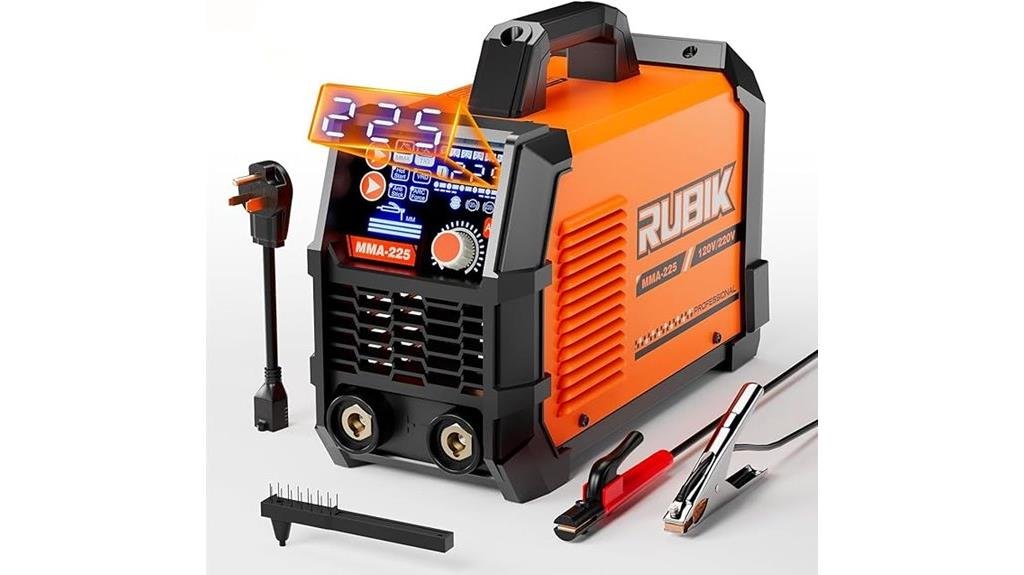
This compact 225 Amp stick welder is aimed at DIY welders who want a portable machine for mild steel and stainless steel repair work. The listing describes dual-voltage 110 V / 220 V input, IGBT inverter controls, Hot Start, Arc Force, Anti-Stick support, and a 60% duty cycle in a 10.8 lb body.
Quick Verdict
This 225 Amp stick welder looks like a practical budget choice for home shops, small farms, and light repair jobs. Its best points are the dual-voltage input, compact 10.8 lb body, large LCD display, and beginner-friendly arc controls. The main limits are also clear: the listing specifies 1.6–2.5 mm electrodes, short basic leads, a passive welding mask, and no aluminum support.
Buy it if you need a portable stick welder for light-to-medium steel repairs and you are comfortable checking the current Amazon listing and manual before use. Skip it if you need production-duty welding, aluminum welding, long premium leads, or a full professional accessory kit.
Key Specs
| Specification | Detail |
|---|---|
| Product Type | MMA / stick welder |
| Model / ASIN | Stick welder-225A / B0CJRX1X38 |
| Output Range | 20–225 A listed output range |
| Input Voltage | AC 110 V ±15% / 220 V, 50/60 Hz |
| Rated Input Current | 23.5 A listed rated input current |
| Power Draw | 5 kW listed power draw |
| Duty Cycle | 60% listed duty cycle |
| Electrode Size | 1.6–2.5 mm listed electrode range |
| Supported Materials | Mild steel and stainless steel listed; not intended for aluminum welding |
| Listed Thickness Range | Up to roughly 5 mm steel, based on the draft listing details |
| Dimensions and Weight | Body roughly 25 × 10.5 × 18 cm; Amazon dimensions listed as 14.9 × 10.6 × 6.3 in; weight listed as 10.8 lb |
| Build | ABS and iron housing with plastic end caps, metal carry handle, and integrated LCD front panel |
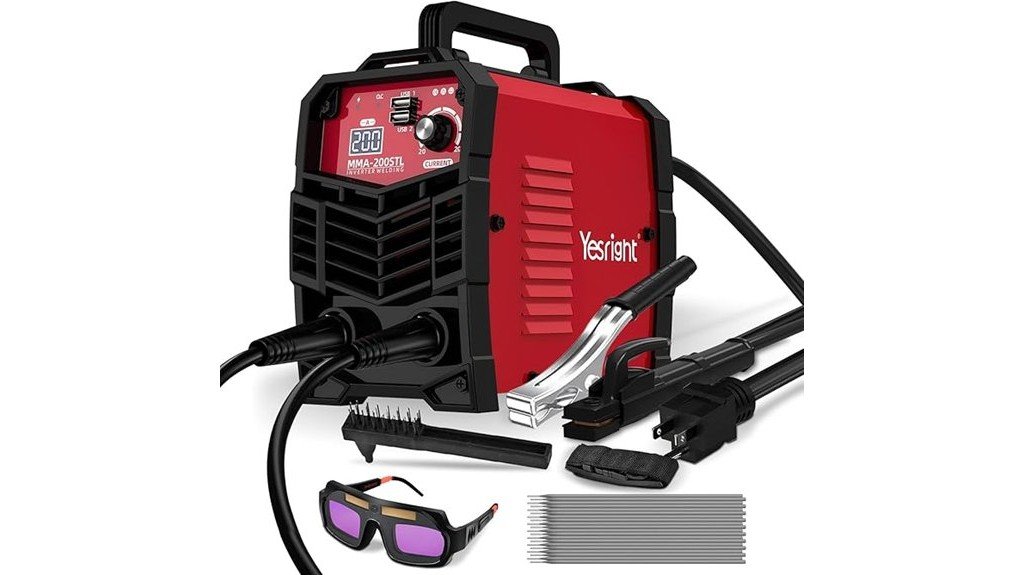
| Included Accessories | 225 A stick welder, 200 A ground clamp lead, 200 A electrode holder lead, passive welding mask, steel brush / chipping hammer, power conversion cable, welder gloves, and manual |
| Warranty / Returns | The draft notes Amazon’s standard 30-day return window and a separate manufacturer warranty link, but the exact warranty term is not clearly listed |
Prices, availability, and listing details can change. Check the current Amazon page and product manual before buying or wiring the welder.
What Is This 225 Amp Stick Welder?
This is a compact inverter-style MMA stick welder for steel repair and fabrication work. The listing describes smart IGBT controls, a large LCD display, Hot Start, Arc Force, Anti-Stick protection, and a 2-in-1 synergy-style control that suggests current based on the electrode diameter you select.
The dual-voltage design is one of its main selling points. It can be used with 110 V or 220 V input, with a conversion cable included in the box. For lighter work, 110 V gives useful flexibility. For higher output and steadier performance, 220 V is the better match when available.
Who It Is For
- DIY welders who want an affordable stick welder for home repair jobs.
- Homeowners and small farms working on gates, fences, brackets, tools, and light steel repairs.
- Users who want a portable backup welder that is easy to carry between jobs.
- Beginners who may benefit from Hot Start, Arc Force, Anti-Stick, and the LCD setting display.
Who Should Skip It
- Production shops that need long full-power welds and industrial-duty accessories.
- Anyone who needs aluminum welding support.
- Users who plan to run 1/8 in / 3.2 mm rods often, since the listed electrode range is 1.6–2.5 mm.
- Buyers who expect long professional leads and an auto-darkening helmet in the box.
Key Features
Dual-Voltage 110 V / 220 V Input
The welder is listed for AC 110 V ±15% or 220 V at 50/60 Hz. That gives it more hookup flexibility than a single-voltage unit. Use 110 V for lighter jobs with smaller rods, and use 220 V when you need stronger output and a more stable arc.
20–225 A Listed Output Range
The listing gives a 20–225 A output range. That sounds strong for a compact welder, but the practical output depends on voltage, circuit capacity, rod size, and duty cycle. The safer buying expectation is light-to-medium stick welding, not heavy production work.
60% Listed Duty Cycle
A 60% duty cycle means that, in a 10-minute window, the machine is rated to weld for up to about 6 minutes and cool for about 4 minutes under the stated test conditions. This is useful for repair work, but it still requires breaks during longer jobs.
Hot Start, Arc Force, and Anti-Stick
Hot Start helps the rod strike more easily at the beginning of a weld. Arc Force helps keep the arc from dying when the rod gets close to the work. Anti-Stick reduces current when the electrode sticks. These features can make the welder more forgiving for new users.
Large LCD and Synergy-Style Setting Help
The front LCD shows settings and status information. The listing also describes automatic current suggestions based on electrode diameter. This can help beginners get closer to a usable setting before fine-tuning by sound, bead shape, and material thickness.
Portable 10.8 lb Body
At a listed 10.8 lb, this welder is easy to move around a garage, farm, or work area. The handle and shoulder strap make it more practical for jobs where a large transformer welder would be too heavy.
Real-World Use
This welder is best matched to small fabrication and repair jobs in mild steel or stainless steel. Good examples include fence repairs, gate hinges, brackets, shelves, small frames, mower deck patches, and general shop fixes.
The listed electrode range is 1.6–2.5 mm, which roughly covers 1/16 in to 3/32 in rods. Staying inside that range is important. Larger 1/8 in / 3.2 mm rods are outside the listed spec and may push the welder, especially on 110 V power.
On 110 V, expect the machine to be most useful for lighter work. On 220 V, it should be better suited to thicker material within its listed range. Use a properly rated circuit, avoid undersized extension cords, and follow the manual and local electrical code.
Pros and Cons
Pros
- Dual-voltage 110 V / 220 V input gives more hookup flexibility
- Hot Start, Arc Force, and Anti-Stick can make welding easier for beginners
- 20–225 A listed output range covers many light-to-medium repair jobs
- Large LCD display makes settings easier to read
- 10.8 lb listed weight is easy to carry around a shop or property
Cons
- Listed electrode range is only 1.6–2.5 mm
- Included leads are short and basic
- Included helmet is passive, not auto-darkening
- Not intended for aluminum welding
- Exact warranty term is not clear from the draft listing details
Is It Worth the Price?
This welder makes the most sense as a budget-friendly, portable stick welder for occasional repair work. Its value comes from the dual-voltage input, LCD controls, 60% listed duty cycle, and included starter accessories.
The accessory kit should be treated as a starting point, not a professional setup. Many users will likely want longer leads and a better welding helmet over time. If you already plan to buy those upgrades, factor that into your total cost before deciding.
Alternatives to Consider
If you are comparing this welder with similar compact stick welders, look at these options for context:
- YESWELDER ARC-205DS: A popular compact dual-voltage stick welder often considered by DIY users.
- HONE Stick Welder 110 V / 220 V: Another budget inverter stick welder for light repair work.
- ARCCAPTAIN ARC200: A portable inverter stick welder from a better-known budget welding brand.
These are comparison names only. Check each product’s current specs, duty cycle, included accessories, and manual before choosing.
FAQs
What is the duty cycle of this 225 Amp stick welder?
The listing gives a 60% duty cycle. That means that, under the stated rating conditions, you should weld for up to about 6 minutes in a 10-minute period and allow about 4 minutes for cooling.
What power supply or breaker size do I need?
The draft listing details show AC 110 V ±15% / 220 V input, 23.5 A rated input current, and 5 kW draw. In practical terms, use a properly rated circuit, follow the manual, and check local electrical code. Do not bypass breakers or use undersized extension cords.
Can this welder run from a generator?
It may run from a suitably sized generator if the generator provides stable 110 V or 220 V output and enough continuous wattage for the welder’s listed 5 kW draw. A generator with headroom is safer than one running at its limit.
What electrode sizes does it support?
The listed electrode range is 1.6–2.5 mm, which roughly covers 1/16 in to 3/32 in rods. Larger 1/8 in / 3.2 mm rods are outside that listed range.
Can it weld aluminum?
No. The draft listing details describe it for mild steel and stainless steel, and state that it is not intended for aluminum welding.
What comes in the box?
The package is listed as including the welder, ground clamp lead, electrode holder lead, passive welding mask, steel brush / chipping hammer, power conversion cable, welder gloves, and manual.
Is the included helmet auto-darkening?
No. The included mask is described as a passive welding mask. For regular welding, a certified auto-darkening helmet with adjustable shade is a useful upgrade.
Does it have a clear warranty?
The draft notes Amazon’s standard 30-day return window and a manufacturer warranty link, but the exact warranty length and coverage are not clearly listed. Check the current Amazon page or contact the seller before buying if warranty coverage matters to you.
Final Verdict
This 225 Amp stick welder is a good fit for buyers who want a compact, dual-voltage MMA welder for light-to-medium steel repair work. The LCD display, Hot Start, Arc Force, Anti-Stick support, and 10.8 lb body make it more user-friendly than many basic budget welders.
Its limits are important. It is not for aluminum, not for heavy production welding, and not ideal if you need long premium leads from day one. For DIY repairs, small farm jobs, and portable steel work with 1.6–2.5 mm rods, it is worth considering.
- Buy if: you want a portable dual-voltage stick welder for repair work and you do not mind upgrading the basic accessories later.
- Skip if: you need aluminum welding, heavy-duty production performance, or a professional accessory kit in the box.