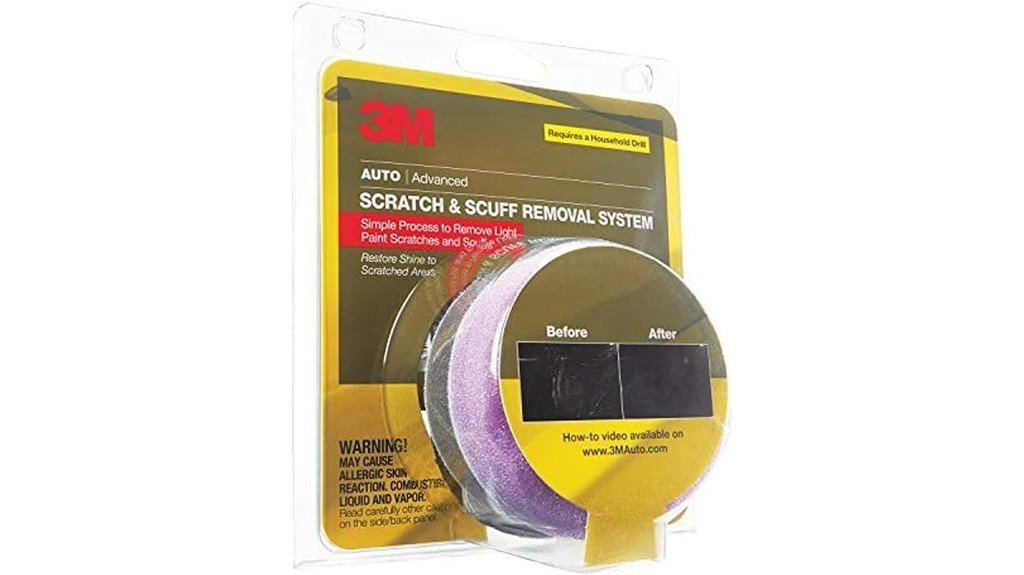
The 3M Scratch Removal System is presented as a compact, user-friendly kit for removing light clear-coat scratches and scuffs. It includes a 3000-grit abrasive pad, rubbing compound, finish polish, and applicators, and the three-step process typically takes 15–30 minutes per panel. How well does it work on hairline scratches versus deeper gouges? Practical notes: use consistent pressure, test on a hidden area, and expect diminished results on paint-penetrating damage—more details follow.
Key Takeaways
- Effective for removing light clear-coat hairline scratches and scuffs when scratches are ≤0.1 mm deep.
- Three-step process (sanding, compounding, polishing) yields salon-like results in 15–30 minutes per panel.
- Requires a household drill, steady hand, low speed (<1,500 rpm), and masking adjacent paint.
- Small 1 oz compound sizes limit multiple uses; deeper gouges (>0.2 mm) usually remain visible.
- Best value for DIY owners tackling swirls, wash scratches, and light vegetation scuffs on daily drivers.
What’s Included in the 3M Scratch Removal System
Contents: the 3M Scratch Removal System (model 39071) arrives as a compact, ready-to-use kit designed for light clear-coat repairs.
It lists kit components and product specifications clearly for quick assessment.
What’s included?
- Disc pad holder, 3 x 6 x 7 inches overall.
- 3000-grit abrasive square (fine grit), purple compounding pad, black polishing pad.
- 1 oz 3M rubbing compound, 1 oz 3M scratch remover, directions.
Why care? Practical considerations: item weight 0.28 lb, requires a household drill, microfiber cloth, water.
Who is it for? DIY owners seeking cost-effective, measured, professional-feeling touch-ups.
How the Three-Step Repair Process Works
The three-step repair process breaks the job into sanding, compounding, and polishing so a homeowner can methodically restore light clear-coat scratches without specialist tools.
It explains a practical sanding technique: use the supplied 3000-grit pad, keep wet, work in 1–2 inch passes to remove edge ridges.
Next, assess compounding effectiveness by applying 1 oz rubbing compound with the purple pad, 30–60 seconds per spot, moderate pressure.
Finally, polish with the black pad and 1 oz scratch remover, 60–90 seconds for gloss.
Consider drill speed control, masking adjacent paint, and finishing with wax for protection.
- Sanding: 3000-grit, wet
- Compounding: 1 oz, 30–60s
- Polishing: 60–90s
Performance: Real-World Results and Limitations
Evaluating real-world performance shows the 3M Scratch Removal System reliably eliminates light clear-coat scratches and scuffs on most daily-driven vehicles, but results depend on scratch depth, technique, and surface condition.
Evaluations show the 3M Scratch Removal System reliably removes light clear-coat scratches and scuffs, with results varying by depth and technique.
In real world applications, user experiences report consistent removal of hairline scratches (≤0.1 mm) and light scuffs; deeper gouges (>0.2 mm) often remain visible.
Questions:
How long does it take? Typical repair time is 15–30 minutes per panel.
What tools are required? Standard drill, 3000-grit wet sanding, compound, polish.
Practical considerations: practice on inconspicuous area, use measured pressure (1–2 psi), finish with wax for protection.
Pros, Cons, and Best Use Cases
Following the real-world performance summary, an assessment of pros, cons, and best use cases helps determine when the 3M Scratch Removal System (39071) is the right choice.
It offers clear pros and cons, with compact kit contents (3 x 6 x 7 inches, 0.28 lb), cost-effective DIY value, and guaranteed light-scratch removal on clear coats.
Limitations include ineffectiveness on deep gouges, required drill power and steady hand, and small 1 oz compound sizes.
- Best practices: use 3000-grit sanding, controlled drill speed, clean surface.
- Best use cases: light swirls, wash scratches, vegetation scuffs.
- When to seek pro help: deep damage, panel repainting.
Tips for Getting the Best Finish
One clear rule for achieving a salon‑quality finish is to control technique and materials at every step: use the supplied 3000‑grit abrasive for sanding, keep drill speed below 1,500 rpm for pads, apply compounds in thin, even passes, and finish with a light coat of automotive wax (about 1–2 mL per 6-inch area).
Readers should follow precise sanding techniques, keep surfaces wet, and sand only until scratches blend.
What polishing methods work best? Use the black pad for final polish, 500–800 rpm, 30–60 seconds per pass.
Practical tips: clean between steps, measure product amounts, and test on inconspicuous areas.
Frequently Asked Questions
Can This Kit Remove Deep Scratches That Reach the Paint Layer?
No; the kit cannot fully repair deep scratches that reach the paint layer. It offers limited deep scratch effectiveness for clear coat defects only, and paint layer damage typically requires touch-up paint or professional bodywork.
Is the Product Safe for Matte or Satin Clear Coats?
“Measure twice, cut once.” It generally cautions against using abrasive systems on matte finishes and satin finishes; 3M’s kit may alter sheen, so testing on an inconspicuous area first is recommended before full application.
Can I Use a Rotary Polisher Instead of a Household Drill?
Yes; a rotary polisher can be used, though rotary polisher advantages include greater speed and heat, while household drill limitations involve lower torque control and pad compatibility—careful technique reduces risk of clear coat damage.
How Long Does the Repaired Finish Last Without Waxing?
Typically a few weeks to a few months; durability concerns arise from exposure and clearcoat depth. Maintenance tips: avoid harsh cleaners, park shaded, and apply automotive wax promptly to extend finish life and resist environmental wear.
Are Replacement Pads or Extra Compounds Available for Purchase?
Yes, replacement options exist; 3M and third-party suppliers sell individual pads and compounds. The reviewer notes pad compatibility varies by model and adapter; buyers should confirm fit and product specs before purchasing replacements.
Conclusion
The 3M Scratch Removal System proves practical: a compact kit with a 3000‑grit abrasive pad, rubbing compound, and finishing polish delivers panel repairs in 15–30 minutes. Can it erase hairline scratches? Yes—consistently. Deep gouges? No—these may remain visible. For DIY owners seeking cost‑effective, user‑friendly maintenance, results are predictable, repeatable, and measurable. Consider paint thickness, work temperature, and light angle when evaluating outcomes; practice on an inconspicuous area first.