
Disclosure: As an Amazon Associate, we earn from qualifying purchases. If you click a link on this page and make a purchase, we may receive a small commission at no extra cost to you.
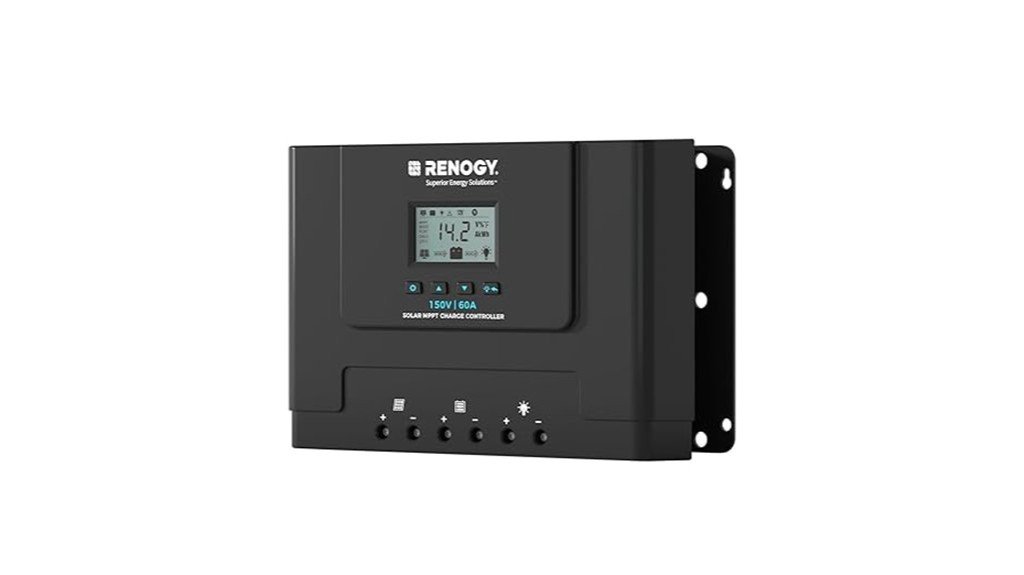
Choosing the wrong solar charge controller can limit your solar output or damage your equipment if the voltage limits are ignored. The Renogy Rover Lite 60A MPPT Solar Charge Controller (RCC60RVRE) offers 60A charging, a 150V maximum solar input, and support for 12V, 24V, 36V, and 48V battery systems. It combines flexible battery settings with an LCD display and optional Bluetooth monitoring, but you still need to size your panels and wiring carefully. This review explains its specifications, installation needs, real-world applications, and limitations so you can decide if it fits your off-grid setup.
Quick Verdict
Rating: Recommended with caveats
Best For: RV owners, off-grid cabin users, and solar system builders who need 60A charging with flexible battery voltage support.
Bottom Line: The Rover Lite 60A offers useful charging capacity, adjustable battery settings, and a clear LCD display. Its main tradeoffs are the need for careful PV sizing, sheltered installation, and a separately purchased Bluetooth module.
Renogy Rover Lite 60A Specifications at a Glance
| Specification | Details |
|---|---|
| Brand | Renogy |
| Model | RCC60RVRE, Rover Lite 60A |
| Product Type | MPPT solar charge controller |
| Rated Charging Current | 60A |
| Battery System Voltage | 12V, 24V, 36V, 48V |
| Maximum PV Voltage | Solar array open-circuit voltage must remain below 150V |
| Maximum Solar Input Power | 900W at 12V; 1,800W at 24V; 3,200W at 48V. Confirm the 36V limit with Renogy because published specifications differ. |
| MPPT Tracking Efficiency | Over 99% claimed by Renogy |
| Conversion Efficiency | Over 97% claimed by Renogy |
| Battery Compatibility | Flooded lead-acid, sealed/AGM, gel, and compatible lithium batteries |
| Charging Profiles | Lead-acid and lithium profiles, plus user-adjustable settings |
| Display | Built-in LCD with function buttons |
| Communication | RS485; compatible with optional Renogy BT-2 Bluetooth module |
| Rated DC Load Output | 20A |
| Cooling | Passive heat-sink cooling |
| Operating Temperature | -31°F to 113°F (-35°C to 45°C), according to the model manual |
| Enclosure Protection | IP32; install in a dry, protected location |
| Dimensions | Approximately 12 x 8.07 x 3.9 inches |
| Weight | Approximately 7.72 lb (3.5 kg) |
| Included Components | One controller, one battery temperature sensor, and four mounting screws |
| Warranty | Two-year materials and workmanship warranty |
What Is the Renogy Rover Lite 60A MPPT Controller?
The Renogy Rover Lite 60A is a solar charge controller designed for small and medium off-grid power systems. It regulates energy from solar panels before sending it to a battery bank. Its MPPT technology adjusts the electrical operating point of the solar array to help capture available power as sunlight and panel conditions change.
Unlike a small controller built for one or two panels, this model supports a rated 60A charging output and multiple nominal battery voltages. That makes it useful when you have a larger solar array or plan to move from a 12V system to a properly designed higher-voltage battery bank.
The controller has an LCD, physical controls, an RS485 communication port, and an optional BT-2 module for smartphone monitoring. It is a charge controller, not a solar inverter, so you still need separate equipment if you want to power standard AC appliances from your batteries.
Key Takeaways
- 60A charging capacity: Suitable for larger battery charging needs when your battery voltage and solar array are correctly matched.
- 150V maximum solar input: Offers flexible panel wiring, but the total cold-weather open-circuit voltage must stay below the limit.
- Multiple battery types: Supports flooded, AGM, gel, and compatible lithium batteries with suitable charging settings.
- Adjustable controls: An LCD and optional BT-2 module help you view operating data and manage supported settings.
- Installation matters: Correct circuit protection, wire sizing, airflow, battery selection, and panel configuration are essential.
- Two-year warranty: Covers materials and workmanship under the manufacturer’s applicable warranty terms.
Key Features and Technical Specifications
60A Charging Capacity and MPPT Performance
The controller’s main strength is its 60A rated battery charging current. This gives you more charging capacity than a 20A, 30A, or 40A unit, provided your solar array and battery bank can make use of it.
Renogy lists MPPT tracking efficiency above 99% and conversion efficiency above 97%. These are different measures: tracking efficiency describes how well the controller finds the array’s maximum power point, while conversion efficiency describes the power retained during electrical conversion.
These figures are manufacturer specifications, not independent test results from this review. Your actual output depends on sunlight, panel temperature, wiring losses, battery charge level, and operating conditions.
150V Solar Input and Panel Configuration
The Rover Lite 60A accepts a maximum PV open-circuit voltage below 150V. A higher input voltage can support longer panel strings, but the limit applies to the total array voltage, including the increase in panel open-circuit voltage during cold weather.
Renogy’s Amazon listing describes using up to six of its 200W monocrystalline panels in series. This is a configuration example, not permission to connect any six 200W panels together. Different modules have different open-circuit voltages, so you must check the exact panel specifications and expected minimum temperature.
The maximum permitted solar power also depends on your battery system. For example, the model manual lists 900W for 12V, 1,800W for 24V, and 3,200W for 48V systems. You should not assume that a 3,200W array is suitable for every supported battery voltage.
Before You Buy: Check both your solar array’s cold-weather open-circuit voltage and its total power against the limits for your battery system. Renogy’s model manual lists 2,600W for 36V systems, while its product webpage lists 2,000W. Confirm the correct limit for your hardware revision directly with Renogy before designing a 36V installation.
Battery Compatibility and Charging Profiles
The controller supports flooded lead-acid, AGM, gel, and lithium charging modes. It also offers adjustable parameters for users who need settings that match a specific battery manufacturer’s requirements.
For conventional lead-acid battery systems, the controller can recognize supported nominal voltages automatically. Lithium systems require manual voltage selection, according to the model-specific manual.
You should confirm the charging voltage, battery chemistry, temperature settings, and battery management system requirements before using it with a lithium battery. The presence of a lithium mode does not guarantee compatibility with every lithium battery.
LCD Display and Bluetooth Monitoring
The built-in LCD lets you view operating information such as battery voltage, solar input, charging current, controller temperature, and error codes. Physical buttons allow access to supported operating modes and settings.
For phone-based monitoring, the RCC60RVRE supports the Renogy BT-2 Bluetooth module, which is sold separately. The module connects through the controller’s communication port and supports monitoring and parameter adjustment through Renogy’s compatible software.
This is useful if the controller is mounted in a cabinet or utility space where the LCD is not convenient to check. However, you should include the cost of the module when comparing controllers that already have built-in Bluetooth.
Who Should Buy It?
Best For
- RV owners upgrading to larger solar arrays and battery banks.
- Off-grid cabin owners needing configurable charging for supported lead-acid or lithium batteries.
- DIY solar system builders who want 60A charging and support for 12V through 48V systems.
Skip If
- Your system is small enough that a lower-current controller meets its charging needs.
- Your panel array exceeds the permitted PV voltage or power limits.
- You need built-in Bluetooth or a controller designed for direct outdoor exposure without additional protection.
Installation Experience and Compatibility
Mounting Location and Ventilation
The Rover Lite 60A is approximately 12 inches tall, 8.07 inches wide, and 3.9 inches deep. Allow additional room for its connections, cable bends, and heat dissipation.
Renogy’s manual calls for a cool, dry, weather-protected mounting location, with ventilation space around the unit. Its mounting diagram shows clearance guidance exceeding 200mm and 100mm on the indicated sides. Follow that diagram for the correct orientation rather than enclosing the controller tightly in an unventilated compartment.
Placing the controller near the battery bank can reduce voltage drop, but there is no single safe cable length that applies to every setup. Cable sizing must account for current, run length, insulation rating, temperature, terminal limits, and applicable electrical rules.
Wiring Sequence and Circuit Protection
The manufacturer’s manual specifies connecting the battery to the controller before connecting the solar array. It then covers the solar connections, optional DC load connections, and external temperature sensor.
For safety, isolate all sources of power before working on the installation. Solar panels can produce hazardous DC voltage whenever exposed to light, even when the battery is disconnected. A qualified solar installer or electrician should handle high-voltage arrays and unfamiliar wiring work.
Use suitable overcurrent protection, disconnects, and appropriately rated conductors on the battery and PV circuits. The manual shows an example battery-side fuse arrangement, but the final protective device and conductor sizes must be selected for the actual installation.
Pro Tip: Before mounting the controller, write down your panel model, series and parallel configuration, cold-weather array Voc, battery voltage, and battery charging requirements. Checking these together can reveal a compatibility problem before you cut or install any cables.
Setting Up Your Battery Profile
Once the controller is safely installed, confirm that the correct battery type and system voltage are selected. This is especially important for lithium batteries, which do not use the same charging behavior as conventional lead-acid batteries.
Use the battery manufacturer’s recommended charging voltages rather than choosing settings based only on battery capacity. Confirm the temperature sensor arrangement and review the displayed charging information after the system starts operating.
Installation Safety and Materials
The controller uses a metal housing with passive heat-sink cooling and carries an IP32 enclosure rating. This does not make it waterproof. It should be protected from rain, direct water exposure, excessive dust, and blocked airflow.
Renogy documents protections and fault reporting for conditions such as reverse polarity, battery overvoltage, solar overvoltage, overheating, and DC load problems. These protections help reduce some risks, but they do not replace properly designed wiring and external safety devices.
The controller also has a rated 20A DC load output. That output is intended for compatible DC loads within its rating, not as a direct connection point for a large inverter. High-power inverters require an appropriately designed battery-side connection and protection system.
For outdoor solar arrays in lightning-prone locations, consider properly selected surge protective devices and grounding or bonding arrangements designed by a qualified professional. The controller’s internal protections should not be treated as full lightning protection.
How It Performs in Real Use
The following scenarios describe how the verified specifications apply to common installations. They are practical use assessments, not results from independent hands-on testing.
RV Solar Systems
For an RV with a larger battery bank, the 60A rating offers charging headroom beyond smaller controllers. Its LCD can help you check charging activity while parked, and the optional BT-2 module adds convenient phone monitoring.
The main concern is installation space. The controller needs a protected, ventilated mounting location and wiring sized for the charging current. A compact RV with a modest solar array may not need the full 60A capacity.
Off-Grid Cabins
In a cabin, the controller can regulate solar charging for a suitable battery bank that powers lighting, communications equipment, or other loads through the rest of the electrical system. Its support for several battery voltages gives you flexibility when designing a larger installation.
Seasonal conditions matter. Cold weather can increase solar array open-circuit voltage, while high heat can affect electrical equipment and charging performance. Plan for both when choosing your panel configuration and mounting location.
Workshop and 48V Battery Systems
A properly designed 48V off-grid system can take advantage of the controller’s higher permitted solar input power. Renogy lists a maximum of 3,200W for 48V battery systems, subject to the controller’s other electrical limits.
You still need a compatible battery bank, correct charging settings, appropriate circuit protection, and a separate inverter for AC-powered workshop equipment. The controller does not replace those components.
Partial Shading and Changing Weather
When clouds pass or solar panel temperatures change, the MPPT controller adjusts its operating point to track available power. This can improve energy collection compared with operating an array at a fixed voltage.
However, MPPT cannot restore power lost to heavy shade or poorly matched modules. If panels are connected in the same string, a shaded panel can reduce the string’s available output. Proper panel layout remains important.
Performance, Reliability, and Warranty
Efficiency and Heat Management
Renogy specifies over 97% conversion efficiency and over 99% MPPT tracking efficiency for the Rover Lite 60A. These ratings support its suitability for a properly sized solar installation, but they should not be read as guaranteed performance under every condition.
Its passive cooling design avoids reliance on a powered cooling fan. Even so, the controller produces heat, and blocked ventilation can cause operating problems. The model manual specifies an operating range of -31°F to 113°F.
Long-Term Maintenance
Routine visual checks can help you spot potential problems before they cause charging interruptions. Renogy recommends inspecting the installation for cable damage, loose or discolored connections, corrosion, and blocked ventilation.
Keep the housing clean and dry, and follow the manufacturer’s instructions before performing maintenance. Persistent error codes, overheating, or repeated charging faults should be investigated rather than ignored.
Two-Year Warranty
The Rover Lite 60A is listed with a two-year materials and workmanship warranty. This provides coverage for qualifying defects, subject to Renogy’s warranty terms, exclusions, and claim requirements.
The warranty is useful, but it is not evidence of a specific product lifespan. Keep your purchase documentation and product identification details, and confirm current warranty terms before ordering.
Pros and Cons
Pros
- 60A rated charging current supports substantial off-grid battery charging needs.
- Supports 12V, 24V, 36V, and 48V battery systems.
- 150V maximum PV input allows flexible solar array designs within the limits.
- LCD display and adjustable battery profiles provide useful operating control.
- Optional BT-2 monitoring and a two-year materials and workmanship warranty.
Cons
- Bluetooth monitoring requires an additional module.
- PV voltage and input power limits require careful system planning, especially with long panel strings.
- IP32 protection and passive cooling call for a sheltered, ventilated installation.
Is It Worth the Price?
The Renogy Rover Lite 60A is worth considering when your system needs the capacity of a 60A MPPT controller rather than a smaller entry-level model. Its supported battery voltages, configurable charging profiles, and monitoring options make it a practical candidate for an established off-grid setup or a planned expansion.
You are likely to get more value from it when you can use a substantial share of its charging capacity. For a small panel array and low charging demand, a lower-current controller may be sufficient and more economical.
Remember to compare the total installed cost, not just the controller price. Suitable wiring, circuit protection, mounting hardware, and the optional BT-2 module can affect your budget.
How It Compares to Alternatives
The Renogy Rover 60A is another option within Renogy’s controller lineup. Because Rover and Rover Lite products are distinct models, compare their electrical limits, terminal specifications, and communication features rather than assuming they are interchangeable.
The Victron SmartSolar MPPT 150/60 is another 60A, 150V-class controller worth comparing if integrated Bluetooth monitoring is a priority. The Rover Lite remains worth considering when its LCD controls, supported battery modes, and specific system limits meet your needs. Compare current prices and installation requirements before making a final choice.
Frequently Asked Questions
Can It Charge a 48V Battery Bank From a 24V Solar Array via Step-Up?
Not directly from an array whose operating voltage is too low to charge the 48V bank. This controller does not act as a voltage-boost charger. An external step-up converter would require a separately engineered and compatible system, so you should use an appropriately configured solar array instead of assuming a converter will make the setup safe.
Does It Support Programmable Battery Charging Profiles for Custom Chemistries?
Yes. The controller provides preset battery modes and user-adjustable charging parameters. Always check the battery manufacturer’s voltage and charging requirements before creating a custom profile.
How Many 200W Solar Panels Can I Connect?
That depends on the panels’ electrical specifications, their wiring arrangement, the battery voltage, and the expected lowest temperature. Although Renogy describes a six-panel series example, you must verify the combined cold-weather Voc and the permitted solar input power before connecting your particular panels.
What Protections Exist Against Lightning-Induced Surges on the PV Input?
The controller includes electrical fault protections, but these are not a substitute for a complete lightning and surge protection design. For exposed solar installations, have a qualified professional assess grounding, bonding, and appropriate external surge protective devices.
Can Firmware Be Updated Through the Bluetooth Module or USB Port?
Renogy documents the optional BT-2 module for monitoring and supported parameter adjustments. The model documentation reviewed does not establish a user-accessible firmware update process through Bluetooth or USB. Confirm firmware service options with Renogy support rather than relying on an undocumented update method.
How Does the Controller Behave During Partial Shading or Mismatched Panels?
Its MPPT system adjusts the array’s operating point as conditions change, but it cannot eliminate losses caused by shade or mismatched panel characteristics. The controller does not independently optimize every panel in a shared string. Proper array design is still necessary.
Does the Rover Lite 60A Protect Lithium Batteries in Cold Weather?
The controller offers low-temperature charging protection for supported lithium settings, and the package includes an external temperature sensor. You must install and configure the temperature monitoring correctly. Follow the battery manufacturer’s limits and use a compatible battery management system for additional protection.
What Is Included, and How Long Is the Warranty?
The listed package includes one solar charge controller, one battery temperature sensor, and four mounting screws. The BT-2 Bluetooth module is not included in the controller-only package. Renogy lists a two-year materials and workmanship warranty, subject to its current terms.
The Bottom Line
The Renogy Rover Lite 60A MPPT Solar Charge Controller is recommended with caveats for RV owners, cabin users, and off-grid system builders who need configurable 60A solar charging. Its flexible battery support and useful controls are strengths, but buyers who need built-in Bluetooth, simpler installation, or a controller for an incompatible panel array should consider other options. Confirm your electrical limits and battery settings before buying.
Ready to Buy?
Check the latest price and product details, and confirm compatibility with your solar system before you decide.


