Disclosure: As an Amazon Associate, we earn from qualifying purchases. If you click a link on this page and make a purchase, we may receive a small commission at no extra cost to you.
A handheld radio can look impressive on a spec sheet and still be frustrating once you try to program it in the field. The Baofeng UV-32 aims to solve that problem with a large color screen, app-based setup, GPS positioning, and selectable power up to 10W. It is a feature-rich analog multi-band radio, not a DMR model, so buyers should understand what its GPS and Bluetooth functions actually do. This review explains its verified specifications, practical strengths, setup limits, and the users who will get the most value from it.
Quick Verdict
Rating: 7.5/10, recommended with caveats
Best For: Licensed radio users who want analog multi-band operation, GPS coordinates, app programming, and a large screen.
Bottom Line: The UV-32 combines up to 10W output, 1,000 channels, GPS, Bluetooth app programming, and USB-C charging in one handheld. Its main tradeoffs are its 12.4-ounce weight, complex feature set, and lack of DMR or digital APRS support.
| Specification | Detail |
|---|---|
| Brand | Baofeng |
| Model | UV-32 |
| Product type | Analog multi-band handheld amateur radio |
| Transmit coverage | 136-174 MHz, 220-260 MHz, and 400-520 MHz on the listed US version; regional limits may differ |
| Additional receive coverage | AM airband 108-136 MHz, FM radio 65-108 MHz, NOAA reception, and additional listed VHF/UHF ranges |
| Output power | Up to 10W with high, medium, and low selections |
| Channel capacity | 1,000 channels across 10 zones |
| Display | 2.0-inch color screen |
| Positioning | Built-in GPS with coordinate display, sharing, and request functions |
| Programming | Bluetooth mobile app, keypad, CPS, and manufacturer-listed CHIRP support |
| Battery | 2500mAh rechargeable battery |
| Charging | USB-C charging and desktop charging base |
| Size | 7.2 x 2.6 x 1.6 inches (182 x 67 x 41 mm) |
| Weight | 12.4 ounces (350 g) |
| Accessory connection | 2-pin Kenwood-style jack |
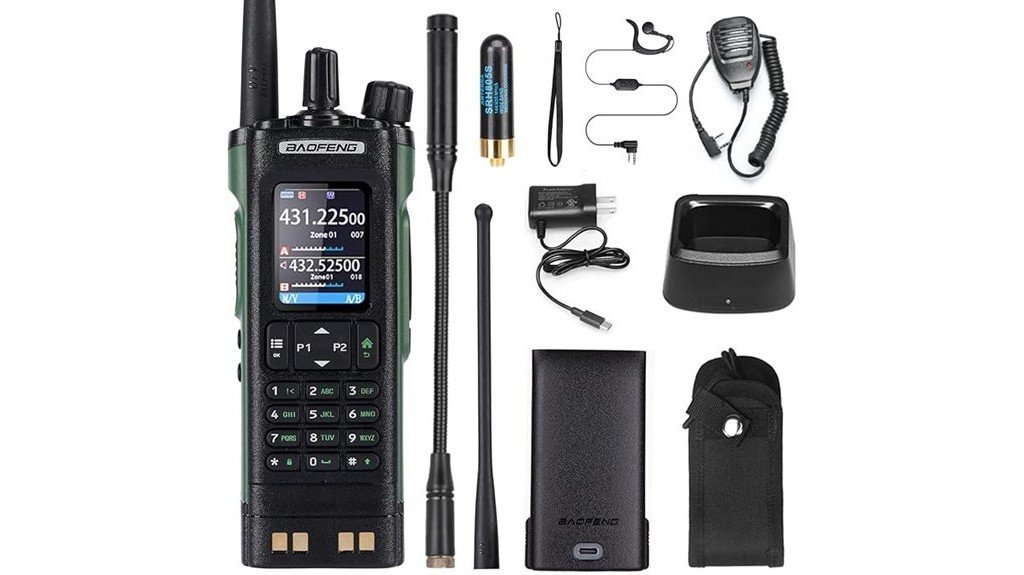
| Standard package | Radio, 2500mAh battery, antenna, headset, belt clip, USB-C charger, desktop base, case holder, and manual |
| FCC ID | 2AJGM-NA32UV |
Key Takeaways
- The UV-32 is an analog tri-band transmit radio with broad receive coverage, not the digital DMR DM-32UV.
- Its main advantages are selectable power up to 10W, a 2.0-inch color screen, 1,000 channels, GPS, and several programming methods.
- The Bluetooth function supports mobile app programming. The verified product information does not promise Bluetooth headset audio.
- The 2500mAh battery supports USB-C and desktop charging, but actual runtime changes with transmit power, GPS use, scanning, volume, and screen settings.
- You must confirm regional frequency limits, licensing rules, and the exact package version before transmitting.
What Is the Baofeng UV-32?
The Baofeng UV-32 is a programmable handheld radio built around analog voice operation. The listed US version can transmit across VHF, the 1.25-meter band, and UHF, while also receiving FM broadcast, AM aviation, NOAA weather, and other listed ranges. That combination suits users who want one handheld for repeater access, local simplex communication, monitoring, and outdoor coordination.
Its standout features are the 2.0-inch color display, 1,000-channel memory, GPS coordinate tools, one-key frequency copy, Bluetooth app programming, and selectable high, medium, or low power. These features make it more flexible than a basic entry-level handheld, but they also create a longer setup process.
The model name matters. The UV-32 is not the Baofeng DM-32UV. The DM-32UV adds DMR digital voice, digital APRS, contacts, and text messaging, while the UV-32 focuses on analog communication and GPS positioning.
Who Should Buy It?
Best For
- Licensed amateur radio users who want VHF, 1.25-meter, and UHF transmit coverage in one handheld
- Outdoor users who value GPS coordinates, NOAA reception, USB-C charging, and a readable color screen
- Operators who want app, keypad, CPS, and CHIRP-based programming options
Skip If
- You need DMR digital voice, digital APRS, large digital contact lists, or text messaging
- You want a small, simple radio with minimal menus and no programming learning curve
- You need a published waterproof or dustproof IP rating
Before You Buy: Check the exact listing title and package contents. The UV-32 and DM-32UV share a similar body and battery, but their radio systems and software features are different.
Design, Display, and Controls
The UV-32 uses a full keypad, channel knob, customizable side keys, and a 2.0-inch color display. The larger screen can show more channel and status information than the smaller monochrome displays found on many basic handhelds. This helps when you switch among several zones, scan lists, or frequency groups.
At 12.4 ounces with a listed size of 7.2 x 2.6 x 1.6 inches, it is not a pocket-light radio. The added weight may feel reassuring on a belt or pack, but it can become noticeable during long walks. The included case holder and belt clip provide practical carry options.
The 2-pin Kenwood-style accessory connection also gives you a familiar route for compatible speaker microphones, earpieces, and programming cables. Compatibility can still vary, so confirm the plug wiring and accessory description before ordering third-party gear.
Band Coverage and Radio Performance
Baofeng lists up to 10W output with high, medium, and low power settings. A lower setting can reduce battery drain when you are close to a repeater or another radio, while the high setting gives you more transmitter power when conditions require it. Range still depends on terrain, antenna position, buildings, frequency, repeater access, and line of sight, so a power number alone cannot guarantee distance.
The listed US transmit ranges are 136-174 MHz, 220-260 MHz, and 400-520 MHz. The radio also receives AM airband, FM broadcast, NOAA weather, and additional VHF/UHF frequencies. Some of those services are receive-only, and many frequencies require specific authorization to transmit.
One-key frequency copy can capture a nearby analog signal’s frequency and CTCSS or DCS settings, which may speed up local setup. You should still verify the channel plan before saving or transmitting because copied settings do not establish legal permission or confirm that a frequency is appropriate for your use.
GPS and Positioning
The built-in GPS can display latitude, longitude, and altitude. Baofeng also describes coordinate sharing and location-request functions between compatible users. This can help a group exchange positions during hiking, event support, or field operations without relying only on spoken directions.
The UV-32’s GPS should not be confused with digital APRS. The official UV-32 feature list does not identify digital APRS network beaconing, while the separate DM-32UV specifically offers GPS with digital APRS. Buyers who need APRS should choose a radio that clearly lists the required APRS mode and network behavior.
GPS performance can change with sky view, buildings, terrain, and initial satellite acquisition. Treat it as a communication aid rather than a replacement for a dedicated navigation device, paper map, or emergency locator.
Programming and Channel Setup
You can program the UV-32 from its keypad, through Baofeng’s Bluetooth mobile app, with customer programming software, or through the manufacturer-listed CHIRP method. The mobile option is useful when you need to adjust channels away from a computer. Keypad entry remains valuable for quick changes, but entering many channels manually takes time.
Baofeng’s product guidance says CHIRP users should select the UV-21ProGPS profile. Software support can change as radio firmware and applications are updated, so back up your original configuration before writing a new channel file. Test a few channels before loading a large codeplug.
The 1,000-channel capacity and 10 zones give you room for local repeaters, simplex channels, travel groups, and receive-only monitoring lists. Good organization matters because a large memory becomes difficult to use when channel names, zones, and scan lists are inconsistent.
Pro Tip: Build a small test zone first with one local repeater, one simplex channel, and one receive-only channel. Confirm offsets, tones, power levels, and channel names before importing the rest of your list.
Battery Life and Charging
The UV-32 includes a 2500mAh battery and supports both USB-C charging and a desktop charging base. USB-C is convenient for travel because you can use a suitable portable power source, while the desktop base keeps the radio upright and easy to grab at home or work.
Baofeng describes the battery as capable of up to a full day of use, but that is not a fixed runtime guarantee. Frequent 10W transmissions, continuous scanning, GPS activity, a bright screen, and high audio volume will reduce operating time. Monitoring with short transmissions should use less power than repeated high-power calling.
A spare battery may be more useful than relying on a larger power bank during long field days. Confirm that replacement batteries are specifically listed for the UV-32 or DM-32UV body and check the charging instructions before use.
How It Performs in Real Use
For Local Repeater and Simplex Use
The large channel memory and selectable power levels suit operators who move between repeaters and local simplex channels. Once the zones and names are organized, the screen makes it easier to confirm where you are transmitting. The main challenge is the initial programming work, not basic push-to-talk operation.
For Hiking and Outdoor Coordination
GPS coordinates, NOAA reception, a belt-mounted case, and USB-C charging add practical value outdoors. The radio’s weight is the tradeoff. You may prefer it on a belt, shoulder strap, or pack webbing instead of carrying it in a small pocket.
For Travel and Monitoring
The broad receive coverage can consolidate several listening tasks in one device, including FM radio, NOAA weather, and AM aviation reception. Store receive-only services in clearly named zones so you do not confuse them with authorized transmit channels.
For Emergency Readiness
The UV-32 can support a communication plan when you have trained operators, programmed channels, charged batteries, and known contacts. A radio does not create an emergency network by itself. Practice with your group, confirm repeater coverage, and keep a written channel plan with the equipment.
Setup Tips Before First Use
- Confirm the exact model. Check that the label says UV-32, not DM-32UV, before installing software or loading a channel file.
- Charge the battery fully. Use the supplied charging method and inspect the battery contacts before first use.
- Save a factory backup. Read the radio with compatible software and store the original file before changing settings.
- Program only authorized channels. Add correct offsets, tones, bandwidth, power, and receive-only restrictions for your region.
- Test at low power first. Use the lowest effective power when communicating nearby or through a strong local repeater.
- Label zones clearly. Separate repeaters, simplex, travel, weather, aviation, and other receive-only groups.
- Practice GPS functions outdoors. Learn how to view and share coordinates before you depend on the feature during a trip.
Compatibility and Safety
The UV-32 is sold as an amateur radio, and transmitting privileges depend on the frequency, radio service, equipment authorization, and laws in your country. Buying or listening to a radio does not automatically authorize transmission. Follow your local regulator’s rules and operate only within your license privileges.
AM aviation, NOAA weather, and FM broadcast functions should be treated as receive features. Do not transmit on public safety, aviation, weather, business, or other restricted channels unless you have explicit authorization and suitable equipment for that service.
The official product information gives an operating temperature range of -10°C to 60°C, but it does not publish an IP water or dust rating. Keep the radio dry, protect the accessory port, and avoid presenting it as waterproof unless the exact listing or manual provides a verified rating.
Pros and Cons
Pros
- Selectable output up to 10W across three listed transmit bands on the US version
- Large 2.0-inch color display with 1,000 channels and 10 zones
- GPS coordinate display, sharing, and request functions
- Bluetooth app, keypad, CPS, and manufacturer-listed CHIRP programming options
- 2500mAh battery with both USB-C and desktop charging
Cons
- Heavier and more complex than a basic analog handheld
- No verified DMR, digital APRS, or text-messaging functions on the UV-32
- No published IP water or dust resistance rating on the official product page
Is It Worth the Price?
The UV-32 offers strong value for buyers who will use its full feature set. The combination of tri-band transmit coverage, broad reception, GPS, a color display, 1,000 channels, app programming, and two charging methods gives it more flexibility than a basic analog handheld.
It is less compelling for users who need only a few local channels or want the smallest possible radio. You are also paying for GPS and programming convenience, not DMR digital operation. The UV-32 makes the most sense when those analog and outdoor features match your actual channel plan.
How It Compares to Alternatives
The Baofeng UV-5R is the simpler option for basic VHF/UHF analog use, with fewer advanced controls and a smaller feature set. It may suit a beginner who wants a familiar low-cost platform and does not need GPS, 1.25-meter transmit coverage, or a large color screen.
The Baofeng DM-32UV is the closer alternative for buyers who need DMR Tier II digital voice, digital APRS, large contact storage, and text messaging. The UV-32 is the better fit when you prefer analog operation, app programming, GPS coordinates, and lower complexity than a full DMR codeplug.
Frequently Asked Questions
Is the Baofeng UV-32 an analog or DMR radio?
The UV-32 is an analog multi-band handheld. Do not confuse it with the DM-32UV, which supports DMR digital voice and a different programming workflow.
Does the UV-32 support APRS?
The official UV-32 information lists GPS coordinate display, sharing, and location requests, but it does not list digital APRS. Choose the DM-32UV or another clearly specified APRS radio when network beaconing is required.
Can you program the Baofeng UV-32 with CHIRP?
Baofeng lists CHIRP support and instructs users to choose the UV-21ProGPS profile. Firmware and software support can change, so save a backup and test a small channel file before writing a full configuration.
Does Bluetooth work with wireless headsets?
The verified Bluetooth feature is mobile app programming. The official product information does not promise Bluetooth audio or wireless-headset support, so do not buy it for that purpose without confirmation from the exact listing or manual.
What frequencies does the UV-32 cover?
The listed US version transmits on 136-174 MHz, 220-260 MHz, and 400-520 MHz. It also receives AM airband, FM broadcast, NOAA weather, and additional VHF/UHF ranges, but regional versions and legal limits may differ.
Do you need a license to use the Baofeng UV-32?
You need the proper authorization to transmit on amateur or other regulated frequencies. Rules differ by country and service, so check your local regulator and operate only on frequencies permitted by your license and equipment.
How long does the 2500mAh battery last?
Baofeng describes it as suitable for up to a full day, but actual runtime depends on transmit power, duty cycle, GPS, scanning, screen brightness, and volume. Frequent high-power transmission can shorten the operating period substantially.
Is the Baofeng UV-32 waterproof?
The official product page does not state an IP water or dust resistance rating. Protect the radio from rain, immersion, and heavy dust unless the exact manual or seller documentation confirms a tested rating.
The Bottom Line
The Baofeng UV-32 is worth considering for licensed users who want a powerful analog handheld with tri-band transmit coverage, broad reception, GPS coordinates, app programming, and USB-C charging. Skip it when you need DMR, digital APRS, Bluetooth headset audio, a lightweight body, or a verified waterproof rating. Its main strength is the amount of analog-radio flexibility it puts into one unit, while its main limitation is the setup complexity and model confusion surrounding the similar DM-32UV.
Ready to Buy?
Check the latest price, model name, regional version, and package details before you decide.