Disclosure: As an Amazon Associate, we earn from qualifying purchases. If you click a link on this page and make a purchase, we may receive a small commission at no extra cost to you.
A radio with lots of features may still be hard to program or unsafe to transmit with on the wrong channel. The Baofeng UV-32 offers a 2.0-inch color screen, GPS position tools, app programming, and power settings up to a claimed 10W. Its broad advertised frequency ranges need extra care, though, because the manufacturer page and user manual do not describe identical transmit limits. This review explains what is documented, where the gaps are, and who should buy this analog handheld instead of a DMR model.
Quick Verdict
Editorial rating: 7.5/10, recommended with caveats (specification-based assessment, not hands-on testing)
Best For: Licensed amateur operators who want an analog radio with GPS coordinates, a large screen, extensive channel storage, and phone-based programming.
Bottom Line: The UV-32 pairs 1,000 channel memories with GPS, Bluetooth app programming, and USB-C charging. It is heavier than basic handhelds, and you must confirm your version’s transmit bands before relying on the advertised 1.25-meter feature.
| Specification | Detail |
|---|---|
| Brand | Baofeng |
| Model | UV-32 |
| Product type | Analog multi-band handheld amateur radio |
| Transmit coverage | Baofeng product page advertises 136–174, 220–260, and 400–520 MHz; US manual instead lists 144–148 and 420–450 MHz TX. Confirm your unit and legal limits. |
| Additional receive coverage | AM aviation 108–136 MHz, FM broadcast 65–108 MHz (product listing), NOAA, VHF 136–174 and 220–260 MHz, UHF 350–390 and 400–520 MHz; version-dependent. |
| Output power | Advertised up to 10W; high, medium, and low settings (not independently measured). |
| Channel capacity | 1,000 channels across 10 zones |
| Display | 2.0-inch color screen |
| Positioning | Built-in GPS with coordinate display, sharing, and request functions |
| Programming | Bluetooth phone app for channel programming, keypad, CPS, and Baofeng-listed CHIRP method (UV-21ProGPS profile). |
| Battery | 2500mAh rechargeable lithium-ion battery; nominal radio input 7.4V DC. |
| Charging | USB-C charging and desktop charging base |
| Size | 7.2 x 2.6 x 1.6 inches (182 x 67 x 41 mm) |
| Weight | 12.4 ounces (350 g) |
| Accessory connection | 2-pin Kenwood-style jack |
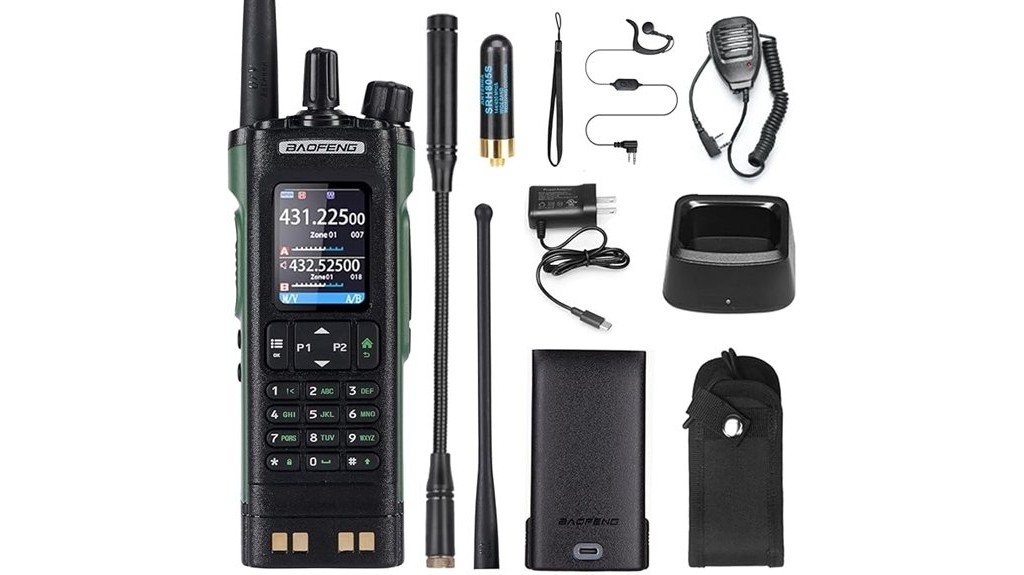
| Standard package | Standard kit shown by Baofeng: radio, 2500mAh battery, antenna, headset, belt clip, USB-C charger, desktop charging base, case holder, manual; confirm your seller’s bundle. |
| Channel spacing | 25 kHz wide / 12.5 kHz narrow |
| Frequency stability | ±2.5 ppm (manufacturer specification) |
| Antenna impedance | 50 ohms |
| Operating temperature | -10°C to 60°C (published range, not an IP rating) |
| Estimated runtime | Manual lists 18 hours at 5W with 5% TX / 5% RX / 90% standby; actual use varies |
| Digital features | Analog voice; no verified DMR voice, digital APRS, or Bluetooth headset audio |
| Available versions | Manufacturer offers US, EU, UK and a US long-airband-antenna package; inclusions and TX settings vary |
| Water and dust rating | No official IP rating published |
| FCC ID | 2AJGM-NA32UV |
Key Takeaways
- The UV-32 is an analog handheld, not the digital Baofeng DM-32UV. Baofeng markets the UV-32 as tri-band, but the published US manual lists narrower TX ranges.
- Its key features are a 2.0-inch color screen, 1,000 channels in 10 zones, GPS coordinate tools, app programming, and advertised power up to 10W.
- Bluetooth is documented for phone-based programming; Bluetooth headset audio is not confirmed.
- The 2500mAh battery charges by USB-C or desktop dock. The manual’s 18-hour figure assumes 5W and a 5% transmit duty cycle, not constant talk time.
- Before you transmit, check the exact radio label, firmware, legal band privileges, antenna, and seller package. Do not assume all advertised tuning ranges are usable TX bands.
How this review was checked: We compared the manufacturer’s UV-32 specifications with the published user manual. This is a documentation-based review, not a hands-on range, transmit-power, or battery test.
What Is the Baofeng UV-32?
The Baofeng UV-32 is a programmable analog handheld amateur radio. Its product page advertises VHF, UHF, and 1.25-meter transmit capability plus wide receive coverage. However, the US section of the published manual lists only 144–148 MHz and 420–450 MHz for transmission. Treat the wider sales specifications as features to confirm with the exact US version rather than as guaranteed usable transmit frequencies.
You get 1,000 channels organized into 10 zones, a color display, GPS coordinate sharing, one-key frequency search, and multiple setup methods. These tools are useful for planned repeater, simplex, and receive-only channel groups, but the first configuration takes care.
Model names matter here. The UV-32 is an analog model; the different Baofeng DM-32UV supports DMR digital voice and digital APRS, with its own software workflow. Do not choose the UV-32 if you need those digital services.
Who Should Buy It?
Best For
- Licensed operators who value analog VHF/UHF operation and are willing to verify any advertised 1.25-meter TX support before purchase
- Outdoor groups that can use GPS coordinates, NOAA listening, USB-C charging, and a visible channel screen
- Operators maintaining large channel plans with app, keypad, CPS, or manufacturer-listed CHIRP programming
Skip If
- You need DMR digital voice, digital APRS reporting, or DMR text messages
- You need a very light radio or want to avoid software and menu setup
- You require proven waterproofing or guaranteed 220 MHz transmit support without checking the exact version
Before You Buy: The official UV-32 product page advertises 220–260 MHz transmit coverage, but the published US manual lists TX only at 144–148 MHz and 420–450 MHz. Ask the seller to confirm your exact radio’s firmware, 1.25-meter TX support, regional limits, and bundle. Also check that the label says UV-32, not DM-32UV.
Design, Display, and Controls
A full keypad, channel knob, customizable side keys, and the 2.0-inch screen help you move among the radio’s 10 zones. The display can show channel and status details clearly, but it also adds menus that you will need to learn.
At 12.4 ounces (350 g) and 7.2 × 2.6 × 1.6 inches, the UV-32 is better carried on a belt or pack strap than in a small pocket. The published dimensions do not include the antenna. Its case holder and belt clip are useful for this type of carry.
The 2-pin Kenwood-style connector can accept compatible wired speaker microphones, earpieces, and programming cables. Check the plug format and model support before buying accessories, since the familiar shape alone does not prove compatibility.
Band Coverage and Radio Performance
Baofeng advertises up to 10W with high, medium, and low transmit power settings. Lower power may save battery when you have a strong signal. More power cannot overcome a blocked path or poor antenna placement, and this review does not include measured RF output or tested distance.
Baofeng’s sales page gives 136–174, 220–260, and 400–520 MHz as transmit ranges, while its published US manual states 144–148 and 420–450 MHz. Those figures are not interchangeable. If 1.25-meter operation is essential, confirm that the exact version supports TX where you are licensed before buying. AM airband, FM broadcast, NOAA, and other extra bands are for listening, not permission to transmit.
One-key frequency search can detect a nearby analog transmission and its CTCSS or DCS tone. It may shorten setup for a known, authorized channel, but a copied frequency is not proof that it is safe or legal for you to transmit.
GPS and Positioning
The built-in GPS displays latitude, longitude, and altitude. Baofeng also describes position sharing and location requests between compatible radios. That can help you exchange a location with a team without reading each coordinate aloud.
GPS positioning is not the same as APRS network reporting. Baofeng does not list digital APRS on the UV-32; the separate DM-32UV offers DMR-based APRS functions. Choose a model with an explicitly supported APRS method if you need map-network reporting.
Try to obtain a GPS fix under open sky before leaving. Trees, buildings, terrain, and initial satellite lock can affect the result. Carry a separate navigation tool and emergency plan when location sharing is critical.
Programming and Channel Setup
You can set channels from the keypad, Baofeng’s Bluetooth phone app, customer programming software (CPS), or the CHIRP method listed by Baofeng. The app is convenient away from a laptop, while CPS is better suited to checking a long channel list before you write it to the radio.
Baofeng currently instructs CHIRP users to choose the UV-21ProGPS profile. That advice may change with firmware or software updates. Save a read-back copy of your original configuration and test a few entries before writing all 1,000 channels.
Use the 10 zones to group nearby repeaters, authorized simplex channels, and receive-only monitoring. Label each entry with a clear name, bandwidth, tone, and transmit status so you can tell at a glance which channels must stay receive-only.
Pro Tip: Start with a three-channel test zone: one authorized repeater, one authorized simplex channel, and one receive-only airband or weather channel. Test offsets, tones, narrow/wide settings, and the transmit-disable option before loading a large channel file.
Battery Life and Charging
The UV-32 uses a 2500mAh rechargeable battery and offers USB-C and desktop-dock charging. USB-C makes a suitable travel power source convenient, while the dock keeps the unit ready for regular use. Follow the included charger and battery instructions.
The manual gives an 18-hour figure at 5W with a 5% transmit, 5% receive, and 90% standby duty cycle. That is a reference condition, not a promise of 18 hours of talking. Frequent high-power calls, scanning, GPS, and a bright display can cut runtime.
For long trips, a compatible spare battery is more reliable than assuming one charge will last all day. Baofeng lists a 2500mAh replacement for the UV-32 and DM-32UV, but check the part number and charging guidance for your radio.
How It Performs in Real Use
For Local Repeater and Simplex Use
A saved repeater zone can keep local offsets, tones, and labels together. Start at the lowest effective power and confirm the receive frequency before you press PTT. Practical range will depend on the location and antenna, not the 10W claim alone.
For Hiking and Outdoor Coordination
For a hiking group, GPS coordinate tools and NOAA listening can help with local coordination in supported areas. A belt or shoulder-strap mount should make the 350 g radio easier to carry. Test location requests between the exact radios before the trip.
For Travel and Monitoring
You can make separate listen-only zones for aviation AM, broadcast FM, and NOAA weather alongside your authorized amateur channels. Double-check transmit lockout or receive-only status when you save channels you must never transmit on.
For Emergency Readiness
For emergency planning, program your authorized channels, charge batteries, and practice calls with your group ahead of time. Confirm coverage without assuming a repeater will remain available during an outage. The radio is not a satellite messenger or a replacement for a dedicated distress beacon.
Setup Tips Before First Use
- Confirm the exact model and region. Check the label and supplied manual for UV-32 rather than DM-32UV; ask about the 220 MHz TX conflict before ordering.
- Charge the battery. Use the supplied USB-C charger or dock and follow the battery safety instructions.
- Back up the factory file. Read the radio with suitable software and keep a copy before making changes.
- Program authorized channels only. Enter correct repeater shifts, tones, channel widths, power, and TX lockouts for listen-only services.
- Test with low power. Check receive audio, channel names, and signal quality before selecting more power.
- Organize the zones. Keep repeaters, simplex, and receive-only weather or aviation channels separate.
- Test GPS outdoors. Obtain a fix, share coordinates with a compatible unit, and check what the other user actually sees.
Compatibility and Safety
The UV-32 is sold for amateur-radio use, not license-free communication on any frequency it can tune. You must follow the laws for your country, your license privileges, the approved equipment, and the transmit band limits of your actual unit. In the US, the UV-32 manual warns against use on services such as FRS, GMRS, and MURS with this radio.
Receive-only services such as aviation AM, NOAA weather, and commercial FM broadcast must stay receive-only. Do not treat frequency search or the ability to type a number into the keypad as permission to transmit on that channel.
Baofeng lists an operating temperature of -10°C to 60°C but no tested IP water or dust rating for the UV-32. Protect it from rain and heavy dust, and keep the accessory connection dry. Follow the manual’s RF exposure and battery-safety warnings.
Pros and Cons
Pros
- Advertised high, medium, and low power settings up to 10W
- 2.0-inch color screen with 1,000 memories across 10 zones
- GPS coordinates, compatible-radio position sharing, and location requests
- Bluetooth app programming plus keypad, CPS, and Baofeng-listed CHIRP options
- 2500mAh battery with USB-C and desktop-dock charging
Cons
- 350 g body and a greater setup burden than a basic UV-5R-style handheld
- No verified DMR voice, digital APRS, or Bluetooth headset audio
- No published IP rating, plus conflicting official TX frequency descriptions that require version checks
Is It Worth the Price?
The UV-32 sits in the feature-rich, budget-friendly analog handheld category. You get a color screen, GPS coordinate tools, phone programming, and broad advertised monitoring coverage without moving to a DMR setup. Its value is strongest when those exact features match your channel plan.
The value falls if you need a lightweight radio, certified water resistance, digital voice, or guaranteed 1.25-meter TX support. Check the seller’s current price and package contents rather than assuming every UV-32 listing includes the same antenna or accessories.
How It Compares to Alternatives
The Baofeng UV-5R is a simpler analog option if you need only a few local VHF/UHF channels and can do without GPS, 1,000 memories, and a large color display. The UV-32 gives you more organization and positioning tools, but it is larger and takes more setup.
The Baofeng DM-32UV is the better comparison if you need DMR digital voice and DMR-based APRS, plus digital contacts and messages. The UV-32 suits an analog-focused operator who values app programming and GPS coordinates over DMR functions.
Frequently Asked Questions
Is the Baofeng UV-32 an analog or DMR radio?
The UV-32 is an analog handheld, not a DMR radio. The separate DM-32UV supports digital DMR operation and requires a different programming workflow.
Does the UV-32 support APRS?
The UV-32 lists local GPS coordinates, sharing, and location requests, but not digital APRS reporting. For DMR-based APRS, consider the separate DM-32UV and check the network requirements.
Can you program the Baofeng UV-32 with CHIRP?
Baofeng lists CHIRP and currently suggests the UV-21ProGPS profile. Back up the radio and test a few channels first, since compatibility can change by software and firmware version.
Does Bluetooth work with wireless headsets?
Bluetooth is documented for app-based channel programming. The official UV-32 description does not confirm wireless headset audio, so use a verified compatible wired audio accessory if needed.
Can the Baofeng UV-32 transmit on the 1.25-meter band?
The product page advertises 220–260 MHz TX, but the published US manual lists only 144–148 and 420–450 MHz transmit ranges. Get version-specific confirmation of 1.25-meter TX support before purchase, and transmit only where licensed.
Do you need a license to use the Baofeng UV-32?
Yes, you need the correct authorization for regulated amateur transmitting. The ability to receive a band or tune a channel does not by itself give permission to use it for transmission.
How long does the 2500mAh battery last?
The manual lists 18 hours at 5W with 5% TX, 5% RX, and 90% standby. Heavy transmitting, GPS, scanning, and screen brightness can reduce runtime, so carry a spare battery for long trips.
Is the Baofeng UV-32 waterproof?
Baofeng does not publish an IP water or dust rating for this model. Keep it dry and use a protective pouch if you expect wet or dusty conditions.
The Bottom Line
The Baofeng UV-32 is recommended with caveats for licensed analog-radio users who want GPS, app programming, and 1,000 organized channels. Skip it for DMR, digital APRS, certified waterproofing, or assured 1.25-meter transmission without unit-specific proof. Its flexible controls are appealing, but the conflicting advertised and manual TX ranges make careful model verification essential.
Ready to Buy?
Check the latest price, UV-32 model label, regional TX limits, antenna package, and included accessories before deciding.