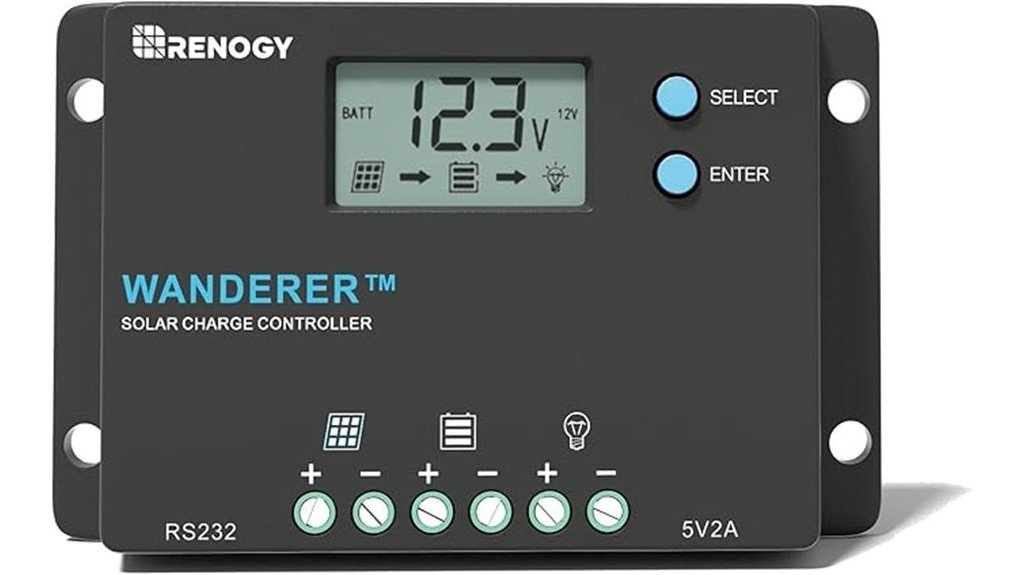
The Renogy Wanderer 10A solar charge controller is a compact PWM unit for 12V/24V systems, offering 10A output, 4-stage charging, and compatibility with AGM, Gel, Flooded, and Lithium batteries. It includes an LCD, optional Bluetooth, overcharge/short-circuit protection, and a two-year warranty. What are its real-world charging efficiencies, thermal performance, and long-term reliability for RV or small off-grid setups? Keep these specifics in mind as the review continues.
Key Takeaways
- Compact, rugged 10A PWM controller suits 12V/24V systems for small RV and off-grid setups.
- Four-stage PWM charging supports AGM, Gel, Flooded, and Lithium batteries with temperature compensation.
- Max 10A output and 5V/2A USB port; charging speed depends on panel wattage and battery capacity.
- Backlit LCD plus optional BT-1 via RS232 for remote monitoring; ultra-low idle draw (<10mA).
- IP32 splash protection, secure upright mounting recommended; 2-year warranty and generally positive user reviews.
Key Features and Specifications
The Renogy Wanderer 10A condenses essential solar-charge capabilities into a compact, travel-friendly package designed for small off-grid systems.
The Renogy Wanderer 10A packs essential solar charging features into a compact, travel-ready unit for small off-grid systems.
It supports 12V/24V systems, measures 4.69 x 2.95 x 1.08 inches, and weighs 5.9 ounces.
What are key features? PWM 4-stage charging, IP32 rating, 5V/2A USB port, ultra-low self-consumption <10mA.
Installation tips: mount upright, protect from direct spray, use correct polarity.
How about solar efficiency? PWM stages and low draw maximize usable panel output.
Practical considerations: fits RV and marine use, offers manual/timed load modes, includes temperature compensation and LCD status readout.
Charging Performance and Battery Compatibility
Although smaller systems demand careful matching of components, the Wanderer 10A delivers predictable charging performance across 12V and 24V setups by using a four-stage PWM algorithm—Bulk, Boost, Float, Equalization—that manages voltage and current to protect battery chemistry and extend service life.
The unit supports common battery types: AGM, Gel, Flooded, and Lithium, with selectable profiles. Charging efficiency is good for a PWM controller; expect lower peak efficiency than MPPT but ultra-low self-consumption (<10mA).
Practical notes:
- Max current: 10A
- USB: 5V/2A
Q: How fast will it charge?
A: Dependent on panel wattage and battery capacity.
Build Quality, Durability, and Protection Features
Because users often install the controller in exposed or vibration-prone environments, build quality and protection features matter as much as electrical specs. The Wanderer uses robust build materials, compact dimensions (4.69 x 2.95 x 1.08 in), and weighs 5.9 oz, aiding vibration resistance. Protection mechanisms include overcharge, over-discharge, overload, short-circuit, reverse polarity, and temperature compensation. Practical question: is it weatherproof? IP32 limits splash protection, so sheltered placement is recommended. Consider mounting orientation, ventilation, and secure wiring for longevity.
| Feature | Detail |
|---|---|
| Size | 4.69 x 2.95 x 1.08 in |
| Weight | 5.9 oz |
| IP Rating | IP32 |
| Protections | Overcharge, short-circuit |
Monitoring, Connectivity, and User Experience
How can users keep tabs on system performance without constant rote checks? The Wanderer offers a backlit LCD showing voltage, current, and status, a clear user interface for quick reads, and an RS232 port enabling app integration via the BT-1 Bluetooth module (sold separately).
Keep easy tabs on voltage, current, and status with a backlit LCD and RS232 app integration via BT-1.
Q: What data is available?
A: Real-time voltage (12V/24V), charging current up to 10A, error codes, and timed load settings.
Practical notes: unit measures 4.69 x 2.95 x 1.08 inches, draws <10mA idle, and includes a 5V/2A USB port.
Setup is straightforward; remote monitoring requires the optional BT-1.
Real-World Use, Customer Feedback, and Warranty
Regularly consulted by RVers and small off-grid users, the Renogy Wanderer 10A demonstrates reliable day-to-day performance with practical limits that matter in real-world setups.
Users report consistent PWM charging, low self-consumption (<10mA), and the handy 5V/2A USB port.
Real world experience highlights suitability for 12V/24V systems, compact 4.69 x 2.95 x 1.08 in size, IP32 protection, and clear LCD readouts.
Customer satisfaction averages 4.3/5 from 91 reviews; common questions: How long is the warranty? Answer: two years for workmanship.
Considerations: 10A max current, no built-in Bluetooth, mount where protected from water.
Frequently Asked Questions
Can It Work With a 36V Solar Panel Array?
No — it cannot. The device’s solar panel compatibility is limited by voltage limitations to 12V/24V systems; connecting a 36V solar panel array would exceed its input range and risk damage unless a suitable DC-DC converter is used.
Is the USB Port Usable While the System Is Off?
Yes — the USB functionality requires system power. It operates only when the controller has input or battery voltage; if the system power is off (no battery or solar input), the USB port will not supply charging.
Can Firmware Be Updated via the RS232 Port?
No, firmware updates cannot be performed via RS232 communication; the device lacks user-accessible firmware update functionality through the RS232 port, limiting interactions to monitoring and app connectivity with the BT-1 module.
Does It Support Temperature Sensors From Other Brands?
No — temperature sensor compatibility is limited; third-party sensors often face brand integration issues due to proprietary pinouts and calibration. The device generally accepts only Renogy-compatible sensors, reducing reliable cross-brand interoperability for temperature monitoring.
Is There an Option for Remote Alarms or Notifications?
Yes; remote monitoring is possible via the RS232 port with Renogy’s BT-1 Bluetooth module and DC Home app, enabling alarm integration through app notifications, though native wired alarm outputs are not provided.