Disclosure: As an Amazon Associate, we earn from qualifying purchases. If you click a link on this page and make a purchase, we may receive a small commission at no extra cost to you.
An unfamiliar ring may look like a diamond, but looks alone cannot settle the question. The Hqdz Diamond Selector II offers a portable first check using a 9V battery, an LED level meter, and sound alerts. It can help you sort likely diamonds from many common imitations before arranging a closer inspection. This review explains the setup, what the signals mean, and why a positive reading is not proof of authenticity.
Quick Verdict
Editorial Verdict: 7.5/10, Recommended with caveats for screening only
Best For: Jewelry hobbyists, small resellers, and jewelers who need a portable first-pass screening tool.
Bottom Line: The light bar, battery indicator, and audible alerts make quick checks practical. You must calibrate for stone size and temperature, and the tester cannot reliably separate diamond from moissanite or replace gemological examination.
| Specification | Detail |
|---|---|
| Brand | Hqdz, as identified by ASIN-specific product references |
| Product Name | Diamond Selector II |
| Product Type | Handheld thermal-conductivity screening tester |
| Power | One 9V battery (006P type in the published manual) |
| Readout | LED level-meter lights, plus battery and ready indicator lights |
| Feedback | Level-meter response, diamond-like beeps, and a separate continuous metal-contact alert |
| Warm-Up | Wait until the ready light turns on; published manuals describe about 20 to 30 seconds |
| Controls | Combined power switch and sensitivity/level control |
| Operating Temperature | 10-35 degrees Celsius |
| Humidity Guidance | Use below 80% humidity for more dependable readings |
| Testing Setup | Clean probe and stone, level adjusted for size/temperature, bare-finger contact with conductive panel, and gentle 90-degree probe contact |
| Best Use | First-pass screening of diamonds from many common imitations |
| Main Limitation | Not a full gemstone identifier, grading tool, or appraisal device; no dedicated moissanite-separation function is established in the supplied details |
| Package Note | ASIN-specific references advertise a pouch, loose-stone testing platform, manual, and 9V battery; confirm exact contents with the current seller |
What Is the Diamond Selector II?
The Hqdz Diamond Selector II is a handheld thermal-conductivity tester for jewelry counters, workbenches, home collections, and resale intake. You place its probe on an accessible stone surface, watch the LED level meter, and listen for the alert pattern. It is designed to screen diamond-like thermal responses, not identify every gemstone.
Its 9V battery makes it useful when there is no outlet nearby. A battery light and ready light help you check the setup before testing, while the small body fits in a counter kit or travel pouch.
This is a screening product, not a grading instrument. It cannot establish carat weight, cut, color, clarity, market value, treatment history, or natural versus laboratory-grown origin. This editorial assessment draws on the product listing references and published operating instructions, not a claim of hands-on laboratory testing.
Who Should Buy It?
Best For
- Jewelry hobbyists sorting inherited or unmarked pieces before a jeweler visit.
- Small resellers screening loose stones and mounted rings before paid verification.
- Jewelers who want a basic backup test at the counter, not a final verdict.
Skip If
- You need written authentication, grading, valuation, or insurance documentation.
- You need dependable separation of diamond from moissanite or identification of many gemstone types.
- You often test in a windy, damp, or temperature-unstable setting.
Before You Buy: Treat every positive result as a screening result, not proof of authenticity. Thermal-style diamond testers can give diamond-like responses on moissanite, and a basic screening result cannot tell you whether a diamond is natural or laboratory-grown. Unless the current manual confirms dual testing, use a dedicated moissanite or dual tester, or seek professional gemological service.
Key Features of the Diamond Selector II
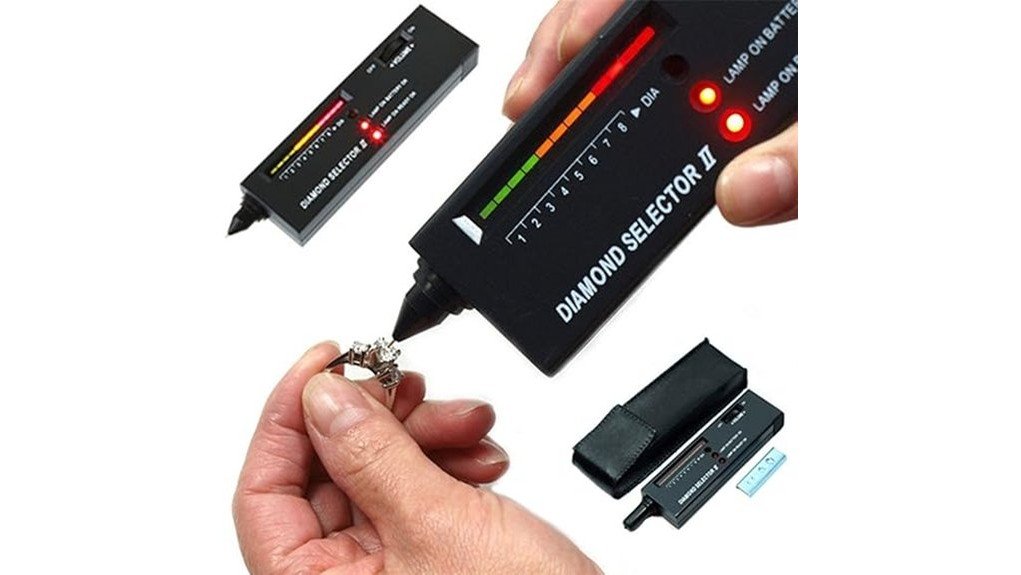
The Diamond Selector II combines a pointed probe, a row of level-meter lights, a sensitivity knob, and an alarm speaker. The separate battery and ready lamps tell you when to replace the battery or begin a test. These cues matter because a weak battery or a cold probe can distort a result.
- LED level meter: Shows how far the light scale advances during contact; it is not a numeric gemstone readout.
- Audible feedback: Beeps accompany a diamond-like response; a sustained metal-contact buzz means reposition the probe.
- 9V battery power: Supports portable use without a charger or wall outlet.
- Adjustable level: The knob sets the initial light level to match stone size and ambient temperature, based on the unit’s chart.
- Metal contact panel: Requires direct finger contact during testing for the intended setup.
- Loose-stone support: Published kit descriptions list a testing platform and storage pouch; confirm they are included in your offer.
The controls are simple, but the process is not completely automatic. You still need a clean probe, a stable room, a suitable setting, and careful contact with the stone.
Display, Alerts, and Reading Clarity
The row of LEDs provides a quick visual reference while the probe touches the stone. You can watch the lights advance and compare the behavior with the guidance in your manual. Some product descriptions call this an LCD display, but the operating diagrams show an LED level meter rather than a numeric LCD screen.
The sound patterns matter. Published instructions describe beeping with a diamond-like response and a continuous buzz when the tip touches metal. A weak or silent result may suggest a common simulant, but poor contact, a tired battery, or the wrong starting level can also cause it. Neither light nor sound is a certificate of authenticity.
Build, Portability, and Storage
The compact body is one of the Diamond Selector II’s clearest advantages. You can keep it in a jewelry drawer, workbench kit, market bag, or counter station without giving up much space.
ASIN-specific package descriptions mention a leather pouch, a loose-stone testing platform, a manual, and a 9V battery. A published manual shows a protective vinyl case for this tester family. Those descriptions do not guarantee what every seller ships, so check the exact bundle before ordering.
Calibration by Stone Size and Temperature
The numbered starting level is not a fixed pass mark. The published calibration chart changes it with the stone’s size and surrounding temperature. For example, one Diamond Selector II manual specifies four starting lights for a 0.06 to 0.5 carat stone at 10 to 30°C. Very small stones and warmer rooms require different settings. Use the chart supplied with your exact unit rather than copying another user’s setting.
Allow the ready lamp to light before touching the stone. Published instructions for this tester family describe roughly 20 to 30 seconds of warm-up. If the tester beeps continuously before a proper test, review the starting level and make sure the probe is not touching metal.
Testing Conditions for Better Accuracy
The article-supported operating range is 10-35 degrees Celsius, with humidity kept below 80%. Cold equipment, high humidity, wind, and sudden temperature changes can make a quick result harder to trust.
Let the tester, battery, and jewelry reach a stable indoor temperature before you begin. A stone moved from a cold vehicle or outdoor market may need time to adjust before you test it.
Keep the work surface steady and dry. You should also test away from strong airflow, because a moving probe or shifting stone can break contact and produce an inconsistent reading.
How to Use It Correctly
- Install and check the 9V battery. Replace a weak battery before relying on the tester for an important decision.
- Clean the probe and stone. Use a soft, lint-free cloth to remove dust, skin oil, lotion, or polishing residue.
- Wait for the ready light. Published instructions describe roughly 20 to 30 seconds, but follow the ready indicator on your unit.
- Set the initial LED level. Check the stone-size/temperature chart on your unit instead of choosing a setting at random.
- Keep bare-finger contact with the conductive panel. Gloves can interfere with the metal alert; follow your manual’s two-hand grip guidance.
- Touch the stone at a right angle. Use gentle pressure, keep the tip off the metal setting, and do not force the probe against tiny stones.
- Repeat after a short pause. Recheck a clean area and let the stone return to room conditions if repeated handling has warmed it.
Pro Tip: Practice on a known diamond and a known imitation before testing unknown jewelry. Note how the LED lights move and how a brief positive-response beep differs from a continuous metal-contact buzz.
Common Testing Mistakes to Avoid
- Testing immediately after moving the jewelry from a cold or humid environment.
- Using the same starting LED level for a tiny stone and a larger stone.
- Touching a prong, bezel, or metal setting instead of the stone.
- Touching the probe at an angle or pressing hard enough to bend the tip.
- Confusing the continuous metal-contact alert with a diamond-like beep.
- Treating the result as proof of origin, grade, or value.
Understanding Test Results
A progressing light bar with the expected beeps indicates a diamond-like thermal response. It does not prove that the stone is a diamond, show whether it is natural or laboratory-grown, or establish whether it has been treated.
- Positive response: The stone reacted in the range the device associates with diamond, but further testing may still be needed.
- Negative response: The stone may be a low-conductivity imitation, or the setup may need correction.
- Inconsistent response: Check the battery, ready light, clean probe, level setting, bare-finger contact, room conditions, and contact angle.
- Continuous metal-alert buzz: Lift the probe and try again on the stone only, away from prongs or a bezel.
- Moissanite concern: Unless the current manual confirms a dedicated separation function, use a moissanite or dual diamond/moissanite tester instead of relying on this tool alone.
- High-value decision: Ask a qualified jeweler, gemologist, or laboratory for confirmation and documentation.
Use the result to choose your next step. It can help you sort pieces or flag a stone for further review, but it should not be the only evidence behind a purchase, insurance claim, estate decision, or resale description.
How It Performs in Real Use
For Jewelry Counter Checks
At a counter, the LED bar and alert make a quick first screen possible without a large setup. Set the correct starting level before checking a ring, and lift the tip if you hear the metal-contact buzz. The result helps you decide whether to use another test or request professional verification.
For Home Jewelry Collections
For inherited rings and loose stones without paperwork, you can use the tester to sort items for later inspection. A loose stone needs a secure testing platform; a mounted one needs a clear surface away from prongs. The device cannot tell you what the piece is worth.
For Travel and Market Use
The 9V battery and small body suit a travel kit, market table, or estate-sale visit. However, wind, heat, cold, and humidity can distort a rushed check. Use a stable indoor space and avoid making a final purchase decision from one reading.
For Long-Term Use
For repeat use, check the starting LED level and battery lamp between batches. Handling a ring for too long can warm the stone, so pause when readings drift. Clean and protect the fine probe, and remove the battery before long storage.
Maintenance and Care Tips for Longevity
Gently wipe residue from the probe and stone using a soft, lint-free cloth, following your unit’s care instructions. Do not scrape the tip across jewelry or press hard enough to bend it.
Turn the tester off before replacing the battery. If readings become weak or inconsistent, check the 9V battery before assuming the stone or tester has changed.
Store the unit in a dry case or pouch. Keep it out of extreme heat and damp storage, and never toss it loose among tools that could hit the tip. Do not open the tester’s housing beyond the battery compartment.
Compatibility and Safety Notes
The Diamond Selector II is designed for first-pass diamond screening, not broad gemstone identification. Its thermal method can confuse moissanite with diamond and cannot establish diamond origin. It is also not a dependable way to classify sapphires, rubies, emeralds, treated stones, or mixed materials.
For mounted jewelry, touch only exposed stone, not the prong, bezel, or band. Hold the piece steady and maintain the conductive-panel grip described in the manual. For loose stones, use the specified testing platform if supplied. Do not force contact with very small or hidden stones.
For expensive jewelry, disputed stones, insurance records, estate distribution, or resale claims, seek professional guidance. A qualified jeweler or gemologist can combine magnification, electrical or thermal testing, spectroscopy, and documentation as needed.
Pros and Cons
Pros
- Portable 9V battery design works without a charger or wall outlet.
- LED level bar, battery/ready lights, and sound cues make responses easy to notice.
- Compact size fits a home, counter, resale, or travel testing kit.
- Adjustable LED starting level lets you account for stone size and room temperature.
- Useful as a first screening step before professional examination.
Cons
- Cannot provide grading, valuation, origin, or formal authentication.
- No dedicated moissanite-separation function is established in the supplied details.
- Requires warm-up, size-based level adjustment, bare-finger contact, and stable room conditions.
Is It Worth the Price?
The Diamond Selector II makes sense as a budget-oriented screening aid for occasional checks. Its 9V operation, light bar, and compact body suit home collections or small resale counters without requiring a large workstation.
You get the most value when you understand its limits and already plan to confirm important stones through another method. It is a weaker buy when you need dependable moissanite separation, broad gemstone identification, written reports, or professional-grade documentation.
The advertised bundle may include a 9V battery, manual, leather pouch, and loose-stone testing platform, but contents vary across sellers. Confirm those items and the return terms on the exact listing before you buy.
How It Compares to Alternatives
A jeweler’s 10× loupe lets you examine inclusions, facet edges, chips, and settings, but it takes practice and does not give an electronic thermal response. The Diamond Selector II is quicker for an initial screening signal, yet tells you little about stone quality or damage.
A dedicated dual diamond/moissanite tester is the more useful next tool when moissanite is possible. A professional jeweler or gemological laboratory is the right route for disputed identity, natural-versus-lab-grown origin, grading, or written documentation.
Frequently Asked Questions
Does a positive Diamond Selector II result prove a stone is a diamond?
No. A positive response means the stone reacted in the range the device associates with diamond during that test. You still need a second method or professional confirmation for valuable, disputed, or undocumented stones.
Can the Diamond Selector II distinguish moissanite from diamond?
Do not rely on this basic screening tester alone for that distinction. Moissanite can produce diamond-like responses on thermal-style testers, so unless the current manual confirms dual testing, use a dedicated moissanite tester, a dual tester, or professional gemological testing.
Can it tell a natural diamond from a laboratory-grown diamond?
No. This type of first-pass tester is not designed to determine diamond origin. Natural and laboratory-grown diamonds require specialized examination when origin matters.
What battery does the Diamond Selector II use?
It uses one 9V battery, listed as 006P in published instructions. Replace it if the battery light is dim or the tester cannot reach its ready state. Confirm whether the seller includes a battery.
Why does the tester stay silent or give inconsistent results?
A dirty probe, weak battery, wrong starting level, poor finger contact, or unstable room can cause this. The ready light must be on before testing, and the tip must touch only stone. A continuous buzz can mean the probe is touching metal, not that you found a diamond.
Can you test a diamond while it is mounted in jewelry?
Yes, when you can place the probe squarely on a clean, exposed stone surface without touching a prong, bezel, or band. Support the jewelry and keep bare-finger contact with the tester’s panel. Tiny or deeply set stones may be too hard to reach safely.
What conditions are best for testing?
The Hqdz-linked guidance lists 10 to 35°C and humidity below 80%. A still indoor space is better than a windy market stall. Let a stone and tester reach room conditions and use the calibration chart for the stone size.
Who should skip the Diamond Selector II?
Skip it when you need a formal appraisal, broad gemstone identification, dependable moissanite separation, or written authentication. It is better for quick screening than for final buying, insurance, estate, or resale decisions.
The Bottom Line
The Hqdz Diamond Selector II is worth considering for hobbyists and small sellers who want a portable, battery-powered first-pass check. Its LED scale and sound alerts are helpful, but they require correct calibration, careful contact, and stable room conditions.
Buy it as a screening aid, not proof of authenticity. Skip it if you need dependable moissanite separation, natural-versus-lab-grown identification, grading, valuation, or formal paperwork.
Ready to Buy?
Check the latest price, seller details, and package contents before you decide.