The 100a permanent jewelry welder is a compact spot-welding unit designed for small jewelry tasks. It handles wire and chain diameters from about 0.8 mm to 3 mm, offers precise, repeatable welds, and runs on a controllable 100-amp output. What are its practical limits, required accessories, and safety steps? Below are structured notes and a brief assessment to help evaluate fit for studio or mobile use—and to guide safe, effective setup.
Key Takeaways
- Compact 100A pulse arc welder excels at precise spot-welding for jewelry components between 0.8–3 mm.
- Includes 10 needles and 4 copper collets; needles require grinding to pointed tips for best results.
- Works well for wire, chains, and small parts but cannot weld thick iron bars or complex assemblies.
- Improves repeatability with proper needle prep, steady hands, correct collet fit, and argon shielding.
- Safety essentials: eye protection, ventilation, insulated gloves, and weekly maintenance inspections.
Overview and Key Features
The 100a Permanent Jewelry Welder is a compact pulse arc welder designed specifically for joining small jewelry components, offering precise spot-welding capability for workpieces between 0.8 mm and 3 mm in diameter.
The 100a is a compact pulse-arc welder for precise spot joins on small jewelry, 0.8–3.0 mm range.
It empowers makers seeking freedom through durable connections.
What are key features?
- Pulse arc spot welding, 110V input, 0.8–3.0 mm workpiece range.
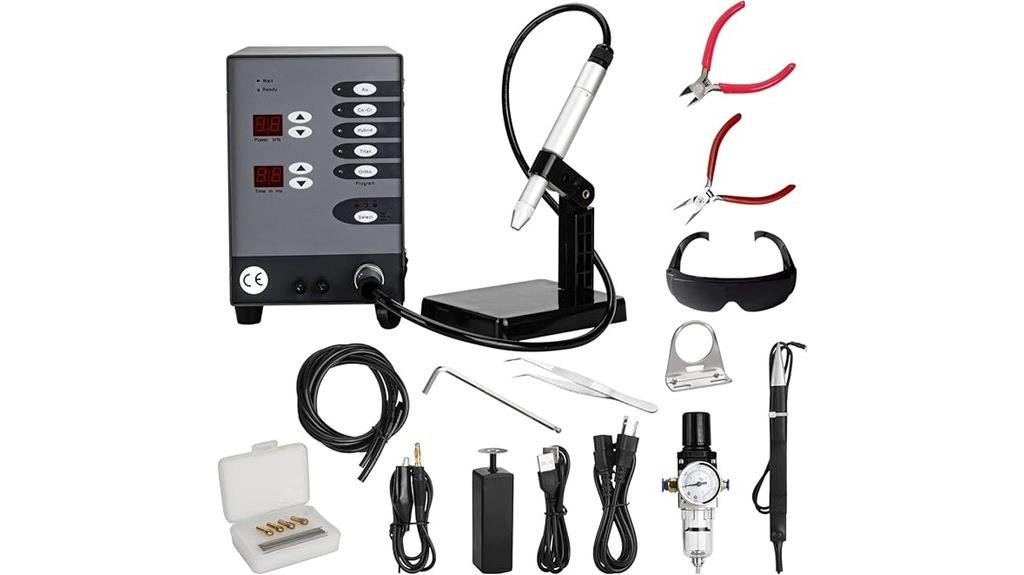
- Includes 10 needles, 4 copper collets; needles require grinding to a point, reusable after cleaning.
- Accessories and English manual included; argon bottle not included, regulator recommended.
Practical considerations: close needle proximity required, unsuitable for iron bars or drilling.
Techniques: focused welding techniques for jewelry applications.
Performance, Limitations, and Best Practices
Moving from the feature set to real-world use, this section examines how the 100a Permanent Jewelry Welder performs, where it falls short, and how to get repeatable results.
The unit reliably spot welds wire, chains and small workpieces 0.8–3mm using focused welding techniques; repeatability improves with needle tip prep, consistent contact and steady hands.
Limitations: cannot weld iron bars, make holes, or handle complex assemblies.
Safety precautions: eye protection, ventilation, and insulated gloves are mandatory.
Q: How to maximize success?
A: Use pointed needles, proper collet fit, 110V supply, and consider argon shielding for cleaner joints.
Accessories, Setup, and Maintenance
Although a simple toolkit at first glance, the accessories and setup for the 100a Permanent Jewelry Welder determine whether a jeweler achieves clean, repeatable spot welds or spends time troubleshooting, so proper preparation is essential.
The reviewer notes accessory selection: 10 needles, 4 copper collets, grinder required, argon regulator recommended (argon bottle not included).
Setup steps: grind needles to a pointed tip, position workpiece within 0.8–3mm, connect regulator per video.
Maintenance tips: clean needles with grinder, inspect collets, replace worn tips.
Q: How often?
A: Inspect weekly under frequent use, replace needles as voltage sag appears.
Frequently Asked Questions
Can This Welder Weld Gold-Filled or Vermeil Chains Safely?
Yes. It can weld gold-filled compatibility and perform vermeil welding cautiously; the device’s spot-weld limits and needle prep require careful technique, empowering makers to join delicate chains while avoiding overheating, thicker cores, or unsuitable ferrous materials.
Is the Machine Safe for Use Without Eye Protection?
No — the machine requires eye safety precautions; freedom-seeking users still need protective gear. Investigating sparks and UV risks reveals clear necessity: wear goggles, shield face, and follow instructions to weld boldly yet responsibly, avoiding careless exposure.
How Long Is the Product Warranty and Who Covers Repairs?
The warranty details state a limited one-year manufacturer warranty; repair coverage is provided by the manufacturer for defects within that period, empowering users to seek restoration and reclaim independent use through authorized service channels.
Can I Use Third-Party Needles or Collets With This Welder?
Like a key fitting a lock, third-party needle compatibility and collet options can work but require matching dimensions and proper grinding. Users seeking liberation should verify fit, maintain cleanliness, and accept responsibility for performance variations and safety risks.
Is There a Temperature or Duty Cycle Specification for Continuous Use?
No specific temperature limits or duty cycle are provided; the device lacks rated continuous-use specs. The liberated user should assume conservative duty cycles, allow cooling periods, and avoid prolonged runs to prevent overheating and premature component failure.
Conclusion
The 100a Permanent Jewelry Welder proves a compact, precise tool for artisans needing spot joins on wires and chains, handling materials from 0.8 mm to 3 mm with consistent results. It is not suitable for heavy steel or iron bars, and users should employ eye protection and ventilation. Best practices include testing on scrap, using correct electrode spacing, and limiting weld duration. Is it worth it? For small-scale jewelry work, the answer is yes.