Disclosure: As an Amazon Associate, we earn from qualifying purchases. If you click a link on this page and make a purchase, we may receive a small commission at no extra cost to you.
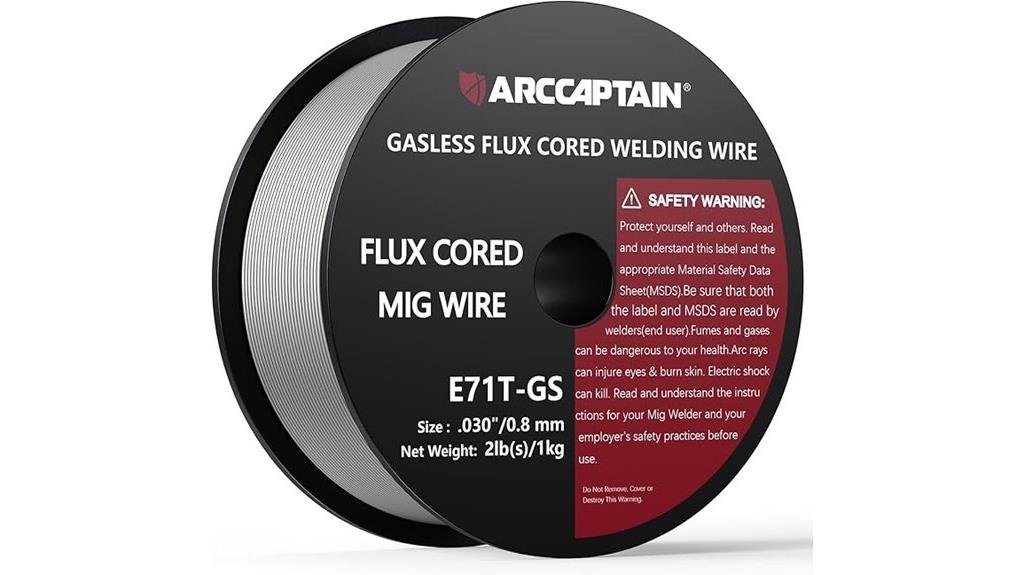
Flux-core wire can save you from hauling a gas cylinder outdoors, but the wrong spool size, diameter, or polarity can cause poor feeding and weak welds. The ARCCAPTAIN .030 E71T-GS Flux Core Welding Wire is a 2 lb, self-shielded mild-steel wire made for compatible MIG and flux-core welders. It offers practical portability, smooth feeding, and useful performance on less-than-perfect steel, although it still creates slag and requires the correct DCEN setup. This review helps you decide whether it fits your machine, material, and typical repair work.
Quick Verdict
Rating: 8.4/10
Best For: DIY repairs, outdoor steel work, and smaller flux-core welders that accept .030-inch D100 spools
Bottom Line: This wire gives you gasless portability, a manageable 2 lb spool, and broad mild-steel usefulness. Its main tradeoffs are slag cleanup, possible spatter, and the need to confirm spool size, drive-roll setup, and DCEN polarity before welding.
Key Takeaways
- The reviewed option is AWS E71T-GS self-shielded flux-core wire for mild steel.
- The .030-inch diameter comes on a 2 lb D100 spool and uses DCEN straight polarity.
- No external shielding gas is required, which makes the wire practical for portable and outdoor repairs.
- The wire can handle T-joints, butt joints, lap joints, and several welding positions when your machine is set correctly.
- You should expect slag removal and some cleanup, especially while dialing in voltage, wire speed, travel speed, and stickout.
| Specification | Detail |
|---|---|
| Brand | ARCCAPTAIN |
| Classification | AWS E71T-GS |
| Product type | Self-shielded flux-core MIG wire |
| Base material | Mild steel |
| Wire diameter | .030 inch (0.8 mm) |
| Net weight | 2 lb spool |
| Spool format | D100 |
| Shielding gas | Not required |
| Polarity | DCEN, also called straight polarity |
| Listed positions | PA, PB, PC, PD, and PE |
| Joint types | T-joints, butt joints, and lap joints |
| Packaging | Vacuum packed for moisture and dust protection |
| Best use | Portable mild-steel repairs, shop projects, farm work, and outdoor welding |
What Is the ARCCAPTAIN E71T-GS Flux Core Welding Wire?
The ARCCAPTAIN E71T-GS is a tubular mild-steel welding wire with flux inside the wire. Heat from the arc activates that flux, creating shielding around the weld pool without a separate gas bottle. This design reduces the equipment you need to move between a garage, driveway, farm, or jobsite.
The reviewed variant uses .030-inch wire on a 2 lb D100 spool. That size often suits compact 120-volt and dual-voltage machines, but physical fit alone does not guarantee compatibility. Your welder must support flux-core wire, accept the spool format, use the correct drive-roll groove, and allow DCEN polarity.
Who Should Buy It?
Best For
- DIY welders repairing mild-steel gates, brackets, carts, or equipment
- Users who need gasless welding for outdoor or mobile work
- Compact-welder owners who need a .030-inch D100 spool
Skip If
- You need wire for aluminum, stainless steel, or another non-mild-steel alloy
- Your machine cannot run DCEN or does not accept a D100 spool
- You prioritize the cleanest indoor finish and already own a shielding-gas setup
Before You Buy: Check your welder manual for .030-inch flux-core support, D100 spool clearance, drive-roll type, contact-tip size, and DCEN polarity. Do not assume a spool fits simply because the wire diameter matches.
Welding Performance and Arc Behavior
The manufacturer describes this wire as having stable arc action, high feedability, and lower spatter than poorly made flux-core wire. In practice, those benefits depend heavily on your setup. A clean liner, correct knurled drive roll, matching .030-inch contact tip, proper tension, and a smooth wire path matter as much as the wire itself.
E71T-GS wire runs hotter than comparable solid wire and is commonly used for quick repair work. That heat can help with penetration, but it also makes travel speed and heat control important on light-gauge steel. Start with your machine chart, test on scrap of the same thickness, and adjust one variable at a time.
Self-Shielded Outdoor Use
Because the flux creates the shielding system, you do not need an external gas cylinder or regulator. This makes the spool easier to use outdoors, where wind can disturb shielding gas used with solid MIG wire. You still need a stable work area, dry equipment, and protection from rain or standing water.
Performance on Rusty, Dirty, or Painted Steel
The product is marketed for use on rusty, dirty, and painted surfaces. Flux-core wire can tolerate less-than-perfect preparation better than solid MIG wire, but surface contamination still increases the risk of porosity, fumes, inclusions, and an uneven bead. Remove paint, heavy rust, oil, and scale around the joint whenever practical.
Single-Pass and Multi-Pass Work
The listing describes the wire for single-pass and multi-pass welding. E71T-GS products can vary by manufacturer, application, and procedure, so do not treat a general listing claim as approval for structural code work. Clean all slag between passes and follow the wire label, your welder manual, and the requirements of the job.
Spool Build, Packaging, and Storage
The wire arrives on a compact D100 spool and is vacuum packed to reduce exposure to moisture and dust before opening. The 2 lb size is convenient for occasional repairs because it does not leave a large amount of wire sitting unused for months.
After opening, store the spool in a clean, dry container. Keep it away from damp floors, open windows, grinding dust, and condensation. If the wire shows visible rust, feeding damage, or contamination, replace it instead of risking unstable feeding or weld defects.
Pro Tip: Keep the product label or spool card with the wire after opening. It preserves the classification, diameter, and polarity information when several similar spools are stored together.
Compatibility and Setup Tips
- Confirm polarity: Set the torch or electrode lead to negative and the work lead to positive for DCEN, unless your machine manual states otherwise.
- Use the correct drive roll: A knurled flux-core groove grips tubular wire without requiring excessive pressure.
- Match the contact tip: Use a tip sized for .030-inch wire and replace it if feeding becomes erratic.
- Set light tension: Apply only enough drive-roll pressure to feed consistently. Too much pressure can deform tubular wire.
- Use a drag angle: Flux-core wire usually performs better when you pull or drag the gun rather than push it.
- Test on scrap: Match the scrap to the workpiece thickness and position before welding the final joint.
- Remove slag: Chip and brush the bead before inspecting it or adding another pass.
How It Performs in Real Use
Garage Repairs
For brackets, utility carts, stands, and mild-steel repairs, the 2 lb spool gives you enough wire for repeated small jobs without committing to a large roll. The .030-inch diameter also works well with many entry-level machines, provided the machine can run flux-core wire correctly.
Outdoor Farm and Fence Work
The gasless design is the main advantage when you need to move the welder to a gate, implement, or fence section. You avoid carrying a cylinder, but you still need clean electrical connections and a protected power source. Grind the joint area when possible rather than relying on the flux to overcome heavy contamination.
Auto-Body and Thin-Steel Projects
The wire can be used on light-gauge steel, but its hotter arc requires care. Use short welds, skip around the panel, and allow cooling time to reduce distortion or burn-through. Practice first because settings that work on a thick bracket may be too aggressive for sheet metal.
Occasional and Long-Term Storage
The smaller spool suits users who weld only when repairs appear. Its value drops if the opened spool sits in a damp shop, so dry storage matters. A sealed plastic container with a dry environment can help protect the remaining wire between jobs.
Safety and Before-Use Checks
Flux-core welding produces heat, ultraviolet radiation, sparks, slag, and fumes. Wear a welding helmet with the correct shade, safety glasses, flame-resistant gloves, protective clothing, and suitable footwear. Use effective ventilation or local fume extraction, especially when welding indoors.
Remove combustible materials from the work area and keep suitable fire-extinguishing equipment ready. Never weld on a closed container, fuel tank, painted surface, or coated metal until you understand and control the fire, explosion, and fume hazards. Follow your welder manual, wire label, workplace rules, and local safety requirements.
Pros and Cons
Pros
- Self-shielded design removes the need for a gas cylinder
- .030-inch wire works with many compact flux-core machines
- 2 lb D100 spool is practical for occasional repairs
- Suitable for several joint types and welding positions
- Vacuum packaging helps protect the unopened spool
Cons
- Produces slag that must be removed between passes
- Can create more spatter and fumes than well-tuned solid-wire MIG welding
- Not suitable for aluminum or stainless-steel welding
Quality and Consistency
ARCCAPTAIN states that the wire is made with controlled materials and has undergone TÜV testing. The manufacturer also lists smooth feeding, stable arc action, and vacuum packaging as quality-focused features. These claims are useful, but your actual results will still depend on storage, machine condition, settings, joint preparation, and technique.
The original article included an Amazon star rating, review count, and category rank. Those figures can change and could not be confirmed during this update, so they have been removed instead of presenting potentially outdated social proof.
Is It Worth the Price?
This wire sits in the budget-friendly consumables category and offers strong value for occasional mild-steel repair work. You get a manageable spool size, gasless operation, and a common .030-inch diameter without buying a larger roll that may sit exposed in storage.
It makes the most sense when portability and simple setup matter more than a nearly spatter-free finish. It is not the best fit if you already weld clean steel indoors with shielding gas and want the smoother bead appearance of a properly tuned solid-wire MIG process.
How It Compares to Alternatives
The .035-inch version of ARCCAPTAIN E71T-GS may suit compatible machines and heavier repair work, while the .030-inch option gives many small welders better control on lighter material. Confirm your machine’s supported wire range before changing diameters.
ARCCAPTAIN ER70S-6 solid wire is another option for clean mild steel when you have shielding gas and work indoors. Solid wire usually reduces slag cleanup and can produce a cleaner-looking bead, while this E71T-GS wire is easier to carry outdoors and use without a cylinder.
Frequently Asked Questions
Does ARCCAPTAIN E71T-GS wire need shielding gas?
No. It is self-shielded flux-core wire, so the flux inside the wire protects the weld pool. You still need the correct machine settings, polarity, ventilation, and surface preparation.
What polarity should I use with this wire?
The manufacturer lists DCEN straight polarity for this E71T-GS wire. Check the diagram inside your welder and its manual before moving leads because machines use different connection layouts.
Will the 2 lb spool fit every MIG welder?
No. Your machine must accept a D100 spool, support .030-inch flux-core wire, and allow the required polarity. Also confirm the drive roll and contact tip before ordering.
Can I use this wire for aluminum?
No. This E71T-GS product is intended for mild steel. Aluminum requires a suitable aluminum filler wire, compatible feeding equipment, the correct shielding gas, and a machine setup designed for that process.
Can it weld rusty or painted metal?
The wire can tolerate less-than-perfect steel better than solid MIG wire, but cleaning still improves safety and weld quality. Remove paint, oil, scale, and loose rust around the joint whenever practical.
Is .030-inch wire suitable for beginners?
It can be a practical starting size for compatible compact welders because no gas setup is required. Beginners should still practice on scrap, learn correct polarity, and adjust wire speed and voltage gradually.
Why is the wire feeding unevenly?
Common causes include excess drive-roll tension, the wrong groove, a worn contact tip, a dirty liner, spool drag, or a kinked gun cable. Check the full wire path before increasing tension.
How should I store an opened spool?
Keep it in a clean, dry container away from condensation, grinding dust, and chemicals. Inspect the exposed wire for rust or contamination before reinstalling it.
The Bottom Line
The ARCCAPTAIN .030 E71T-GS Flux Core Welding Wire is a practical choice for mild-steel repairs when you want a portable, gasless setup and a compact 2 lb spool. Buy it after confirming D100 spool fit, .030-inch support, and DCEN polarity; skip it for aluminum, stainless steel, or buyers who want the cleaner finish of gas-shielded solid wire.
Ready to Buy?
Check the latest price, selected wire diameter, spool count, and product details before you decide.