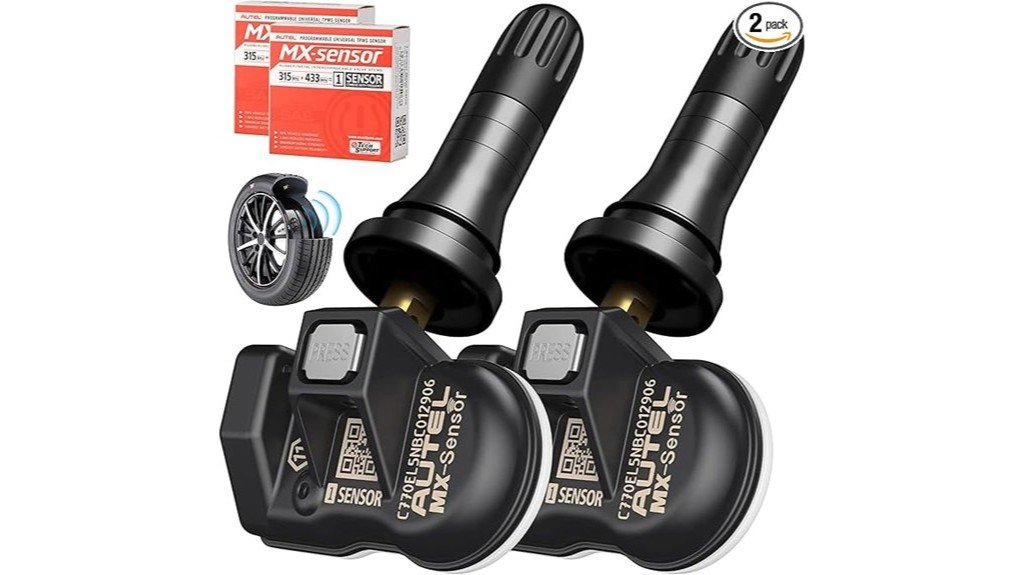
The Autel TPMS MX Sensor is evaluated for reliability, versatility, and ease of use. It supports 315/433 MHz, fits 98% of vehicles, offers a 4–6 year battery life, and measures 0–800 kPa. Who is it for: pros and DIYers with Autel tools. Installation requires Autel programming devices; compatibility and reprogramming steps matter. Ready for detailed specs, programming steps, performance tests, and a concise value judgment?
Key Takeaways
- Dual-frequency (315/433 MHz) MX sensors offer ~98% vehicle coverage for broad compatibility.
- New-generation 88 chip improves RF stability and reduces signal dropout.
- Requires Autel TS-series programmer (TS408/501/508/601) for sensor activation and cloning.
- Rated 4–6 year battery life, 0–800 kPa range, ±10 kPa accuracy, and -40°C to 125°C operating range.
- Strong value for shops and DIYers with Autel tools, but tool dependency limits non-Autel users.
Key Features and Technology
The Autel TPMS MX Sensor combines compact design with modern circuitry to deliver reliable tire-pressure monitoring across most passenger vehicles.
The Autel TPMS MX Sensor pairs compact design with modern circuitry for reliable tire-pressure monitoring on most passenger vehicles
It runs dual frequencies (315/433 MHz), uses the new generation 88 chip for improved signal strength and stability, and comes as a 2PCS rubber-stem set backed by a 2-year warranty.
The reviewer notes sensor advantages: stronger signal, 11 g weight, -40°C to 125°C range, 4–6 year battery life, 0–800 kPa ±10 kPa accuracy.
Technology advancements include 88 chip stability and easier wireless programming.
Q: What are installation needs?
A: Autel tool programming; press-in fit.
Compatibility and Who It’s For
Building on the sensor’s technical strengths and easy press-in fit, this section examines which vehicles and users benefit most from the Autel TPMS MX Sensor.
The MX Sensor offers 98% vehicle coverage, dual-frequency 315/433MHz support, and a 2-year warranty, making it a practical choice for shops and DIYers.
Questions: Who is it for?
Target audience:
- technicians needing one-SKU solutions;
- home mechanics seeking reliable user compatibility;
- fleet managers desiring consistent specs, 4–6 year battery life, -40°C to 125°C range.
Practical note: requires Autel programming tools, consider tool availability before purchase.
- One-SKU technicians
- Home mechanics
- Fleet managers
Programming and Installation Process
Begin by confirming tool compatibility and vehicle frequency—Autel MX Sensors require programming with Autel TS-series tools (TS408, TS501, TS508, TS601, etc.) and support both 315 MHz and 433 MHz, so technicians should verify tool firmware is up to date before starting.
The process is straightforward: connect the TS tool, select vehicle, choose sensor function.
Q: How many at once? A: Up to 16 per session with current tools.
Installation tips: press-in fit, torque valve stem per vehicle spec, check 11 g weight balance.
Programming techniques: clone vs. new ID, save original IDs, confirm sensor response at 2–3 meters.
Performance, Reliability, and Specifications
Having confirmed programming and fitment with Autel TS-series tools, attention turns to how the MX Sensor performs in service and what its specifications mean for everyday use.
The sensor delivers consistent pressure readings, 0–800 kPa with ±10 kPa sensor accuracy, and reliable RF communication thanks to the 88 chip. Battery life is rated 4–6 years or ~24,000 miles, weight 11 g, SAE-compliant. The operating temperature range is −40°C to 125°C, suitable for varied climates.
What does this mean for the user? It offers predictable monitoring, fewer replacements, and straightforward diagnostics.
- Precise pressure range and accuracy
- Long battery life, low weight
- Wide temperature range, robust signal
Pros, Cons, and Value Assessment
Although not flawless, the Autel TPMS MX Sensor presents a strong value proposition for most shops and DIYers, combining broad vehicle coverage, precise readings, and long service life into a single, easy-to-install unit.
Although not perfect, the Autel MX Sensor delivers wide compatibility, accurate readings, and long life for shops and DIYers.
Pros and cons are clear: pros include 98% vehicle compatibility, 4–6 year battery life (≈24,000 miles), dual 315/433MHz support, 11g weight, SAE compliance, and 2-year warranty.
Cons: requires Autel programming tools, limited to Autel ecosystem, and occasional cloning steps for non-standard vehicles.
Value assessment: is it cost-effective? Yes for shops needing one SKU, and for DIYers with Autel tools; otherwise weigh tool cost.
Frequently Asked Questions
Can the Sensor Be Used on Motorcycles or ATVS?
Yes. Satirically pretending every garage is suddenly a racetrack, the sensor supports motorcycle compatibility and ATV usage in most cases, though riders should confirm valve stem fitment, programming tool support, and environmental demands before final installation.
Does Autel Offer Volume Discounts for Repair Shops?
Yes; Autel offers volume pricing for qualified accounts. The company provides repair shop benefits and outlines discount eligibility through distributor or direct sales channels, encouraging businesses to contact Autel representatives for tiered pricing and account setup.
Is the Sensor Waterproof for Submersion or Heavy Washdowns?
No, it is not rated for full submersion; the sensor offers robust sensor durability for normal washdowns and road exposure but lacks explicit waterproof testing certification for prolonged underwater immersion, so avoid sustained submersion.
Can Original Sensor IDS Be Transferred Remotely via Bluetooth?
Yes. Bluetooth transfer can remotely clone original sensor IDs when using compatible Autel tools, ensuring sensor compatibility across vehicles; technicians benefit from seamless cloning and no relearn requirement, provided authorized Autel devices are used.
Are Replacement Rubber Stems or Caps Sold Separately?
Yes — replacement parts like rubber stems and caps are available separately; practicality contrasts with simplicity. This supports sensor compatibility for varied installations, easing repairs, reducing inventory burdens, and maintaining functionality without full sensor replacement.