Disclosure: As an Amazon Associate, we earn from qualifying purchases. If you click a link on this page and make a purchase, we may receive a small commission at no extra cost to you.
Building or repairing a battery pack can be tricky when you need to attach nickel strips without using a bulky welding station. The AWithZ H1 Handheld Spot Welder offers a compact option with 11 adjustable power settings, two welding modes, and an integrated welding pen. Its rechargeable design suits small DIY battery projects, although weld quality depends on the strip material, thickness, and setup. This review explains its specifications, practical uses, safety concerns, and limitations so you can decide whether it fits your work.
Quick Verdict
Rating: Recommended with caveats
Best For: DIY battery repair enthusiasts who need a portable welder for compatible cylindrical cells and thin nickel strips.
Bottom Line: The AWithZ H1 combines an integrated welding pen, 11 power levels, and automatic/manual controls in a compact tool. It is worth considering for occasional battery-tab work, but thicker materials and frequent professional use may require a more capable machine.
Key Takeaways
- 11 adjustable power settings: The H1 lets you change welding output to suit different thin metal strips and compatible battery projects.
- Integrated handheld design: The power source and welding pen form one unit, so you do not need a separate wired welding pen.
- Automatic and manual modes: Two labeled buttons handle power, gear selection, and welding mode changes.
- Rechargeable operation: The manufacturer advertises more than 200 spot welds per charge, although actual results depend on use.
- Safety protections: Listed features include temperature, overcharge, short-circuit, and low-voltage protection.
- Important limitation: Material thickness and composition affect weld strength. This is not a substitute for a heavy-duty spot welding station.
Product Features and Specifications
The AWithZ H1 is a battery-powered spot welder intended for joining thin metal strips during compatible battery assembly and repair work. Its main appeal is the combination of handheld convenience and adjustable welding output.
| Specification | Detail |
|---|---|
| Brand | AWithZ |
| Model | H1 |
| ASIN | B0C4NJWM6F |
| Product Type | Rechargeable handheld battery spot welder |
| Design | Integrated welding pen and power source |
| Power Settings | 11 adjustable gears |
| Welding Modes | Automatic and manual |
| Controls | Two labeled buttons and indicator lights |
| Power Source | Built-in rechargeable battery power |
| Battery Type | Two lithium-polymer batteries listed as included |
| Charging Interface | USB Type-C |
| Advertised Welds per Charge | More than 200 under the manufacturer’s stated conditions |
| Battery Formats Listed | 18650, 26650, and 36650 cylindrical cells; selected small battery applications |
| Suggested Nickel Strip Range | 0.1 to 0.15 mm in the published gear guidance |
| Item Weight | 9.1 ounces, according to the Amazon listing |
| Package Dimensions | 8.39 x 3.27 x 1.14 inches |
| Included Accessories | 2-meter nickel-plated strip, USB charging cable, frosted paper, manual, and replacement welding tips listed in the product details |
| Listed Safety Features | Overcharge, temperature, short-circuit, and low-cell-voltage protection |
| Best Use | Occasional DIY battery-tab welding with compatible materials |
What Is the AWithZ H1 Handheld Spot Welder?
The AWithZ H1 is a compact spot welding tool designed mainly for battery projects. Unlike a desktop welder that may use separate cables and welding probes, the H1 combines the welding tips and rechargeable power source in one handheld unit.
The tool targets users who need to attach compatible thin metal strips to cylindrical battery terminals. It supports both automatic and manual operation, with 11 output settings that let you adjust the welding intensity.
Its small design is useful when you have limited bench space or need to carry the tool between work areas. However, portability does not guarantee strong welds on every material. You still need to match the strip, cell, and welding settings carefully.
Who Should Buy It?
Best For
- DIY users making occasional repairs to compatible cylindrical battery packs.
- Hobbyists who want adjustable power without a large welding station.
- People who value rechargeable operation and a portable integrated welding pen.
Skip If
- You regularly weld thick pure nickel or other demanding metals.
- You need verified production-level consistency or high-volume continuous operation.
- You lack the training to work safely with lithium battery cells and electrical connections.
Before You Buy: The H1 is not a general-purpose metal welder. Its advertised welding ability depends on material composition, thickness, and battery type. Nickel-plated steel and pure nickel can behave differently. Confirm your intended strip and battery application before buying, and do not assume that every lithium battery is safe to weld.
Usability and Design
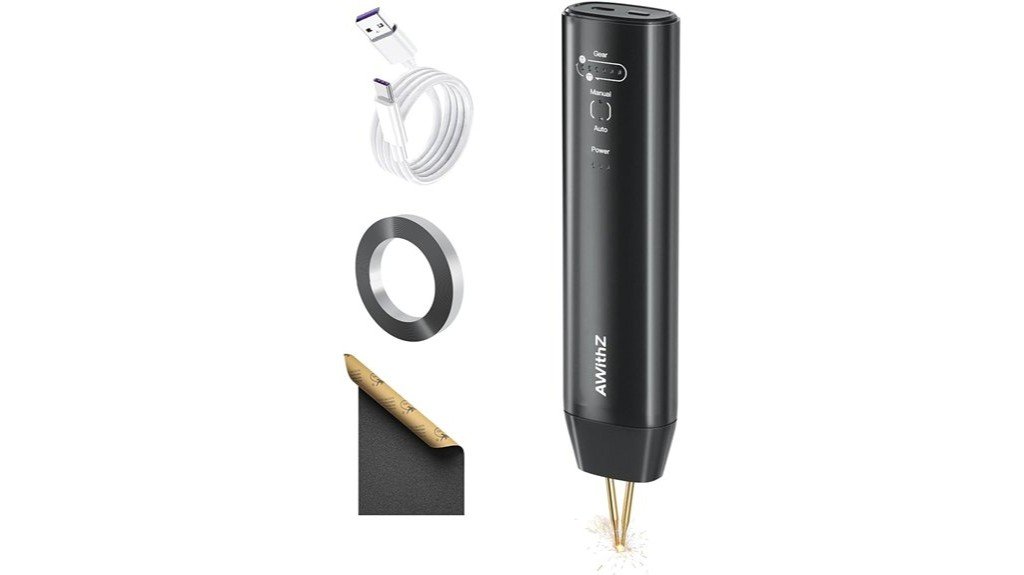
The AWithZ H1 uses a compact, pen-shaped body with built-in welding electrodes. Because you do not need a separate external welding pen, there are fewer accessories to arrange before starting a small project.
Its controls are straightforward. A side button manages power, while the upper control lets you adjust the gear and select the welding mode. Indicator lights provide visual feedback rather than the larger display found on some newer welders.
Controls and Operation
- Power: Press and hold the side power button for approximately two seconds to turn the unit on or off.
- Gear selection: Use the upper control to cycle through the 11 available settings.
- Mode selection: Press and hold the mode control for approximately two seconds to change between automatic and manual operation.
- Welding tips: The integrated electrodes reduce the need to handle separate probe cables.
These controls can make occasional work easier, but the compact design has a tradeoff. You must position the whole device carefully, which may feel less flexible than using separate probes in tight battery layouts.
Adjustable Power Settings
The H1 provides 11 adjustable output gears. This is one of its main features because different strip thicknesses can require different welding output.
The Amazon listing provides the following general gear guidance:
| Power Gear | Listed Application | Buyer Note |
|---|---|---|
| 1-3 | Selected small battery applications | Use only with compatible tabs and approved battery repair methods. |
| 3-6 | 0.1 mm nickel strip | Check material type and test weld strength on suitable scrap. |
| 6-11 | 0.12-0.15 mm nickel strip | Higher settings do not guarantee reliable results with every strip. |
These ranges are manufacturer guidance, not independently established settings for every cell and metal combination. Strip quality, electrode condition, and contact can change the result.
The main benefit is control. You can choose from several output levels instead of relying on one fixed setting. The limitation is that you must assess weld quality rather than assume a selected gear will always produce a strong joint.
Battery Life and Charging
The AWithZ H1 uses an internal rechargeable lithium-polymer power system and a USB Type-C charging interface. Its integrated battery means you do not need an external welding power pack during normal operation.
AWithZ advertises more than 200 spot welds from one charge. Treat this as a manufacturer estimate, not a guaranteed count. The number you achieve can change with the power level, material thickness, operating temperature, and condition of the internal battery.
For occasional repairs, the rechargeable setup is convenient. For large batches, however, charging time and heat buildup can interrupt your work. If you regularly assemble battery packs, compare the H1 with equipment designed for longer welding sessions.
How It Performs in Real Use
The following examples describe practical applications based on the listed features and compatibility. They are not claims of independent hands-on testing.
1. Welding Tabs for 18650 Battery Projects
The H1 is intended for compatible 18650 battery work. Its adjustable output can help when connecting suitable thin nickel strips during a properly designed battery assembly or repair.
The key concern is joint quality. A strip that appears attached may still have a weak connection. Always follow the cell manufacturer’s handling guidance and use appropriate checks before putting a repaired pack into service.
2. Working With Larger Cylindrical Cells
The product listing also names 26650 and 36650 cylindrical battery formats. This makes the H1 relevant to users working with more than one cell size.
Cell diameter alone does not establish safe welding compatibility. The terminal design, strip material, cell condition, and intended pack construction are more important than size alone.
3. Small Electronics and Battery Repairs
AWithZ markets the H1 for selected small battery applications, including mobile phone battery work. Its lower gear settings may suit some thin, compatible metal connections.
Modern phone batteries often use delicate pouch cells with specialized protection circuits. Such repairs can present serious risks and may not be suitable for direct spot welding. For sealed or pouch-cell batteries, professional battery replacement is generally the safer choice.
4. Repeated DIY Welding Jobs
The built-in battery and 11 gears make the H1 convenient for several small tasks at a workbench. You can change the output without connecting an external welding station.
For prolonged sessions, pay attention to device temperature, battery charge, and tip condition. The manufacturer’s advertised weld count does not mean the unit should operate continuously without cooling breaks.
Setup Tips Before First Use
Proper preparation matters more than simply choosing a high welding setting. Follow the supplied manual and the safety instructions for the specific battery cells and connecting material.
- Check the battery: Do not work on swollen, punctured, leaking, damaged, or otherwise unsafe cells.
- Confirm the strip: Make sure its composition and thickness are within the welder’s intended range.
- Prepare the work area: Use an appropriate nonflammable surface, keep conductive clutter away, and wear suitable eye protection.
- Inspect the electrodes: Make sure the tips are clean, properly fitted, and in good condition before use.
- Practice safely: Familiarize yourself with the controls and assess sample welds on appropriate test material before working on a live battery assembly.
- Follow the manual: Use the specified charging method and stop if the tool becomes unusually hot or behaves abnormally.
Pro Tip: Keep a small record of the strip material, thickness, and welding setting used in each successful test. That makes it easier to reproduce a suitable setup and spot changes in weld quality. Do not reuse a setting blindly with a different cell or strip.
Safety Features and Protections
The AWithZ H1 lists several built-in protections intended to reduce electrical and battery-related faults during normal use.
- Overcharge Protection: Designed to help protect the internal rechargeable battery during charging.
- Temperature Protection: Intended to respond to abnormal device temperature conditions.
- Short-Circuit Protection: Listed as a safeguard against certain electrical fault conditions.
- Low Cell Voltage Alarm: Alerts you when the internal battery voltage is low.
- Abnormal Battery Temperature Alert: The listing also describes a temperature warning function.
These are manufacturer-listed features. They should not be treated as proof that every electrical hazard is prevented or that the welder is safe for all battery types.
Important Lithium Battery Safety Notes
Lithium battery work carries a risk of burns, short circuits, fire, and thermal runaway. Even a small handheld welder can deliver high current during a pulse.
Keep conductive objects away from exposed battery terminals. Do not try to repair damaged cells or weld directly onto a pouch battery unless the cell manufacturer explicitly allows the method and you have appropriate professional training.
A safe battery pack also needs the correct insulation, electrical protection, and battery-management design. A spot welder alone cannot establish that a completed pack is safe.
Packaging and Accessories
The AWithZ H1 comes with several accessories for basic setup. According to the Amazon listing, the standard package includes:
- One AWithZ H1 handheld spot welder.
- A 2-meter nickel-plated metal strip for suitable welding projects.
- One USB Type-C charging cable.
- One piece of frosted or abrasive paper.
- A user manual.
- Replacement welding tips listed in the product details, in addition to those fitted to the tool.
The included nickel-plated strip is useful for initial practice, but it should not automatically be treated as suitable for every battery pack. Choose connecting materials based on your pack’s electrical requirements and the cell manufacturer’s guidance.
Accessory bundles can vary by listing version or seller. Check the selected H1 variant and current package details, especially if replacement tips are important to you.
Maintenance and Storage
Welding electrodes wear during use. Inspect the tips for damage, contamination, or uneven contact, and replace them with compatible parts when needed.
Keep the charging port dry, store the tool away from heat and moisture, and avoid leaving loose metal pieces near its electrodes. Follow the manufacturer’s battery-storage guidance if you will not use it for an extended period.
Pros and Cons
Pros
- 11 adjustable output settings provide more control than a fixed-power tool.
- Integrated welding pen eliminates separate probe cables.
- Automatic and manual modes support different operating preferences.
- USB-C charging and internal batteries improve portability.
- Included strip, accessories, and replaceable electrodes add practical value.
Cons
- Weld performance depends heavily on strip thickness and metal composition.
- Rechargeable operation may be limiting during long or frequent welding sessions.
- The integrated pen format is less flexible than separate probes for some confined layouts.
Is It Worth the Price?
The AWithZ H1 is positioned as a compact, entry-level battery spot welder. Its strongest value comes from combining adjustable output, rechargeable operation, and an integrated welding pen in one portable device. For occasional work with compatible thin strips, these features may be enough without buying a larger welding station.
However, its value depends on the current seller price and your workload. Amazon did not show a featured offer when this review was updated, so a reliable current price comparison is not available here. Check the actual selling price, included accessories, warranty terms, and return policy before deciding.
If you plan frequent pack assembly or need stronger welding performance on demanding materials, a higher-capacity machine may be the better long-term investment.
How It Compares to Alternatives
The AWithZ H1 is most attractive when you want a simple portable welder with 11 power settings. AWithZ also offers newer models, including the H1-2026 and H2-2026. The H2-2026 uses a color display and finer power adjustment, making it worth comparing if you want more control. These are different products from the original H1 reviewed here, so do not assume their specifications apply to this Amazon listing.
For workshop use, the SUNKKO 737G offers a desktop welding arrangement with a fixed welding head and foot pedal. That setup may suit repeated battery assembly better, but it gives up the H1’s compact, cable-free convenience. Your choice should depend on material compatibility, welding frequency, and workspace rather than portability alone.
Frequently Asked Questions
Can the AWithZ H1 weld battery types beyond 18650 and 26650?
Yes. The manufacturer lists 36650 cylindrical cells and selected small battery applications in addition to 18650 and 26650 cells. You must still confirm that the specific cell, terminal, and metal strip are suitable for spot welding.
How many spot welds can it perform on one charge?
AWithZ advertises more than 200 spot welds per full charge. Actual results may vary with output level, material thickness, battery condition, and operating temperature. This figure should be treated as a manufacturer estimate.
Do you need training to use the AWithZ H1 safely?
The controls are simple, but safe battery welding requires an understanding of electrical hazards, cell handling, and weld quality. Read the manual and learn the correct process before attempting a repair. Seek qualified guidance if you have no experience with lithium battery assemblies.
What warranty comes with the AWithZ H1 Handheld Spot Welder?
A specific warranty period could not be confirmed for this exact Amazon listing. Check the seller’s current warranty statement, return conditions, and support options before purchasing. Do not assume coverage offered on another AWithZ model applies to the H1.
Are replacement welding tips available for the AWithZ H1?
The Amazon product details list replacement welding tips among the included components. AWithZ also offers welding-pin accessories for its handheld series. Confirm the exact tip shape and model compatibility before ordering additional parts.
Can the AWithZ H1 weld 0.2 mm pure nickel?
Do not assume it can reliably weld 0.2 mm pure nickel. The published gear guidance focuses mainly on thinner strips up to 0.15 mm, and pure nickel can require different welding energy than nickel-plated steel. If thicker pure nickel is essential, choose equipment with verified support for that material.
Does the H1 require a separate welding pen or external power supply?
No. The H1 integrates the welding electrodes and rechargeable power source into one handheld body. You will need the charging cable to recharge it, but normal welding operation does not require a separate wired welding pen.
What comes in the AWithZ H1 package?
The listing includes the handheld welder, a 2-meter nickel-plated strip, a Type-C charging cable, frosted paper, and a manual. Its technical details also list spare welding tips. Confirm the contents of your selected bundle before checkout because accessories can vary by version or seller.
The Bottom Line
The AWithZ H1 Handheld Spot Welder is worth considering if you need a compact rechargeable tool for occasional battery-tab welding with compatible thin metal strips. Its main advantages are the 11 adjustable settings, integrated welding pen, and two operating modes, while its limitations include material sensitivity and modest suitability for demanding workloads. Choose it for portability and small DIY tasks, but consider a more capable welder if you need frequent, high-volume, or thicker-material welding.