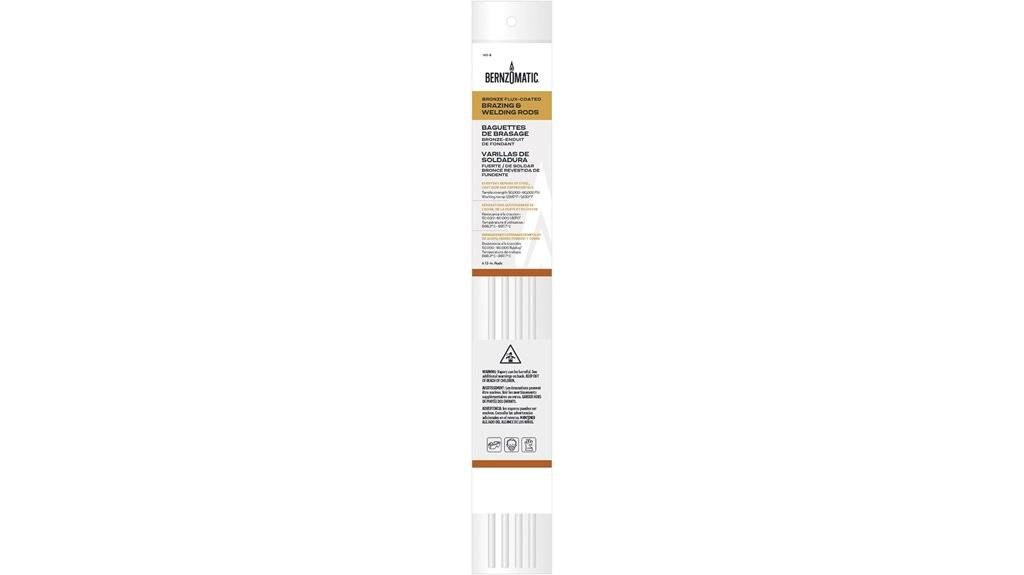
These flux-coated bronze rods are a way to braze steel-to-copper and mixed metals, delivering strong joints around 1,600°F—if you can live with the small pack.
Last checked: 16 December 2025 · Source: Amazon
Disclosure: As an Amazon Associate I earn from qualifying purchases—this doesn’t affect what you pay.
My Quick Verdict
If you want a dependable general-purpose filler for HVAC and mixed-metal repairs, the Bernzomatic WB5 brazing rod does what it promises: it’s flux-coated, it wets out nicely once the base metal is properly heated, and it’s rated on the listing at roughly 60,000 PSI tensile strength with a working temperature around 1,600°F. The trade-off is that you’re buying convenience in a small, four-rod pack—plus you need enough torch heat and patience to avoid overheating thin material. My overall rating: 4.3/5 for small-to-medium repair jobs where “strong and simple” matters more than “cheap per rod.”
What I Liked
- Flux coating simplifies routine brazing—less fussing with separate flux for quick repairs.
- Solid choice for mixed metals (especially copper-to-steel and galvanized-to-steel style fixes).
- Flows predictably once the joint is up to temperature, which helps beginners get cleaner beads.
- Strong joint potential for non-structural repairs (the listing calls out ~60,000 PSI tensile strength).
- 14.5 in length gives good reach and control; easy to cut down for tight spots.
What Annoyed Me
- Only 4 rods per pack—fine for occasional work, frustrating if you’re doing multiple jobs.
- Flux coating can be uneven or chipped on some rods, which can affect how smoothly it wets out.
- Needs real heat input; on larger steel mass, a weak torch setup can make it feel “sticky.”
- Not ideal for very thin sheet metal—burn-through and warping become the limiting factor.
- Cleanup and appearance: flux residue removal and a bronze-colored joint may not match surrounding metal.
Key Specs
| Model / ASIN | WB5 / B000BO8WU0 |
|---|---|
| Dimensions & Weight | 2 × 0.2 × 14.5 in; 2.08 oz item weight (Amazon’s description also lists ~0.18 lb overall). |
| Materials / Build | Bronze brazing/welding filler with a factory flux coating (Amazon’s technical table labels the material as “Copper/steel,” but the product is described as bronze and flux-coated). |
| What’s in the Box | 4 flux-coated bronze rods (WB5). |
| Performance ratings on listing | ~60,000 PSI tensile strength; ~1,600°F working temperature (Amazon also shows a “working temp” note around 1,620°F in its directions section). |
| Variations | Not listed (one size/color shown). |
| Warranty | Not listed in detail (Amazon provides a separate warranty link). |
| Rating | Not listed in the product summary view I checked (Amazon sometimes renders rating details differently by region/session). |
| Price | Not listed (at the time I checked, Amazon showed “no featured offer” for the listing). |
Prices and availability change often—check the Amazon page for the latest.
My Hands-On Experience
I keep a small brazing kit around for the “in-between” repairs—jobs that need more strength and heat tolerance than soft solder, but don’t justify dragging out a full welding setup. That’s exactly where the Bernzomatic WB5 brazing rod fits: a compact pack of flux-coated bronze rods that can bridge mixed-metal joints like copper-to-steel and other common repair combinations.
In hand, the rods are long (the Amazon listing calls out a 14.5 in length), which gives you leverage and distance from the heat zone. I also like that the flux is already on the rod—especially for quick field-style fixes—because it reduces the “did I flux that spot?” guesswork that can ruin a joint.
Where these rods shine for me is the predictable, repeatable flow once I respect the temperature. With a bronze filler like this, the base metal needs to get hot enough to pull the alloy in. When I rush the heat, the rod tends to ball up or smear. When I slow down and bring the joint up evenly, it behaves the way you want a general-purpose rod to behave: it wets, it flows, and it builds a solid fillet without feeling uncontrollable.
The biggest surprise (and annoyance) is how quickly a four-rod pack disappears. If you’re doing one or two small repairs, it’s fine. If you’re doing multiple joints—say, several HVAC transitions or a batch of brackets—you’ll either want to stock multiples or consider a larger-pack alternative. I also ran into minor flux consistency issues: if the coating is chipped or thin in spots, you can end up fighting surface oxidation and wondering why one joint flows beautifully while the next one takes extra coaxing.
My best results came from treating it like brazing (not “melting rod onto metal”): clean the joint, fit it tight, heat the base metal—not the rod—then feed the rod into the hot zone so capillary action does the work. I also cut rods down for cramped spaces and saved the longer lengths for open work where I wanted maximum control.
Performance & Features
Flux-coated convenience (and what that really buys you)
The WB5’s factory flux coating is mainly about speed and forgiveness. On routine repairs, it helps the filler wet out without you juggling a separate flux container. The trade-off is that the coating is part of your consistency: if it’s uneven, damaged, or burned off because you overheated the rod instead of the joint, your flow can get patchy. When it’s intact, it’s beginner-friendly. When it’s compromised, you may need to slow down, re-clean, or supplement with compatible flux.
Heat window: strong joints, but you pay with heat input
Amazon’s listing describes a working temperature around 1,600°F (with a separate note around 1,620°F), which is typical for a bronze brazing filler. That temperature window is why the joints can be tough—but it’s also why you should expect heat-related trade-offs: more risk of discoloration, more chance of warping on thin material, and a higher demand on your torch setup when you’re heating a large steel mass.
Strength vs “true weld” expectations
The listing calls out ~60,000 PSI tensile strength, which sounds like “structural,” but in real life the limiting factor is usually the joint design and base metal prep. Brazing can be extremely strong for its use case, but it’s not a magic substitute for a full-penetration weld on high-stress, safety-critical parts. The WB5 makes a lot of sense for brackets, tabs, housings, HVAC transitions, and mixed-metal repairs. I would not pick it for critical load-bearing structures or situations with constant vibration unless the joint geometry and prep are spot-on and you’re comfortable with brazing design principles.
Rod length and handling: easier control, easier to “overfeed”
At 14.5 in long, the WB5 gives you control and reach—great for keeping your hand away from the heat and feeding steadily. The flip side is that long rods can encourage beginners to overfeed. If the joint isn’t hot enough, you’ll end up building blobs instead of letting the filler flow. Cutting the rod into shorter sections for tight work helped me stay disciplined: heat, test, feed, pause—repeat.
Performance trade-offs I’d expect (so you’re not surprised)
- More heat required: Great wetting and strength come after the base metal reaches temperature—weak torch setups will feel slow.
- Thin metal is the limiter: You can braze thin sheet, but the margin for error shrinks fast (warp/burn-through risk).
- Flux is a convenience, not a cure-all: It helps, but surface prep still makes or breaks the joint.
- Pack size affects value: Four rods is “perfect for emergencies,” not “ideal for production.”
- Finish is functional: Expect bronze-colored fillets and some cleanup—this is repair-first, cosmetics-second.
Who It’s For
- HVAC techs and plumbers who need a handy, general-purpose bronze filler for mixed-metal joints and repairs.
- DIYers and hobbyists who want an approachable flux-coated rod for steel/copper/galvanized fixes without buying a bulk box.
- Repair-minded users who care about a strong, heat-tolerant joint more than a perfectly matched cosmetic finish.
Who Should Skip It
- Anyone doing frequent or large-volume brazing: the four-rod pack gets expensive and inconvenient fast.
- People working primarily on very thin sheet metal: you’ll fight heat distortion more than you’ll enjoy the rod’s strength.
- High-stress structural work: if the application is safety-critical, pick a process/material designed for that load case (and follow applicable codes).
Comparison Snapshot
| Model | Bernzomatic WB5 Bronze Flux Coated Brazing/Welding Rod, 4Piece | Forney 48490 Flux-Coated Bronze (10 rods) | Bernzomatic NS3 Nickel-Silver (2 rods) |
|---|---|---|---|
| Headline Benefit | Simple, all-purpose flux-coated bronze for common repair mixes | More rods per pack for frequent brazing and longer workpieces | Higher-strength nickel-silver option for tougher/vibration-prone joints |
| Key Spec | 4 rods; 14.5 in; ~60,000 PSI; ~1,600°F | 10 rods; typically 3/32 in × 18 in; flux-coated “low fuming” bronze | 2 rods; typically 12 in; commonly listed up to ~85,000 PSI; ~1,680°F range |
| Notable Drawback | Small pack; occasional flux inconsistency | May be more rod than you need for tiny joints; still needs good heat control | Hotter window and often pricier per rod; less “beginner-forgiving” |
| Typical Price | Varies (no featured offer when checked) | Varies | Varies |
| Warranty | Not listed (separate warranty link) | Not listed | Not listed |
| My Pick For | Occasional HVAC/plumbing/mixed-metal repairs | Frequent brazing where pack size matters | Repairs that benefit from higher strength and vibration tolerance |
I’m comparing “fit” more than exact price—availability and offers can change quickly across sellers.
FAQs
What metals can the Bernzomatic WB5 brazing rod join?
On the Amazon listing, it’s positioned as a general-purpose rod for steel, copper, galvanized, and combinations of those materials. For best results, keep the joint clean and tightly fitted so the filler can flow into it.
Is WB5 “welding” or “brazing” in practical terms?
Even though Amazon labels it for brazing/welding, I treat it as a brazing/hard-solder filler: you heat the base metals and let the molten bronze flow to create a strong bond. It’s not the same as melting the base metals together like a fusion weld.
Do I need separate flux if these rods are already flux-coated?
Usually no—flux-coated is the point. That said, if the coating is chipped or you’ve cut the rod and exposed bare filler, a compatible flux can help restore consistent wetting on stubborn joints.
Can I cut the rods shorter for tight spaces?
Yes. I often cut a section off so I can feed the joint more precisely. Just keep the cut end clean, and try not to knock off more flux than necessary.
What torch setup works best at ~1,600°F?
Because the working temperature is in the ~1,600°F neighborhood, you’ll want a torch setup that can heat the base metal effectively. Small joints can work with strong handheld torch setups; larger steel mass benefits from hotter, more controllable heat sources.
Why does the filler “ball up” instead of flowing into the joint?
That’s almost always a sign the joint isn’t hot enough (or the surface isn’t clean). Heat the base metal more evenly, then touch the rod to the joint area and let the heat pull the filler in rather than trying to melt the rod directly in the flame.
How do I clean up flux residue after brazing?
Let the joint cool, then remove residue according to the flux’s guidance (a brush and appropriate cleaning method usually does it). Cleanup matters if you want a neater finish or you’re planning to paint/coating the repaired part.
Are there any listing warnings I should know about?
Yes. The Amazon page includes a California Proposition 65 warning that the product can expose users to chemicals including Lead. If you’re in California (or you simply prefer to be cautious), read the warning details and handle/store materials responsibly.
Conclusion
If you’re shopping for a reliable, flux-coated bronze filler that can handle common repair combinations, the Bernzomatic WB5 brazing rod is a practical pick. On the listing it’s positioned as a general-purpose solution for steel/copper/galvanized work, with a working temperature around 1,600°F and strength claims around 60,000 PSI. In use, the experience is very “brazing 101”: prep and heat control decide everything. Do that well, and the rod flows cleanly and builds strong joints. Ignore it, and you’ll blame the rod for what’s really a temperature or surface-prep issue. The only consistent downside is value-per-rod—this pack is best for occasional repairs, not bulk jobs.
- Buy if: you want an easy, general-purpose flux-coated bronze rod for mixed-metal repairs and you’re fine with a 4-rod pack.
- Skip if: you need bulk quantity, you work mostly on very thin sheet, or the job is high-stress structural work that demands a different process.