Choosing a fifth-wheel setup for a Ford F-250 is not simply a matter of picking the highest-rated hitch. Your truck’s model year, factory towing-prep equipment, bed length, payload, trailer pin weight, and cab-to-trailer clearance all affect which parts you actually need.
This guide compares one complete fifth-wheel hitch and three mounting-system options for different F-250 configurations. That distinction matters: a rail kit or mounting bracket gives a hitch somewhere to attach, but it does not replace the hitch itself or automatically solve short-bed turning-clearance problems.
This roundup is reader-supported. When you click through Amazon links, we may earn a referral commission on qualifying purchases at no extra cost to you.
Quick Verdict:
If your F-250 already has a compatible Ford OEM puck system and you need a complete fixed fifth-wheel hitch, the B&W RVK3300 is the only complete hitch in this group. If your truck does not have the mounting system you need, the three Reese products address different rail, bracket, and under-bed installation requirements.
Short-bed warning: A fixed hitch does not automatically provide enough cab clearance for every short-bed F-250 and fifth-wheel combination. Verify your truck, trailer nose, pin-box geometry, and hitch placement before making tight turns. A compatible slider or other manufacturer-approved clearance solution may be required.
Key Takeaways
- Only the B&W RVK3300 below is a complete fifth-wheel hitch; the Reese products are mounting hardware or under-bed mounting systems.
- Match every component to your exact F-250 year, body configuration, factory prep package, and bed setup before ordering.
- A rail kit does not create extra short-bed turning clearance. Short-bed owners must separately verify cab-to-trailer clearance.
- Count the hitch itself, loaded trailer pin weight, passengers, cargo, and other equipment against the truck’s available payload.
- Use the lowest applicable rating among the truck, hitch, mounting system, pin box, tires, and other towing components.
Quick Comparison
| Product | What It Is | Best Fit | Short-Bed Note |
|---|---|---|---|
| B&W RVK3300 Companion | Complete fixed fifth-wheel hitch | Compatible Ford OEM puck-system trucks | Fixed hitch; verify cab clearance before using in a short-bed setup. |
| Reese 30180 | Under-bed fifth-wheel/gooseneck mounting system | Seller-listed 2017–2022 Ford Super Duty applications without the required factory prep setup | Provides mounting points, not slider travel. |
| Reese 50043 | Vehicle-specific mounting brackets | 1999–2004 F-250/F-350 Super Duty, except Cab & Chassis | Requires compatible rails and a separate hitch. |
| Reese 30035 | Universal-style in-bed rail and bracket kit | Select older F-250 applications after fitment confirmation | Rails remain in the bed and do not add turning clearance. |
B&W Trailer Hitches 20K Companion OEM Fifth Wheel Hitch (RVK3300)
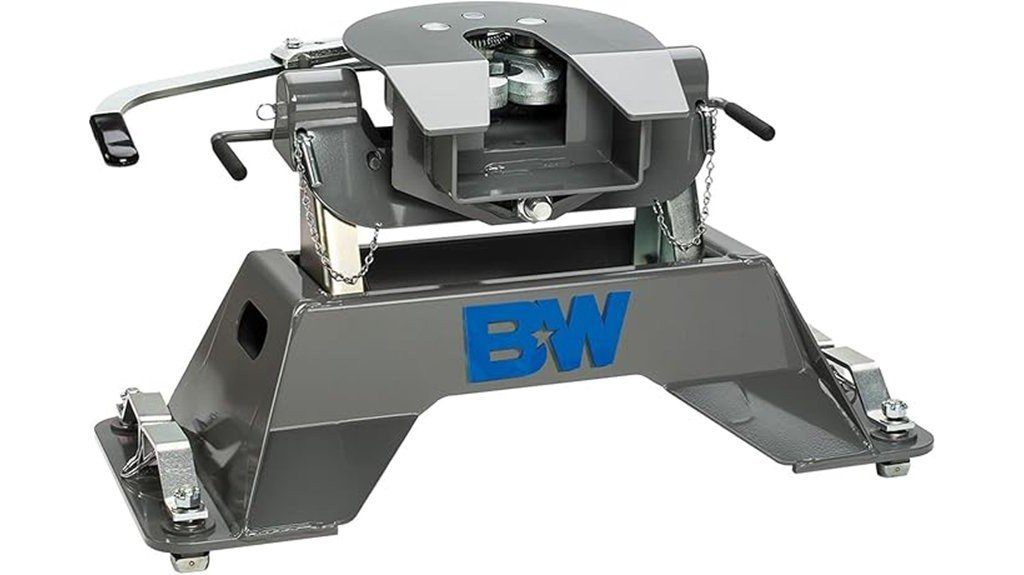
Best Complete Hitch for Ford OEM Pucks
If your F-250 already has the compatible Ford OEM puck system and you want a removable complete fifth-wheel hitch, the B&W Companion RVK3300 is the most directly relevant product in this group. It is rated for up to 20,000 lb gross trailer weight and 5,000 lb vertical trailer weight, with three hitch-height positions from 16.75 to 18.75 inches and up to 2 inches of front-to-back adjustment.
Its articulating coupler helps accommodate changes in road angle and uneven campsites, while B&W’s close-fitting jaw design is intended to reduce unwanted movement at the kingpin connection. The two-piece construction can also make removal easier than lifting the complete assembly as one unit.
Short-bed note: RVK3300 is a fixed hitch, not a slider. Do not assume its small fore/aft adjustment creates enough trailer-to-cab clearance for tight short-bed turns. Confirm your specific truck and trailer geometry before purchase.
Best For: F-250 owners with a compatible Ford OEM puck system who want a removable fixed fifth-wheel hitch and have confirmed adequate trailer-to-cab clearance.
Pros:
- Complete fifth-wheel hitch rather than a rail or bracket kit.
- 20,000 lb gross trailer weight and 5,000 lb vertical trailer weight ratings.
- Multiple height positions and limited front-to-back adjustment help with trailer leveling and bed-rail clearance.
- Removable two-piece design is useful when you need the bed for cargo between towing trips.
Cons:
- Requires a compatible Ford OEM puck mounting system.
- Fixed design does not provide the rearward slider movement many short-bed combinations need for tight maneuvering.
- Its 20,000 lb hitch rating does not increase the F-250’s own towing, payload, axle, tire, or GVWR limits.
Reese 30180 Elite Series Fifth Wheel Hitch Mounting Rail Kit for 2017-2022 Ford F-250/F-350/F-450 Super Duty
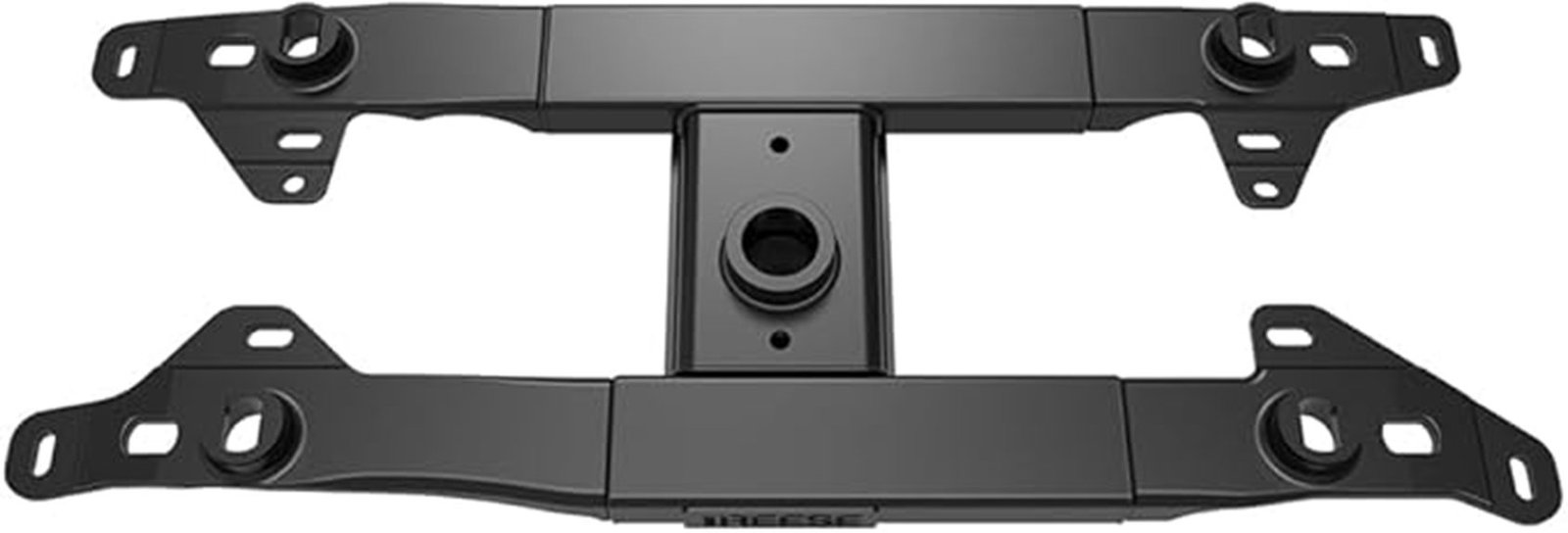
Best Under-Bed Mounting Option for the Listed Super Duty Applications
The Reese 30180 is not a standalone fifth-wheel hitch. It is an under-bed mounting system that creates Reese/Ford-style mounting points while allowing a cleaner bed when the removable towing components are taken out. Its wider under-bed mounting footprint is useful for owners who prefer a puck-style setup rather than permanent above-bed industry-standard rails.
The supplied product listing identifies this kit for 2017–2022 Ford F-250, F-350, and F-450 Super Duty applications. Because Super Duty mounting systems and factory-prep packages vary by model year, verify the current Reese application guide for your exact truck before ordering, especially on newer trucks or vehicles already equipped with a factory towing-prep system.
Capacity also depends on the supporting bracket configuration. Reese installation information lists up to 27,000 lb fifth-wheel / 27,500 lb gooseneck with the required bolt-on inner-bracket configuration, or up to 32,000 lb fifth-wheel / 35,000 lb gooseneck with the specified welded inner brackets and additional maximum-capacity hardware. Those are mounting-system limits; your actual allowable trailer weight can be much lower based on the truck and hitch.
Best For: F-250 owners in a confirmed compatible application who need an under-bed mounting system before installing an appropriate puck-compatible fifth-wheel hitch.
Pros:
- Under-bed design leaves a much cleaner cargo floor when removable towing hardware is taken out.
- Supports both fifth-wheel mounting points and a gooseneck configuration when equipped with the correct components.
- Vehicle-specific layout is preferable to guessing at universal rail placement.
Cons:
- It is mounting infrastructure, not a complete fifth-wheel hitch.
- Exact fitment depends on model year, factory prep equipment, and the required frame-bracket configuration.
- Higher advertised system ratings require specific supporting brackets and do not override the truck’s own ratings.
Reese Towpower Fifth Wheel Hitch Mounting System Custom Bracket for Ford F-250/F-350 Super Duty
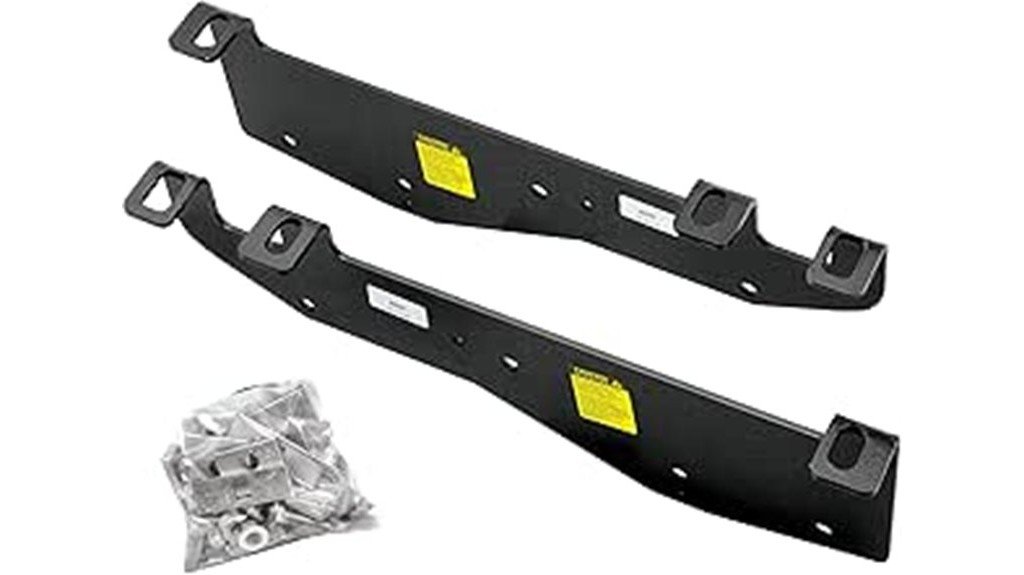
Best Custom Bracket for 1999–2004 F-250/F-350 Super Duty
The Reese 50043 is a vehicle-specific mounting bracket for 1999–2004 Ford F-250 and F-350 Super Duty pickups, except Cab & Chassis applications. It is useful when you want a bracket designed around the truck’s frame instead of relying only on a universal bracket arrangement.
This product is not a complete rail-and-hitch package. The 50043 brackets are used with Reese 58058 rails, which are sold separately unless you buy a combined kit containing both components. Reese also identifies drilling as part of the installation, so this is not a simple no-drill puck-system upgrade.
Best For: Owners of compatible 1999–2004 F-250/F-350 Super Duty pickups who need the correct custom frame brackets for an in-bed rail system.
Pros:
- Vehicle-specific fit for the listed 1999–2004 F-250/F-350 Super Duty applications.
- Designed to work with Reese 58058 in-bed rails.
- Custom bracket positioning can simplify alignment compared with a fully universal frame-bracket setup.
Cons:
- Bracket only; Reese 58058 rails and a compatible fifth-wheel hitch are separate components unless purchased as a combined kit.
- Fitment is limited to specific 1999–2004 F-250/F-350 Super Duty configurations.
- Installation requires drilling and appropriate tools.
Reese Fifth Wheel Trailer Hitch Mounting Rail & Bracket Kit
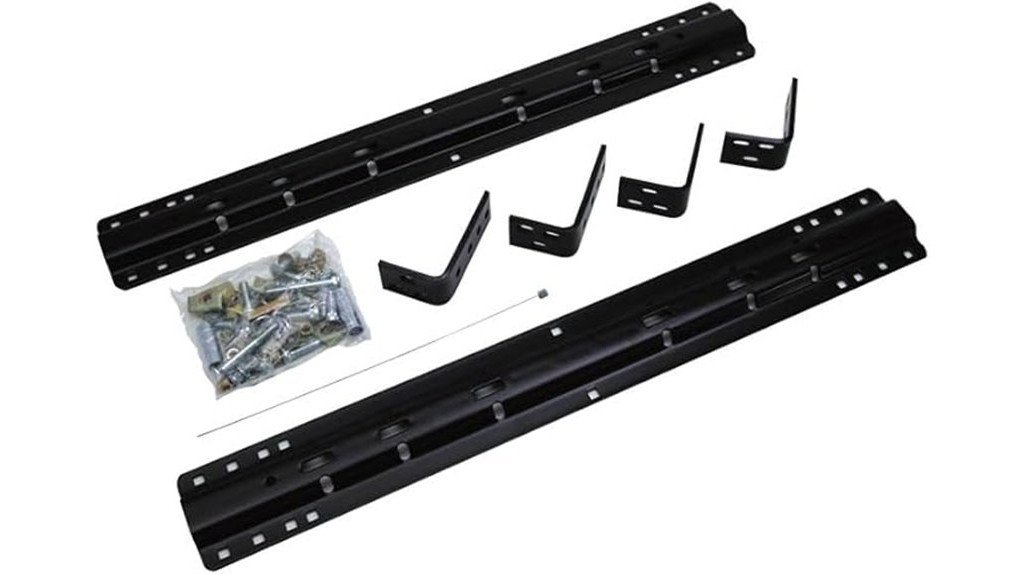
Best Universal-Style In-Bed Rail Kit for Compatible Older F-250 Applications
The Reese 30035 is a 10-bolt in-bed rail and bracket kit for installing a compatible fifth-wheel hitch in many full-size pickups. Reese lists numerous Ford applications, including several F-250 and F-250 Super Duty model-year ranges, so it can make sense for an older F-250 that does not already have an OEM puck system.
Unlike an under-bed puck system, the 30035 leaves its base rails above the bed floor after you remove the hitch. That still gives you the ability to take the bulky hitch out when it is not needed, but the bed does not become completely smooth or unobstructed. Installation also requires drilling, so careful measurement and truck-specific instructions are essential.
Best For: Owners of a confirmed compatible F-250 who need traditional above-bed fifth-wheel rails and brackets for a compatible in-bed hitch.
Pros:
- Includes base rails, universal-style brackets, and installation hardware.
- Ten-bolt system is widely used with compatible in-bed Reese fifth-wheel hitches.
- Lets you remove the fifth-wheel hitch when you need more cargo room.
Cons:
- Not a complete fifth-wheel hitch.
- Requires drilling and exact vehicle-specific placement.
- Above-bed rails remain installed after the hitch is removed.
- Does not create additional short-bed cab clearance by itself.
Before You Buy
- Confirm truck fitment: Check model year, F-250 configuration, bed length, drivetrain, and whether the truck already has Ford’s factory fifth-wheel/gooseneck prep package.
- Check available payload: Use the certification and payload labels on your actual truck. Include the hitch, loaded trailer pin weight, passengers, cargo, and accessories.
- Verify short-bed clearance: Measure truck-to-trailer geometry and follow the hitch and trailer manufacturers’ clearance guidance before attempting tight turns.
- Match the mounting system: Industry-standard above-bed rails, Ford OEM-style pucks, and Reese Elite mounting points are not automatically interchangeable.
- Use the lowest rating: Never assume a high-capacity rail or hitch increases the truck manufacturer’s towing, payload, axle, tire, or GVWR limits.
Factors to Consider When Choosing a Fifth-Wheel Hitch or Mounting System for a Ford F-250
The right setup starts with identifying what your truck already has. An F-250 with factory puck mounting points needs a different solution from an older truck that requires traditional rails, while a short-bed truck adds a separate cab-clearance question. Treat hitch type, mounting type, truck ratings, and trailer geometry as four connected decisions.
Bed Length and Short-Bed Clearance
A shorter pickup bed reduces the distance between the fifth-wheel pivot area and the cab, which can increase the chance of the trailer nose contacting the truck during a sharp maneuver. A slider hitch or another trailer-manufacturer-approved clearance solution may be needed depending on the truck, trailer width, front-cap shape, and pin-box design. Traditional rails or puck systems only mount the hitch; they do not create additional clearance on their own.
Do not assume every short-bed combination can safely reach a 90-degree truck-to-trailer angle. Follow the hitch and trailer manufacturers’ clearance requirements and physically confirm clearance before attempting extreme turns.
Hitch Position and Kingpin Geometry
The relationship between the hitch pivot point, rear axle, truck cab, trailer front cap, and pin box affects both clearance and handling. Hitch location should follow the mounting-system manufacturer’s installation dimensions rather than being moved forward or backward simply to gain clearance.
Trailer pin-box geometry can also influence how much space you have between the trailer and cab. If your combination has limited clearance, use only a hitch, slider, pin-box, or other solution that the relevant manufacturers approve for that application.
Turning Clearance Needs
Short-bed clearance matters most during low-speed, tight-angle maneuvers such as backing into campsites or making sharp turns in confined areas. A true slider hitch can move the pivot point rearward during maneuvering, increasing the space between the cab and trailer.
Always return a manual slider to its normal locked towing position before regular road travel according to the hitch manufacturer’s instructions. A fixed hitch such as the RVK3300 does not provide this rearward slider movement.
Hitch Head Articulation
Hitch-head articulation allows the truck and trailer to accommodate changes in pitch and side-to-side road angle as the combination travels over uneven surfaces. Good articulation can make coupling and towing feel smoother, particularly on sloped campsites and uneven roads.
Articulation should not be confused with short-bed clearance. An articulating head can move with the trailer, but it does not automatically move the fifth-wheel pivot point far enough away from the cab for a tight turn.
Mounting System Type
Fifth-wheel mounting systems generally fall into a few common categories. Traditional above-bed rails stay visible in the bed after the hitch is removed. An under-bed or OEM-style puck system provides removable attachment points and a cleaner cargo floor when the hitch is out.
Before ordering, determine whether your truck already has factory prep equipment and confirm that the hitch and mounting system use compatible attachment points. A Ford OEM-puck hitch should not be assumed to fit traditional rails without an approved adapter, and traditional rail hitches should not be assumed to drop directly into puck openings.
Payload, GVWR, and Pin Weight
The hitch’s advertised trailer rating is only one part of the towing equation. Fifth-wheel pin weight presses directly into the truck bed and counts against available payload along with the hitch itself, passengers, cargo, tools, accessories, and other added weight.
Use the labels and documentation for your actual F-250 rather than relying on a generic payload number from another truck. Stay within the truck’s GVWR, rear-axle rating, tire ratings, payload, and Ford’s applicable towing limits. A suspension aid may change ride height or feel, but it does not increase the truck manufacturer’s certified weight ratings.
Installation Complexity
Installation difficulty varies substantially. A hitch that drops into an existing compatible factory puck system can be relatively straightforward, while retrofitting above-bed rails or an under-bed mounting system may require drilling, precise measurements, frame brackets, bed access, or substantial disassembly.
For example, the Reese 30035 and 50043 installations involve drilling, while the 30180 is a more involved under-bed mounting system whose required brackets depend on the truck’s existing equipment. If you are not comfortable working around the truck frame, bed, fuel-system components, and high-torque fasteners, professional installation is worth considering.
Stability, Loading, and Hitch Fit
A properly matched fifth-wheel connection should minimize unnecessary movement at the kingpin while allowing the articulation the hitch is designed to provide. Stability also depends on correct trailer loading, appropriate tire pressure, proper hitch height, a level towing attitude where practical, working trailer brakes, and staying within every component’s ratings.
Before each trip, confirm that the hitch is fully coupled and locked, mounting hardware is secure, safety-related trailer connections are complete, and nothing has loosened or become damaged since the previous tow.
Frequently Asked Questions
Can I Tow a 5th Wheel With a Used F-250 Without Upgrading Suspension?
Possibly. The deciding factor is whether the fully loaded truck and trailer combination stays within the F-250’s actual towing, payload, axle, tire, and GVWR limits and whether the truck is mechanically sound. Suspension aids may help with ride quality or leveling, but they do not increase the manufacturer’s certified payload or GVWR. If the truck is overloaded, reducing weight or using a properly rated tow vehicle is the appropriate solution.
How Does a Slider Hitch Help in Tight Campsites?
A slider can move the fifth-wheel pivot point rearward during low-speed maneuvering. That increases the distance between the trailer and truck cab and can provide additional clearance for sharper turns. With a manual slider, follow the manufacturer’s procedure for moving it into the maneuvering position and return it to the normal locked towing position before road travel.
Are There Special Permits for Towing Long 5th Wheels Across State Lines?
Rules vary by state and by the overall dimensions and configuration of the truck and trailer. Check the current length, width, height, weight, licensing, and permit rules for every state on your route before traveling. Do not assume that being legal in your home state makes the combination legal everywhere else.
Can I Install a 5th Wheel Hitch Without Drilling My Truck Bed?
If your F-250 already has a compatible factory puck or under-bed mounting system, the removable hitch itself may install without adding new holes to the bed. Retrofitting traditional rails or an under-bed system is different: some installations require drilling, bed access, or additional frame hardware. Check the instructions for the exact mounting kit instead of assuming the installation is no-drill.
What Routine Maintenance Helps Protect Fifth-Wheel Hitch Components?
Follow the hitch manufacturer’s maintenance schedule. Keep the jaws, pivot points, handles, mounting points, and other specified moving components clean and lubricated with the recommended products. Inspect fasteners, pins, clips, welds, coating damage, and corrosion regularly, and repair damaged protective finishes before rust spreads. Do not apply lubricant or anti-seize to a fastener or surface unless the manufacturer allows it, because lubrication can change required torque values.
Conclusion
The four products in this guide solve different parts of the Ford F-250 fifth-wheel setup. The B&W RVK3300 is the complete fixed hitch for compatible Ford OEM puck systems. The Reese 30180 provides under-bed mounting infrastructure for confirmed compatible Super Duty applications, the Reese 50043 supplies model-specific brackets for 1999–2004 trucks, and the Reese 30035 provides traditional above-bed rails and brackets for compatible applications.
If you own an F-250 short bed, make clearance a separate buying decision. Match the mounting hardware to the truck first, then choose a compatible hitch that meets your trailer weight and turning-clearance requirements. Finally, verify payload, pin weight, truck ratings, and current manufacturer fitment before you order or tow.