If you tow with a Ford F-250, you’ll want a fifth-wheel hitch that’s strong, smooth, and easy to use. I’ll point out three top options—the CURT Q20, Reese M5, and CURT Q16 with Ford legs—explain why they work with your truck’s puck system, and highlight the key factors to check before you buy. Stick around to make sure your next setup’s safe and efficient.
CURT 16035 Q20 5th Wheel Hitch (20,000 lbs) for Select Ford F-250/F-350/F-450 with 8-Foot Bed Puck System
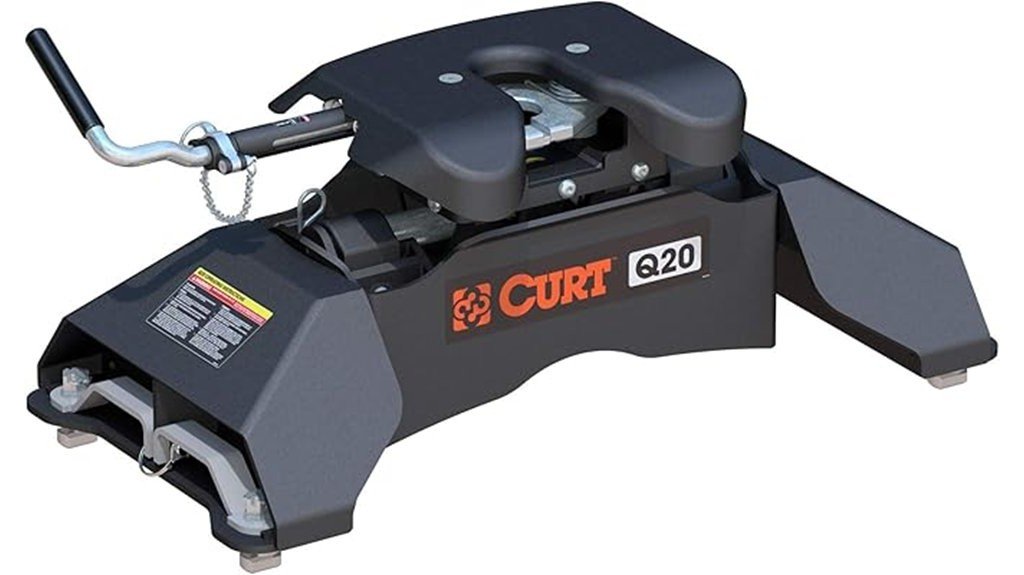
If you’ve got a Ford F-250 (or F-350/F-450) with the 8-foot puck system and you want a heavy-duty, low-maintenance hitch, the CURT 16035 Q20 is a smart pick — it’s rated for 20,000 lbs GTW and uses a spherical axial bearing for a quieter, more flexible ride while offering a simple, single-handle operation and quick quarter-turn puck mounting. You’ll appreciate its 5,000 lb vertical load, 51.9 lb weight, and carbide black powder coat for corrosion resistance. The 3-position coupling indicator and SAE J2638 testing boost safety. Note: it won’t fit articulating/turret pin boxes.
Best For: Owners of Ford F-250/F-350/F-450 trucks with the 8-foot factory puck system who need a heavy-duty, low-maintenance 5th wheel hitch with smooth, quiet towing.
Pros:
- Rated for 20,000 lbs GTW and 5,000 lbs vertical load, providing strong towing capacity.
- Spherical axial bearing and 3-position coupling indicator deliver quieter, more flexible towing and clear coupling status.
- Quick quarter-turn puck mounting and single short-throw handle make installation and operation fast and easy.
Cons:
- Only compatible with select Ford trucks with the 8-foot puck system—won’t fit other mounting setups.
- Not compatible with articulating/turret-style pin boxes (e.g., Rota-Flex, Sidewinder).
- Customer rating averages 3.7/5 based on 30 reviews, indicating mixed user satisfaction.
Reese 30921 M5 Fifth Wheel Hitch 20,000 lbs Capacity (Complete System)

For drivers who tow heavy loads regularly and want a snug, stable connection, the Reese 30921 M5 is a top pick thanks to its Talon jaw that grips the king pin to eliminate lateral chucking and reduce sway. You’ll appreciate the 20,000 lb towing and 5,000 lb pin capacities, modular three-part design, and industry-leading shock absorption for a smoother ride. It fits 2011–2024 Ford Super Duty trucks with the OE Prep Package, uses alloy steel with black powder coat over E-coat for corrosion resistance, and features an ergonomic, easy-reach handle. Item weight is 46.9 lb; warranty details available on request.
Best For: Drivers of 2011–2024 Ford F-250/F-350/F-450 Super Duty trucks with the OE Prep Package who tow heavy loads regularly and want a snug, stable, low-sway fifth-wheel connection.
Pros:
- Talon jaw design that grips the king pin to reduce lateral chucking, sway, and noise.
- High capacity (20,000 lb towing, 5,000 lb pin) with modular three-part construction and industry-leading shock absorption for a smoother ride.
- Durable alloy steel construction with black powder coat over E-coat and an ergonomic, easy-reach handle.
Cons:
- Compatible only with Ford Super Duty trucks equipped with the OE Prep Package (2011–2024), limiting fitment for other vehicles.
- Moderate customer rating (3.9/5) from a small number of reviews, offering limited user feedback.
- Relatively heavy (46.9 lb) and may require assistance for installation or removal.
Curt 16033 Ford OEM Legs w/ Q16 5th Wheel Hitch Head
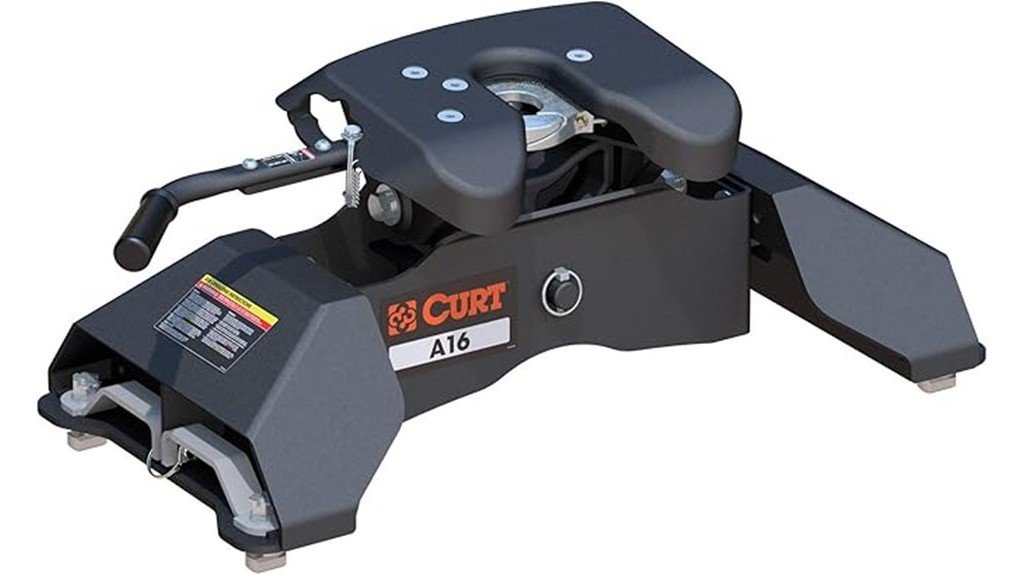
The Curt 16033 with Q16 head is ideal for Ford F-250 owners who want a high-capacity, truck-specific hitch that installs quickly into the factory puck system. You’ll appreciate the self-resetting handle for easier coupling, the 3-position indicator visible from the cab, and the full-articulation head with poly-torsion inserts that cuts shock and noise. Rated to SAE J2638 at 16,000 lbs GTW and 4,000 lbs VTL, it uses interlocking jaws and an extra-wide head for stability. Quarter-turn anchors speed installation, and the carbide black powder finish boosts corrosion and UV resistance for long-term durability.
Best For: Ford F-250, F-350, and F-450 owners with an 8-foot bed and factory puck system who need a high-capacity, quick-install 5th wheel hitch for heavy towing.
Pros:
- Self-resetting handle and 3-position coupling indicator make coupling easier and more user-friendly.
- Full-articulation Q16 head with poly-torsion inserts and interlocking jaws reduces shock, noise, and improves towing stability.
- Quick quarter-turn puck anchors and durable carbide black powder finish simplify installation and resist corrosion/UV damage.
Cons:
- Compatible only with select Ford trucks with the 8-foot bed puck system, limiting fitment.
- Heavier unit (90.8 lbs) can be cumbersome to handle during installation or removal.
- Higher upfront cost and specialized fit may not be necessary for light or occasional towing.
Factors to Consider When Choosing 5th Wheel Hitch For Ford F250
You’ll want to match the hitch’s towing capacity to your loaded trailer weight so you’re never under-rated. Check that the mounting system fits your F-250’s bed and consider head styles and shock-absorption features for ride quality and sway control. Also inspect coupling mechanism indicators to guarantee secure, easy hookups every time.
Towing Capacity Requirements
When you’re picking a 5th-wheel hitch for your Ford F‑250, make certain its towing and vertical load capacities meet or exceed your trailer’s gross weight—many compatible hitches handle 16,000–20,000 lbs and up to about 5,000 lbs of pin weight. Check the hitch’s published towing and vertical load ratings against your trailer’s GVW and pin weight; never assume margins. Confirm compatibility with your F‑250’s model year and factory towing package since capacities and requirements can differ. Factor in the hitch’s own weight because heavier units reduce your truck’s usable payload. Look for industry safety ratings like SAE J2638 to ascertain the hitch’s performance has been tested. When capacities and certifications align, you’ll tow safer and with greater confidence.
Mounting System Compatibility
Because your F‑250’s mounting system determines fit, ease of use, and whether a hitch meets your trailer’s loads, verify compatibility before you buy. Check whether your truck uses the Ford puck system or an OE Prep Package—many hitches are built specifically for those anchor patterns and quarter‑turn installs. Confirm the hitch’s rated gross trailer weight and vertical load match your F‑250’s mounting capacity and the hitch manufacturer’s limits. Look for models designed for quick installation if you want fast removal and reinstallation. Also verify compatibility with your trailer’s pin box design—articulating or turret‑style pin boxes can limit which hitches will work safely. Don’t assume universal fit; measure, match ratings, and consult fit guides to avoid problems.
Head Style Options
Any hitch head you pick will shape your towing feel and ease of use, so match head style to your hauling needs. Choose a spherical-bearing or full-articulation head if you want multi-directional tilt and better control; those designs help stability and reduce noise. Look for jaw styles like the Talon Jaw that eliminate lateral chucking to minimize sway. Guarantee a clear coupling indicator is present—three-position indicators visible from the cab let you confirm hitch status without leaving the truck. Prioritize ergonomic handle designs so you can hitch and unhitch with less force and fewer hassles. Balance these features against your trailer type and driving conditions to pick a head that improves safety, comfort, and everyday usability.
Shock Absorption Features
If you tow regularly over rough roads or long distances, choosing a 5th-wheel hitch with solid shock absorption will noticeably smooth the ride and cut down on vibration transfer to your F‑250. You’ll want a hitch that reduces impact and vibration to improve comfort and lower noise. Advanced systems cut lateral chucking, which minimizes sway and keeps your trailer tracking straighter. Modular designs often let you add or replace shock-absorbing components, so you can tailor performance and extend the hitch’s service life. Less vibration means reduced wear on both hitch and truck, so maintenance intervals can lengthen. Prioritize proven absorption features to maintain control, improve stability, and enjoy quieter, more comfortable towing.
Coupling Mechanism Indicators
A clear coupling mechanism indicator makes it easy for you to confirm the hitch is properly engaged before you drive, reducing the chance of a dangerous uncoupling or unstable tow. Look for visual indicators that show coupled, uncoupled, and ready-to-tow positions so you can verify status at a glance from the cab or beside the truck. A 3-position indicator is especially useful for quick checks and greater confidence before pulling out. Designs with self-resetting handles simplify operation by returning to the ready position after uncoupling, saving you a step and reducing user error. Ascertain indicators comply with safety standards like SAE J2638 to guarantee reliable performance and lower the risk of accidents due to improper engagement.
Installation Ease Factors
Those coupling indicators give you confidence that the hitch’s engaged, but you’ll also want to pay attention to how easy the unit is to install. Pick a model that fits your F-250’s puck system so you can use quarter-turn anchors for fast, tool-light mounting. Look for ergonomic handles that cut the force needed to latch and unlatch—you’re less likely to struggle or strain. Favor self-resetting or easily adjustable components so you can fine-tune alignment without specialty tools. Consider hitch weight: lighter units are simpler to lift and position, especially solo. Clear coupling indicators help during installation by confirming engagement without guesswork. Together, these factors reduce setup time, limit frustration, and improve safety when you hitch up.
Durability and Finish
While you’re comparing hitches, prioritize builds and finishes that stand up to rust, scratches, and UV exposure so your investment keeps performing over years of heavy towing. You’ll want alloy steel construction for rugged endurance under repeated loads, paired with a corrosion-resistant finish like black powder coat over an E-coat base. That layered protection helps prevent surface damage and slows corrosion that can weaken components. Look for carbide black powder coat options for extra wear resistance and lasting appearance. Verify compliance with testing standards such as SAE J2638 so you know the hitch met rigorous durability and safety assessments. Picking a hitch with these materials and finishes reduces maintenance, preserves performance, and protects your tow setup for the long haul.
Weight and Dimensions
Because your Ford F-250’s bed space and lifting setup dictate what you can safely use, check both the hitch’s maximum towing and vertical (pin) load capacities against your trailer’s gross and pin weights, and confirm the item weight and dimensions will fit your bed and be manageable for installation or removal. Aim for a hitch rated within the common 16,000–20,000 lb range so you have towing margin, and verify the vertical capacity—often about 5,000 lbs—covers your pin weight. Note item weights vary roughly 46.9–90.8 lbs; heavier units need help during mounts or removal. Measure bed clearance and compare to typical hitch dimensions (about 20 x 48 x 48 in) to avoid interference. Finally, confirm puck-system compatibility for straightforward installation.
Frequently Asked Questions
Can I Tow a 5th-Wheel Without Bed Pucks Installed?
You generally can’t safely tow a 5th-wheel without bed pucks; you’ll need either a compatible rail system or a custom base. Don’t improvise—have a professional install the correct pucks or hitch to guarantee secure, legal towing.
Will These Hitches Fit a Different Truck Model?
Sometimes they will, but you’ll need to check each hitch’s fitment, rail system, and truck bed dimensions; adapters or different rails may be required, so confirm model-specific compatibility with the hitch manufacturer before you buy.
Do These Hitches Affect Fuel Economy?
Yes — towing with these hitches will lower your fuel economy because they add weight and increase aerodynamic drag from the trailer; you’ll see bigger drops at high speeds, with heavier setups causing the largest fuel penalties.
Can I Use a 5th-Wheel Hitch With a Gooseneck Adapter?
Yes, you can use a 5th-wheel hitch with a gooseneck adapter, but you’ll need a compatible adapter rated for your hitch and tow weight, and you should check clearance, pin placement, and manufacturer safety guidelines before towing.
Are Special Licenses Required for Towing Heavier Loads?
Right off the bat, sometimes you will need a special license; rules vary by state or country, and if your load’s over weight limits you’ll need endorsements. Don’t bite off more than you can legally tow.
Conclusion
You’ve seen the top picks — CURT 16035 Q20, Reese 30921 M5, and CURT 16033 Q16 — so which fits your towing life? Choose the one that matches your F-250’s puck system, hauling needs, and desire for smooth, secure rides. Prioritize shock absorption, ease of use, and certified capacity to tow safely. With the right hitch, you’ll tow confidently and comfortably wherever the road takes you.