Updated
If you want to bring your dog on stroller-friendly trails, wheel size, pet capacity, stability, and easy entry matter more than an “all-terrain” label alone. Some pet strollers work well on packed gravel, grass, park paths, and relatively smooth trails, while smaller-wheel models are better kept to easier surfaces.
This guide compares three practical dog strollers for outdoor use: a balanced Zoosky model for dogs up to 66 lbs, a lightweight ROODO option for smaller pets up to 30 lbs, and a heavy-duty Zoosky stroller for large dogs up to 110 lbs. You can compare capacity, wheel setup, portability, ventilation, and trail suitability before choosing the best match for your dog and your usual routes.
Affiliate disclosure: This article contains Amazon affiliate links. If you make a qualifying purchase through one of these links, we may earn a commission at no extra cost to you.
Quick Verdict
Best Overall: The Zoosky Medium Dog Stroller up to 66 lbs offers the best balance of usable wheel size, adjustable handling, ventilation, storage, and medium-to-large-dog capacity for stroller-friendly outdoor routes.
Best Lightweight for Smooth Trails: The ROODO 3-Wheel Pet Stroller is much easier to carry and store, making it a practical choice for small pets and smoother paths.
Best for Large Dogs: The Zoosky Large Dog Stroller up to 110 lbs gives you the largest capacity, low-entry access, bigger wheels, and a roomy carriage for heavier dogs.
Quick Comparison
| Product | Best For | Max Pet Weight | Trail Use | Main Advantage |
|---|---|---|---|---|
| Zoosky Medium Dog Stroller | Medium and larger dogs | Up to 66 lbs | Packed trails, grass, firm gravel, parks | Balanced capacity and maneuverability |
| ROODO 3-Wheel Pet Stroller | Small dogs and cats | Up to 30 lbs | Pavement, boardwalks, parks, smoother packed paths | Lightweight and compact |
| Zoosky Large Dog Stroller | Large dogs or multiple smaller pets | Up to 110 lbs | Firm outdoor paths, grass, packed gravel | Large carriage and low entry |
Trail Safety Note: “All-terrain” does not mean suitable for every hiking trail. Avoid steep, narrow, highly rocky, root-heavy, deeply rutted, or strongly side-sloped routes where a stroller could become difficult to control. Always use the brakes as directed, stay within the stated pet-weight limit, and follow the manufacturer’s instructions for pet restraint.
Medium Dog Stroller for Dogs Up to 66lbs (All-Terrain, Adjustable Handle & Canopy)
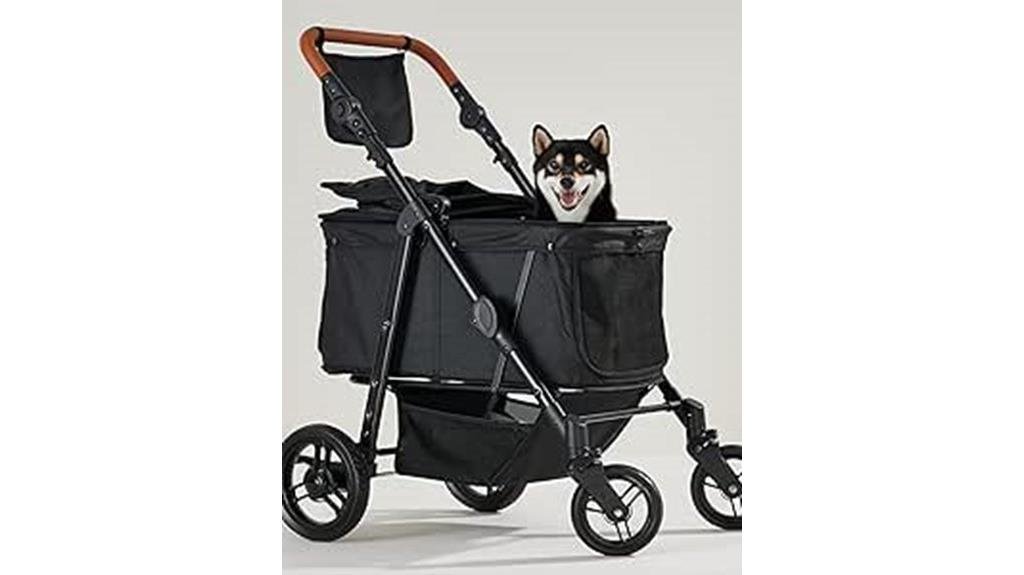
Best Overall: If you need more capability than a lightweight city stroller but do not need an extra-large 110-lb model, the Zoosky Medium Dog Stroller is the most balanced choice here. It is rated for pets up to 66 lbs and combines larger rear wheels with swiveling front wheels and spring suspension to make grass, firm gravel, packed paths, and other relatively smooth outdoor surfaces easier to handle.
The adjustable handle ranges from about 26.8 to 43.3 inches, which gives different users more control over pushing height. A 180° dual-open breathable canopy provides ventilation and flexible shade, while the side mesh entry makes loading a medium or heavier dog easier than lifting the pet over a high carriage wall. The stroller also includes storage space and a removable waterproof pad that simplifies cleanup.
Why You’ll Like It: It combines a useful 66-lb capacity with better outdoor-oriented wheels and a more substantial frame without moving all the way to the size of an extra-large stroller.
Best For: Owners of medium or larger dogs who mainly use parks, grass, firm gravel, packed walking trails, and other stroller-friendly outdoor routes.
Who Should Avoid It: Skip it if you need a very small travel stroller, have extremely limited trunk space, or regularly use steep and technical hiking trails. Also confirm the current pet-restraint arrangement before buying if your dog tends to jump or climb out.
Pros:
- Supports dogs up to 66 lbs, giving it much more capacity than lightweight small-pet strollers.
- Larger rear wheels, swiveling front wheels, and spring suspension improve handling on stroller-friendly outdoor surfaces.
- Adjustable handle and 180° breathable canopy make longer outings easier for both pet and owner.
- Side access, storage space, and a removable waterproof pad improve everyday convenience.
Cons:
- Heavier and bulkier than lightweight three-wheel pet strollers.
- Still intended for stroller-friendly terrain rather than steep, rocky, or technical hiking routes.
- Owners who need a secure built-in restraint should confirm the current product configuration before ordering.
ROODO 3-Wheel Lightweight Foldable Pet Stroller for Small/Medium Dogs and Cats (Green)
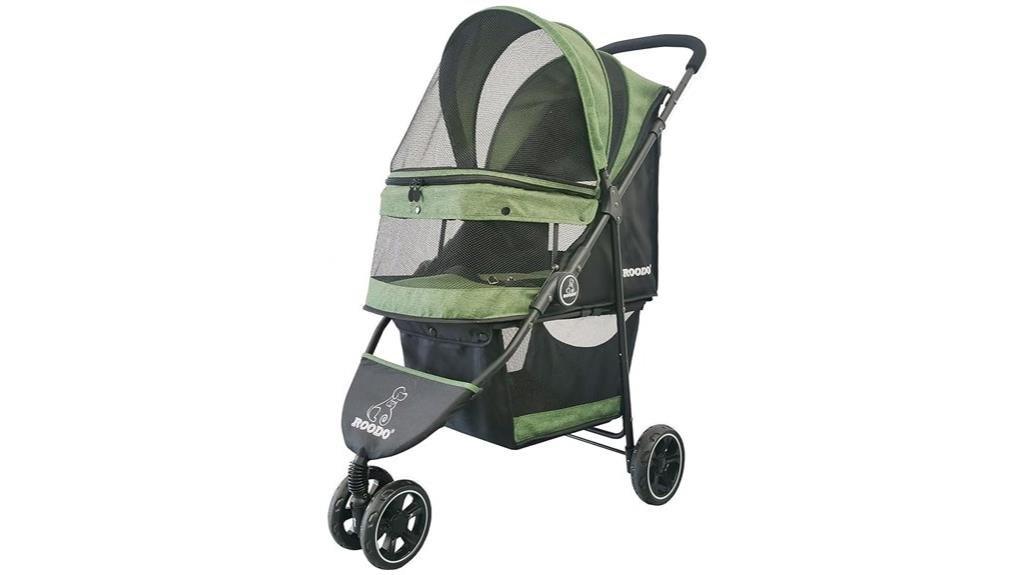
Best Lightweight for Smooth Trails: The ROODO 3-Wheel Pet Stroller makes sense when portability matters more than maximum off-road ability. It supports pets up to 30 lbs and weighs about 5 kg, so it is much easier to lift into a vehicle or store than either of the larger Zoosky models.
Tool-free wheel installation and quick-disassembly hardware simplify setup and packing. Breathable mesh around the pet area improves airflow, while the storage basket gives you space for a leash, water, treats, or other walking essentials. Its front wheel is roughly 5.5 inches and the rear wheels are roughly 6.5 inches, so it is better matched to pavement, park paths, boardwalks, firm dirt, and relatively smooth packed trails than rough hiking terrain.
Why You’ll Like It: It is the easiest option in this guide to carry, fold, store, and use for everyday outings with a smaller pet.
Best For: Small dogs, cats, and other pets up to 30 lbs whose owners want a compact stroller for parks, neighborhood walks, travel, and smoother outdoor paths.
Who Should Avoid It: Choose a larger-wheel model if your regular routes contain deep gravel, large roots, rocks, ruts, mud, or other demanding terrain. Owners of heavier pets will also need a higher-capacity stroller.
Pros:
- Approximately 5-kg design is easier to carry and load than heavier large-dog strollers.
- Tool-free wheel installation and compact folding simplify storage and transport.
- Breathable mesh and a supported pet compartment make it practical for everyday outings.
- Storage basket provides useful space for basic pet gear.
Cons:
- 30-lb maximum recommendation limits it to small pets.
- Smaller 5.5-inch front and 6.5-inch rear wheels are less suitable for rough trails.
- Published listing data is inconsistent about the exact restraint configuration, so confirm the current design before purchase.
Pet Stroller for Large Dogs (up to 110 lbs), All-Terrain, Dual-Window, Waterproof Oxford Fabric
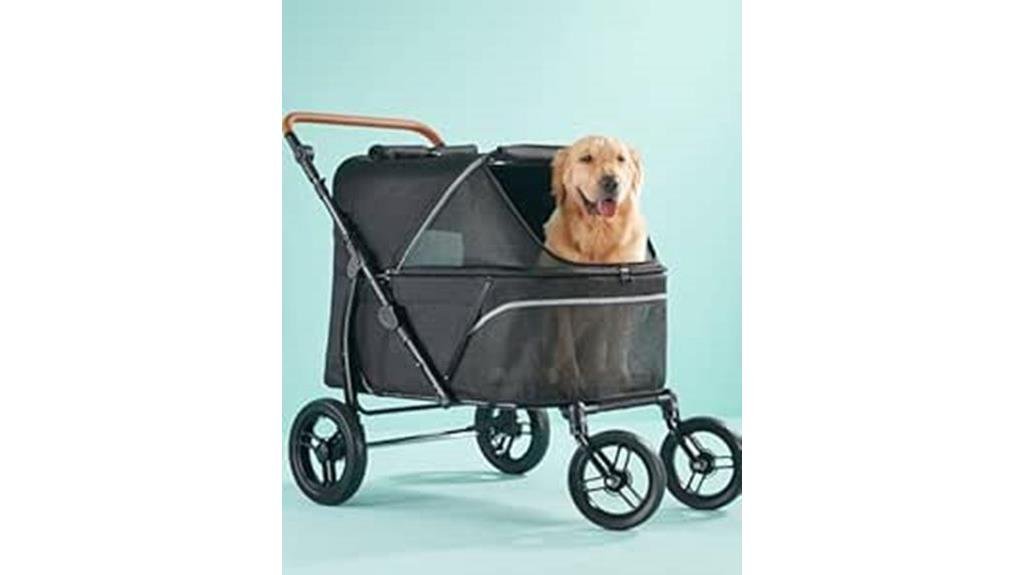
Best for Large Dogs: When a 30-lb or 66-lb stroller is simply too small, this Zoosky model raises the capacity to 110 lbs and provides a roomy carriage for a large dog or multiple smaller pets. Its approximately 33 × 20 × 12-inch interior gives bigger pets more usable space, while the low rear entry sits about 12 inches from the ground to reduce the amount of lifting required when loading a dog.
The stroller uses durable 1680D Oxford fabric with a substantial metal frame. Front and top mesh windows improve airflow and visibility, and the canopy opens to approximately 120° for easier access. The wheels measure about 8.9 inches at the front and 10.7 inches at the rear, providing a larger rolling platform than the lightweight ROODO. An adjustable handle and braking system help with control during normal stroller-friendly outdoor use.
Why You’ll Like It: The combination of a 110-lb capacity, low entry, spacious cabin, large wheels, and mesh ventilation solves the biggest limitations that smaller pet strollers have for large dogs.
Best For: Large dogs, heavier senior dogs that are difficult to lift, or owners who want one roomy stroller for multiple smaller pets on firm outdoor paths.
Who Should Avoid It: This is not the best choice if you frequently lift the stroller by yourself, have a small vehicle, or need an ultra-compact travel setup. Its folded dimensions are roughly 47 × 30 × 19 inches, so measure your cargo area before buying.
Pros:
- Supports pets up to 110 lbs and provides substantially more cabin room than the other options in this guide.
- Low rear entry can make loading a larger or less-mobile dog easier.
- Large front and rear wheels are better suited to grass, firm gravel, and packed outdoor paths than small-wheel travel strollers.
- 1680D Oxford material, dual mesh windows, adjustable handle, and wide canopy opening add durability and everyday usability.
Cons:
- Large folded footprint can be difficult to fit in small trunks or storage areas.
- Its size makes it less convenient to lift and carry than a lightweight stroller.
- Despite the all-terrain positioning, it should not be treated as suitable for steep or technical hiking trails.
Factors to Consider When Choosing a Dog Stroller for Hiking
A dog stroller can make outdoor trips easier for an older dog, a small pet that tires quickly, or a larger dog that cannot comfortably walk an entire route. For hiking and trail use, however, you need to look beyond capacity alone. Trail surface, wheel size, braking, cabin dimensions, ventilation, entry height, fold size, and pet restraint all affect whether a stroller is practical for your routine.
Weight Capacity and Cabin Size
Start by weighing your dog and checking the stroller’s stated maximum recommendation. Then measure your pet’s body length, width, and comfortable sitting or lying height against the usable cabin dimensions.
Do not buy only from the weight number. A tall but relatively light dog can outgrow a short cabin, while a compact heavier breed may fit differently. Larger dogs may also benefit from a low-entry door that lets them step into the stroller with less lifting.
Wheel Type and Suspension
Wheel size becomes more important as the surface gets rougher. Small wheels can work well on pavement and firm park paths, but larger wheels generally roll over shallow gravel, grass, small bumps, and minor trail irregularities more easily.
Swiveling front wheels improve maneuverability around turns, while suspension can reduce some of the jarring movement transmitted to the pet compartment. For trail-oriented use, also check whether the front wheel can maintain predictable tracking and whether the rear braking system is easy to reach.
Terrain Compatibility and Traction
Match the stroller to the routes you actually use. A product described as “all-terrain” may still be intended mainly for grass, packed gravel, firm dirt, parks, and similar surfaces.
Wide, relatively level trails are the safest match for a pet stroller. Avoid routes with major rock steps, deep mud, large exposed roots, narrow bridges, severe side slopes, loose descents, or other sections where a wheeled stroller could become difficult to control.
Pet Restraint and Brakes
Containment deserves the same attention as wheels. Check the current product listing and manual for built-in tethers, harness attachment points, mesh closures, zippers, and brake operation. Restraint specifications can differ between models and product revisions.
Follow the manufacturer’s restraint instructions rather than improvising an attachment point. Test the brake on level ground before every outing and keep control of the handle whenever the stroller is occupied.
Canopy and Ventilation
A breathable mesh canopy helps maintain airflow and gives your dog visibility during the ride. Adjustable shade panels are useful when conditions change during a walk.
Never assume a closed stroller will stay cool simply because it has mesh. On warm days, monitor your dog closely, provide water, use shaded routes when possible, and shorten the outing if your pet appears uncomfortable.
Entry Height and Access
Entry design matters especially for a large, older, or less-mobile dog. A low rear or side door can reduce the need to lift the dog’s full body weight over the stroller wall.
Check how the opening closes after loading and make sure your dog cannot push through an unsecured mesh panel or opening during the ride.
Storage and Portability
Think about the full trip, not only the trail. You may need room for water, a leash, waste bags, treats, a towel, and basic pet supplies. A storage basket can help, but do not overload it beyond the manufacturer’s stated limit.
Also compare stroller weight and folded dimensions with your vehicle. A 110-lb-capacity stroller can offer excellent room for a large dog but still be inconvenient if you cannot comfortably lift it or fit it in your cargo area.
Before You Buy
- Weigh and measure your dog instead of relying on breed name alone.
- Compare cabin dimensions as well as the maximum weight recommendation.
- Choose wheel size based on your normal trail surface.
- Check the current restraint and brake design.
- Measure your vehicle’s cargo area against the folded stroller size.
- Confirm that your planned trail is wide, stable, and stroller-friendly.
Frequently Asked Questions
Can Strollers Be Used on Steep, Technical Trails Safely?
In general, a pet stroller is a poor match for steep or technical hiking trails. Choose wide, reasonably level routes with firm surfaces and avoid large rocks, deep roots, severe ruts, loose descents, narrow sections, and major side slopes. If the route becomes unsafe for a wheeled stroller, turn around rather than trying to force the stroller through.
How Do I Train My Dog to Stay Calm in a Stroller?
Introduce the stroller while it is stationary and let your dog investigate it voluntarily. Reward calm behavior, then practice very short rides on a smooth surface before gradually increasing the duration. Keep early sessions positive and stop if your dog shows persistent stress or attempts to escape.
Are Stroller Wheels Repairable or Replaceable?
It depends on the model. Some pet strollers use quick-removal wheels or have replacement wheel sets available, while others require manufacturer-specific parts. Before a longer trip, check the manual and current parts availability rather than assuming that a damaged wheel can be repaired beside the trail.
Can a Dog Stroller Fit in a Rooftop Cargo Carrier?
Possibly, but compare the stroller’s folded dimensions with the cargo carrier’s usable interior dimensions and weight limit first. Removable wheels may reduce the required space on some models. Secure the stroller and loose components so they cannot move inside the carrier during travel.
Can I Take a Dog Stroller on an Airline?
Airline policies vary, and most full-size pet strollers should not be assumed to qualify as cabin baggage. Check the stroller’s folded dimensions and contact the airline for its current stroller, pet-equipment, checked-baggage, and cargo rules before traveling.
Which Dog Stroller Is Best for a Senior Dog?
Look for a model that fits your dog’s weight and body dimensions while minimizing the effort required to enter. A lower entry can be especially useful for a large dog that is difficult to lift. Smooth wheel movement, good ventilation, reliable brakes, and enough room to lie comfortably are also important.
Is a Lightweight Pet Stroller Good for Hiking?
It can work on easy, stroller-friendly routes, but small wheels limit what it can comfortably handle. A lightweight model such as the ROODO is better for pavement, parks, boardwalks, firm dirt, and smooth packed trails. For rougher but still stroller-friendly surfaces, larger wheels and a more substantial frame are usually the better match.
Conclusion
The right dog stroller depends more on your dog’s size and your actual trail conditions than on a generic “all-terrain” label.
For the most balanced combination of capacity, outdoor-oriented wheels, adjustable handling, and manageable size, the Zoosky Medium Dog Stroller up to 66 lbs is the strongest overall choice. If portability matters most and your pet weighs no more than 30 lbs, the ROODO 3-Wheel Pet Stroller is better suited to smooth routes and everyday travel. For a genuinely large dog, the Zoosky 110-lb Stroller provides the capacity, low entry, and cabin space that the smaller models cannot match.
Final Recommendation
Choose by trail first, then capacity: use the ROODO for smoother surfaces and small pets, the 66-lb Zoosky for a more balanced mix of capacity and outdoor maneuverability, and the 110-lb Zoosky when cabin space and large-dog access are the priority. None of these should be treated as a substitute for appropriate equipment or judgment on steep or technical hiking terrain.