Disclosure: As an Amazon Associate, we earn from qualifying purchases. If you click a link on this page and make a purchase, we may receive a small commission at no extra cost to you.
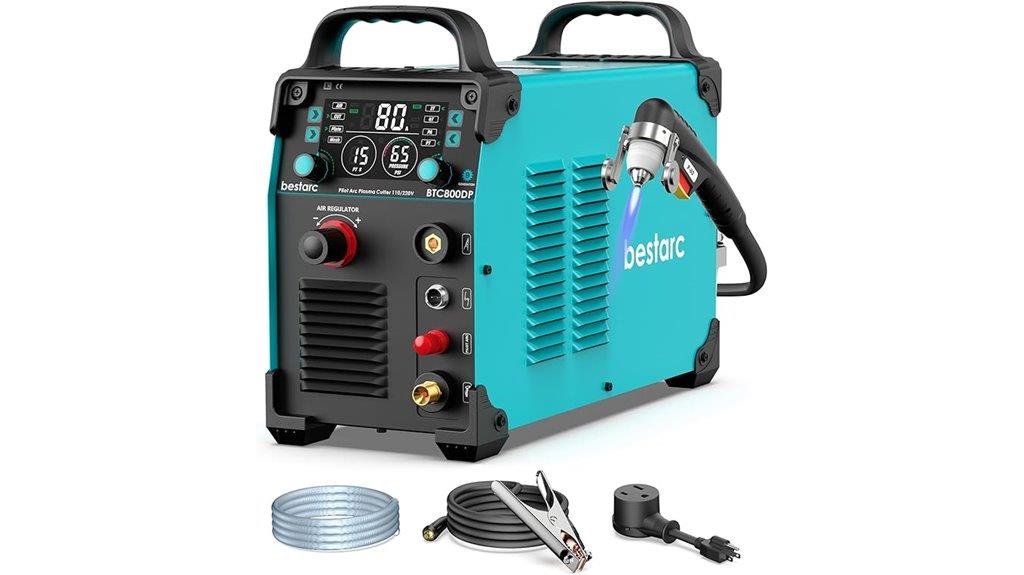
Choosing a plasma cutter is not just about buying the machine with the biggest advertised thickness number. You also need enough electrical capacity, dry compressed air, usable controls, and realistic cutting performance for the metal you work with. The Bestarc BTC800DP 9GEN combines up to 80A output on 220V with dual-voltage operation, a high-frequency non-touch pilot arc, digital monitoring, and adjustable torch-control functions. It is a capable choice for garage fabrication and DIY metalwork, but you should understand the difference between rated clean-cut capacity and maximum severance before buying.
Quick Verdict
Rating: 8/10, Recommended with caveats
Best For: DIY fabricators, garage workshops, farm repairs, and buyers who can supply 220V power and suitable compressed air.
Bottom Line: The BTC800DP 9GEN gives you useful 110/220V flexibility, up to 80A output on 220V, non-touch pilot arc starting, and unusually detailed front-panel controls. Its main drawback is that published cutting-thickness figures vary between the Amazon-linked listing and Bestarc’s current product page, so you should plan around the more conservative manufacturer figures for repeatable work.
Key Specifications
| Specification | Detail |
|---|---|
| Brand | Bestarc |
| Model | BTC800DP 9GEN |
| Product Type | High-frequency pilot-arc plasma cutter |
| Input Voltage | 110V or 220V AC |
| Output Current | 15-40A on 110V; 15-80A on 220V |
| Duty Cycle | 60% at 40A on 110V; 60% at 80A on 220V |
| Arc Start | High-frequency non-touch pilot arc |
| Front Display | Digital display for air pressure, voltage, current, and error information |
| Operating Modes | 2T, 4T, PA pilot timing, and PT post-flow timing |
| Post-Flow Time | Adjustable from 3 to 15 seconds; Bestarc recommends roughly 4-8 seconds for general use |
| Pilot-Arc Timing | Adjustable up to 15 seconds |
| Air Connection | Built-in air regulator/filter system with 1/4-inch NPT quick connection |
| Breaker Guidance | Bestarc lists 60A for 110V and 50A for 220V |
| Rated Clean Cut | Current Bestarc product page markets up to 5/8 inch |
| Maximum Severance | Current Bestarc product page markets up to 1 inch |
| Warranty | 3 years listed by Bestarc for BTC800DP-9GEN |
Before You Buy: Do not treat the largest advertised thickness as the thickness you will cleanly cut all day. The Amazon-linked listing has advertised a 7/8-inch clean cut and a 1.38-inch maximum cut, while Bestarc’s current product page gives a more conservative 5/8-inch maximum rated clean cut and 1-inch maximum severance. For production planning, the conservative figure is the safer baseline.
Key Takeaways
- The exact linked product is the Bestarc BTC800DP 9GEN, an 80A high-frequency pilot-arc plasma cutter.
- You get dual-voltage operation, but full 80A output requires 220V. On 110V, output is limited to 40A.
- The non-touch pilot arc helps you initiate cuts without dragging the torch tip directly against the workpiece.
- The digital panel shows operating information and gives you 2T/4T trigger modes plus adjustable pilot and post-flow timing.
- Compressed air is required, and compressor capacity, moisture control, air pressure, current, torch speed, and consumable condition all affect cut quality.
- Bestarc currently lists a 3-year warranty for the BTC800DP-9GEN.
What Is the Bestarc BTC800DP 9GEN?
The BTC800DP 9GEN is a dual-voltage plasma cutting machine designed for electrically conductive metals such as mild steel, stainless steel, aluminum, copper, and similar materials. It uses IGBT inverter technology and a high-frequency non-touch pilot arc, giving you a practical way to start cuts on surfaces where direct tip contact would be inconvenient.
Its main advantage is flexibility. You can operate it from 110V when portability matters, then move to 220V when you need access to the full 80A output range. That makes it more versatile than a fixed-voltage cutter, although you should not expect the same cutting capacity from the 110V setting.
The front control system is also more detailed than a basic entry-level cutter. Air-pressure information, current, voltage, error codes, 2T/4T trigger behavior, adjustable pilot-arc duration, and post-flow cooling give you more control over how the torch behaves during different jobs.
Who Should Buy It?
Best For
- Garage and home-shop users who want both 110V portability and stronger 220V performance.
- DIY fabricators, farm-maintenance users, and metalworkers cutting steel, aluminum, copper, or stainless steel.
- Buyers who value non-touch pilot arc, digital monitoring, and adjustable torch-control functions.
Skip If
- You do not have a suitable air compressor or reliable dry-air supply.
- You expect the same maximum cutting performance from a standard 110V outlet as you get from 220V.
- You need industrial production capacity where published duty cycle, consumable life, and repeated thick-plate cutting are critical.
Cutting Performance and Material Capability
The BTC800DP’s biggest performance advantage appears when you connect it to 220V. Bestarc lists an output range of 15-80A at 220V, compared with 15-40A at 110V. That difference matters when you move from thin sheet to heavier plate because thicker material generally demands more current, slower travel, and better air delivery.
You should also separate a clean cut from a severance cut. A clean cut is the thickness you can reasonably expect to cut with better edge quality and less cleanup. Severance means getting through the material, often at lower speed with more dross and a rougher edge. Bestarc’s current product page markets a maximum rated clean cut of 5/8 inch and maximum severance of 1 inch.
The exact Amazon-linked listing has carried higher cutting claims, so this is one area where conservative expectations make sense. Your actual result will depend on metal type, amperage, air pressure, torch height, travel speed, consumables, input power, and how clean and dry your compressed air is.
| Material | Suitability | What to Expect |
|---|---|---|
| Mild Steel | Primary use | Best use of the full 220V/80A capability on heavier plate. |
| Stainless Steel | Suitable | Cut quality depends heavily on speed, amperage, and air quality. |
| Aluminum | Suitable | Requires practice with travel speed and current to control edge quality. |
| Copper | Suitable | Conductive material can be cut, but thermal behavior differs from mild steel. |
Pilot Arc, Air Management, and Consumable Life
The high-frequency non-touch pilot arc lets the torch establish an arc without requiring the tip to scrape directly across the workpiece. That is useful when you are working with painted, rusty, dirty, or uneven metal, and it also helps when cutting mesh where the arc repeatedly crosses gaps.
The PA control lets you adjust pilot-arc duration up to 15 seconds. Longer pilot duration can help on mesh or interrupted surfaces, while shorter settings reduce unnecessary pilot-arc time and may help preserve electrodes and nozzles when you do not need a long pilot period.
Post-flow cooling is adjustable from 3 to 15 seconds. Bestarc recommends roughly 4-8 seconds for general use. That airflow continues cooling the torch after the cut ends, which helps manage heat around the consumables.
Air supply is equally important. The machine has a built-in regulator/filter arrangement and air-pressure monitoring, but you still need an external compressor. Make sure the compressor can provide stable, dry air rather than only reaching a high pressure for a few seconds before falling behind.
Pro Tip: If cut quality suddenly gets worse, check air moisture, pressure stability, nozzle condition, electrode wear, work-clamp contact, and travel speed before assuming the cutter itself has failed.
User Interface and Controls
The large digital display gives you more operating feedback than a simple analog pressure gauge. Bestarc says the panel can display air pressure, voltage, current, and error information, making it easier to notice a setup problem before wasting material or consumables.
The 2T mode works as a semi-automatic trigger mode. The 4T mode is intended to reduce the need to hold the torch trigger continuously during longer cuts. These functions are useful when you move between quick fabrication work and longer straight cuts.
You also get separate PA and PT adjustments for pilot duration and post-flow cooling. Those controls add a small learning curve, but they give you more flexibility than a cutter that chooses every torch behavior automatically.
Setup and Safety
Plasma cutting involves high electrical energy, compressed air, extremely hot metal, sparks, fumes, and intense arc light. Follow the Bestarc manual for your exact unit, use suitable eye and face protection, wear appropriate gloves and protective clothing, maintain ventilation, and keep combustible material away from the cutting area.
Bestarc lists breaker guidance of 60A for 110V operation and 50A for 220V. Electrical installation should match local codes and the machine’s requirements. If you are unsure about your outlet, breaker, wiring, or extension arrangement, have a qualified electrician verify the circuit rather than guessing.
Connect the work clamp to clean conductive metal, supply dry compressed air, confirm the regulator setting, and inspect the torch consumables before cutting. Do not cut sealed containers, pressurized vessels, or materials that may release dangerous fumes without proper hazard controls and professional guidance.
How It Performs in Real Use
Garage Fabrication on 220V
This is where the BTC800DP makes the most sense. On 220V you have access to the machine’s full 15-80A output range, giving you more headroom for brackets, repair plates, frames, metal art, and general fabrication than the 110V setting provides.
Portable Jobs on 110V
The 110V option gives you useful flexibility when 220V is unavailable, but output is limited to 40A. It is better to think of 110V as the portability mode rather than expecting the cutter’s maximum advertised thickness capability.
Painted, Rusty, or Mesh Material
The non-touch pilot arc is one of the stronger reasons to choose this model. It can establish the pilot arc without direct torch-tip contact, which helps when the surface is not perfectly clean. You should still remove heavy contamination when possible because cleaner metal normally gives you better work-clamp contact and more predictable cutting.
Repeated Workshop Cutting
The listed 60% duty cycle means the cutter is designed to alternate cutting time with cooling time when operated near rated output. For repeated heavy cuts, watch the machine’s thermal behavior, respect its duty-cycle limits, and give the torch adequate post-flow cooling.
Setup Tips for Better Cuts
- Use 220V when you need maximum output. The machine is limited to 40A on 110V but reaches 80A on 220V.
- Start with clean, dry compressed air. Moisture and unstable airflow can shorten consumable life and hurt edge quality.
- Match amperage to thickness. More current is not automatically better on thin material.
- Keep the work clamp connection clean. Rust, paint, or poor contact at the clamp can create an unstable cutting circuit.
- Watch travel speed. Moving too fast may leave uncut sections. Moving too slowly can increase dross and widen the kerf.
- Inspect consumables regularly. A damaged nozzle or worn electrode can make a good machine cut poorly.
- Use longer pilot timing only when useful. Mesh may benefit from it, but continuous pilot operation can increase consumable wear.
Pros and Cons
Pros
- Dual 110/220V operation gives you more setup flexibility.
- Up to 80A output is available when running on 220V.
- Non-touch pilot arc is useful for painted, rusty, dirty, or interrupted surfaces.
- Digital display provides air-pressure, current, voltage, and error information.
- Adjustable PA, PT, 2T, and 4T controls give you more control over torch operation.
Cons
- Full 80A cutting performance requires 220V rather than 110V.
- You need a separate compressor with adequate continuous airflow and moisture control.
- Published cutting-thickness figures are not fully consistent between the Amazon-linked listing and Bestarc’s current product page.
Is It Worth the Price?
The BTC800DP 9GEN makes the most sense if you want more cutting headroom than a lower-amperage DIY cutter while keeping dual-voltage flexibility. The 80A ceiling on 220V, non-touch pilot arc, digital display, air-pressure monitoring, and adjustable torch controls give you features that are useful beyond occasional thin-sheet cutting.
Its value depends on your supporting equipment. If you already have suitable 220V power and a capable compressor, you can use much more of what the machine offers. If you only have a light 110V circuit and a small compressor, you may be paying for performance that your shop cannot fully access.
It is worth considering for a serious home workshop or mixed repair/fabrication use. It is less compelling if your work consists only of thin sheet or if you need a production-grade industrial machine for continuous heavy cutting.
How It Compares to Alternatives
Within Bestarc’s own range, the BTC500DP and BTC650DP models are worth comparing if your work does not require the BTC800DP’s full 80A capability. A lower-output model can make more sense for lighter fabrication, thinner material, or shops with less demanding electrical requirements.
The BTC800DP 9GEN is the better fit when you specifically want the higher 220V output ceiling while keeping 110V compatibility, non-touch pilot arc, digital monitoring, and adjustable cutting controls. Your decision should be based on the thickest material you routinely cut, not the thickest material you might cut once.
Frequently Asked Questions
What exact Bestarc model does this Amazon link point to?
The linked ASIN B0CXXLTXVB corresponds to the Bestarc BTC800DP 9GEN 80A plasma cutter. The associated item model is listed as BTC800DP-9GEN-1122.
Can the BTC800DP run on both 110V and 220V?
Yes. It is a dual-voltage cutter. Bestarc lists a 15-40A output range on 110V and 15-80A on 220V, so you need 220V to access the full output.
How thick can the Bestarc BTC800DP 9GEN cut?
Published numbers differ. The Amazon-linked listing has advertised a 7/8-inch clean cut and a 1.38-inch maximum cut, while Bestarc’s current manufacturer page markets a 5/8-inch maximum rated clean cut and a 1-inch maximum severance. For buying decisions, use the more conservative manufacturer figure and remember that real results depend on power, air, material, speed, and consumable condition.
Does the plasma cutter need a separate air compressor?
Yes. The machine has air-pressure monitoring, a regulator/filter arrangement, and an air connection, but you still need an external source of dry compressed air. Stable airflow is important for consistent cutting and consumable life.
Will the pilot arc work on rusty or painted metal?
The high-frequency non-touch pilot arc is designed to initiate without direct tip contact, which is useful on painted, rusty, or dirty surfaces. Cleaning the work area and work-clamp location can still improve stability and final cut quality.
What warranty does the BTC800DP 9GEN have?
Bestarc’s current manufacturer page lists the BTC800DP-9GEN under its 3-year warranty coverage. Check the current seller and manufacturer terms before purchase because warranty procedures and eligibility can change by region or sales channel.
What common setup mistakes should you avoid?
Avoid using an undersized electrical circuit, wet or unstable compressed air, badly worn consumables, poor work-clamp contact, or the wrong travel speed. Also avoid assuming that maximum severance thickness will give you the same edge quality as a normal clean cut.
The Bottom Line
The Bestarc BTC800DP 9GEN is a strong fit for garage fabricators and serious DIY users who want dual-voltage operation, up to 80A output on 220V, non-touch pilot arc starting, and more control over air and torch behavior. Skip it if you lack suitable compressed air or electrical capacity, or if you need industrial continuous-duty performance. Its main strength is the combination of power and control, while the biggest caveat is the inconsistent cutting-thickness language across current product sources.
Ready to Buy?
Check the latest price, seller details, and current product specifications before you decide.