Disclosure: As an Amazon Associate, we earn from qualifying purchases. If you click a link on this page and make a purchase, we may receive a small commission at no extra cost to you.
BLINORY X60 Drone Review: Beginner-Friendly 2K FPV Drone With 2 Batteries
Your first drone should be easy to control, inexpensive enough to learn with, and stable enough to prevent every flight from becoming frustrating. The BLINORY X60 targets that need with one-key controls, optical flow positioning, a brushless motor, Wi-Fi FPV, and two modular batteries.
Its lightweight folding design works well for practice flights and casual aerial clips, but it lacks the GPS safety features and camera stabilization found on more advanced drones. This review will help you decide whether the X60 offers enough control, camera performance, and flight time for the way you plan to use it.
Quick Verdict
Rating: Recommended with caveats
Best For: First-time pilots, supervised younger users, indoor practice, and calm-weather recreational flying.
Bottom Line: The BLINORY X60 combines simple controls, two batteries, a foldable body, and a brushless motor in an approachable starter package. Its light weight, limited camera system, and lack of advertised GPS return features make it less suitable for wind, long-distance flying, or serious video work.
Key Specifications
| Specification | BLINORY X60 Detail |
|---|---|
| Brand | BLINORY |
| Model | X60 |
| Product Type | Foldable Wi-Fi FPV quadcopter |
| ASIN | B0DDPLQ3RY |
| Camera | 2K video output with listed 1080p video capture |
| Camera Angle | Up to 90° adjustable angle |
| Photo and Video Formats | JPEG photos and MP4 video |
| Motor Type | Brushless motor system |
| Positioning | Optical flow positioning and altitude hold |
| Beginner Controls | One-key takeoff and landing, headless mode, and two speed modes |
| App Features | Live FPV view, gesture capture, and waypoint flying |
| Battery Package | Two rechargeable modular lithium-ion batteries |
| Claimed Flight Time | Up to 32 minutes total across both batteries under ideal conditions |
| Listed Weight | 0.32 lb, approximately 145 grams |
| Listed Dimensions | 11.81 x 7.87 x 2.17 inches |
| Material | Plastic |
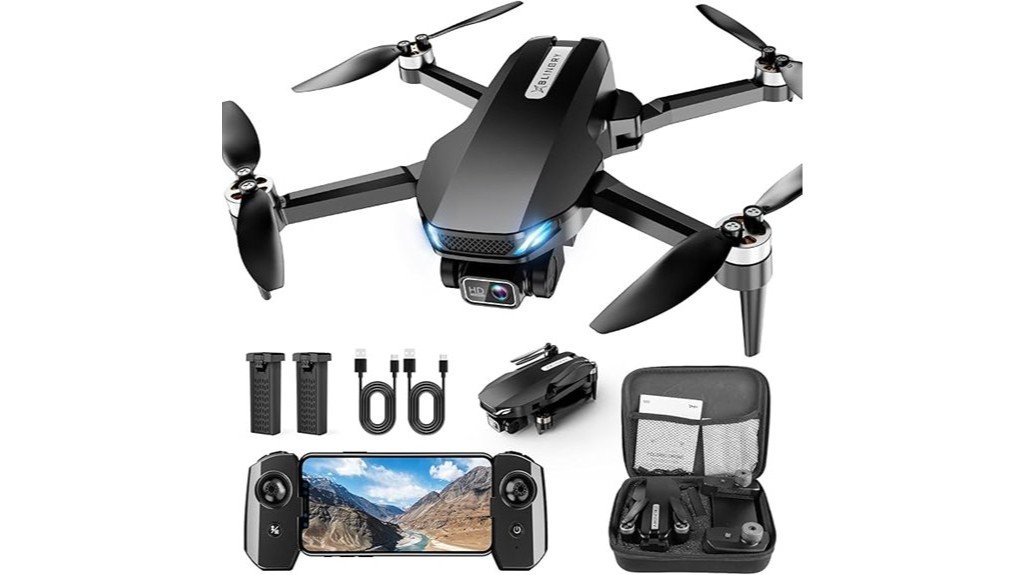
| Included Accessories | Manual lists a remote controller, two batteries, two USB charging cables, four spare propellers, screws, screwdriver, user manual, and carrying case |
| Best Use | Beginner practice, casual FPV flying, travel, and simple photos or clips |
| Key Limitation | No advertised GPS return-to-home system or professional camera stabilization |
What Is the BLINORY X60?
The BLINORY X60 is a compact quadcopter designed for people learning basic drone control. You can unfold its arms, connect the compatible app for a live camera view, and use one-key takeoff to begin flying without mastering a complicated startup sequence.
Its main selling points are the brushless motors, optical flow positioning, two included flight batteries, and lightweight folding body. It also adds recreational features such as gesture-triggered photos, waypoint paths, multiple speeds, and 360° flips, sometimes described as 3D flips.
This is not a GPS camera drone. It does not advertise automatic GPS return, obstacle avoidance, long-range navigation, or a stabilized gimbal. You still need to keep it close, maintain visual contact, and choose an open flying area.
Before You Buy: Do not treat the “2K” label as proof of professional 2K recording. Available product data distinguishes between 2K video output and 1080p video capture, and the camera does not replace a stabilized GPS photography drone.
Who Should Buy It?
Best For
- First-time pilots who want one-key controls and a low-speed learning mode.
- Casual users who want two batteries for longer practice sessions.
- Travelers who prefer a light folding drone with a carrying case.
Skip If
- You need GPS return-to-home, subject tracking, or dependable long-range control.
- You plan to fly regularly in wind or capture stabilized professional footage.
- You need a drone for paid work, inspections, or other non-recreational operations.
Design, Build, and Portability
At approximately 145 grams, the X60 is light enough to fit comfortably in a small travel setup. Its folding arms reduce storage space, while the listed carrying case protects the body, batteries, charging cables, and small replacement parts between flights.
The plastic body helps keep the weight down, but it also places the X60 closer to a recreational starter drone than a rugged outdoor aircraft. Avoid rough landings, hard impacts, wet grass, and loose dirt that could reach the motors or camera.
Brushless motors are a useful upgrade over the brushed motors found in many basic toy drones. They generally provide smoother operation, lower operating noise, and less mechanical wear because they do not use internal brushes that need to maintain contact.
Camera and FPV Experience
The camera offers a viewing angle that can be adjusted by up to 90°, helping you switch between forward-facing views and more downward-looking shots. Wi-Fi FPV sends a live view to the compatible smartphone app, so you can frame a photo or see the drone’s perspective while it remains within visual range.
The specification wording needs careful interpretation. Product data lists 2K video output but 1080p video capture. You should expect shareable recreational clips in good daylight, not the sharpness, dynamic range, or stabilization of a premium camera drone.
Small body movements can appear in the footage because the X60 does not advertise a mechanical gimbal. Calm conditions, slow stick inputs, and gentle turns will usually produce better clips than fast flying or repeated flips.
Flight Controls and Stability
One-key takeoff and landing reduce the difficulty of the first and final seconds of a flight. Headless mode can also help new pilots because the controls respond relative to the pilot instead of requiring constant awareness of which direction the drone’s nose faces.
Altitude hold helps the drone maintain height while you focus on forward, backward, and side-to-side movement. Optical flow positioning uses the surface below the aircraft to improve hovering, especially over a well-lit floor or textured ground.
Optical flow is not a replacement for GPS. Performance may weaken over reflective, dark, plain, moving, or poorly lit surfaces. The drone can also drift when wind pushes its lightweight body, so you should leave extra space around trees, buildings, people, water, and roads.
Two speed modes let you begin with slower responses before moving to the faster setting. Gesture capture, waypoint paths, and one-button flips add entertainment, but new pilots should first learn steady hovering, directional control, and controlled landing.
Battery Life and Charging
The package includes two modular flight batteries with a claimed combined flight time of up to 32 minutes. That figure represents ideal total use across both batteries, not one uninterrupted 32-minute flight.
Actual time can be shorter when you use the faster speed mode, record video, perform flips, fly in wind, or operate in very hot or cold conditions. Battery age and charging habits can also affect performance.
Modular batteries are easier to swap than built-in cells. Charge both before leaving home, carry the second battery in the case, and follow the manual’s charging instructions. Stop using a battery that becomes damaged, swollen, unusually hot, or physically distorted.
Pro Tip: Use the first battery for slow control practice and save the second for photos, waypoint tests, or faster flying. This gives you a structured practice session instead of using both batteries on repeated takeoffs and flips.
How It Performs in Real Use
Indoor Practice
The X60’s low-speed mode, altitude hold, and optical flow positioning make it suitable for practice in a large, uncluttered indoor space. Bright, textured flooring can give the optical flow sensor a clearer surface to read.
Avoid small rooms, ceiling fans, glass doors, hanging lights, pets, and nearby people. The drone has exposed propellers, and no obstacle-avoidance system is advertised.
Calm Outdoor Flying
In calm weather, the X60 gives beginners more room to practice turns, height changes, and smoother landings. Its light body can drift quickly when gusts appear, so keep it close and land before the wind becomes difficult to manage.
An open field offers a safer learning area than a backyard surrounded by roofs, trees, utility lines, or fences. Always confirm that the location and airspace permit recreational drone flight.
Casual Photos and FPV Clips
The adjustable camera and live app feed help you frame simple landscape views, family moments, or short travel clips. The camera works best in good daylight with slow movements and minimal vibration.
This model is less suitable for smooth cinematic footage. It lacks an advertised mechanical gimbal, and its camera specifications do not match the stabilized 4K systems available on more expensive GPS drones.
Travel and Storage
The folding body and carrying case make the X60 practical for road trips, visits, and occasional outdoor use. You can keep the drone, two batteries, charging cables, spare propellers, and screwdriver together instead of storing loose parts in separate bags.
Check local drone rules before traveling, especially when crossing national borders or entering parks, controlled airspace, event areas, or private property.
Setup Tips Before Your First Flight
- Check the current package: Confirm that the drone, controller, two batteries, charging cables, propellers, tools, manual, and case match the seller’s current bundle.
- Charge both flight batteries: Use a compatible USB power source and follow the charging instructions supplied with the drone.
- Inspect the propellers: Replace any blade that is cracked, bent, loose, or visibly damaged.
- Unfold the arms fully: Make sure each arm is extended and every propeller can turn without obstruction.
- Connect the app carefully: Join the drone’s Wi-Fi network and confirm that the live FPV view works before takeoff.
- Begin in low-speed mode: Practice hovering, short forward movements, turns, and landing before trying flips or waypoint flying.
- Keep the drone close: Maintain direct visual contact and do not rely only on the phone screen.
- Land with battery time remaining: Do not deliberately fly until the battery is completely exhausted.
Cleaning, Maintenance, and Storage
Inspect the propellers and motor areas after each impact or rough landing. Small cracks or bent blades can create vibration, unstable flight, and extra strain on the motors.
Use a soft, dry cloth on the body and camera lens. Avoid harsh chemicals, excess moisture, and compressed air directed closely into delicate components.
For longer storage, the manual recommends keeping the batteries in a cool, dry place at roughly half charge instead of leaving them fully charged or completely empty. Fold the drone and place it in the carrying case to limit dust and accidental damage.
Safety and U.S. FAA Considerations
The X60’s listed weight is approximately 145 grams, which is below the 250-gram FAA registration threshold for drones flown exclusively under the U.S. recreational exception. That exception does not apply to every operation.
U.S. recreational flyers must still complete the free Recreational UAS Safety Test, carry proof of completion, follow approved safety guidelines, respect airspace restrictions, and maintain visual line of sight. Flights conducted under Part 107 require registration regardless of the drone’s light weight.
Do not fly over people, moving vehicles, emergency operations, airports, restricted areas, or locations where local rules prohibit drones. Younger users need responsible adult supervision because the propellers, lithium-ion batteries, and outdoor flight environment can create safety risks.
Pros and Cons
Pros
- Brushless motors offer a practical upgrade over many brushed toy drones.
- One-key controls, headless mode, and two speeds support gradual learning.
- Two modular batteries provide up to 32 minutes of claimed combined flight time.
- Optical flow positioning can improve hovering in suitable conditions.
- Foldable arms and a carrying case simplify travel and organized storage.
Cons
- The 2K output and 1080p capture wording can create unrealistic camera expectations.
- No advertised GPS return-to-home or obstacle-avoidance system.
- The lightweight body is best suited to indoor use or calm outdoor weather.
What to Check in Recent Buyer Reviews
Amazon ratings, review totals, packages, and seller details can change. Before ordering, read recent verified-purchase reviews and focus on comments about app connection, battery consistency, hover stability, replacement propellers, and seller support.
Give more weight to reviews that explain the flying conditions and the buyer’s experience level. A report from an indoor beginner may describe a different result than an outdoor user flying in wind.
Is It Worth the Price?
The BLINORY X60 belongs in the entry-level category rather than the premium GPS camera-drone category. It offers the most value when its current price is clearly below models with GPS navigation, stabilized 4K capture, stronger wind resistance, and longer transmission systems.
You get several useful beginner features in one bundle: brushless motors, two batteries, optical flow, one-key controls, an adjustable camera, app-based FPV, spare propellers, and a carrying case. That combination is worth considering when your goal is practice and casual entertainment.
It is not the best fit when camera quality, outdoor stability, automated return features, or dependable long-distance control matter more than a low learning barrier.
How It Compares to Alternatives
The Potensic ATOM SE is the stronger comparison for buyers who need GPS-assisted flight, 4K capture, longer single-battery flight time, and better stated wind resistance. It sits in a higher performance and price class, so it may be excessive for simple indoor practice.
The DJI Neo is another step up for buyers focused on guided shooting, stabilized 4K video, subject-focused modes, and a more developed app ecosystem. The BLINORY X60 makes more sense when you want a simpler, lower-cost practice drone with a traditional controller-style flying experience and two included batteries.
Frequently Asked Questions
Is the BLINORY X60 good for beginners?
Yes. It includes one-key takeoff and landing, headless mode, altitude hold, optical flow positioning, and two speed settings. Beginners should start in low-speed mode and practice in a large, open area.
Does the BLINORY X60 record true 2K video?
Available product data describes 2K video output but lists 1080p video capture. You should expect casual footage for personal use, not the detail or stabilization of a professional 2K or 4K camera drone.
Does the BLINORY X60 have GPS or return-to-home?
No GPS return-to-home feature is advertised for the X60. Its optical flow system helps with low-altitude hovering, but it does not provide the location-based recovery features of a GPS drone.
How long do the BLINORY X60 batteries last?
The two batteries provide a claimed combined flight time of up to 32 minutes under ideal conditions. Wind, faster flying, video use, flips, temperature, and battery condition can reduce real-world flight time.
Can the BLINORY X60 fly in windy weather?
Its lightweight body is better suited to indoor use and calm outdoor conditions. Even moderate gusts can cause drift, so land the drone when the wind begins pushing it away from your intended position.
Does the BLINORY X60 require FAA registration?
At its listed weight of about 145 grams, it can avoid registration when flown exclusively under the U.S. recreational exception. Recreational pilots still need TRUST and must follow FAA rules, while Part 107 operations require registration regardless of weight.
Does it come with a controller and carrying case?
The model-specific manual lists a remote controller, carrying case, two batteries, charging cables, spare propellers, tools, and instructions. Seller bundles can change, so compare the current package list and product photos before ordering.
How does waypoint flying work on the X60?
The compatible app lets you draw a route for the drone to follow. This is an app-based flight feature rather than GPS navigation, so use it only in a clear area and continue watching the drone directly.
The Bottom Line
The BLINORY X60 is a practical starter choice when you want simple controls, two batteries, brushless motors, and a compact folding design for indoor practice or calm-weather fun. Skip it when you need GPS recovery, dependable wind handling, obstacle avoidance, or stabilized footage for serious content creation.
Its main strength is the accessible beginner package. Its main limitation is that the camera and positioning system remain recreational rather than professional.
Ready to Buy?
Check the latest package contents, seller details, price, and product information before you decide.