Disclosure: As an Amazon Associate, we earn from qualifying purchases. If you click a link on this page and make a purchase, we may receive a small commission at no extra cost to you.
CURT 17200 Trailer Anti-Sway Bar Control Kit Review
Trailer sway can make a routine highway trip feel tense, especially when crosswinds or passing trucks push your trailer sideways. The CURT 17200 is a mechanical friction sway control kit designed to reduce that lateral movement on many A-frame trailer setups. It gives you adjustable resistance without requiring electronics or a complete hitch replacement. However, it cannot be used with surge brakes, and the installation requires careful measuring, drilling, and clearance checks.
Quick Verdict
Rating: 8.3/10
Best For: Owners of compatible A-frame campers and utility trailers who want adjustable add-on sway control.
Bottom Line: The CURT 17200 offers simple friction-based sway control, useful adjustment, and a complete mounting kit. Its main tradeoffs are limited brake compatibility and the need to remove or inspect the unit in certain road and backing situations.
| Specification | Detail |
|---|---|
| Brand | CURT |
| Model | 17200 |
| Product Type | Friction-style trailer sway control kit |
| Finish | Carbide black powder coat |
| Shipping Weight | 14 lb |
| Compatibility | Most weight distribution hitches, CURT sway tab mount #45820, and most A-frame trailers |
| Standard Mounting Position | Trailer-side ball centered 24 inches behind the coupler on the right side of the frame |
| Drill Size | 11/32-inch holes for the spacer plate and trailer-mounted ball |
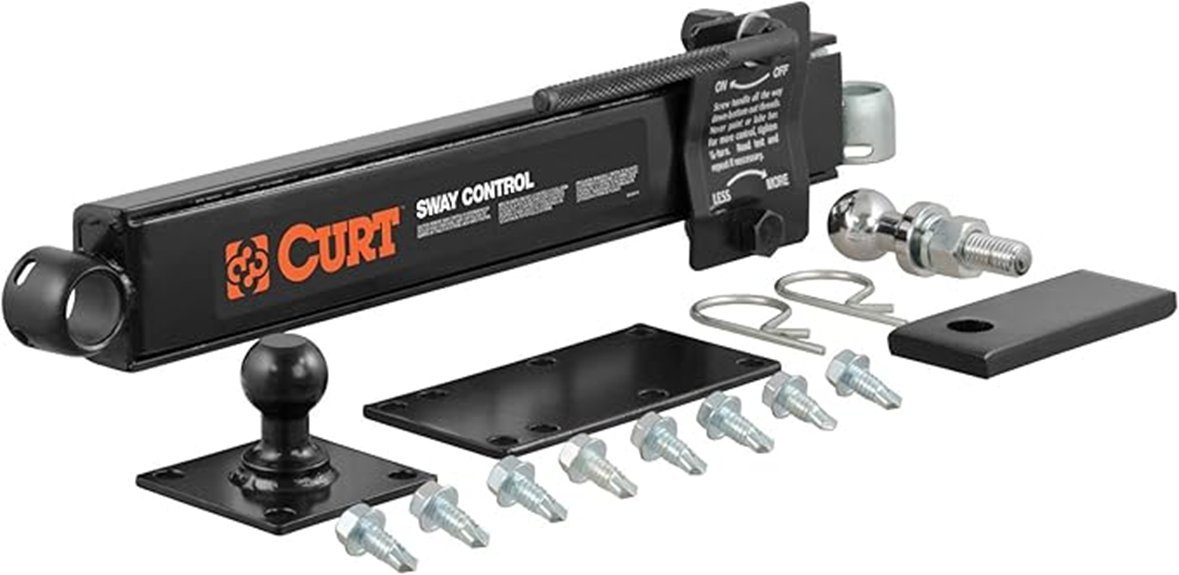
| Included Parts | Sway control unit, ball #40093, trailer ball #17201, two clips, eight self-tapping screws, spacer plate, and weld-on tab #45822 |
| Maintenance | Clean slide bar after 1,000 miles, then every 10,000 miles; never lubricate or paint the slide bar |
| Safety Limits | Not compatible with surge brakes; remove for wet, icy, gravel, or snow-covered roads |
| Warranty | Limited lifetime warranty with one-year finish and one-year parts coverage |
What Is the CURT 17200?
The CURT 17200 mounts between the trailer frame and the tow vehicle’s ball-mount area. A sliding bar uses friction material similar to brake-pad material to resist side-to-side trailer movement while still allowing normal turns. The unit is an add-on sway control device, not a complete weight distribution hitch.
You control the amount of resistance with a tension screw. An on/off handle lets you engage the system for road use and release tension during setup or inspection. CURT recommends two units for larger, heavier, or broad-sided trailers, so one bar may not be enough for every towing combination.
The package includes the main sway control, both attachment balls, clips, self-tapping screws, a spacer plate, and a weld-on tab. You still need enough open frame space, the correct hitch layout, and suitable tools for drilling or professional welding.
Key Takeaways
- The friction bar helps reduce lateral trailer movement caused by wind, passing traffic, curves, and steering inputs.
- The tension screw lets you increase resistance in small 1/4-turn steps after a controlled road test.
- The kit works with many A-frame trailers and weight distribution hitches, but frame clearance must be checked before installation.
- The product is not compatible with surge brakes and must be removed on wet, icy, gravel, or snow-covered roads.
- Correct loading, tongue weight, tire condition, and tow-vehicle capacity still matter because a sway bar cannot fix an unsafe setup.
Who Should Buy It?
Best For
- Drivers with a compatible A-frame camper or utility trailer that wanders mildly in crosswinds.
- Owners who already use a weight distribution hitch or compatible sway-tab ball mount.
- Buyers who prefer adjustable mechanical sway control with no wiring, battery, or app.
Skip If
- Your trailer uses surge brakes.
- Your frame does not provide the required mounting space or you cannot drill or arrange qualified welding.
- You are trying to correct severe sway caused by poor loading, low tongue weight, worn equipment, or an undersized tow vehicle.
Before You Buy: Confirm your brake type and measure the trailer frame before ordering. This kit cannot be used with surge brakes, and the standard trailer-side ball location is 24 inches behind the coupler.
Feature-by-Feature Review
Friction Sway Control Performance
The CURT 17200 resists side-to-side movement through a sliding friction bar. This simple design can dampen small trailer movements before they build into repeated steering corrections. It is most useful when your trailer already has correct loading and remains mildly unsettled in open-road conditions.
The bar does not steer the trailer or distribute tongue weight. Its sway-control function does not replace any published towing limit. You must stay within the tow vehicle, receiver, hitch, coupler, axle, tire, and trailer ratings.
Adjustability and On/Off Control
CURT instructs you to begin with the factory-set tension and road test the setup. If you need more resistance, turn the tension screw 1/4 turn clockwise and test again. Small adjustments help you avoid adding too much resistance before you understand how the trailer responds.
The on/off handle releases or applies the main tension. For normal use, the handle is tightened until it sits parallel with the body. This setup is easy to understand, but it adds another item to your pre-trip and campsite checklist.
Fit and Compatibility
The kit fits most weight distribution hitches that already have a sway-control ball plate. It can also work with CURT sway tab mount #45820. When a suitable hole is not available, the included weld-on tab #45822 can adapt many ball mounts, including left-side installations when required.
On the standard right-side installation, the trailer-mounted attachment ball is centered 24 inches straight back from the coupler. The spacer plate transfers the hole locations to the frame, where the instructions call for 11/32-inch holes. Propane trays, battery boxes, wiring, breakaway equipment, or narrow frame rails may block this position.
Installation and Setup
A confident DIY owner can complete the bolt-on portion with careful measuring and drilling. You attach the trailer ball and spacer plate with the supplied self-tapping screws, then connect the slide-bar socket to the hitch-mounted ball. Any welding should be handled by a qualified welding shop.
Before road use, CURT instructs you to check the full turning range. With another person watching the sway control, slowly back in both directions toward a jackknife position. Remove the unit before backing whenever it contacts the bumper or frame, fully compresses, or begins to separate.
Build, Finish, and Included Hardware
The sway control uses a carbide black powder-coated finish for exposed towing use. The kit includes the hardware needed for the standard trailer-frame mounting arrangement, including eight self-tapping screws and two retaining clips. The complete package is more useful than buying a replacement friction bar without the balls or mounting pieces.
The slide bar is a working friction surface and needs different care from painted exterior parts. Never paint, grease, or oil it. CURT only calls for a drop of oil on the on/off handle threads.
Setup Tips and Common Mistakes
- Load heavy cargo low and ahead of the trailer axle, then balance the load from side to side.
- For most trailers, aim for tongue weight within the 10 to 15 percent range stated in the CURT instructions, while following your trailer and vehicle limits.
- Start with the factory tension instead of tightening the adjustment screw before the first road test.
- Check that both retaining clips are fully seated before towing.
- Inspect turning and backing clearance after installation and whenever you change the hitch height or trailer configuration.
- Stop and inspect the towing setup if sway continues. Do not accelerate to pull out of sway.
Pro Tip: Add the sway-control handle, clips, and clearance check to your written hookup checklist. A simple routine reduces the chance of towing with loose tension or missing hardware.
Compatibility and Safety
The most important restriction is brake compatibility. CURT states that the 17200 cannot be used on trailers with surge brakes. Before installation, identify your trailer’s braking system rather than assuming that every A-frame trailer can use a friction bar.
Road conditions also change when the unit should be used. CURT instructs owners to remove the sway control on wet, icy, gravel, or snow-covered roads. The added friction can affect how the trailer and tow vehicle respond when traction is limited.
A sway control bar cannot correct an overloaded trailer, insufficient tongue weight, worn tires, loose suspension parts, incorrect tire pressure, or a tow vehicle that lacks adequate capacity. If the trailer continues to sway, slow down safely, stop, and inspect the full setup before continuing.
How It Performs in Real Use
Highway Travel and Passing Trucks
On a correctly loaded trailer, the friction bar can reduce the quick side movement caused by a passing truck or a gust of wind. You may notice fewer small steering corrections and a more settled trailer. The benefit should be treated as damping, not as permission to tow faster.
Compact Campers and Utility Trailers
The CURT 17200 makes practical sense for compatible campers and utility trailers when you want add-on control without replacing the entire hitch system. A single unit is the simplest setup. Larger, heavier, or broad-sided trailers may need two units, which adds installation work and requires suitable mounting space on both sides.
Backing Into a Campsite or Driveway
Gentle backing may be possible after you verify full clearance. Sharp turns can compress or extend the bar beyond its safe movement range. If the unit touches the trailer or tow vehicle, fully compresses, or starts to come apart, remove it before continuing to back.
Changing Weather or Loose Surfaces
This product is not designed to stay attached in every condition. Remove it before towing on wet, icy, gravel, or snow-covered roads, as directed by CURT. That requirement makes the kit less convenient for trips where weather or road surfaces change often.
Pros and Cons
Pros
- Adjustable friction bar helps dampen lateral trailer movement.
- Works with many weight distribution hitches and A-frame trailers.
- Includes both attachment balls, clips, screws, spacer plate, and weld-on tab.
- On/off handle gives you direct mechanical control with no electronics.
- Factory instructions provide clear adjustment, cleaning, and clearance procedures.
Cons
- Cannot be used with surge brakes.
- Must be removed on wet, icy, gravel, or snow-covered roads.
- Installation may require drilling, welding, and repeated clearance checks.
Is It Worth the Price?
The CURT 17200 offers strong value for the price when you already have a compatible hitch and need moderate add-on sway control. You receive the friction unit, attachment balls, mounting plate, clips, screws, and weld-on tab in one package. That can be more practical than piecing together a bar and separate mounting hardware.
The value is lower when your trailer uses surge brakes or lacks open frame space at the required mounting point. A professional welding job can also raise the total installation cost. Buyers with larger or broad-sided trailers should budget for the possibility of two units or compare an integrated weight distribution and sway-control system.
How It Compares to Alternatives
The Reese 83660 is another friction-style sway control bar worth comparing when you want a similar add-on design. The key comparison points are included mounting hardware, hitch compatibility, installation position, and the manufacturer’s instructions for backing and poor-weather use.
CURT TruTrack and Equal-i-zer 4-Point systems take a different approach by combining weight distribution with built-in sway control. Those systems replace more hitch hardware and usually require more setup. The CURT 17200 makes more sense when your existing hitch is suitable and you only need a separate friction bar.
Maintenance and Long-Term Use
Apply one drop of oil to the handle threads as directed, but keep all oil, grease, paint, and protective coatings off the slide bar. The exposed slide surface must remain clean so it can create consistent friction.
After the first 1,000 miles, remove the slide bar and clean it with a wire brush or steel wool. Repeat the cleaning every 10,000 miles. Inspect the balls, clips, screws, welds, mounting plate, and finish more often after salt, mud, gravel, or long trips.
Friction components wear during use. Replace damaged, bent, loose, or heavily worn parts instead of trying to restore them with lubrication. Follow the current CURT instructions and have uncertain welds or frame issues inspected by a qualified professional.
Frequently Asked Questions
Does the CURT 17200 work with surge brakes?
No. CURT states that this sway control cannot be used on trailers with surge brakes. Confirm your brake system before buying or drilling the trailer frame.
Does this kit replace a weight distribution hitch?
No. The 17200 is an add-on friction sway control unit. It can connect to many weight distribution hitches, but it does not distribute tongue weight or replace required towing hardware.
How far back does the trailer-side ball mount?
For the standard right-side installation, center the trailer-mounted attachment ball 24 inches straight back from the center of the coupler. Check for propane trays, batteries, wiring, and frame obstructions before drilling.
Can the CURT 17200 be mounted on the left side?
The included weld-on tab can support a left-hand installation when the hitch and trailer layout require it. Welding should be completed by a qualified shop, and the full turning range must be checked afterward.
Can you back up with the sway control attached?
Only after checking clearance through the full backing range. Remove the bar if it contacts the bumper or frame, fully compresses, or begins to separate during a sharp turn.
How do you adjust the sway resistance?
Start with the factory-set tension and complete a careful road test. If more resistance is needed, turn the tension screw 1/4 turn clockwise, test again, and repeat only when necessary.
Should you use one or two sway controls?
One unit is common for many smaller compatible trailers. CURT says larger, heavier, or broad-sided trailers may require two units, provided the hitch and trailer have suitable mounting locations.
What maintenance does the CURT 17200 need?
Oil only the handle threads with a drop of oil. Keep the slide bar dry, clean it after the first 1,000 miles, and clean it every 10,000 miles afterward with a wire brush or steel wool.
The Bottom Line
The CURT 17200 earns an 8.3/10 for its adjustable friction control, complete mounting hardware, and broad compatibility with many A-frame trailer setups. Buy it when your trailer and hitch are compatible and your loading is already correct. Skip it if you have surge brakes, need a system that stays attached in slippery conditions, or require integrated weight distribution and sway control.
Ready to Buy?
Check the latest product details and confirm compatibility before you decide.