Disclosure: As an Amazon Associate, we earn from qualifying purchases. If you click a link on this page and make a purchase, we may receive a small commission at no extra cost to you.
Towing a trailer with modern vehicle lighting systems often leads to signal confusion, rapid LED flashing, or blown vehicle fuses. Complex Pulse-Width Modulation (PWM) and separate turn/brake wire setups require precise signal conversion to match standard 4-pin flat trailer connectors. The CURT 59236 Trailer Tail Light Converter Kit addresses these electrical hurdles by using an integrated microcontroller and a fully potted epoxy housing. This review evaluates its real-world durability, protection features, wiring requirements, and overall value to help you decide if it is the right fit for your towing setup.
Quick Verdict
Rating: 4.3 / 5 (Recommended for PWM & Complex Vehicle Wiring)
Best For: Vehicles with PWM, 2-wire, or 3-wire lighting systems that need a reliable 4-pin flat trailer connection.
Bottom Line: The CURT 59236 excels at converting modern vehicle lighting outputs to standard 4-pin trailer plugs while offering epoxy-filled weatherproofing and active circuit protection. Splicing into your rear harness requires extra installation time, but its resistance to moisture and short circuits makes it worth the effort.
| Specification | Detail |
|---|---|
| Brand | CURT |
| Model | 59236 |
| Product Type | Multi-Function Splice-in Trailer Tail Light Converter |
| Output Connector | Standard 4-way flat socket (2-wire trailer system) |
| Input Compatibility | 2-wire, 3-wire, PWM ST (Stop/Tail), and PWM STT (Stop/Tail/Turn) |
| Minimum Voltage | Operates down to 7.0 Volts |
| Enclosure Construction | Potting epoxy-filled weather-resistant housing |
| Circuit Safeguards | Microcontroller current sensing, short-circuit, and thermal protection |
| Dimensions | ~3.5 x 2.5 x 1.2 inches (~4.5 to 5.5 inches overall with wire exits) |
| Unit Weight | 1.61 lbs (~25.8 oz) |
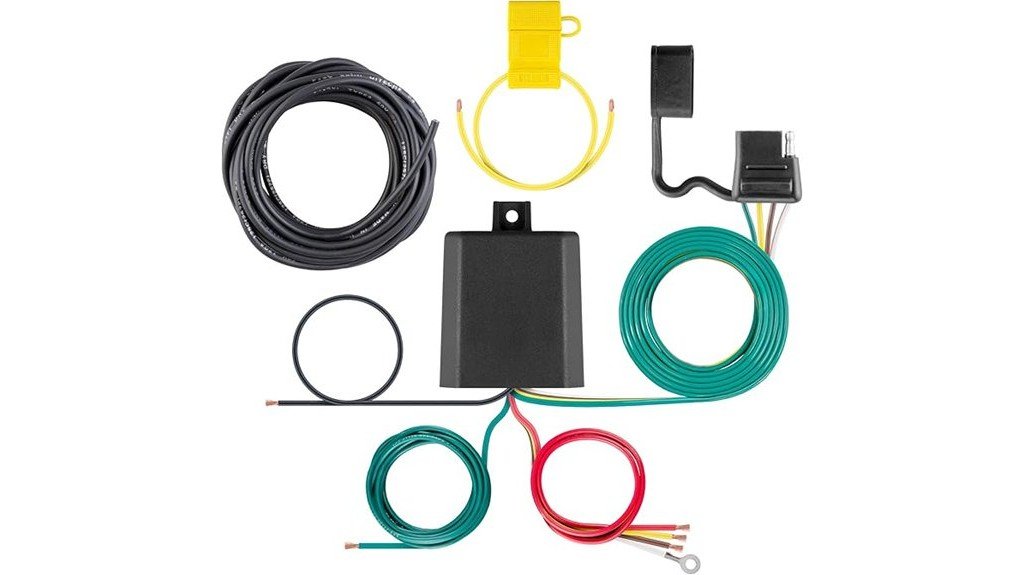
| Included Kit Components | Color-coded wire leads, snap locks, wiring kit, and instruction guide |
| Mounting Area | Under-vehicle bumper frame or rear trunk harness access point |
What Is the CURT 59236 Trailer Light Converter?
The CURT 59236 is a compact electrical conversion module designed for vehicles whose lighting wiring does not directly match standard 2-wire trailer lights. Modern cars, SUVs, and crossover trucks often combine brake and tail functions on a single wire using Pulse-Width Modulation (PWM) or separate turn signal wires from brake wires (3-wire systems). The CURT 59236 takes these complex signals and translates them into a clean 2-wire format compatible with standard 4-way flat trailer plugs.
Unlike basic unpowered converters, the 59236 uses integrated microcontroller logic to monitor electrical current. This allows the unit to regulate output, prevent damage to sensitive vehicle body control modules, and safely power trailer tail lights, turn signals, and brake lights without overloading vehicle circuits.
Who Should Buy It?
Best For
- Vehicles using PWM single-wire combined tail and stop signals.
- Exposed under-vehicle installations subject to rain, snow, road salt, and dirt.
- Drivers who want active short-circuit protection for vehicle body control electronics.
Skip If
- Your vehicle has a direct plug-and-play T-connector available for your exact year and model.
- You require a 7-way RV blade plug for electric trailer brakes or battery charging.
- You want a quick installation without stripping or splicing wires.
Before You Buy: The CURT 59236 is a universal splice-in kit. It requires manual wire identification, stripping, and crimping into your vehicle rear tail light harness. If CURT or Tekonsha offers a vehicle-specific plug-and-play T-connector for your vehicle, that option will save you installation time.
Signal Conversion and Multi-System Compatibility
Matching vehicle tail lights to a trailer requires handling different electrical setups. Vehicles use 2-wire systems, 3-wire systems (separate turn and brake lights), or PWM systems (where one wire carries variable voltage for both tail lights and brake lights). The CURT 59236 accepts inputs from 2-wire, 3-wire, PWM ST (Stop/Tail), and PWM STT (Stop/Tail/Turn) setups.
The module functions down to 7.0 volts minimum. This low operating threshold guarantees consistent trailer light illumination even when vehicle battery voltage drops slightly during engine start-up or under heavy accessory electrical load. It eliminates dimming and signal dropouts while driving.
Build Quality and Weather Resistance
Rear-mounted towing equipment faces constant exposure to moisture, road spray, gravel, and temperature swings. The CURT 59236 uses a dense housing filled entirely with potting epoxy. Encapsulating internal components in solid epoxy locks out water, grit, and road salt while dampening harsh road vibrations.
Measuring roughly 3.5 x 2.5 x 1.2 inches (and 4.5 to 5.5 inches including molded strain-relief cable exits), the unit weighs 1.61 pounds. This solid weight reflects the dense epoxy core. Molded cable exits prevent wire fatigue at entry points, extending service life in harsh underbody conditions.
Microcontroller Protection Safeguards
Trailer wiring short circuits are common when wires rub against metal trailer frames or exposed ground terminals. The CURT 59236 features an internal microcontroller with active current sensing. When it detects an short circuit or severe current overload on the trailer side, it limits or shuts down output to protect both the module and vehicle fuses.
Thermal shutdown protection is also built in. If electrical demand creates excessive internal heat, the microcontroller reduces output until temperatures normalize. Once the thermal or short-circuit condition is corrected, the system resets automatically, avoiding permanent module burnout.
Placement and Installation Guide
Installation requires attaching the input leads into your vehicle rear lighting harness and routing the 4-way flat output connector to your trailer hitch area. Included color-coded wires, snap locks, and instruction guides simplify connection identification.
Pro Tip: Mount the module upright so wire exits point toward the ground. Always form a small drip loop in the wiring harness directly below the module. This prevents water runoff from tracking down the wires into connection points.
Keep these practical setup steps in mind for a reliable installation:
- Verify Signals First: Use a circuit tester or multimeter to confirm turn, stop, and tail light wire functions on your vehicle before applying snap locks.
- Secure Grounding: Attach the ground wire ring terminal directly to clean, unpainted vehicle sheet metal to prevent ground loops or flickering lights.
- Protect Splices: Wrap snap lock connections with quality electrical tape or use solder and heat-shrink tubing for exposed under-vehicle installs.
- Avoid Exhaust Heat: Route input and output wiring away from hot exhaust pipes and muffler heat shields to prevent wire insulation melting.
Safety and Electrical Protection Notes
Modern vehicles rely on Body Control Modules (BCM) to regulate exterior lighting. Splicing raw trailer loads directly into factory wiring can trigger error codes or damage vehicle control computers. The CURT 59236 isolates vehicle electronics from trailer load spikes.
Its microcontroller acts as an electrical barrier. If a trailer wire grounds out against a trailer axle, the module senses the spike and cuts power before the fault travels back into your car’s main fuse panel. This safeguard prevents roadside breakdowns caused by blown vehicle lighting fuses.
How It Performs in Real Use
For Vehicles with PWM Lighting
On vehicles using pulsed voltage for combined tail and brake lights, the CURT 59236 smooths out the pulse signal. It delivers steady 12V output for full-brightness brake lights and consistent lower voltage for running lights without flickering.
For Rough Roads and Wet Towing Conditions
Because the internal circuitry is completely potted in epoxy, water immersion from boat launch ramps or driving through heavy rainstorms will not penetrate the housing. Vibrations from unpaved dirt roads or gravel trails do not loosen internal connections.
For Low-Voltage Systems
Vehicle electrical systems experience voltage drops when idling with headlights, air conditioning, and accessories active. Operating down to 7 volts ensures trailer turn signals and brake lights remain fully functional under heavy accessory load.
For LED Trailer Light Conversions
LED trailer lights draw significantly less current than traditional incandescent bulbs, which causes hyper-flashing on some vehicles. The microcontroller logic balances current draw to prevent rapid flashing and maintain standard turn signal cadence.
Pros and Cons
Pros
- Solid epoxy potting provides superior protection against water, mud, and vibration.
- Microcontroller actively protects vehicle electronics against short circuits and thermal overloads.
- Wide compatibility across 2-wire, 3-wire, PWM ST, and PWM STT lighting systems.
- Low-voltage threshold down to 7V prevents light flickering during voltage drops.
- Color-coded wire leads and complete kit simplify installation steps.
Cons
- Requires manual splice-in installation rather than simple plug-and-play setup.
- Output is limited strictly to a standard 4-pin flat trailer socket.
- Priced higher than basic unpowered, unpotted signal converters.
Is It Worth the Price?
The CURT 59236 sits in the mid-range price category for universal tail light converters. While cheaper unpowered converters exist, unpotted modules lack protection against water intrusion and road vibration. A cheap converter that burns out or shorts your vehicle body control module costs significantly more in repairs than the price difference for a protected unit.
For drivers towing light-duty trailers, utility trailers, or boat trailers, the 59236 provides excellent long-term reliability. Its active current sensing and heavy epoxy potting justify its price tag for anyone installing a converter in an exposed location.
How It Compares to Alternatives
When comparing trailer light converters, the main choices are non-powered basic converters, vehicle-specific T-connectors, and multi-function powered units like the CURT 59236:
- vs. Basic Unpowered Converters: Basic units only convert 3-wire signals to 2-wire output without active current sensing or PWM support. They risk overloading vehicle fuses. The CURT 59236 offers active protection and supports PWM signals.
- vs. Vehicle-Specific T-Connectors: T-connectors plug directly into factory wiring sockets without splicing. If a T-connector is available for your exact vehicle year and trim, it offers a faster setup. If no plug-and-play harness exists for your car, the CURT 59236 is the ideal universal splice-in solution.
Frequently Asked Questions
Will this kit work with RV integrated tail light systems?
Yes. The CURT 59236 accepts integrated RV lighting inputs including PWM, ST, and STT signals. It converts them into standard 2-wire trailer signals while protecting against electrical overloads and moisture intrusion.
Can it handle LED tail lights with hyper-flashing issues?
Yes. The internal microcontroller uses active current sensing to regulate signal flow. It mitigates rapid hyper-flashing caused by the low electrical resistance of LED trailer bulbs, ensuring steady turn signal timing.
Is the epoxy enclosure UV-resistant for direct sun exposure?
The potting epoxy is designed primarily for waterproofing and vibration dampening rather than UV exposure. While durable, mounting the module under the chassis or inside a bumper cavity shields it from direct sunlight and prolongs housing life.
Can I mount the converter inside a sealed trailer compartment?
Yes. You can mount the unit inside a sealed compartment provided there is basic clearance for wiring access. Although the epoxy potting protects against heat, avoiding tightly sealed enclosures with high ambient temperatures helps thermal regulation.
Are replacement wire leads or snap locks available separately?
Yes. Replacement quick-splice snap locks, wire leads, and 4-way flat extension harnesses are widely available at automotive parts stores or through official CURT dealers.
What is the difference between PWM ST and PWM STT inputs?
PWM ST refers to Pulse-Width Modulation handling combined Stop and Tail functions on a single wire. PWM STT includes Stop, Tail, and Turn functions modulated on shared wires. The CURT 59236 correctly decodes both formats into standard 4-pin output.
Does this converter power electric trailer brakes?
No. Standard 4-pin flat connectors only carry lighting signals (running lights, turn signals, brake lights, and ground). Electric trailer brakes require a 7-way blade connector connected to an auxiliary brake controller.
The Bottom Line
The CURT 59236 Trailer Tail Light Converter Kit is a reliable choice for drivers needing to adapt complex vehicle tail light wiring to a standard 4-pin trailer plug. Its epoxy-filled housing and microcontroller safeguards provide solid protection against water, vibration, short circuits, and thermal overloads. While installation requires manual splicing into your vehicle harness, its durable construction and broad PWM signal compatibility make it a dependable tow wiring solution.
Ready to Buy?
Check the latest price and current product details on Amazon before you decide.