Disclosure: As an Amazon Associate, we earn from qualifying purchases. If you click a link on this page and make a purchase, we may receive a small commission at no extra cost to you.
Compact welders often advertise several processes, but the accessory list and usable output matter more than the number printed on the product page. The FLARING 175A MIG Welder FM175 combines gas MIG, gasless flux-core MIG, Stick, Lift TIG, and spool-gun-ready operation with 120V/240V input. This review explains what those modes let you do, which parts are included, and where the machine’s limitations begin. Its strongest advantages are portability and process flexibility, while its main drawbacks are unverified duty-cycle data and extra accessories for some modes.
Quick Verdict
Rating: 8/10, Recommended with caveats
Best For: DIY welders, garage users, and small fabricators who want a portable machine for flux-core MIG, gas MIG, Stick, and occasional Lift TIG work.
Bottom Line: The FM175 offers useful dual-voltage flexibility, synergic MIG controls, and several welding processes in an 8-pound class machine. However, you must purchase separate accessories for Lift TIG and spool-gun work, and the published product information does not provide a dependable duty-cycle figure.
| Specification | Detail |
|---|---|
| Brand | FLARING |
| Model | FM175 |
| Product Type | Portable multi-process inverter welder |
| Maximum Listed Output | 175A |
| Input Voltage | 120V/240V dual-voltage AC input |
| Operating Modes | Gas MIG, gasless flux-core MIG, Stick/MMA/ARC, Lift TIG, and spool-gun-ready operation |
| Control Type | Synergic MIG control with manual adjustment |
| Display | Large LED digital display |
| Flux-Core Wire | .030 in and .035 in |
| Solid MIG Wire | .030 in |
| Referenced Stick Electrodes | 6013, 7018, 6010, and 6011 |
| Listed Mild-Steel Capacity | Up to approximately 5 mm, depending on process, input power, joint design, and preparation |
| Product Dimensions | 12.2 × 5.51 × 9.45 inches |
| Listed Item Weight | 7.96 pounds |
| Listed Color | White |
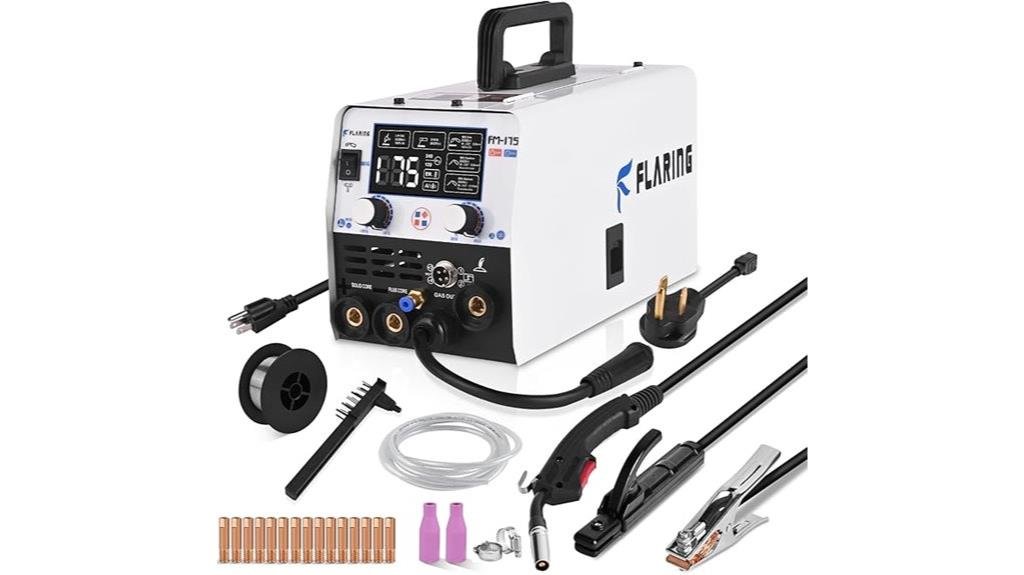
| Listed Components | FM175 welder, MIG torch, electrode holder and cable, ground clamp and cable, hose, flux-core wire spool, wire-feed wheels, wrench, and consumable set |
| Accessories Not Listed as Included | Lift TIG torch and spool gun |
| Best Use | Garage repairs, maintenance, hobby fabrication, brackets, frames, and light shop projects |
| Safety Note | Use suitable PPE, ventilation, grounding, polarity, and an electrical circuit that meets the machine manual and local requirements. |
What Is the FLARING 175A MIG Welder?
The FLARING FM175 is a portable inverter welder designed to cover several common home-shop processes without taking up the space of multiple separate machines. Its published maximum output is 175A, and its dual-voltage input lets you connect it to a compatible 120V or 240V supply.
Its five operating options include gas MIG, gasless flux-core MIG, Stick welding, Lift TIG, and a connection for a compatible spool gun. That range suits users who may begin with flux-core wire but want room to try gas MIG, electrode welding, or occasional TIG work later.
The machine is best viewed as a compact DIY and light-fabrication tool. It does not provide the documented duty cycle, accessory package, or advanced controls you would expect from a larger production welder.
Before You Buy: The published package list does not name a Lift TIG torch or spool gun. Package contents can also vary by seller or bundle, so confirm every included lead, gas component, torch, and adapter on the current Amazon page before ordering.
Who Should Buy It?
Best For
- DIY users who want to begin with flux-core MIG and add other processes later.
- Garage users who need a compact welder that can work with compatible 120V and 240V supplies.
- Small fabricators handling brackets, repairs, frames, patches, and other light mild-steel projects.
Skip If
- You need a documented production-duty cycle for long welds throughout the workday.
- You want advanced functions such as confirmed pulsed MIG or AC TIG controls.
- You need a complete aluminum or TIG package without buying and matching extra accessories.
Controls, Wire Support, and Power
Dual-Voltage Input
The FM175 accepts 120V and 240V input, which gives you more location flexibility than a 240V-only machine. A compatible 120V circuit can be useful for light repairs, testing, and portable work where a higher-voltage outlet is unavailable.
Do not assume both inputs provide identical welding performance. Available output depends on the supply, circuit capacity, process, settings, and the limits stated in the manual. Use the correct plug or manufacturer-approved adapter rather than modifying electrical connections yourself.
Synergic MIG Control
The synergic mode helps coordinate basic settings after you select the wire size. This can give a new user a more practical starting point than setting every parameter without guidance.
You can still fine-tune the output and wire feed when the preset does not match your joint, travel speed, or metal condition. Synergic control reduces initial guesswork, but it cannot correct dirty steel, poor grounding, incorrect polarity, or weak technique.
Wire and Electrode Compatibility
The published information lists support for .030-inch and .035-inch flux-core wire and .030-inch solid MIG wire. Those sizes cover many common mild-steel repairs and hobby-fabrication jobs.
For Stick mode, the listing references 6013, 7018, 6010, and 6011 electrodes. Usable rod diameter and performance still depend on the input supply, selected amperage, material thickness, joint condition, and your ability to maintain the arc.
Welding Modes and Compatibility
Gasless Flux-Core MIG
Flux-core MIG offers the simplest starting setup because it does not require an external shielding-gas cylinder. It is useful for repairs, outdoor work, and situations where moving a gas bottle would be inconvenient.
The tradeoff is additional smoke, spatter, and slag compared with a well-tuned solid-wire MIG setup. You must also confirm polarity because many self-shielded wires require a different polarity from gas-shielded solid wire.
Gas MIG With Solid Wire
Gas MIG can produce cleaner beads and less slag on prepared mild steel. The FM175 supports .030-inch solid wire, but you also need suitable shielding gas, the correct flow equipment, proper polarity, and protection from wind.
The published component list names a hose but does not clearly confirm every gas-system part. Check whether the current bundle includes the regulator, fittings, and other equipment required for your cylinder.
Stick Welding
Stick mode gives you another option for maintenance work, thicker joints, and surfaces where wire welding may be inconvenient. It also avoids the wire-feed and shielding-gas equipment required for gas MIG.
Electrode choice matters. A rod that works well on clean steel may not behave the same on painted, rusty, thin, or poorly fitted material. Start with the manufacturer’s parameter guidance and test the selected rod on scrap steel.
Lift TIG
Lift TIG lets you start the arc by briefly touching the tungsten to the work before lifting it. This gives you more control than MIG for certain detail jobs, but it does not turn the FM175 into a dedicated AC/DC TIG machine.
The Lift TIG torch is not listed among the standard components. You may also need a gas regulator, shielding gas, tungsten, filler rod, and other process-specific parts before this mode is usable.
Spool-Gun-Ready Operation
The machine includes spool-gun-ready functionality, but the compatible spool gun is not listed as part of the standard package. Treat this as an expansion option rather than an included aluminum-welding setup.
Before planning an aluminum project, confirm the connector type, recommended spool-gun model, supported wire, polarity, gas requirements, and thickness range. Spool-gun-ready does not guarantee good results with every gun or aluminum alloy.
Package Contents and Accessory Requirements
The published component list includes the FM175 machine, MIG torch, electrode holder and cable, ground clamp and cable, hose, flux-core wire spool, wire-feed wheels, wrench, and a consumable set. This should provide the core hardware needed to begin basic flux-core or Stick setup after you inspect and assemble the equipment.
The list does not name a Lift TIG torch or spool gun. It also does not clearly identify every gas-MIG component, protective item, plug adapter, or replacement consumable you may need.
Check the listing photographs and written package list instead of relying only on the “5-in-1” label. A multi-process machine can support a mode even when the torch, gas hardware, filler material, or wire required for that mode is sold separately.
Design and Portability
The listed dimensions are 12.2 × 5.51 × 9.45 inches, with a listed item weight of 7.96 pounds. That compact footprint makes the machine easier to store on a workshop shelf, place on a small cart, or carry between repair locations.
Low machine weight does not include every item needed for a complete setup. A shielding-gas cylinder, spool gun, TIG equipment, welding helmet, leads, consumables, and extension equipment can add considerable bulk.
The large LED display provides a clearer view of selected parameters than small analog markings. Keep the panel and controls protected from grinding dust, impact, metal debris, and moisture during storage and transport.
Exact warranty and customer-support terms were not confirmed. Review the current seller information, return policy, warranty card, and manufacturer contact details before purchase.
Setup Tips Before First Use
Begin by identifying the process you plan to use. Match the wire or electrode, drive wheel, contact tip, polarity, torch or holder, shielding gas, and input supply to that process.
Inspect the power cord, torch, ground cable, connectors, liner, contact tip, and consumables before switching on the machine. Secure the ground clamp to clean bare metal near the weld area, not over paint, rust, oil, or a loose surface.
For MIG welding, load the wire without forcing it through the feed path. Set enough roller tension to feed the wire steadily without crushing it, then trim the wire and install the correct contact tip.
Clean the workpiece and prepare the joint before testing settings. Mill scale, paint, grease, corrosion, wide gaps, and poor fit-up can make a suitable machine appear underpowered or unstable.
Pro Tip: Use scrap metal with the same type, thickness, orientation, and joint design as your project. Run several short test beads, inspect penetration and bead shape, then adjust one setting at a time before welding the final part.
How It Performs in Real Use
For Basic Garage Repairs
The FM175 is suited to brackets, tabs, mild-steel patches, small supports, and similar repair work when the material and joint stay within its practical range. Flux-core mode can help you start quickly without moving a gas cylinder into position.
Thin panels still require care. Use short welds, allow cooling time, and move between areas to reduce distortion or burn-through. Test settings before working on any structural or safety-critical component.
For Hobby Fabrication
The 175A maximum-output claim and 5 mm mild-steel claim provide useful room for carts, stands, frames, and small shop projects. Actual joint capacity depends on beveling, gap, process, position, number of passes, input supply, and preparation.
Do not use the listed thickness as a promise that every 5 mm joint can be completed in one pass. Critical joints require suitable design, proven procedure, inspection, and the skill to confirm adequate fusion.
For Outdoor Work
Self-shielded flux-core wire is the most practical mode when wind would disrupt MIG shielding gas. It also reduces the equipment you need to carry outside.
You should expect additional cleanup from slag and spatter. Keep the machine itself dry, place it on a stable surface, and protect the electrical connections from rain, standing water, and conductive debris.
For Occasional Portable Use
The listed 7.96-pound weight makes the FM175 easier to move than many larger shop welders. This can help when you repair gates, equipment, brackets, or frames in different areas of a property.
Portability does not remove power requirements. Verify the available outlet and circuit before traveling to the work area, and avoid relying on an undersized extension cord or an improvised adapter.
For Longer Welding Sessions
A reliable duty-cycle figure was not confirmed for this model. Watch for the machine’s warning indicators, changing arc behavior, or a protective shutdown, and follow the operating and cooling instructions in the manual.
Keep all vents unobstructed and remove dust only with a method approved by the manufacturer. A compact welder should not be treated like a continuous-duty industrial power source.
Electrical and Welding Safety
Use a properly rated welding helmet, safety glasses, dry welding gloves, flame-resistant clothing, closed footwear, and suitable hearing protection. Protect nearby people from arc light, sparks, hot metal, fumes, and grinding debris.
Remove flammable liquids, paper, fuel, sawdust, aerosols, and other combustible materials from the work area. Welding fumes require suitable ventilation, especially when coatings, plated metal, stainless steel, or confined spaces are involved.
Match the machine, plug, receptacle, breaker, and wiring to the manufacturer’s electrical requirements and local rules. Do not alter a plug, bypass grounding, work with damaged cables, or operate the machine in wet conditions.
Do not weld fuel tanks, pressurized containers, sealed vessels, vehicle safety parts, lifting equipment, or structural components unless the item has been properly prepared and you have the required training. Seek qualified help when weld failure could cause injury or major property damage.
Common Mistakes to Avoid
- Assuming all five modes are ready from the box: Lift TIG and spool-gun work require separate equipment that is not listed among the standard components.
- Using the wrong polarity: Solid MIG wire and self-shielded flux-core wire may require different polarity arrangements.
- Welding over contamination: Paint, rust, oil, coatings, and poor ground contact can create an unstable arc and weak fusion.
- Skipping test welds: Wire feed, voltage, stick-out, travel speed, torch angle, and joint design all affect the final bead.
- Treating the 5 mm claim as universal: Material thickness alone does not determine whether a joint can be welded safely.
- Overloading the electrical supply: An unsuitable circuit, adapter, or extension cord can cause poor performance and create a hazard.
Pros and Cons
Pros
- Supports gas MIG, flux-core MIG, Stick, Lift TIG, and spool-gun-ready operation.
- Accepts compatible 120V and 240V input for greater workshop flexibility.
- Synergic MIG control gives beginners a more useful starting point for setup.
- Supports common .030-inch and .035-inch wire sizes.
- Listed 7.96-pound weight and compact dimensions make storage and transport easier.
Cons
- Lift TIG torch and spool gun are not listed as included components.
- A dependable duty-cycle specification was not confirmed.
- Gas MIG, TIG, and aluminum work may require several extra parts beyond the base package.
Is It Worth the Price?
The FLARING FM175 is worth considering when you want more process flexibility than a basic 120V flux-core-only welder. Its value comes from the dual-voltage input, compact size, common wire support, synergic controls, and ability to expand into several welding methods.
Buyers who plan to use both MIG and Stick modes are likely to get more value from it than someone who needs only occasional flux-core repairs. The included core leads and flux-core supplies also provide a more practical starting point than a bare machine.
Account for the complete setup cost before deciding. A gas cylinder, regulator, TIG torch, spool gun, consumables, protective equipment, and suitable electrical connection can cost more than the base welder alone.
How It Compares to Alternatives
Compared with a basic 120V flux-core welder, the FM175 offers dual-voltage input, gas MIG support, Stick welding, Lift TIG capability, and a spool-gun connection. A simpler flux-core machine may still be the better choice when you want the lowest setup cost and will never use the additional processes.
Larger 200A-class multi-process welders may offer higher advertised output, larger wire-spool support, longer documented duty cycles, or advanced controls. They are often heavier and may require more workshop space and electrical capacity.
The FM175 makes the most sense when portability and process choice matter more than continuous production output. Compare the complete accessory package, manual, duty cycle, local support, and compatible spool gun before choosing between similar machines.
Frequently Asked Questions
Is the FLARING 175A MIG Welder suitable for beginners?
It can be a practical beginner machine because the LED display and synergic MIG mode provide a clearer starting point for setup. You still need to learn polarity, wire selection, joint preparation, travel speed, grounding, and welding safety.
Does the FM175 include everything needed for all five modes?
No. The published package list includes the basic MIG and Stick hardware, but it does not list a Lift TIG torch or spool gun. Gas-shielded processes can also require a cylinder, regulator, fittings, consumables, and other equipment.
Can the FLARING FM175 weld aluminum?
The machine is described as spool-gun ready, but the spool gun is not listed as included. Confirm the exact compatible gun, connector, wire, shielding gas, polarity, and supported material range before buying the machine for aluminum work.
Does it run on both 120V and 240V?
Yes, the FM175 is listed with 120V/240V dual-voltage input. The available welding output can vary with the input supply, so follow the manual’s connection and circuit requirements for the process you plan to use.
What wire sizes does it support?
The published specifications list .030-inch and .035-inch flux-core wire and .030-inch solid MIG wire. Match the contact tip, feed wheel, polarity, gas, and settings to the exact wire you install.
How thick can the FM175 weld?
The listing claims mild-steel capacity up to approximately 5 mm. Treat that as a maximum product claim, not a guarantee for every joint, because process, input power, preparation, fit-up, position, and technique affect usable capacity.
Can you use the FM175 outdoors?
Flux-core mode is useful outdoors because it does not depend on an external shielding-gas cloud. Keep the machine and electrical connections dry, protect the work area from fire hazards, and provide safe ventilation.
Who should skip this welder?
Skip it if you need a documented production-duty cycle, advanced pulsed MIG, dedicated AC TIG, or a complete TIG and aluminum package. It is better suited to DIY repairs, garage projects, maintenance, and light fabrication.
The Bottom Line
The FLARING 175A MIG Welder FM175 is a solid compact option for DIY users who value dual-voltage input, several welding processes, and easy storage. Its main limitation is that Lift TIG and spool-gun work require additional equipment, while dependable duty-cycle information remains unavailable.
Buy it for garage repairs, hobby fabrication, and process flexibility. Choose a larger or better-documented machine if you need daily production work, advanced controls, or a complete TIG and aluminum setup.
Ready to Buy?
Check the latest package contents, price, and product details before you decide.