Disclosure: As an Amazon Associate, we earn from qualifying purchases. If you click a link on this page and make a purchase, we may receive a small commission at no extra cost to you.
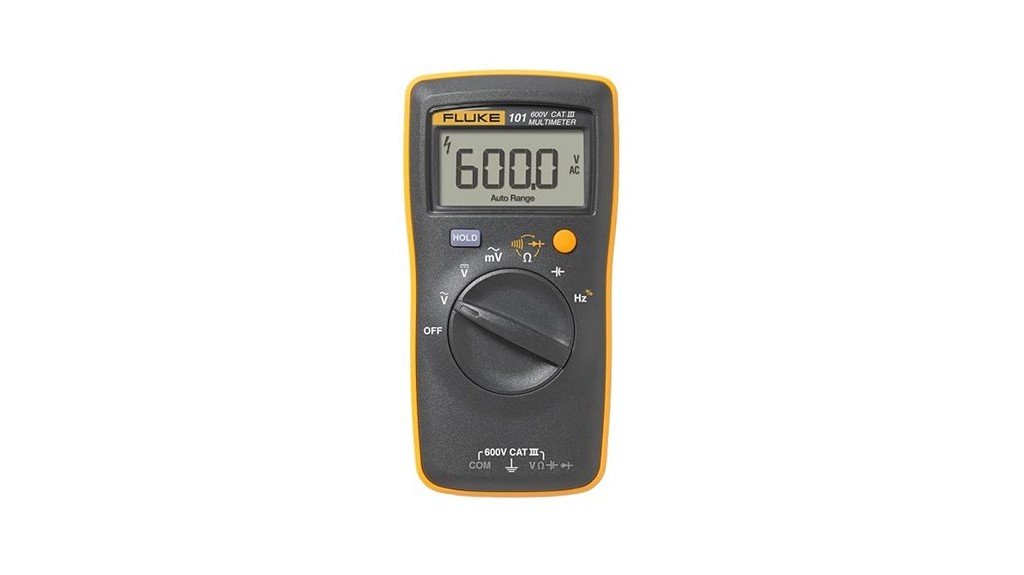
A pocket-size multimeter can make routine troubleshooting easier, but only when its measurement functions match your work. The FLUKE-101 Digital Multimeter combines a compact 160 g body with AC and DC voltage, resistance, continuity, diode, capacitance, frequency, and duty-cycle testing. Its CAT III 600 V rating and simple two-jack layout suit quick field and bench checks. However, it cannot measure AC or DC current directly and does not provide a data-hold function, so this review will help you decide whether its compact design outweighs those limits.
Quick Verdict
Rating: 8.5/10
Best For: Electricians, HVAC technicians, maintenance users, electronics hobbyists, and DIYers who need a compact meter for voltage and component checks.
Bottom Line: The FLUKE-101 packs a useful set of voltage, resistance, capacitance, and frequency functions into a durable palm-size meter. Its biggest tradeoffs are the lack of direct current measurement and data hold.
Key Features and Specifications
| Specification | Detail |
|---|---|
| Brand | Fluke |
| Model | FLUKE-101 |
| Product type | Palm-size digital multimeter |
| DC voltage range | 6.000 V, 60.00 V, and 600.0 V |
| Basic DC voltage accuracy | ±0.5% of reading plus 3 digits |
| AC voltage range | 600.0 mV, 6.000 V, 60.00 V, and 600.0 V at 40 to 500 Hz |
| Resistance range | 400 Ω to 40 MΩ |
| Capacitance range | 50.00 nF to 1000.0 µF |
| Frequency range | 10 Hz to 100 kHz |
| Duty-cycle range | 0.1% to 99.9% |
| Additional functions | Audible continuity, diode test, and automatic shutdown |
| Direct current measurement | Not supported |
| Data hold | Not included |
| Safety rating | CAT III 600 V |
| Ingress protection | IP40 under IEC 60529 |
| Drop testing | Tested for a one-meter drop under the listed Fluke and IEC requirements |
| Dimensions | 130 × 65 × 27 mm |
| Weight | 160 g |
| Power | Two AAA batteries |
| Listed package contents | FLUKE-101 meter, TL75 test leads, two AAA batteries, and user manual |
| Warranty | One year |
| Best use | Routine voltage checks, resistance testing, continuity checks, diode testing, capacitor checks, frequency measurements, and compact field use |
What Is the FLUKE-101 Digital Multimeter?
The FLUKE-101 is a compact digital multimeter designed for basic electrical testing. Fluke positions it for residential and commercial electricians, heating and air-conditioning technicians, maintenance users, and anyone who needs reliable measurements without carrying a full-size meter.
Its main selling point is the balance between size and measurement range. The meter measures AC and DC voltage to 600 V, resistance to 40 MΩ, capacitance across several nano- and microfarad ranges, and frequency to 100 kHz. You also get duty-cycle testing, audible continuity, diode testing, and automatic shutdown.
The FLUKE-101 has only two input jacks because it does not measure current directly. That simpler design reduces the risk of accidentally leaving a lead connected to an amperage jack, but it also prevents you from measuring AC or DC amperage through the meter itself.
Key Takeaways
- The 160 g body and 130 × 65 × 27 mm dimensions make the FLUKE-101 easy to carry and operate with one hand.
- Its 0.5% basic DC voltage accuracy supports routine electrical and low-voltage troubleshooting.
- AC/DC voltage, resistance, capacitance, frequency, duty cycle, continuity, and diode modes cover more tasks than a basic voltage tester.
- The CAT III 600 V rating supports use in suitable distribution-level environments when the meter, leads, and work method match the task.
- The meter cannot measure current directly and does not have data hold, which can limit professional troubleshooting.
- Two AAA batteries, automatic shutdown, IP40 protection, and one-meter drop testing support everyday portability.
Before You Buy: The FLUKE-101 does not measure AC or DC current directly. Choose another model if amperage testing is a regular part of your work, and never assume that a voltage rating alone makes a meter suitable for every electrical environment.
Who Should Buy It?
Best For
- Electricians and maintenance users who want a compact backup meter for voltage, resistance, continuity, and frequency checks.
- HVAC technicians who need voltage, capacitance, frequency, and continuity functions but do not need direct current measurement.
- DIY users and electronics hobbyists who value straightforward controls, small dimensions, and a recognized test-tool brand.
Skip If
- You need to measure AC or DC amperage directly through the meter.
- You regularly need data hold, advanced recording, temperature measurement, or a wider professional feature set.
- You need a meter rated for measurement categories or voltages beyond CAT III 600 V.
Design, Durability, and Usability
The FLUKE-101 is noticeably smaller than a traditional full-size multimeter. Its 130 × 65 × 27 mm body fits easily in a small tool pouch, service bag, desk drawer, or electronics kit. At 160 g, it is light enough to hold while positioning the probes with your other hand.
A rotary selector provides direct access to the main measurement modes. The two-jack layout also keeps setup simple because you use the same voltage and common terminals for the supported tests. You do not have to move a lead between separate milliamp and amp inputs because the meter has no direct current ranges.
Fluke lists IP40 ingress protection, a one-meter drop test, and vibration testing to MIL-PRF-28800F Class 2. These details make the meter better suited to everyday tool-bag use than an unverified low-cost meter, but IP40 does not make it waterproof. Keep it away from rain, standing water, and wet work areas.
Measurement Functions and Performance
AC and DC Voltage
The FLUKE-101 measures DC voltage across 6.000 V, 60.00 V, and 600.0 V ranges. Its stated basic DC accuracy is ±0.5% of the reading plus three digits, which is suitable for battery checks, power-supply troubleshooting, control-voltage testing, and many routine electrical tasks.
AC voltage ranges extend from 600.0 mV to 600.0 V within a listed 40 to 500 Hz band. This range covers common mains and control-system checks, but you must still confirm that the measurement category, voltage, leads, and work environment match the task.
Resistance and Continuity
Resistance measurement extends from 400 Ω to 40 MΩ. That range lets you check resistors, wiring paths, heating elements, switches, coils, and other components when the circuit has been safely de-energized.
The audible continuity mode is useful when you cannot keep your eyes on the screen. It can help you locate broken conductors, confirm switch operation, check cable paths, and identify open connections more quickly.
Capacitance Testing
Unlike the earlier article claim, the FLUKE-101 does measure capacitance. Its listed ranges run from 50.00 nF to 1000.0 µF, giving it practical value for checking many electronic and HVAC capacitors.
A capacitance reading alone does not prove that a component will perform correctly under its normal operating load. Disconnect power, discharge the capacitor safely, and follow the equipment and meter instructions before testing.
Frequency and Duty Cycle
The frequency function covers 10 Hz to 100 kHz, while duty cycle covers 0.1% to 99.9%. These modes can help when you work with control signals, pulse-based electronics, switching circuits, and equipment where signal timing matters.
The FLUKE-101 does not provide advanced logging or waveform analysis. It gives you a numerical reading, so an oscilloscope or more advanced diagnostic tool may still be necessary for intermittent or distorted signals.
Diode Testing
The diode function measures the forward voltage drop across a semiconductor junction. It can help you identify open or shorted diodes and perform basic checks on rectifiers and other components.
In-circuit readings can be influenced by parallel components. For clearer results, follow the service instructions for the equipment and remove the component from the circuit when appropriate.
Safety Rating and Electrical Use
The FLUKE-101 carries a CAT III 600 V rating. Measurement category and voltage must be considered together because a CAT rating describes the transient-energy environment the meter is designed to withstand, not only the steady voltage shown on the display.
Use test leads with ratings that meet or exceed the meter and the task. Inspect the meter, connectors, insulation, and probe tips before every use. Do not use damaged leads, cracked housings, loose connectors, or a meter that behaves unpredictably.
Turn off circuit power and discharge high-voltage capacitors before measuring resistance, continuity, capacitance, or diode junctions. Live electrical testing can cause shock, burns, fire, or equipment damage, so follow the FLUKE-101 manual and all applicable workplace procedures.
Pro Tip: Before testing an unknown live circuit, confirm the selector position and verify meter operation on a known voltage source. Recheck the meter on that known source after the measurement when the job requires a live-dead-live verification process.
How It Performs in Real Use
For Household and Building Voltage Checks
The compact body works well for outlet, switch, control-circuit, and supply-voltage checks where the CAT III 600 V rating is appropriate. The simple selector and two input jacks reduce setup steps, which can help during repeated basic checks.
You still need to identify the circuit category before testing. Do not use the meter merely because the expected voltage falls below 600 V.
For HVAC Service Calls
The combination of voltage, resistance, continuity, capacitance, frequency, and duty-cycle testing covers several common HVAC diagnostic needs. You can check supply voltage, control signals, wiring continuity, resistive components, and capacitor values with one small meter.
The missing current function remains important. Technicians who need direct amperage readings must use a compatible external method or choose a meter or clamp meter designed for current measurement.
For Electronics and Bench Work
The resistance, diode, capacitance, frequency, and low-voltage ranges make the FLUKE-101 useful for basic electronics work. Its small footprint also takes up little space on a crowded bench.
It is not a replacement for an oscilloscope, bench multimeter, or logging meter. The lack of data hold may also be inconvenient when the display is difficult to see while you maintain probe contact.
As a Backup or Travel Meter
At 160 g, the FLUKE-101 is easy to keep in a service vehicle, emergency kit, secondary tool bag, or travel case. Automatic shutdown helps conserve its two AAA batteries when you forget to turn the selector off.
The listed package includes test leads and batteries, but a dedicated protective case is not listed as included. A fitted pouch can help protect the display, selector, and probes during transport.
Setup and Usage Tips
Read the user manual before first use and identify every selector position. Confirm that both test leads are fully inserted, free from damage, and rated for the measurement environment.
- Start with the correct function: Select voltage before connecting to an energized circuit. Use resistance, continuity, capacitance, and diode modes only on safely de-energized circuits.
- Check a known source: Confirm meter operation before relying on it to identify whether a conductor is energized.
- Discharge capacitors safely: Never switch directly to capacitance mode on a charged component.
- Keep the meter dry: Its IP40 rating does not protect it against water entry.
- Protect it during transport: Store the meter and leads in a separate pouch so metal tools cannot damage the screen or probe insulation.
- Remove batteries for long storage: This reduces the risk of leakage when the meter will not be used for an extended period.
Pros and Cons
Pros
- Compact 160 g design is easy to carry and operate with one hand.
- Measures AC/DC voltage, resistance, capacitance, frequency, duty cycle, continuity, and diodes.
- 0.5% basic DC voltage accuracy supports routine troubleshooting.
- CAT III 600 V rating suits appropriate residential and commercial electrical environments.
- Automatic shutdown, IP40 protection, and one-meter drop testing support regular field use.
Cons
- Cannot measure AC or DC current directly.
- Does not include a data-hold function for freezing a reading on screen.
- A dedicated case or holster is not listed among the standard included components.
Is It Worth the Price?
The FLUKE-101 is worth considering if you want a compact meter from an established test-equipment brand without moving to a large professional model. Its value comes from combining voltage, resistance, capacitance, frequency, duty-cycle, continuity, and diode functions in a 160 g body.
It makes the most sense for buyers who prioritize portability, straightforward operation, and a CAT III 600 V rating. It can also offer good value as a backup meter because it covers more component tests than a basic voltage-only tester.
It is not the best value for you if current measurement or data hold is essential. Paying more for a model with those functions may cost less than buying a second tool later.
How It Compares to Alternatives
The Fluke 106 is worth comparing if you want a similar palm-size design with direct AC and DC current measurement and data hold. The Fluke 107 adds direct current measurement, data hold, and a backlit display, making it more practical when you regularly work in dim panels or need to freeze readings.
The larger Fluke 15B+ measures AC and DC voltage to 1000 V, measures current to 10 A, and includes data hold and a bright display backlight. The FLUKE-101 remains the better fit when minimum size and weight matter more than direct current measurement or expanded controls.
Frequently Asked Questions
Is the FLUKE-101 good for electricians?
Yes. It works well as a compact primary or backup meter for AC/DC voltage, resistance, continuity, capacitance, frequency, and diode checks. Choose another model if your work requires direct current measurement, data hold, or a higher measurement-category rating.
Can the FLUKE-101 measure capacitance?
Yes. Fluke lists capacitance ranges from 50.00 nF to 1000.0 µF. Disconnect circuit power and safely discharge the capacitor before testing.
Can it measure frequency and duty cycle?
Yes. The frequency range extends from 10 Hz to 100 kHz, and the duty-cycle range is 0.1% to 99.9%. These functions can help with control signals and pulse-based circuits, but the meter does not provide waveform analysis.
Does the FLUKE-101 measure current or amps?
No. The FLUKE-101 does not include direct AC or DC current ranges or dedicated current input jacks. Compare the Fluke 106, Fluke 107, or another current-capable meter if amperage measurements are required.
What batteries does the FLUKE-101 use?
It uses two AAA batteries, not one. The Amazon listing states that two batteries are included, but you should confirm the current package contents before ordering.
What comes with the FLUKE-101?
The listing identifies the meter, TL75 test leads, two AAA batteries, and a user manual as included components. It does not list a dedicated protective case or holster, and package details can change by seller.
Is the FLUKE-101 suitable for HVAC troubleshooting?
It can handle voltage, resistance, continuity, capacitance, frequency, and duty-cycle checks used in many HVAC service tasks. It is less suitable when you need direct current measurement, temperature testing, or advanced recording features.
Who should skip the FLUKE-101?
Skip it if you need direct amperage readings, data hold, logging, temperature measurement, a backlit full-size display, or ratings beyond CAT III 600 V. It is best for buyers who want a compact meter for routine voltage and component checks.
The Bottom Line
The FLUKE-101 Digital Multimeter is a strong compact choice for voltage, resistance, capacitance, frequency, continuity, and diode testing. Its 160 g body, CAT III 600 V rating, and broad basic function set make it useful for field kits, HVAC work, maintenance, and electronics benches.
Buy it if you value portability and do not need direct current measurement or data hold. Choose a Fluke 106, 107, 15B+, or another expanded model if those missing functions are essential to your work.
Ready to Buy?
Check the latest price, seller, and package details before you decide.