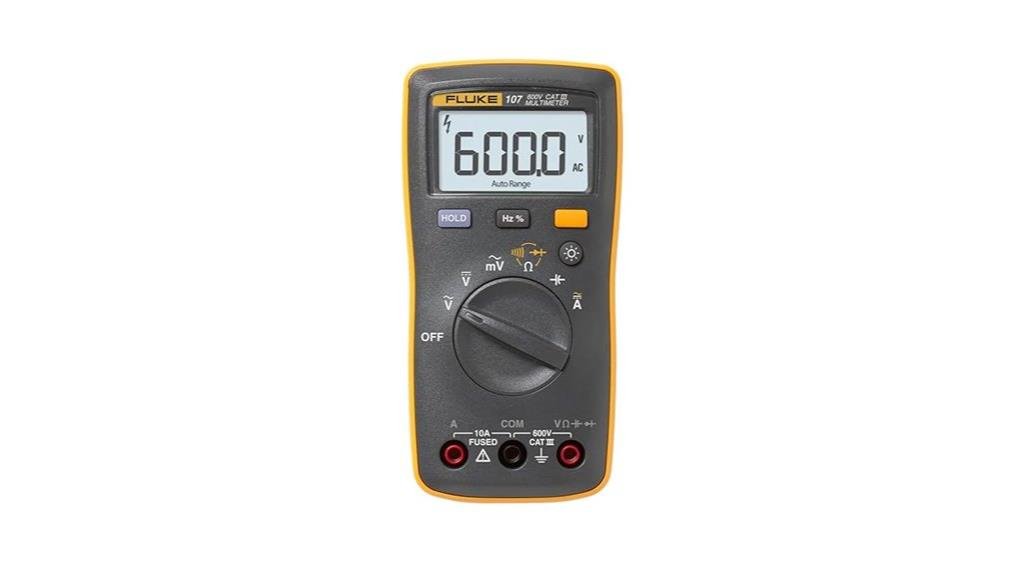
The Fluke 107 is presented as a compact, reliable multimeter for field technicians and electricians, weighing 150 g and measuring essential parameters like AC/DC voltage to 600 V, resistance to 40 MΩ, and basic continuity and diode tests. It lacks true-RMS for complex waveforms but offers a backlit display, auto-ranging, and sturdy pocket-friendly housing. How well does its accuracy and portability balance against the missing true-RMS capability?
Key Takeaways
- Compact, lightweight design (≈150–165 g) makes the Fluke 107 highly portable for field technicians and pocket carry.
- Measures AC/DC voltage to 600 V and DC current to 10 A, covering common troubleshooting tasks.
- Typical DC accuracy of ±(0.5% + 2 digits) provides reliable readings for component checks and maintenance.
- Useful features include resistance to 40 MΩ, capacitance to 100 µF, frequency, duty cycle, diode test, and data hold.
- Safety-rated CAT III 600 V and backlit display enhance field usability, though AC true-RMS is not supported.
Why the Fluke 107 Stands Out for Field Work
Because technicians often need reliable tools in unpredictable environments, the Fluke 107 is engineered to meet field demands with compactness and practical features.
It fits pockets, weighs about 150 g, and sports a backlit display for low-light jobs.
What practical benefits matter? Portability, single-hand operation, and robust casing.
How safe is it? CAT III 600 V rated for many site tasks.
Who should consider it? Electricians, HVAC techs, and maintenance staff seeking a basic, dependable DMM.
Considerations: limited advanced functions, no true-rms for complex loads, and measurement ranges suitable for everyday troubleshooting.
Key Measurements and Performance Highlights
Having established why the Fluke 107 is well suited to field use, the discussion now turns to what it actually measures and how well it performs.
The meter measures AC/DC voltage to 600 V, DC current to 10 A, resistance to 40 MΩ, capacitance to 100 µF, plus frequency and duty cycle; diode test included.
How accurate is it? Typical DC accuracy is ±(0.5% + 2 digits), suitable for troubleshooting and component checks.
Practical notes: backlit display aids reading, data hold captures fleeting readings, response is prompt.
Limitations: no true-rms for AC, modest capacitance range for advanced electronics.
Safety, Usability, and Portability Features
When engineers and technicians need a compact tool that balances safety, day-to-day usability, and easy transport, the Fluke 107 presents a clear package: CAT III 600 V protection, a lightweight 165 g (approx.) body, and a pocket-sized footprint that fits in a shirt or jacket.
The meter offers data hold and backlight for visibility, simple rotary controls, and clear legends.
How durable is it? Rated for CAT III 600 V, suitable for distribution panels and outlet-level work.
Practical considerations: 165 g weight, small form factor, battery life adequate for field use.
Who benefits most? Field technicians and electricians seeking reliable portability.
Frequently Asked Questions
Does It Include a Carrying Case or Probe Storage?
No, it does not include a carrying case or dedicated probe storage. The Fluke 107 is supplied as the handheld meter only; users typically store probes separately or acquire third-party cases or protective pouches for transport and organization.
What Type of Battery Does It Use and How Long Does It Last?
It uses a single 9V alkaline battery. Typical runtime is about 200 hours under normal use; actual life varies with display backlight, frequency of measurements and use of data-hold, so heavy use reduces runtime accordingly.
Is There Warranty or Customer Support Information?
Yes — the device includes a limited warranty and manufacturer customer support; users see Fluke’s service network like a lighthouse, guiding repairs, registration and assistance through authorized centers, phone and online resources for claims and technical help.
Can It Interface With a Computer or Log Data Externally?
No; it cannot interface with a computer or log data externally. The Fluke 107 lacks built-in data-logging or USB/serial connectivity, so measurements must be recorded manually, relying on its display and data-hold function for temporary capture.
Is It Suitable for Automotive Diagnostic Work?
Is it robust enough for garages and roadside repairs? Yes. It handles basic automotive tasks: AC/DC voltage, current, resistance, diode, frequency, duty cycle, and capacitance. Its CAT III 600 V safety and backlight aid field use.
Conclusion
The Fluke 107 proves itself as a compact, accurate tool for field technicians: 150 g weight, 600 V AC/DC range, 40 MΩ resistance, backlit display. It lacks true‑RMS—so not ideal for distorted AC waveforms—but performs reliably for standard troubleshooting. Safety features, simple interface, and pocketable size make it practical on-site. Is it the right choice? For everyday electrical diagnosis and portable convenience, yes; for complex RMS measurements, consider a true‑RMS model.