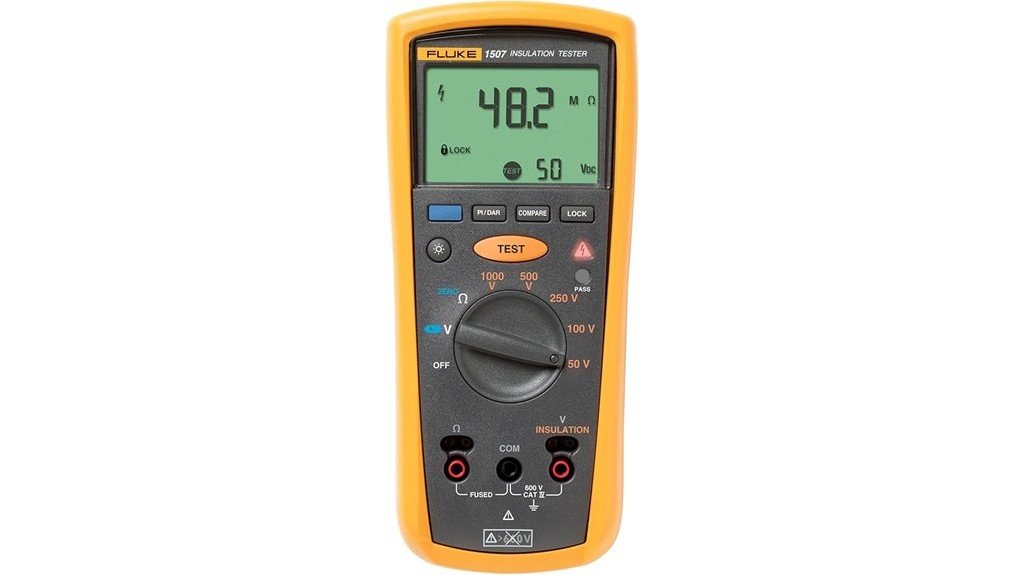
The Fluke 1507 insulation tester is a compact, rugged tool for electricians and maintenance technicians, offering 50–1000 V test voltages, 0.01 GΩ resolution, and rapid test times. It features a clear backlit LCD, automatic discharge, and NIST-traceable calibration, enhancing safety and traceability. How does it perform under heavy field use, in tight panels, or across long cable runs? The next sections examine performance, usability, and value.
Key Takeaways
- Compact, rugged design (2.9×5.9×11.75 in, 3.2 lb) makes the Fluke 1507 highly portable and field-ready.
- Tests 50–1000 V with fast ramp and reliable PI/DAR measurements suitable for confined or live-area work.
- Large backlit display, intuitive rotary switch, and single-button start enable quick operation and minimal learning curve.
- Safety features include live-circuit detection >30 V, auto-discharge, and IEC/EN 61010-1 CAT IV 600 V compliance.
- NIST-traceable calibration, ~1000-test battery life, and durable housing deliver professional reliability despite a one-year warranty.
Key Specifications and Design Overview
Dimensions and weight matter when carrying test gear into the field. The Fluke 1507 pairs compact product dimensions—2.9 in. height, 5.9 in. width, 11.75 in. depth—with a 3.2 lb (1.45 kg) mass, easing transport and pocketing.
Compact and lightweight, the Fluke 1507’s 2.9×5.9×11.75 in. footprint and 3.2 lb mass make it field-friendly.
What is it made of? Rugged design materials and durable housing suit industrial use.
Key specs: test voltages 50–1000 V, battery: 4 AA (≈1000 tests), large backlit display, remote probe included.
Practical considerations: fits most tool bags, balanced for handheld use, meets IEC/EN 61010-1 CAT IV 600 V.
Who benefits? Technicians seeking portable, reliable insulation testing.
Safety and Calibration Features
After outlining portability and handling, attention turns to how the Fluke 1507 protects the user and maintains measurement accuracy in the field. It integrates safety mechanisms: live-circuit detection above 30 V, auto-discharge of capacitive voltage, and CAT IV 600 V compliance. Calibration accuracy is supported by a NIST-traceable certificate; expect stable readings across 50–1000 V test ranges. Practical considerations: battery life ~1000 tests, weight 1.45 kg, dimensions 2.9×5.9×11.75 in.
| Feature | Detail |
|---|---|
| Safety mechanisms | Live detect, auto-discharge |
| Calibration accuracy | NIST-traceable certificate |
| Compliance | IEC/EN 61010-1 (CAT IV 600 V) |
Performance in Field Testing Scenarios
Evaluate the Fluke 1507’s field performance by looking at how it handles real-world insulation-testing tasks: portability, test speed, accuracy under varying voltages, and usability on energized or confined equipment.
The tester shows strong field reliability, compact dimensions (5.9″×2.9″×11.75″), and 3.2 lb weight, easing transport and one-handed use.
Q: How fast are tests?
A: Typical ramp to 500 V and readout is seconds, enabling rapid routines.
Q: Is testing accuracy consistent?
A: Yes, across 50–1000 V it maintains tight tolerances useful for PI and DAR measurements. Practical for cramped or live-area screening.
Usability and Display Functionality
While compact and rugged in build, the Fluke 1507’s usability is defined by a clear, backlit display and an intuitive control layout that help technicians work quickly in low-light or cramped environments.
The user interface presents large digits, icons, and menus on a 2.9 × 5.9 inch frontal area, aiding display readability at arm’s length.
How easy is navigation? Simple rotary switch, single-button test start, and contextual prompts.
Practical considerations: weight 3.2 lb, remote test probe, battery life ~1000 tests.
Prospects: straightforward setup, quick readouts, minimal learning curve for seasoned technicians.
Pros, Cons, and Value for Professionals
Strengths and weaknesses are clearly defined for the Fluke 1507, making it straightforward for technicians to assess value: compact and rugged at 11.75 in deep, 5.9 in wide, 2.9 in high, and 3.2 lb (1.45 kg), it delivers five selectable test voltages (50 V, 100 V, 250 V, 500 V, 1000 V), NIST-traceable calibration, live-circuit detection that blocks tests above 30 V, and automatic capacitive discharge—features that favor field reliability and safety; what are the trade-offs?
Pros and cons?
- Pros: ruggedness, calibration, PI/DAR, remote probe, 1000-test battery life.
- Cons: single-year warranty, older model, moderate weight.
Professional value?
– High for field electricians, industrial maintenance; cost justified by reliability.
Frequently Asked Questions
Can It Store and Download Test Results to a PC or Cloud?
No, it cannot store or directly download results; the Fluke 1507 lacks onboard data management and cloud compatibility. The device requires manual recording or use of external logging solutions to transfer measurements for cloud storage.
Is There an Auto-Save or Memory Recall for Previous Tests?
Yes; the device lacks an internal auto save feature and built‑in memory recall for prior tests. The Fluke 1507 requires manual recording or use of external data‑logging accessories to archive and review test results.
Are Replacement Parts and Probes Readily Available Globally?
“Better safe than sorry.” He states replacement parts and probes have strong global availability through Fluke’s distribution network; probe compatibility is high with standard connectors, though local stock and authorized reseller access may vary by region.
Does It Support Firmware Updates or Software Integration?
No — the Fluke 1507 lacks firmware compatibility for updates; it does not support firmware updates or software integration. The device operates standalone, with no documented PC connectivity or downloadable firmware for expanded functionality.
What Accessories Are Included Beyond the Remote Test Probe?
Probes, pouches, pads, power: the package presents practical peripherals. Included are test leads, crocodile clips, a carrying case, replacement batteries highlighting battery life, calibration certificate, wrist strap, and an extensive user manual for guidance.