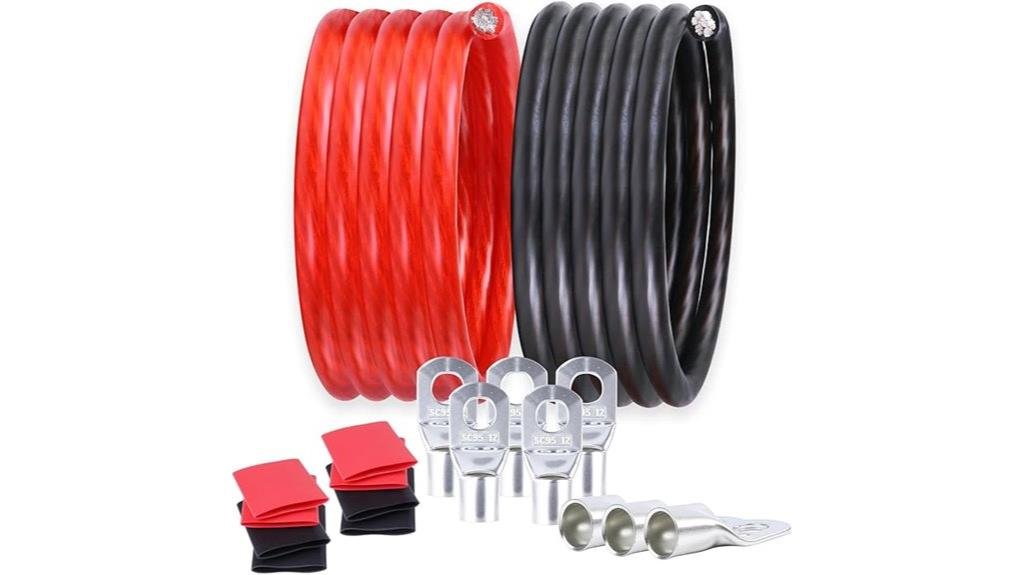
The 2/0 Gauge Battery Welding Cable Kit is presented as a practical, value-focused option for heavy low-voltage work. It includes two 13 ft cables (red, black), M10 and M12 lugs, CCA conductors, and a PVC jacket; rated for truck starting, solar arrays, and RV inverters. The build mixes cost-efficiency with durability, offering a one-year warranty and straightforward installation tips. How well it performs under sustained load depends on connector choice and installation technique.
Key Takeaways
- Kit includes two 13-foot 2/0 CCA cables (red and black) with M10 and M12 tin-plated lugs and heat-shrink wraps.
- CCA conductors offer cost-effective conductivity suitable for low-voltage truck, RV, and solar applications, not heavy continuous high-current duty.
- PVC jacket and rubber core provide weather resistance, flexibility, and easy routing for battery-to-inverter or starter runs.
- Proper installation requires correct lug selection, 1/2″ strip, specified crimp die, torque adherence, and heat-shrink sealing.
- Good value with 1-year warranty and acceptable voltage drop for moderate cranking and inverter use, but pure copper needed for extreme continuous loads.
Product Overview and Key Features
The 2/0 Gauge Battery Welding Cable Kit supplies two 13-foot cables—one black, one red—designed for heavy-duty low-voltage applications such as truck starting, solar array connections, and RV inverter systems.
It offers M10 and M12 SC lugs, heat-shrink wraps, and CCA conductors, delivering cost-effective conductivity and solderability.
Compatibility options: which terminals and systems are supported? User feedback notes easy polarity identification and flexible routing.
Practical specs: 13 ft length each, 3:1 shrink ratio, tin-plated lugs, weatherproof PVC jacket.
Considerations: confirm lug sizing for your battery posts, verify environmental exposure and warranty coverage.
Build Quality and Materials Analysis
Following the product overview and connection considerations, this section assesses the kit’s physical construction and material choices with attention to real-world use and longevity.
The build uses 13 ft red and 13 ft black CCA cables, PVC jacket, tin-plated M10/M12 lugs, and 3:1 heat shrink.
Material comparison: CCA versus pure copper — lighter, cost-effective, good conductivity for low-voltage systems.
Durability testing: PVC resists oil, moisture, dust; rubber core adds flexibility.
Q: Will it last?
A: Expect serviceable life for truck, solar, RV charging when installed correctly.
Practical note: verify torque specs, inspect shrink seal.
Performance in Truck, Solar, and RV Applications
Evaluating real-world performance requires matching the 2/0 gauge CCA cable kit’s electrical and mechanical properties to typical truck, solar, and RV use cases. It addresses truck performance needs: 13 ft runs, reduced weight, durable PVC jacket, acceptable voltage drop for starter and inverter duty. For solar efficiency, CCA conducts well at low-voltage arrays, supports inverter input, minimizes cost. Practical considerations: 13 ft length, M10/M12 lugs, 1-year warranty. Questions: Will it handle high cranking amps? Yes for moderate duty; heavy continuous loads may favor pure copper.
| Application | Practical takeaway |
|---|---|
| Truck | Good for 13 ft, moderate cranking |
| Solar/RV | Efficient, cost-effective CCA |
Installation Tips and Connector Details
When planning installation, installers should focus on correct lug selection, secure crimping or bolting, and proper heat-shrink placement to guarantee reliable, low-resistance connections.
The 13-foot 2/0 cables, fitted with M10 and M12 SC lugs, are sized for common battery-to-inverter or starter runs and require attention to torque specs, conductor preparation, and environmental sealing.
Q: Which connector compatibility matters?
A: Match M10/M12 to posts, verify lug inner diameter, confirm thread pitch.
Practical tips: strip 1/2″ conductor, crimp with specified die, heat-shrink 3:1 ratio, torque to device spec, route away from heat.
Warranty, Pricing, and Value Assessment
After confirming correct lug selection, crimping, and heat-shrink placement for a reliable install, attention moves to warranty coverage, price point, and overall value of the 2/0 Gauge Battery Welding Cable Kit.
The kit offers 1 year warranty details and a 30-day return window via Amazon, clear protections for buyers seeking independence from repair hassles.
Pricing comparison: current market rates favor CCA at lower cost than pure copper, 13 ft red and 13 ft black cables, M10 & M12 lugs, weight 6.83 lb.
Is it worth it? For truck, solar, RV use, cost-effectiveness, durability, and specs indicate strong value.
Frequently Asked Questions
Can These Cables Be Used for Jump-Starting a Car Safely?
Yes; they can jump-start a car safely. The liberated user values jump starting safety and cable durability, trusting CCA conductance, weatherproof jackets, tin‑plated lugs, and heat‑shrink protection for confident, empowered roadside rescues.
Are These Cables Compatible With Marine (Saltwater) Environments?
Yes. It will resist marine corrosion reasonably well due to tin‑plated lugs and PVC cable insulation, though freedom‑seeking users should still apply extra corrosion protection and regular inspection for long‑term saltwater exposure.
Do the Cables Come Pre-Marked for Polarity and Length Increments?
Yes. It states visible cable labeling with bright outer color for polarity and includes length measurement markers implied by 13 feet specification, empowering users to quickly verify polarity and measure lengths for liberated DIY installations.
Can the Heat Shrink Be Shrunk Without a Heat Gun?
Absolutely—one can shrink heat shrink without a heat gun using alternative heating methods like a hairdryer, lighter flame cautiously, or hot water; choice depends on heat shrink types and encourages resourceful, liberated DIY solutions.
Are There Torque Specifications for the M10 and M12 Lug Bolts?
Yes. He notes torque settings vary by lug specifications and manufacturer; typical M10 bolts tighten around 25–30 Nm and M12 around 40–50 Nm. He urges confirmation from product documentation for safe, liberated installation.
Conclusion
Conclusion:
The 2/0 gauge battery welding cable kit delivers practical value: two 13-foot cables (red, black), CCA conductors, PVC jacket, M10 and M12 lugs, one-year warranty. Is it ideal for truck starting, solar arrays, or RV inverters? Yes for budget-conscious setups, but consider copper alternatives for sustained heavy duty use. Installation is straightforward, tools minimal, terminals require proper torque. Worth purchasing for short-term, cost-sensitive needs — imagine a Roman legionnaire using it to jump-start a model T.