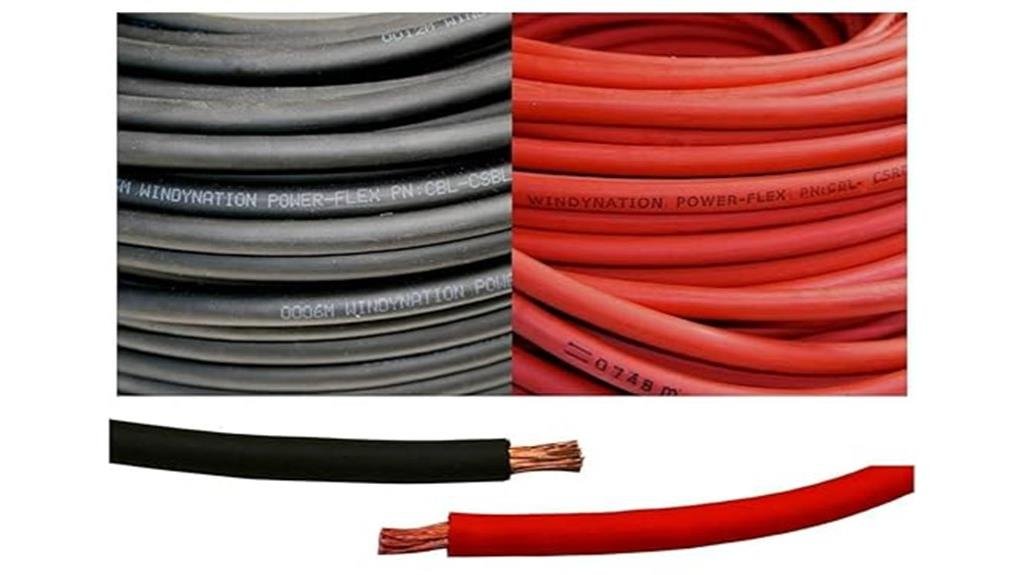
The 4 gauge welding battery cable is presented as a durable, medium‑duty option for battery, welding, automotive, RV, and small solar use, built from fully annealed pure copper with high strand count and EPDM insulation rated -50°C to +105°C and 600 V. It offers flexibility, abrasion and solvent resistance, and industry compliance; what are its real-world voltage drop, continuous current capacity, and best termination practices—details that determine fit for a specific job?
Key Takeaways
- 4 AWG welding battery cable offers high flexibility and conductivity with fully annealed pure copper and high strand count.
- EPDM insulation is tough, weather- and solvent-resistant, and rated for -50°C to +105°C, suitable for outdoor use.
- Meets ASTM and SAE J1127, plus IEC and RoHS compliance, ensuring industry-standard materials and safety.
- Suitable for medium-duty automotive, inverter, RV, and small solar use; not intended for heavy welding leads.
- Install with proper lugs, clamps, heat-shrink, and periodic inspections; expect ~0.3–0.4 V drop at 100 A.
Key Specifications and Build Quality
Because performance depends on materials and construction, the 4 AWG welding battery cable is described here by its measurable attributes and practical build details.
The cable uses fully annealed PURE copper with high strand count; copper quality supports flexibility and conductivity. Insulation is tough EPDM, solvent-resistant, rated -50°C to +105°C; insulation durability resists abrasion and weather.
Fully annealed pure copper with high strand count for flexibility and conductivity; EPDM insulation resists solvents, abrasion, and −50°C to +105°C.
Specifications: 4 AWG, available 25 ft per color, rated to 600 V.
Questions? What about compliance — meets ASTM and SAE J1127, IEC, RoHS.
Practical considerations: strand count, copper thickness, jacket thickness, and connector preparation for reliable terminations.
Performance and Application Suitability
Overall, the 4 AWG welding battery cable delivers dependable performance for medium-duty automotive, inverter, RV, and small solar installations, balancing current capacity, flexibility, and environmental resilience.
It meets clear performance metrics: rated up to 600 V, usable -50°C to +105°C, and supports typical 4 AWG continuous currents (roughly 85–120 A depending on installation).
How versatile is it? High—application versatility covers starters, inverter input, RV house banks, and small PV arrays.
Practical considerations: 25 ft lengths (red and black), fully annealed pure copper, EPDM jacket, ASTM/SAE compliance.
Question: Is it suitable for heavy welding leads? No, medium-duty only.
Installation Tips and Maintenance
A few straightforward preparation steps make installation faster and increase long-term reliability: assess required run length, account for voltage drop over 25 ft runs (approximately 0.3–0.4 V drop at 100 A for 4 AWG), and plan positive (red) and negative (black) routing to minimize loop area and avoid heat sources. Practical installation techniques include using proper lugs, crimping tools, and heat-shrink; secure runs every 12–18 in; avoid sharp bends. Cable care requires inspected insulation, tight terminals, corrosion protection.
| Item | Recommendation |
|---|---|
| Lugs | Use copper, correct size |
| Fastening | Nylon clamps, 12–18 in |
| Protection | Heat-shrink, conduit |
| Inspection | Quarterly, terminals clean |
Frequently Asked Questions
Are There Matching Battery Terminals Included With the Cable?
No, matching battery terminals are not included. The reviewer notes battery terminal compatibility varies by gauge and recommends cable installation tips: select appropriate terminal size, ensure clean connections, use proper crimping, heat shrink, and corrosion protection.
Is This Cable Safe for Marine Saltwater Exposure?
Can it withstand salt spray and marine conditions? It offers good marine corrosion resistance due to pure copper and EPDM jacket; cable insulation durability is high, but added marine-grade coatings or tinned copper are recommended for prolonged saltwater use.
Can I Order Custom Lengths Other Than 25 Feet?
Yes. The seller offers custom cable lengths and custom order options; the buyer should select custom order options or contact support to request non‑standard lengths, confirming specs, lead time, and any additional charges before purchase.
Does the Cable Come With a Warranty or Satisfaction Guarantee?
Like a steadfast anchor, the seller states warranty details and a satisfaction policy are available: a limited warranty covers manufacturing defects and a satisfaction guarantee allows returns within the specified period; customers should review product listing for exact terms.
Are There Color Options Beyond Red and Black?
Yes; the listing primarily offers red and black, though the manufacturer provides additional color variations for aesthetic choices on other gauges and custom orders, so customers should check selection tabs or contact support for alternate insulation colors.
Conclusion
The 4 gauge welding battery cable delivers solid build quality and reliable performance for medium-duty use: fully annealed pure copper conductor, high strand count for flexibility, EPDM insulation rated -50°C to +105°C, 600 V rating. Is it suitable for automotive, RV, and small solar systems? Yes—use for runs up to about 10–15 ft depending on allowable voltage drop. Tight crimps, correct lug sizes, and corrosion protection ensure long service; a dependable, workmanlike choice.