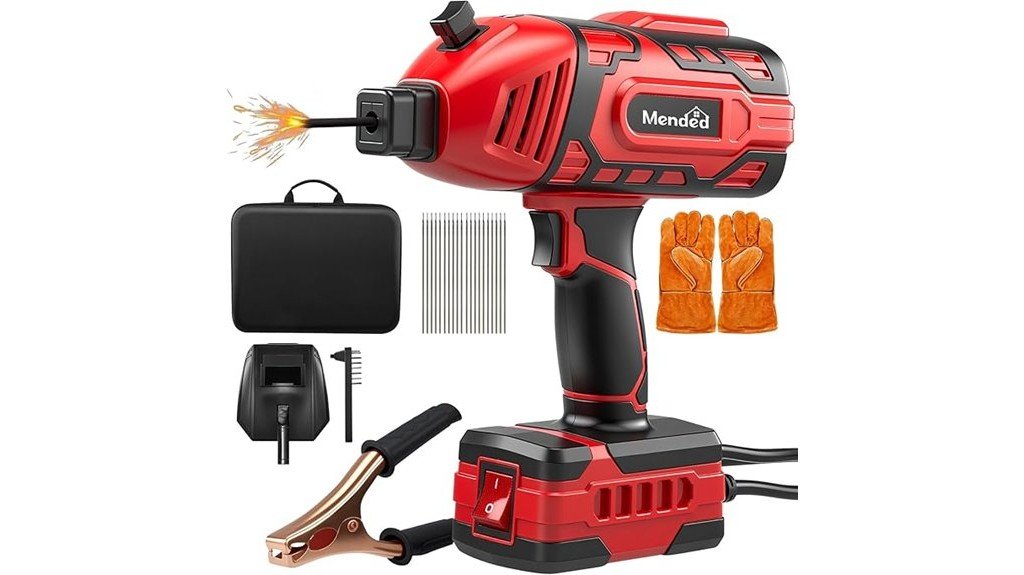
Editorial note: This review is based on the current Amazon listing and supplied product information. It is not a hands-on welding test. Confirm specifications, safety instructions, and package contents in the current manual before use.
GEARLASSO Handheld MIG Welder Review
A full-size welding machine can be awkward when you only need to repair a bracket, gate, mower deck, or thin steel panel. The GEARLASSO MIG-120 offers a smaller alternative with 110 V input, gasless flux-core wire, and five current settings from 20 to 120 A.
This review helps you decide whether its compact design is useful for your repair work or too limited for your projects. Portability and simple controls are its main strengths, while the missing duty-cycle specification and flux-core-only design are important tradeoffs.
Quick Verdict
Rating: 7.5/10, recommended with caveats
Best For: Occasional thin-steel repairs where portability and 110 V power matter more than advanced controls.
Bottom Line: The GEARLASSO MIG-120 provides a compact gasless setup with five current steps and a starter accessory kit. It is less suitable for long welds, structural fabrication, aluminum, or buyers who need gas-shielded MIG, stick, or TIG capability.
Key Specifications
| Specification | Detail |
|---|---|
| Brand | GEARLASSO |
| Model | MIG-120 |
| ASIN | B0FFSYY96Z |
| Product Type | Portable self-shielded flux-core wire welder marketed as a gasless MIG welder |
| Input Power | 110 V AC |
| Current Settings | Five listed steps: 20, 40, 70, 100, and 120 A |
| Wire Compatibility | 0.8–1.0 mm, approximately 0.030–0.040 inch, flux-core wire |
| Power Technology | IGBT inverter |
| Listed Materials | Mild steel, iron, and stainless steel when the correct compatible wire and setup are used |
| Listed Weight | Product bullet lists 3.15 kg, about 6.9 lb; Amazon technical details list an 8 lb item weight |
| Package Dimensions | About 17.5 × 13.5 × 5 inches |
| Protection Features | Listed overheat, overcurrent, overvoltage, and overload protection with an integrated cooling fan |
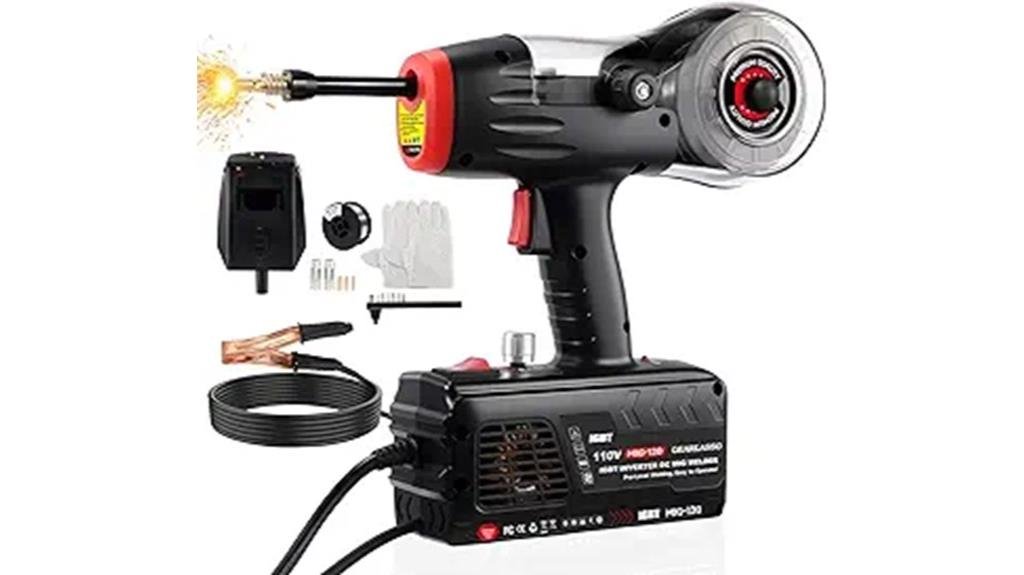
| Included Accessories | Handheld welding torch, gloves, handled face shield, optical filter, cleaning brush, torch nozzle, protective nozzle, and welding wire |
| Duty Cycle | Not stated in the verified listing |
| Best Use | Short, light-duty repairs on appropriately prepared steel |
| Not Designed For | Aluminum welding, gas-shielded MIG, stick welding, TIG welding, or safety-critical structural fabrication |
Specification note: The listing contains different weight figures and does not state a duty cycle or exact welding-thickness range. Check the current product manual before matching the machine to a project.
What Is the GEARLASSO MIG-120?
The GEARLASSO MIG-120 is a compact wire-feed welder with a handheld torch and a separate power base. It runs from a 110 V AC supply and feeds self-shielded flux-core wire through the torch, so you do not need a gas cylinder, regulator, or shielding-gas hose.
Although the listing calls it a gasless MIG welder, the process is more accurately described as self-shielded flux-cored arc welding. That distinction matters because flux-core wire produces slag, smoke, and more cleanup than a typical gas-shielded MIG setup.
The machine is aimed at homeowners, hobbyists, farm-maintenance users, and mobile repair workers who need short welds on suitable steel. Its five fixed current levels make adjustment simple, but you get less fine control than a welder with separate voltage and wire-speed settings.
Who Should Buy It?
Best For
- You need a compact welder for occasional brackets, gates, panels, hinges, and equipment repairs.
- You only have access to a suitable 110 V power source.
- You value portability and quick gasless setup more than advanced process controls.
Skip If
- You need verified capacity for thick, structural, load-bearing, or safety-critical work.
- You want gas-shielded MIG, aluminum capability, TIG, stick, or dual-voltage input.
- You regularly run long welds and need a published duty-cycle rating.
Before You Buy: Do not choose this welder only because the listing shows a 120 A maximum. The current listing does not state its duty cycle or an exact supported metal thickness, so you cannot assume continuous full-output performance.
Feature-by-Feature Review
Handheld Design and Portability
The compact torch-style format is the product’s clearest advantage. The listing gives a welder weight of 3.15 kg, while Amazon’s technical table lists 8 pounds. Either figure places it below many conventional cart-style machines, although the torch, lead, power base, wire, and PPE still need to be carried together.
The smaller design can help when you are working beside a fence, under equipment, or in a crowded garage. It does not remove the need for a stable work area, a secure ground connection, and safe cable placement.
Five Current Settings
You can select 20, 40, 70, 100, or 120 A. Fixed steps reduce control-panel complexity and may feel less intimidating when you are learning. They also limit how precisely you can tune the arc for changes in wire, joint position, material thickness, and travel speed.
Start with scrap that matches your actual workpiece. A setting that works on a thick bracket may burn through thin sheet, while a low setting may leave a weak, poorly fused joint on heavier material.
Flux-Core Wire Compatibility
The listing specifies 0.8–1.0 mm, or roughly 0.030–0.040 inch, flux-core wire. Check the wire classification, polarity instructions, spool fit, and recommended settings before loading it. Wire diameter alone does not confirm that every flux-core wire is suitable for the machine or your base metal.
Self-shielded wire works better outdoors than shielding gas in light wind because there is no external gas cloud to blow away. Strong wind can still disturb the arc and spread fumes, so you need a controlled and ventilated work area.
IGBT Inverter and Protection Features
The MIG-120 uses IGBT inverter technology. The listing also identifies overheat, overcurrent, overvoltage, overload protection, and an integrated cooling fan.
These safeguards can shut down or protect the machine when operating conditions move outside its limits. They do not turn a small welder into a continuous-duty fabrication unit. Stop if a warning light appears, airflow becomes blocked, or the manual calls for a cooling period.
Starter Accessory Package
The listed package includes a handheld torch, gloves, a handled face shield with an optical filter, a cleaning brush, two nozzle types, and welding wire. That gives you basic setup components, but the listing does not state the wire quantity or detailed PPE ratings.
A handheld shield occupies one hand and may make torch control harder for a beginner. A correctly rated auto-darkening helmet, suitable gloves, flame-resistant clothing, and closed footwear usually provide a more practical working setup.
How It Performs in Real Use
Small Garage Repairs
The MIG-120 is best matched to short repair work where you can clean the steel, clamp the joint, test your setting, and run brief beads. Examples include non-structural brackets, light frames, hinges, guards, and steel panels.
Its 110 V input can be convenient in a home garage. However, the outlet, circuit, plug, and extension cord must support the machine’s electrical load without overheating or creating excessive voltage drop.
Outdoor and Mobile Maintenance
Gasless wire reduces the equipment you need to carry because you do not need a shielding-gas bottle. That makes the machine easier to move to a gate, shed, farm implement, or service area.
You still need dry conditions, safe electrical connections, adequate ventilation, and fire control. Do not weld in rain, standing water, or an area containing dry grass, fuel, solvents, pressurized containers, or hidden combustible material.
Automotive and Equipment Work
The welder may suit small, non-structural repairs after the part has been safely prepared. Exhaust hangers, shields, brackets, mower decks, and similar pieces may be reasonable candidates when the material falls within the machine’s practical capability.
Do not use it for vehicle frames, suspension parts, hitches, rollover structures, pressurized tanks, or other safety-critical components unless the work is designed and completed by a qualified professional.
Thin Sheet and Longer Welds
Thin sheet requires careful heat control. Short tack or stitch welds can reduce distortion and burn-through compared with one continuous bead. Let the workpiece cool between passes and move between spaced weld locations when the joint design permits it.
The listing does not provide a duty cycle, so long high-output beads are a poor match. A larger machine with published output data and finer controls is easier to evaluate for frequent fabrication.
Setup Tips Before First Use
- Read the manual first. Confirm the required input circuit, polarity, wire-loading process, current controls, warning indicators, and cooling instructions.
- Inspect every component. Check the plug, power cable, welding lead, torch, nozzle, wire path, and ground clamp for shipping damage or loose connections.
- Prepare bare metal. Remove paint, rust, oil, plating, and heavy scale from the weld area and ground-clamp location. Identify hazardous coatings before applying heat.
- Use matching scrap. Practice with the same material type and similar thickness before touching the finished part.
- Secure the joint. Clamp the pieces firmly and confirm the fit-up before striking an arc.
- Watch the cable position. Keep leads away from sharp edges, hot metal, moving machinery, water, and your travel path.
- Inspect the finished weld. Remove slag and check for cracks, holes, incomplete fusion, or excessive porosity. Appearance alone does not prove structural strength.
Pro Tip: Mark each successful scrap-metal test with the wire type, current setting, and material thickness. That gives you a useful starting point when you repeat a similar repair.
Safety and Electrical Considerations
Welding exposes you to ultraviolet light, hot metal, sparks, electric shock, fire risk, fumes, and fine particles. Use a correctly rated welding helmet, protective gloves, flame-resistant clothing, closed footwear, and suitable eye protection during slag removal and grinding.
Provide local exhaust or strong ventilation that moves fumes away from your breathing zone. A respirator may be required when ventilation cannot control exposure, so follow the wire safety data sheet, product manual, and applicable workplace rules.
Keep an appropriate fire extinguisher nearby and inspect the surrounding area before and after welding. Sparks can travel into cracks, wall cavities, vehicle interiors, dry vegetation, and other hidden spaces.
Use the shortest suitable extension cord only when necessary. An undersized or excessively long cord can cause voltage drop, poor arc behavior, hot connections, and breaker trips. Follow the manufacturer’s electrical requirements instead of guessing from the plug shape.
Pros and Cons
Pros
- Compact handheld format is easier to move than many conventional welding machines.
- 110 V input suits garages and repair areas without a 240 V outlet.
- Self-shielded flux-core wire removes the need for a gas cylinder and regulator.
- Five current steps cover a wider range than a single-output repair tool.
- Starter package includes wire, torch accessories, gloves, a brush, and a basic face shield.
Cons
- The current listing does not provide a duty cycle or exact weld-thickness range.
- Fixed current steps offer less tuning control than separate voltage and wire-speed adjustments.
- Flux-core welding creates slag, fumes, and cleanup that gas-shielded MIG can reduce.
- The basic handheld shield may be inconvenient for two-handed positioning and regular use.
Is It Worth the Price?
The GEARLASSO MIG-120 is worth considering when its current price reflects an entry-level, light-repair tool. You get 110 V operation, five current levels, gasless wire capability, protection features, and enough starter accessories to evaluate the basic setup.
You receive less value if you expect one machine to handle structural fabrication, aluminum, gas MIG, stick welding, or TIG. The unpublished duty cycle also makes it harder to compare sustained output with established machines that provide detailed performance charts.
Compare the full cost, not only the machine price. Allow for quality flux-core wire, a suitable helmet, protective clothing, replacement consumables, clamps, metal-preparation tools, and a suitable electrical circuit.
How It Compares to Alternatives
The Forney Easy Weld 100 FC-i is worth comparing when you prefer a conventional flux-core machine from an established welding-equipment brand with published output and duty-cycle information. Its separate machine-and-gun layout is less compact than the GEARLASSO handheld format, but its documentation can make project matching easier.
The TOOLIOM TL-135M-PRO is a stronger comparison when you want MIG, stick, and lift-TIG processes with a digital display and more control. It requires more setup and storage space, while the GEARLASSO makes more sense when your priority is a small gasless repair tool.
Choose the machine around your thickest regular material, required process, available circuit, and expected welding duration. Maximum amperage alone does not tell you how well a welder fits those needs.
Frequently Asked Questions
Can the GEARLASSO MIG-120 run from a standard 110 V outlet?
The listing identifies it as a 110 V AC welder. You still need to confirm the required circuit capacity in the manual and avoid sharing the circuit with other high-load tools during welding.
Does this welder need shielding gas?
No external gas cylinder is needed when you use the specified self-shielded flux-core wire. The wire creates its own shielding, but it also leaves slag and normally creates more smoke and spatter than gas-shielded MIG.
What wire size does the GEARLASSO MIG-120 use?
The listing specifies 0.8–1.0 mm, approximately 0.030–0.040 inch, flux-core wire. Confirm wire classification, polarity, spool dimensions, and base-metal compatibility before loading a new spool.
How thick can it weld?
The verified listing does not provide a specific thickness range. Joint design, material type, wire, fit-up, electrical supply, travel speed, and duty cycle all affect practical capacity, so test matching scrap and follow the manual.
Can the GEARLASSO MIG-120 weld aluminum?
The current listing does not identify aluminum capability, a spool gun, or a compatible aluminum-wire setup. Treat it as a steel-focused flux-core machine unless the current manual specifically states otherwise.
Is it suitable for beginners?
Its five current steps and gasless setup reduce the number of controls and accessories you need to manage. Beginners still need welding instruction, suitable PPE, scrap-metal practice, fire prevention, ventilation, and careful weld inspection.
Can you use an extension cord with this welder?
Use one only when necessary and when the manual permits it. The cord must be correctly rated for the welder’s load, kept as short as practical, fully uncoiled, and inspected for heat or damage.
Does it replace a full-size MIG or multi-process welder?
No. It is better treated as a portable light-repair machine. A larger welder is easier to justify when you need long beads, published duty-cycle performance, finer adjustment, gas MIG, aluminum support, TIG, stick welding, or frequent fabrication.
The Bottom Line
The GEARLASSO MIG-120 is a reasonable choice when you need a portable 110 V flux-core welder for occasional, non-structural steel repairs. Its compact format, five current levels, gasless operation, and starter kit support quick setup, but the unpublished duty cycle and limited process options justify the 7.5/10 rating.
Buy it for portability and light repair work. Skip it when you need verified thick-metal capability, long production welds, advanced tuning, aluminum, gas-shielded MIG, TIG, or stick welding.
Ready to Compare the Current Listing?
Check the latest price, package contents, manual details, and seller information before you decide.