Disclosure: As an Amazon Associate, we earn from qualifying purchases. If you click a link on this page and make a purchase, we may receive a small commission at no extra cost to you.
Gikfun Soldering Practice DIY Kit EK7026 Review
Tiny SMD parts can make soldering feel harder than it should, especially when you move from simple wires to 0402, 0603, and 0805 components. The Gikfun Soldering Practice DIY Kit EK7026 gives you a low-pressure board where you can practice placement, heat control, joint inspection, and circuit testing before you work on a real repair. This review explains what you get, how the board performs, and whether this compact soldering trainer is worth buying for your bench, class, or maker kit.
Our Verdict
Rating: 8/10
Best For: Beginners and hobbyists who want structured SMD soldering practice on a labeled PCB with real components.
Bottom Line: You get a compact two-sided practice board, labeled pads, 3-12V circuit testing, and LED feedback after assembly. You give up premium documentation and large working space, so very new learners should use magnification, flux, and a fine-tip soldering iron.
| Specification | Detail |
|---|---|
| Brand | Gikfun |
| Model | EK7026, ASIN B00Y20JYTM |
| Product Type | SMD/SMT soldering practice board DIY kit |
| PCB Size | 85.6 mm x 54 mm x 1.6 mm on the Amazon listing; 89 mm x 58 mm installed size in the included manual |
| Package Size Listed in Article | About 5.3 x 0.4 x 3.4 inches |
| Weight Listed in Article | About 0.8 oz |
| Operating Voltage | DC 3.0V-12.0V |
| Operating Temperature | -40°F to 185°F (-40°C to 85°C) |
| Operating Humidity | 0% to 95% RH |
| Practice Components | 1206, 0805, 0603, 0402, SOT-23, SOP-8, and SOP-16 components |
| Included Accessories | Two-sided PCB, English instructions, and required SMD components |
| Visual Feedback | Flashing LED and water-flow LED effect after correct soldering and power-up |
| Measurement Features | Back-side mm/in ruler and PCB line-width reference marks |
What Is the Gikfun Soldering Practice DIY Kit?
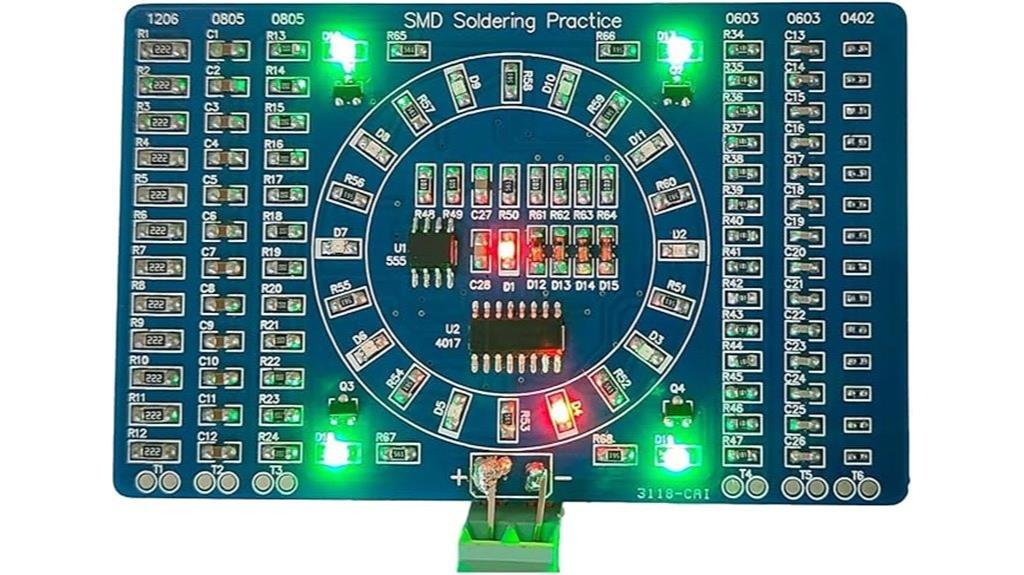
The Gikfun Soldering Practice DIY Kit EK7026 is a compact training board for surface-mount soldering. It uses a two-sided PCB with clearly marked component locations, so you can identify pads, place parts, solder joints, and test the circuit after assembly.
This kit sits in the beginner-to-intermediate practice category. You won’t use it as a finished electronic gadget every day, but you will use it to build the hand control needed for real repairs and small electronics projects. The board includes common SMD sizes such as 1206, 0805, 0603, and 0402, which gives you a useful path from easier parts to harder parts.
The headline feature is the built-in LED demonstration circuit. After you solder the board correctly, you can power it with DC 3.0V-12.0V and check your work through flashing LED feedback. That makes the board more useful than a blank practice PCB because you can see when placement, polarity, or solder joints need correction.
Who It’s For and Who Should Skip It
Who It’s For
- Beginners who want to practice SMD soldering on 1206, 0805, 0603, and 0402 parts before touching a real device.
- Electronics hobbyists who need a compact board for heat control, flux use, tack soldering, and joint inspection practice.
- Teachers, makerspace leaders, and STEM instructors who need an affordable classroom activity with visible LED feedback after assembly.
Who Should Skip It
- Complete beginners who do not already own a fine-tip soldering iron, flux, tweezers, solder, fume extraction, and eye protection.
- Advanced repair technicians who already work with tiny SMD parts and need BGA, QFN, microscope-level, or hot-air rework training.
- Buyers who want a polished finished gadget instead of a training board focused on soldering skill development.
What’s in the Box and First Impressions
The kit arrives as a small DIY soldering package with a compact PCB, English instructions, and all required SMD components for the training board. The original article lists the package at about 5.3 x 0.4 x 3.4 inches and about 0.8 oz, so it takes very little space on your desk or in a tool drawer.
The PCB feels like the main value of the kit. It includes printed component labels, a back-side mm/in ruler, and PCB trace-width reference marks. Those details help you measure components, check placement, and understand board layout while you practice.
The included component mix gives you more than simple resistor practice. The manual lists resistors, capacitors, LEDs, S8050 transistors, IN4148 diodes, an NE555 SOP-8 chip, and a CD4017 SOP-16 chip. That range helps you move from simple two-terminal parts to polarity-sensitive LEDs and multi-pin ICs.
Key Features and Technical Specs
The Gikfun Soldering Practice DIY Kit EK7026 uses a small PCB with clearly labeled SMD pads and a functional LED test circuit. The Amazon listing states a PCB size of 85.6 mm x 54 mm x 1.6 mm, while the manual lists the installed size as 89 mm x 58 mm. That makes it small enough for a beginner bench but large enough to include multiple practice areas.
The Gikfun soldering kit pairs a compact two-sided PCB with labeled SMD pads, 3-12V testing, and LED feedback for practical SMT training.
The operating voltage range is DC 3.0V-12.0V. After assembly, the LED circuit gives you a flashing effect, so you can check solder joints, polarity, and component placement. That feedback helps you spot cold joints, solder bridges, reversed LEDs, and missed pads faster than visual inspection alone.
The kit also covers a useful range of SMD sizes. You can start with 1206 parts, then move down to 0805, 0603, and 0402 parts as your hand control improves. Smaller 0402 parts demand a steady tweezer grip, good lighting, and enough flux, so this board can still challenge you after the first few joints.
- PCB size: 85.6 mm x 54 mm x 1.6 mm on the Amazon listing.
- Installed size: 89 mm x 58 mm in the included manual.
- Voltage: DC 3.0V-12.0V for circuit testing.
- Practice parts: 1206, 0805, 0603, 0402, SOT-23, SOP-8, and SOP-16.
- Measurement tools: back-side mm/in ruler and PCB line-width reference marks.
- Feedback circuit: flashing LED and water-flow LED effect after correct assembly.
Assembly Experience and Soldering Practice Tasks
Assembly starts with sorting the small components and matching them to the silkscreen labels. That first step matters because the board includes many similar-looking SMD resistors and capacitors. You should work slowly, keep parts grouped, and compare each part location with the manual before heating the joint.
The easiest path is to start with the larger 1206 and 0805 parts. These parts give you more pad area, so you can practice tacking one side, aligning the component, and finishing the second joint. A fine-tip iron, tweezers, flux, and good lighting will make the process much easier.
The 0603 and 0402 parts create the real training value. These small parts expose shaky hand movement, too much solder, poor flux control, and weak magnification. You should use a short contact time, avoid flooding the pads, and inspect every joint before moving to the next group.
The IC sections add another useful challenge. The NE555 SOP-8 and CD4017 SOP-16 parts require careful pin alignment and clean solder flow. Drag soldering can work well here, but you need flux and solder braid nearby in case you bridge adjacent pins.
For testing, a 5V supply is a practical starting point within the 3-12V range. You should check polarity before powering the board because reversed LEDs or incorrect component placement can stop the display effect. The LED feedback gives you a clear pass-or-check-again result after assembly.
Design, Build, and Board Layout
The board design focuses on practice rather than decoration. You get labeled pads, grouped component zones, and a back-side measurement area with mm/in markings. The 1.6 mm board thickness listed on the product page gives the PCB a familiar feel compared with many standard hobby boards.
The silkscreen labels help reduce confusion during placement. Beginners still need to watch part orientation, especially for LEDs, diodes, transistors, and ICs. The board will not teach you good habits by itself, but it gives you enough printed guidance to work through each step carefully.
The compact size creates one tradeoff. You can finish the board on a small desk, but you also need steady hands because the working area feels tight. A bench mat, adjustable lamp, and magnifier will improve your experience more than a larger solder spool or heavy iron stand.
SMD Practice Value
The strongest reason to buy this kit is its mix of SMD sizes. A blank practice board can teach heat control, but this kit also teaches part identification, polarity checks, and circuit testing. That combination makes the board more useful for learners who want to move toward real electronics work.
The 1206 and 0805 parts help you build confidence. The 0603 and 0402 parts show you how fast small pads can overheat or shift when you use too much solder. By the time you reach the ICs, you should have better control over solder amount, iron angle, and touch time.
This kit also teaches troubleshooting through failure. If the LED effect does not work after power-up, you can inspect joints, reflow dull pads, remove bridges, and check orientation. That process teaches a skill that matters more than simply making the board look clean.
Included Circuit and LED Feedback
The functional test area gives the kit a clear advantage over pure practice boards. Once you power the finished board within the DC 3.0V-12.0V range, the LEDs can show a flashing or water-flow effect. That visual response helps you confirm that key joints and components work together.
The circuit includes more than simple LEDs. The manual lists an NE555 SOP-8 timer and a CD4017 SOP-16 counter, along with S8050 SOT-23 transistors, IN4148 diodes, resistors, and capacitors. Those parts make the board more useful because you practice both passive and active components.
The LED test does not replace careful inspection. A board can still show partial signs of life while one section has weak joints or messy solder. You should inspect with magnification, clean flux residue as needed, and recheck polarity before you increase voltage.
Tools You Should Use With This Kit
This kit does not replace the basic tools needed for safe soldering. You should have a temperature-controlled soldering iron with a fine tip, thin solder, flux, tweezers, and solder wick. You should also use ventilation or fume extraction because soldering fumes can irritate your eyes and breathing.
Magnification helps a lot with 0603, 0402, SOT-23, SOP-8, and SOP-16 parts. A simple desk magnifier can work for basic practice, but a microscope or inspection camera will help you spot bridges and cold joints faster. Good lighting also reduces mistakes because tiny parts can hide poor alignment.
You should use eye protection and keep the board secure while you work. A PCB holder or small vise helps stop the board from sliding when you place parts. That stable setup matters because one hand usually controls tweezers while the other hand controls the iron.
Performance, Durability, and Usability
In regular practice, the Gikfun Soldering Practice DIY Kit performs best as a short training project. The board gives you repeated practice across multiple pad sizes, component shapes, and joint styles. The 3-12V test range also gives you flexibility when you use a bench supply, battery pack, or regulated adapter.
The FR-4 PCB and 1.6 mm thickness suit normal beginner soldering practice. You still need to avoid excessive heat because small pads can lift if you overwork the same area. Use flux, touch each joint briefly, and let the pad cool before you rework a mistake.
Small SMD pads make this kit useful for practice, but they also punish excess heat, too much solder, and poor tweezer control.
The board’s printed ruler and line-width marks add real usability. You can measure parts, compare trace widths, and understand scale while you work. That small design detail helps learners connect soldering practice with basic PCB design awareness.
How It Performs in Real Use
For First-Time SMD Practice
The kit gives a clear learning path from larger 1206 parts to tiny 0402 parts. You can build confidence on easier pads, then move to harder sections as your hand control improves. The labeled layout reduces guesswork, but you still need patience because small parts can move with the slightest tweezer pressure.
For Classroom or Makerspace Training
The compact board and visible LED feedback make the kit useful for lessons. Students can identify parts, place components, solder joints, and test the circuit within a structured activity. Instructors should provide extra flux, spare components, supervision, and safety guidance because the kit includes very small parts.
For Hobby Bench Skill Building
The kit works well as a warm-up board before you repair headphones, game controllers, keyboards, or small electronics. The SOT-23, SOP-8, and SOP-16 areas help you practice pin alignment and solder bridge removal. You can also use the back-side ruler to compare part sizes and understand how small SMD footprints feel in real work.
Pros and Cons
Pros
- Includes common SMD sizes, including 1206, 0805, 0603, and 0402, for step-by-step skill growth.
- Supports DC 3.0V-12.0V testing, so you can check the LED circuit after assembly.
- Uses a compact 1.6 mm PCB with clear silkscreen markings for easier component placement.
- Includes active components such as SOT-23 transistors, NE555 SOP-8, and CD4017 SOP-16 for broader practice.
- Back-side mm/in ruler and PCB line-width marks add useful measurement practice.
Cons
- Very small 0402 and 0603 parts can frustrate total beginners without magnification and tweezers.
- The kit does not replace required tools such as a fine-tip iron, flux, solder, and fume extraction.
- Documentation may feel basic if you want a full electronics theory lesson instead of hands-on practice.
Is It Worth the Price?
The Gikfun EK7026 offers strong value for the price if you want practical SMD soldering practice. You get a labeled PCB, multiple component sizes, active IC practice, LED testing, and measurement markings in one small kit. That mix makes it more useful than a plain scrap board.
You get the most value from this kit if you already own basic soldering tools. A fine-tip iron, flux, tweezers, solder wick, and magnification will help you finish the board cleanly. Without those tools, the kit can feel harder than it should because the smallest parts require control and visibility.
This is a smart buy for everyday skill building, not a premium electronics course. It helps you practice repeatable technique, but it will not teach every concept behind the NE555, CD4017, or LED driver behavior. Pair it with a beginner soldering guide if you also want theory.
How It Compares to Alternatives
If you want a more advanced SMD challenge, the Gikfun Advanced SMD/SMT Soldering Practice Kit EK8489 offers more IC styles and a larger practice workload. If you want a more decorative project, a Gikfun LED Christmas tree soldering kit gives you a finished display piece instead of a pure training board.
The EK7026 remains the better choice if you want a compact, simple, and focused SMD practice board with LED feedback. It gives you enough variety to build skill without turning the project into a long multi-day electronics build.
Frequently Asked Questions
Does the Gikfun EK7026 need a power supply?
Yes. You need an external DC power source within the 3.0V-12.0V range to test the finished LED circuit. A regulated 5V supply is a practical starting point for careful testing.
Is the Gikfun Soldering Practice DIY Kit good for total beginners?
Yes, but only if you have the right tools and patience. The 1206 and 0805 parts are easier to start with, while 0603 and 0402 parts can feel difficult without magnification, flux, and fine tweezers.
Does this kit include soldering tools?
No. The kit includes the PCB, English instructions, and required SMD components, but you still need a soldering iron, solder, flux, tweezers, fume control, and inspection tools.
What SMD component sizes can you practice on this board?
You can practice common SMD sizes such as 1206, 0805, 0603, and 0402. The board also includes SOT-23, SOP-8, and SOP-16 packages, so you can practice small IC and transistor soldering.
Does the LED circuit confirm that every joint is perfect?
No. The LED effect helps confirm that key parts of the circuit work, but it does not prove every joint is perfect. You should still inspect the board for bridges, dull joints, lifted pads, and incorrect part orientation.
Can this board be used for classroom group activities?
Yes. It works well for classroom and makerspace training because students can place parts, solder, inspect joints, and test the LED circuit. Younger users need close adult supervision because soldering tools, hot tips, fumes, and small parts create safety risks.
The Bottom Line
The Gikfun Soldering Practice DIY Kit EK7026 earns an 8/10 because it gives you structured SMD practice, real component variety, 3-12V circuit testing, and LED feedback in a compact kit. Buy it if you want to improve soldering control before real repairs or electronics projects. Skip it if you need advanced microscope-level rework training or a complete starter bundle with tools included.
Ready to Buy?