
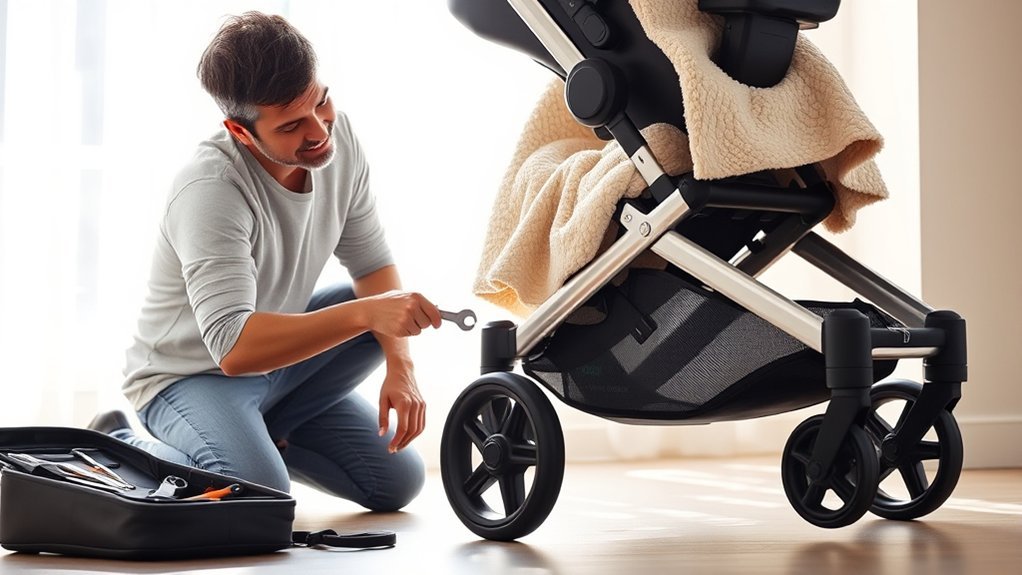
A wobbling stroller wheel can come from trapped debris, an incompletely seated wheel, incorrect tire pressure, a loose user-serviceable fastener, or a worn or bent part. Before adjusting anything, remove your child, identify the stroller model, read its manual, and check for recalls. Do not use homemade spacers to hide looseness in the wheel or swivel assembly.
Quick Answer
To fix stroller wobble safely, check that the wheel is clean, undamaged, correctly inflated if applicable, and fully locked into its axle or fork. Tighten only fasteners identified as user-serviceable in the manual. Stop using the stroller if a wheel will not lock, a structural part is bent or cracked, or the wobble continues.
Key Takeaways
- Remove your child and empty the stroller before inspecting, lifting, or removing a wheel.
- Check the exact model manual and the CPSC recall database before attempting a repair.
- Clean and reseat removable wheels before assuming that a bearing, axle, or swivel assembly has failed.
- Never add erasers, tape, washers, rubber scraps, zip ties, or other homemade spacers to a wheel-retention mechanism.
- Stop using the stroller when a wheel cannot lock securely, a brake malfunctions, a structural part is damaged, or wobble persists after basic maintenance.
At a Glance
| Time Required | 15 to 30 minutes for inspection, cleaning, reseating, and an empty-stroller test |
| Difficulty | Easy for inspection and cleaning; replacement of an axle, bearing, fork, or swivel assembly may require professional service |
| Tools Needed | Owner’s manual, clean cloth, soft brush, flashlight, mild soapy water, tire gauge for pneumatic tires, and only the exact hand tool specified by the manufacturer |
| Cost | Basic inspection and cleaning may cost nothing; official replacement parts and service vary by stroller model |
Warning: Do not place a child in a stroller with a loose, detached, cracked, bent, or unreliable wheel assembly. Do not modify an axle, quick-release device, swivel lock, brake, bearing, or retention plate with homemade materials. Contact the manufacturer when the approved repair is unclear.
Identifying the Wobble Issue
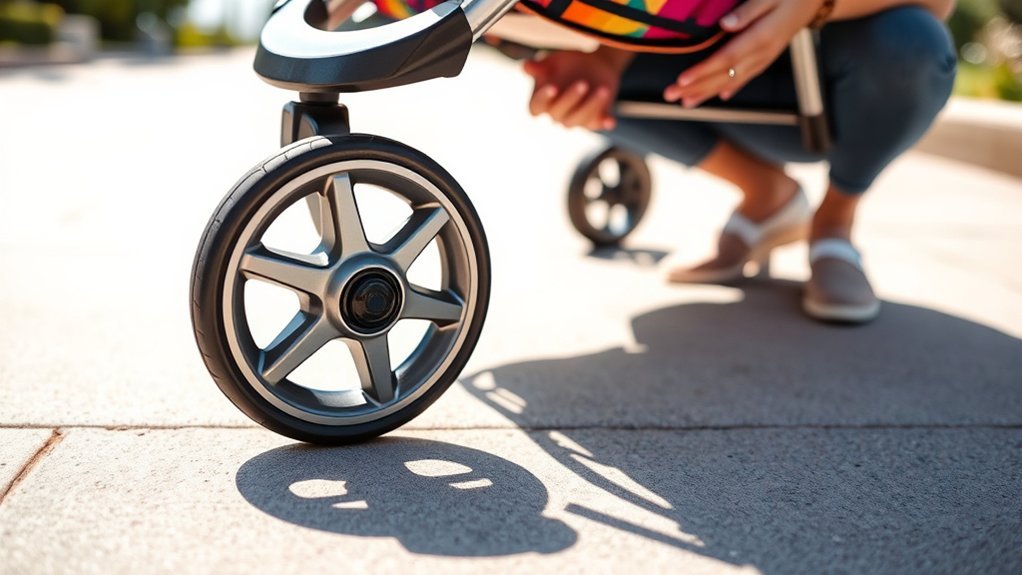
Start by identifying what the wheel is doing. Different symptoms can point to different causes, and tightening random screws may make the problem worse.
Check for Side-to-Side Wheel Play
With the stroller empty and supported on a level surface, hold the fork or frame steady and gently move the wheel from side to side. A small amount of movement may be normal on some designs, but a visible gap, clicking sound, partially released wheel, or loose axle needs attention.
Spin the Wheel and Watch Its Edge
Lift only the affected end while another adult steadies the stroller, or position the stroller as directed in its manual. Spin the wheel slowly and watch the tire or rim from the front. A tire that rises and falls, a rim that moves from side to side, or a hub that grinds may indicate an out-of-round tire, damaged rim, worn bearing, or bent axle.
Observe the Swivel While Pushing
Some front caster wheels shake rapidly only while the stroller is moving. This can happen when the wheel is not seated correctly, the swivel joint is dirty or worn, the tire is damaged, or the stroller’s tracking adjustment is incorrect. On jogging strollers, it can also occur when a front wheel that should be locked for running is left in swivel mode.
A persistent stroller wobble is a symptom to investigate, not a feature to hide with extra pressure, tape, rubber, or improvised spacers.
Common Causes of Stroller Wheel Wobble
- Hair, thread, sand, mud, or small stones trapped around the hub or swivel joint
- A removable wheel that has not clicked fully into place
- A loose fastener that the manual identifies as user-serviceable
- Low or uneven pressure in pneumatic tires
- A tire that is damaged, poorly seated, or out of round
- A bent wheel, axle, fork, or frame connection
- A worn bearing, bushing, hub, swivel assembly, or retention component
- A swivel lock that is only partly engaged
- An incorrect tracking adjustment on a stroller equipped with adjustable tracking
- A missing washer, clip, cap, pin, bolt, or manufacturer-supplied spacer
Check the Manual and Recalls Before Repair
Find the stroller’s model name, model number, manufacture date, and serial number. The label is often on the frame, basket support, rear crossbar, or underside of the seat, but its location varies.
Download or locate the exact owner’s manual. Confirm how the wheel is removed, how its retention device should engage, whether any fastener is adjustable, and whether lubrication is allowed. Do not rely on instructions for a similar-looking stroller.
Search the U.S. Consumer Product Safety Commission recall database using the brand and model. A known defect may have a manufacturer-provided repair kit, replacement part, refund, or stop-use instruction.
Carriages and strollers sold in the United States are covered by 16 CFR Part 1227, which incorporates applicable requirements from ASTM F833-21. A household modification is not a substitute for the tested wheel-retention and structural design of the stroller.
Note: If the stroller is under warranty, contact the manufacturer before opening a sealed bearing, removing a retention plate, drilling a part, or using a non-approved replacement. An unauthorized modification may affect the repair remedy or warranty.
Tools and Materials Needed
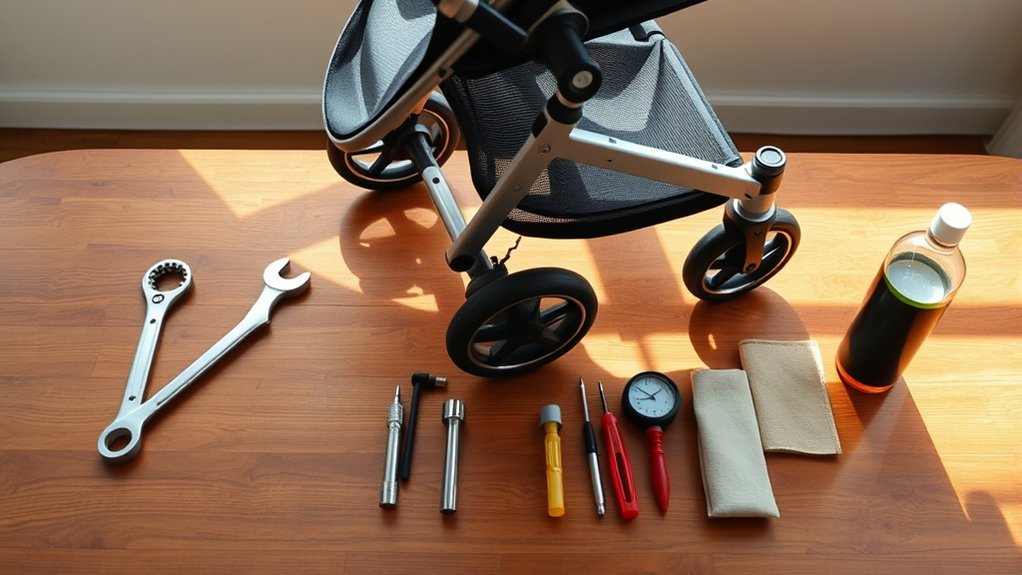
Gather only the items needed for inspection and manufacturer-approved maintenance:
- Exact owner’s manual: Use it to identify the wheel-release system, approved adjustments, replacement parts, and maintenance instructions.
- Clean cloth and soft brush: Use these to remove hair, thread, grit, and dried dirt without damaging seals.
- Mild soap and water: Use a lightly damp cloth for washable external surfaces, then dry the parts fully.
- Flashlight: Check inside the fork, around the axle opening, and near the swivel lock for missing or damaged parts.
- Tire-pressure gauge: Use one only if the stroller has pneumatic tires. Follow the pressure printed on the tire or stated in the manual.
- Correct screwdriver, hex key, or wrench: Use a tool only when the manual identifies the fastener as adjustable by the owner.
- Manufacturer-approved lubricant: Use it only when the manual specifies the lubricant and application point.
Do not use pencil erasers, rubber scraps, adhesive tape, extra washers, zip ties, glue, or makeshift clips to increase pressure inside the wheel assembly. These materials can obstruct full engagement or conceal a worn part.
Step-by-Step DIY Fix

Use the following process for basic inspection, cleaning, and reseating. Skip any step that conflicts with your stroller’s manual.
Remove your child and empty the stroller. Park on a level surface. Engage the parking brake, remove bags and accessories, and keep children away from hinges, wheels, and tools.
Record the model information. Photograph the model and serial label. Check the manual and recall database before removing a wheel.
Inspect the wheel, fork, and axle. Look for cracks, bends, missing clips, damaged release buttons, loose caps, uneven tire wear, exposed bearings, or metal rubbing marks. Stop if a structural or retention part is damaged.
Remove the wheel only as instructed. Some wheels use a push button, release lever, pin, bolt, or fixed axle. Do not pry off a cap or plate unless the manual specifically directs you to do so.
Clean accessible parts. Remove hair and thread with your fingers or a soft brush. Wipe dirt from the axle, hub exterior, fork opening, and swivel area. Avoid flooding sealed bearings or spraying cleaner into the brake.
Dry everything completely. Moisture left inside a hub or around metal parts can attract dirt or contribute to corrosion.
Check pneumatic tire pressure. Inflate each tire to the pressure specified on the tire or in the manual. Do not exceed the listed limit. Compare paired tires so one side is not much softer than the other.
Reinstall and seat the wheel. Insert the wheel in the direction shown in the manual. Confirm that the button, pin, lever, or retention device returns fully to its locked position. Gently pull the wheel outward to confirm that it does not release.
Check approved fasteners. Tighten only fasteners identified for owner adjustment. Use the specified tool and torque value when the manual provides one. Do not overtighten a swivel joint to remove all movement.
Check the swivel lock and tracking control. Move the swivel lock fully between its positions. If the stroller has adjustable tracking, follow the manufacturer’s procedure rather than turning the adjustment randomly.
Lubricate only when permitted. Apply only the named lubricant, in the stated amount, to the specified location. Keep lubricant away from tire tread, wheel brakes, parking-brake teeth, fabric, and wheel-retention surfaces.
Test the empty stroller. Push it slowly on a smooth, level surface. Test straight travel, gentle turns, wheel swivel, and the parking brake. Stop if the wheel clicks, loosens, drags, shakes, or fails to track consistently.
Pro Tip: Take a clear photo before removing a wheel, washer, pin, or manufacturer-supplied spacer. The photo can help you restore the original order without guessing, but the manual remains the primary guide.
Reassembly and Adjustment Tips
Correct reassembly matters more than making the wheel feel unusually tight. A caster wheel may need controlled movement to swivel correctly, while its axle-retention system must remain fully locked.
- Return every original washer, clip, pin, cap, and spacer to the position shown in the manual.
- Confirm that push buttons and release levers spring back completely.
- Make sure the wheel rotates without grinding, scraping, or binding.
- Check that the wheel cannot be pulled off after its locking device engages.
- Move the swivel lock through its full range and confirm that it does not stop halfway.
- Keep oil and grease away from parking-brake parts unless the manual specifically instructs otherwise.
- Never use an impact driver or power tool on small stroller fasteners unless the manufacturer explicitly permits it.
- Do not continue tightening a plastic housing that is cracked, stripped, distorted, or pulling away from the frame.
If the wheel becomes difficult to turn after reassembly, stop and check for a misplaced washer, overtightened fastener, trapped debris, incorrectly seated bearing, or reversed component. Do not force the stroller through the resistance.
When to Stop Using the Stroller
Basic cleaning and reseating cannot correct every wobble. Stop using the stroller and contact the manufacturer or an authorized service provider when:
- The wheel can be pulled out after the locking device appears to engage.
- A release button, lever, pin, clip, or axle does not return to its locked position.
- The fork, axle, frame, wheel, hub, or mounting point is cracked or bent.
- A fastener is missing, stripped, corroded, or repeatedly loosens.
- The wheel grinds, binds, or has substantial side play after cleaning and reseating.
- The stroller pulls strongly to one side after approved tracking adjustments.
- The parking brake fails to engage or releases unexpectedly.
- The wobble becomes worse with speed or returns shortly after maintenance.
- The stroller is included in a recall or safety warning.
- You cannot confirm that an earlier homemade modification used the correct parts.
An official replacement wheel may solve a damaged tire, rim, hub, or bearing problem. A damaged fork, axle mount, brake assembly, frame connection, or swivel housing may require a larger replacement assembly or professional inspection. Use parts approved for the exact stroller model and production year.
If a failure caused a fall, injury, or near miss, you can submit a report through SaferProducts.gov and notify the stroller manufacturer.
Maintenance for Long-lasting Performance
Regular checks can help you find looseness or damage before it affects steering.
- Before outings: Confirm that removable wheels are locked, tires appear sound, and the parking brake works.
- After rough or sandy terrain: Check for stones, hair, mud, salt, and plant material around the wheels and swivel joints.
- After transport: Inspect the stroller if it was dropped, gate-checked, tightly packed, or struck by heavy luggage.
- For pneumatic tires: Check pressure according to the manual and the tire marking.
- For removable wheels: Clean the axle and hub as directed before reinstalling them.
- For lubrication: Follow the manufacturer’s product, location, quantity, and schedule. Do not invent a fixed interval.
- For storage: Store the stroller clean and dry, away from standing water and corrosive road salt.
- For replacement parts: Use the exact wheel, axle, bearing, bushing, fastener, or fork approved for the model.
Recheck the stroller after any approved repair. A repaired wheel should remain seated, rotate smoothly, swivel as designed, track consistently, and stop securely when the brake is engaged.
Frequently Asked Questions
Can I use rubber, an eraser, or an extra washer to stop stroller wobble?
No. A homemade shim can prevent a wheel lock, axle, bearing, or swivel component from seating as designed. It may also hide a worn or broken part. Use only the replacement component or repair method approved for your exact stroller model.
How often should I lubricate stroller wheels?
Follow the maintenance schedule in the stroller manual. Some models permit a specific lubricant on selected swivel or axle points, while others use sealed or maintenance-free parts. Do not apply lubricant simply because several months have passed.
Is stroller wheel wobble normal?
A brief vibration on a very rough surface can occur, but repeated shaking, clicking, excessive side play, poor tracking, or a wheel that loosens is not something to ignore. Inspect the wheel and stop using the stroller if its retention or structure is uncertain.
What should I do if the wobble remains after cleaning and reseating the wheel?
Stop using the stroller and contact the manufacturer. Persistent wobble may come from a damaged tire, rim, bearing, bushing, axle, fork, swivel housing, frame connection, or tracking system. These parts may require an approved replacement or professional inspection.
Are professional stroller-repair services available?
Yes. Start with the manufacturer, an authorized retailer, or a service provider recommended by the brand. Give them the model number, serial number, purchase date, photographs, and a description of when the wobble occurs.
How can I tell whether a removable stroller wheel is fully seated?
Follow the model manual. The wheel may click into place, show a visual indicator, or require a lever or pin to return to its locked position. After installation, gently pull outward on the wheel. It should remain attached without the release control being pressed or opened.
Can I keep using the stroller if it wobbles only at faster walking speeds?
Do not continue at the speed that triggers the wobble. Inspect the wheel, tire, swivel lock, tracking control, and retention system. If the cause is not corrected through manual-approved maintenance, stop using the stroller and request service.
Sources
- Electronic Code of Federal Regulations, 16 CFR Part 1227 — U.S. safety standard for carriages and strollers and incorporation of ASTM F833-21.
- U.S. Consumer Product Safety Commission Recall Database — current stroller recalls, safety warnings, and official remedies.
- SaferProducts.gov — official portal for searching and reporting consumer-product safety incidents.
- CPSC Britax BOB Modified Axle Recall — an official example showing why wheel and axle remedies must follow manufacturer instructions.
Conclusion
Fixing stroller wobble starts with finding the cause, not forcing the wheel to feel tighter. Check the manual and recalls, inspect the wheel and frame, remove debris, verify tire pressure, reseat removable wheels, and adjust only the parts the manufacturer identifies as user-serviceable.
Do not rely on rubber pieces, erasers, tape, extra washers, or generic grease to correct a loose wheel assembly. When the wheel will not lock securely, a structural part is damaged, the brake is unreliable, or the wobble persists, stop using the stroller and arrange an approved repair or replacement.


