How to Go Down a Curb With a Stroller Safely
Last updated: May 28, 2026
Going down a curb with a stroller looks simple until the front wheels drop, the handle pulls forward, or the sidewalk feels uneven. The safest choice is always a curb ramp, but if you must use a low curb, slow down, check the surface, keep your child buckled in, and control the stroller with both hands.
For most low curb descents, do not roll the front wheels straight off the edge. Stop first, line up square to the curb, press the handle down slightly to lift the front wheels, let the rear wheels roll down first, then lower the front wheels gently. Use the parking brake only when the stroller is stopped, not while it is moving down the curb.
Quick Answer
To go down a curb with a stroller safely, first look for a curb ramp. If no ramp is available and the curb is low, stop at the edge, check for traffic and obstacles, buckle your child in, keep both hands on the handle, lift the front wheels slightly, roll the rear wheels down first, then lower the front wheels with control.
Key Takeaways
- Use a curb ramp whenever one is available.
- Do not descend with the parking brake locked. Use the brake when stopped.
- Approach the curb squarely, not sideways or parallel to the edge.
- Keep the front wheels lifted until the rear wheels reach the lower surface.
- Avoid high curbs, slippery curbs, stairs, and escalators with a child in the stroller.
Understanding the Stroller’s Features
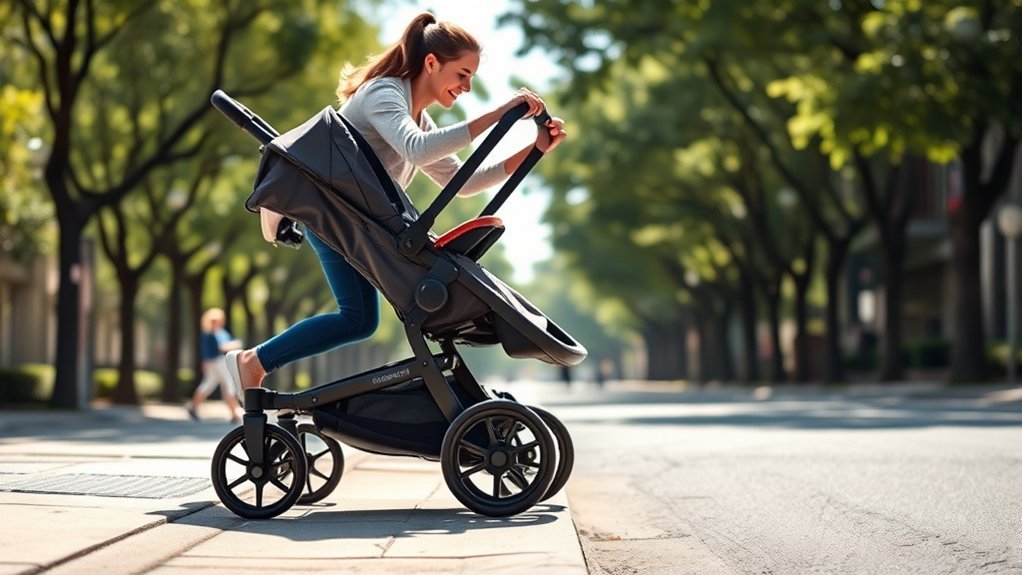
Before you try a curb descent, know how your stroller handles weight, wheels, brakes, and bumps. A stroller with a wide base, sturdy frame, and stable wheels will usually feel easier to control at the curb than a narrow, very light stroller.
Check the parking brake before each walk. The American Academy of Pediatrics says baby strollers should have easy-to-use brakes and that you should use the brake whenever the stroller is stopped. That means the brake helps while you pause, check the curb, or adjust your grip, but it should not stay locked while you are rolling down the curb. Source: HealthyChildren.org
Also check the harness. A secure harness keeps your child from sliding forward during a bump or sudden stop. Many strollers use a five-point harness, which holds the shoulders, waist, and between-the-legs area. Follow your stroller manual for the correct harness fit because each model adjusts differently.
Wheel size matters too. Small front wheels can catch in cracks or drop suddenly off a curb. Larger wheels and suspension can smooth the movement, but they do not remove the need for slow handling and a steady grip.
| Feature | Why It Matters at a Curb | What to Check |
|---|---|---|
| Parking brake | Stops the stroller while you assess the curb. | It locks and releases smoothly before you move. |
| Harness | Helps keep your child secure during bumps. | It fits snugly and follows the manual. |
| Wheel size | Larger wheels may handle rough edges better. | Wheels roll straight and do not wobble. |
| Frame and base | A stable base lowers tip-over risk. | The frame locks open and feels solid. |
| Storage basket | Low storage helps balance the stroller. | Heavy bags sit low, not on the handle. |
Preparing to Descend the Curb
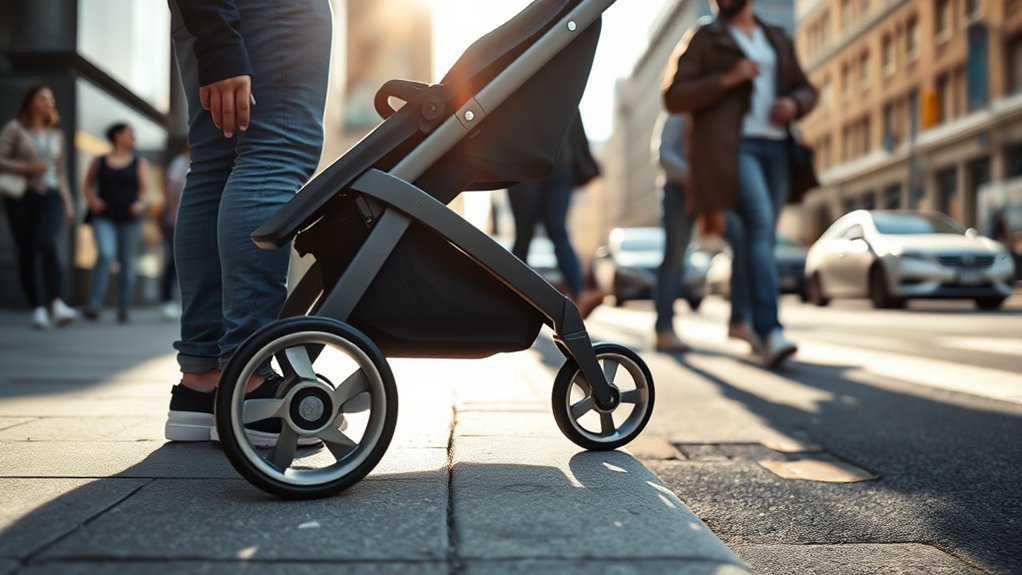
Start with the safest route. Look for a curb ramp, driveway cut, or lower section of the sidewalk. A ramp gives you more control and lowers the chance that a wheel will drop suddenly.
If you cannot find a ramp and the curb is low, stop fully before the edge. Lock the brake while you check the curb height, pavement condition, and traffic. Make sure your child is buckled in and sitting properly. Move bags from the handlebar to the lower basket because hanging weight from the handle can make a stroller tip more easily.
Before you move, release the brake and place both hands on the handle. Keep your phone, coffee, or shopping bag out of your hands. You need full control during the descent.
- Choose a curb ramp first when one is nearby.
- Check the curb height, slope, cracks, loose gravel, and wet spots.
- Secure the harness before the stroller moves.
- Put heavy items in the storage basket, not on the handle.
- Use both hands and move slowly.
Safety note: Avoid using a stroller on stairs or escalators with your child inside. Use ramps and elevators when available. If the curb is high, uneven, icy, or close to traffic, stop and choose another route.
Positioning the Stroller at the Curb
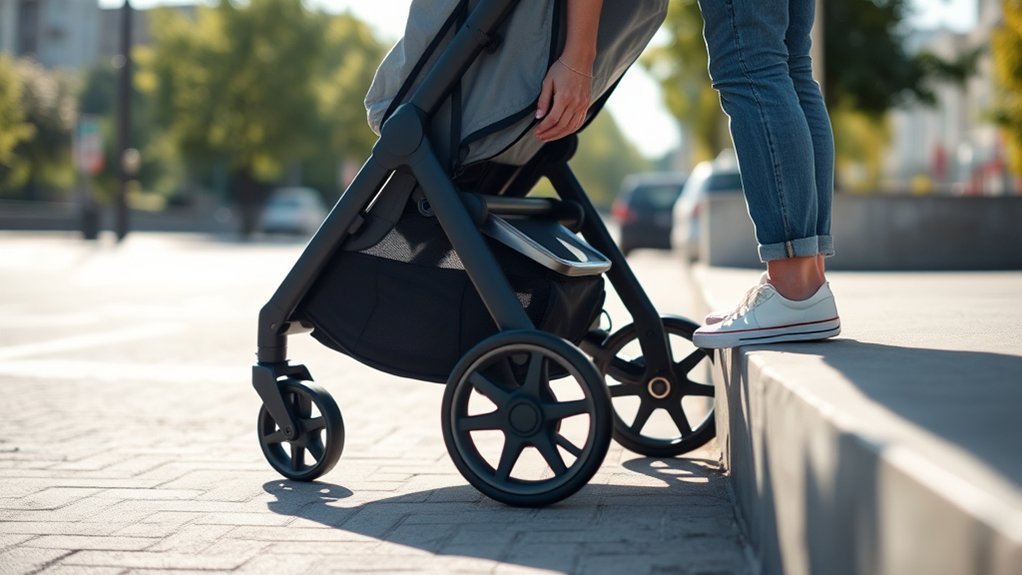
Position the stroller square to the curb, with both rear wheels lined up evenly near the edge. Do not place the stroller parallel to the curb. A parallel position can make one wheel drop before the other, which can twist the stroller and reduce control.
Keep the stroller fully on the sidewalk until you are ready to move. Stand behind the handle with your feet steady and your body close enough to control the stroller without reaching.
Use both hands to grip the handle securely. Your hands should be about shoulder-width apart if the handle shape allows it. Keep your elbows slightly bent so you can absorb the movement when the rear wheels leave the curb.
Check your surroundings one more time. Look for pedestrians, cyclists, parked cars, moving traffic, puddles, broken pavement, and sloped street edges. A clear path matters more than speed.
Keep the Front Wheels Controlled Until the Rear Wheels Land
Do not let the small front wheels drop off the curb first unless your stroller manual tells you to use a different method. A front-wheel-first drop can pull the stroller forward and create a sudden jolt.
Instead, press down gently on the handle to lift the front wheels just off the sidewalk. Keep the stroller balanced on the rear wheels. Then roll the rear wheels down the curb slowly. Once both rear wheels are on the lower surface, lower the front wheels with control.
This method works best on low curbs with a clear landing area. It is not a safe fix for high curbs, stairs, broken pavement, or slippery surfaces.
Positioning for Safety
Stand directly behind the stroller. Keep your shoulders, hips, and feet lined up with the stroller’s path. This gives you better control than standing to the side.
Before the rear wheels roll down, shift your body weight slightly backward. Do not lean so far back that you lose your footing. The goal is to counter the stroller’s forward pull while you guide it down slowly.
- Keep both rear wheels even at the curb edge.
- Lift the front wheels only as much as needed.
- Keep your child’s weight centered in the seat.
- Do not twist the stroller while the wheels are leaving the curb.
Maneuvering Downward Smoothly
Move in one slow sequence. First, stop and check the area. Next, release the brake. Then lift the front wheels slightly, roll the rear wheels down, and lower the front wheels after the stroller feels steady.
Watch the landing area as the rear wheels touch down. If a rear wheel lands in a pothole, crack, or puddle, stop immediately and stabilize the stroller before you continue.
After all wheels are down, pause for a second. Check that the stroller is stable, your child is secure, and the path ahead is clear. Then continue walking.
Guiding the Stroller Down Safely
A safe curb descent depends on control, not speed. Keep the stroller close to your body and guide it down with steady pressure on the handle. Do not push from far behind because that reduces leverage and makes the stroller harder to stop.
Use this step-by-step method for a low curb:
- Stop before the curb and look for a ramp.
- If no ramp is available, check that the curb is low and the lower surface is clear.
- Lock the brake while stopped and secure your child’s harness.
- Move loose bags to the lower basket.
- Stand behind the stroller and grip the handle with both hands.
- Release the brake when you are ready to move.
- Press down gently on the handle to lift the front wheels.
- Roll the rear wheels down slowly and evenly.
- Lower the front wheels once the rear wheels are stable.
- Pause, check stability, and continue walking.
Use the brake when the stroller is stopped. Release it before the stroller moves, then control the descent with both hands.
Maintaining Balance and Control
Balance starts before the wheels move. Keep your feet planted, your knees slightly bent, and your body behind the stroller. This position helps you resist the stroller’s forward pull as the rear wheels drop.
Do not rush the movement. A fast descent can make the stroller bounce, twist, or tip. Slow movement gives you time to correct the angle if the surface is uneven.
Proper Stroller Grip
A proper grip helps you react quickly if the stroller shifts. Hold the handle with both hands and keep your grip firm but not stiff. A stiff grip can make the movement jerky, while a loose grip can let the stroller pull away.
- Use both hands before, during, and after the curb descent.
- Keep your hands balanced on the handle.
- Do not hold a phone, drink, umbrella, or bag while descending.
- Use a wrist strap if your stroller has one and the manual recommends it.
Engage your core muscles and keep the stroller close. This helps you control the stroller without overusing your arms.
Body Positioning Techniques
Keep your body slightly behind the handle as the stroller moves down. Bend your knees a little so your legs can absorb the motion. Keep your back straight and avoid leaning sideways.
If the stroller starts to twist, stop the movement if you can do so safely. Bring the stroller back to a straight position before you continue. Do not yank the handle because a sharp pull can startle your child and shift the stroller’s balance.
Think of the movement like easing a suitcase down a small step. You want slow, even contact, not a drop.
Checking for Obstacles and Hazards
Before you head down a curb with your stroller, scan the area for hazards that could interrupt the descent. Small problems matter because stroller wheels can catch on cracks, loose stones, drain edges, and uneven pavement.
Check both the top and bottom of the curb. The sidewalk might be smooth, but the street edge may have a pothole, puddle, sloped gutter, or raised asphalt. Also look for cyclists, scooters, turning cars, and pedestrians who may step into your path.
- Check for cracks, potholes, gravel, leaves, mud, snow, or ice.
- Watch for cars pulling in or out of driveways.
- Do not descend while another person or stroller blocks the landing area.
- Use extra caution near buses, parking lots, and busy crossings.
- Choose a different route when visibility is poor.
Weather can change the risk level. Rain, ice, and wet leaves make curb edges slippery. Strong wind can also affect lightweight strollers, especially if a canopy or hanging bag catches the wind.
Practicing Safe Descent Techniques
Practice helps you build confidence before you face a busy street or crowded sidewalk. Start with an empty stroller on a very low curb in a quiet area. Practice stopping, checking, lifting the front wheels slightly, rolling the rear wheels down, and lowering the front wheels.
After you feel comfortable, practice again with normal walking weight in the basket. Do not overload the stroller, and do not hang heavy items from the handle. The Raising Children Network notes that tipping is a common cause of stroller-related injuries and that bags on handles can make even stable strollers tip. Source: RaisingChildren.net.au
Practice should feel boring and controlled. If the stroller jumps, twists, or feels too heavy to control, stop and use ramps instead.
When Not to Descend a Curb With a Stroller
Some curbs are not worth the risk. Do not try to force a stroller down a curb when the drop is high, the landing area is broken, the street is busy, or you cannot keep both hands on the handle.
Avoid curb descents in these situations:
- The curb is high enough that the stroller would drop suddenly.
- The surface is wet, icy, muddy, or covered with loose gravel.
- The stroller is overloaded or has heavy bags on the handle.
- Your child is not fully buckled in.
- You need to hold another child’s hand and cannot control the stroller with both hands.
- The curb leads directly into traffic, a bike lane, or a crowded path.
- The stroller manual warns against steps or curb drops.
In these cases, look for a ramp, elevator, driveway cut, or safer crossing point. If you have no safe route, remove your child from the stroller first, fold or carry the stroller separately, and ask for help if needed.
Safety Sources and References
This guide uses general stroller safety principles from pediatric and consumer-safety sources. Always follow your stroller’s own manual first because brake systems, wheel locks, recline positions, and weight limits vary by model.
- American Academy of Pediatrics, HealthyChildren.org: How to Choose a Safe Baby Stroller
- AAP News: Safety Tips Help Protect Children From Stroller Injuries
- Raising Children Network: Pram and Stroller Safety
- Consumer Product Safety Office Singapore: Safety Tips on Strollers
Frequently Asked Questions
What Type of Stroller Is Best for Curb Descents?
A stroller with a wide base, sturdy frame, secure harness, dependable parking brake, and larger wheels usually handles curb descents better. All-terrain strollers often feel steadier on uneven sidewalks. Lightweight strollers can work on low curbs, but they may feel less stable on rough or high edges.
Can I Go Down a Curb Alone With a Stroller?
Yes, you can go down a low curb alone if the path is clear, your child is buckled in, and you can control the stroller with both hands. Use a ramp when one is available. Avoid high curbs, stairs, slippery edges, or any curb that feels unsafe.
Should the Front Wheels or Rear Wheels Go Down First?
For most low curb descents, keep the front wheels lifted and let the rear wheels roll down first. Then lower the front wheels gently after the rear wheels are stable. This helps reduce the sudden forward drop that can happen when small front wheels fall off the curb first.
Should I Use the Stroller Brake While Going Down a Curb?
Use the brake when the stroller is stopped, not while you are rolling down the curb. Lock the brake while you check the curb and adjust your position. Release it only when you are ready to move, then keep both hands on the handle.
How Can I Practice Curb Descents Safely?
Practice on a low curb in a quiet area with no traffic. Start with the stroller empty, then practice again with normal diaper-bag weight in the basket. Keep both hands on the handle, move slowly, and stop if the stroller feels unstable.
What if the Curb Is Too High for My Stroller?
Do not force a stroller down a high curb. Look for a curb ramp, driveway cut, elevator, or safer crossing point. If no safe route exists, remove your child first, fold or carry the stroller separately, and ask for help when needed.
Are There Any Accessories to Help With Curb Descents?
Some accessories can help, but they do not replace careful handling. A wrist strap, larger wheels, and a stable stroller frame may improve control. Portable curb ramps are useful in some settings, but they must match the curb height and weight limit.
Is It Safe to Take a Stroller Down Stairs?
A curb is not the same as a staircase. Avoid taking a stroller down stairs with your child inside unless the stroller manual clearly allows it and you have help. Use ramps or elevators whenever possible because stairs increase tipping and grip-loss risk.
What Should I Check Before Going Down a Curb?
Check the curb height, pavement cracks, wet spots, traffic, pedestrians, cyclists, and loose items on the stroller. Make sure your child is buckled in, bags sit low in the storage basket, and both rear wheels can reach the curb edge evenly.
Can Hanging Bags on the Stroller Handle Make Curb Descents Unsafe?
Yes. Heavy bags on the handle can shift the stroller’s balance and increase tip-over risk, especially at curbs. Put bags in the lower storage basket instead, and stay within the stroller maker’s weight limit.
Conclusion
Going down a curb with a stroller safely comes down to three habits: choose a ramp when possible, control the wheels slowly, and keep your child secure before the stroller moves. A low curb may feel routine, but a small wheel drop can still jolt the stroller if you rush.
Before your next walk, practice on a quiet, low curb and check your stroller manual for model-specific guidance. When a curb looks high, broken, slippery, or too close to traffic, take the safer route instead of forcing the descent.