Disclosure: As an Amazon Associate, we earn from qualifying purchases. If you click a link on this page and make a purchase, we may receive a small commission at no extra cost to you.
Innova 5568 Pro Digital Timing Light Review
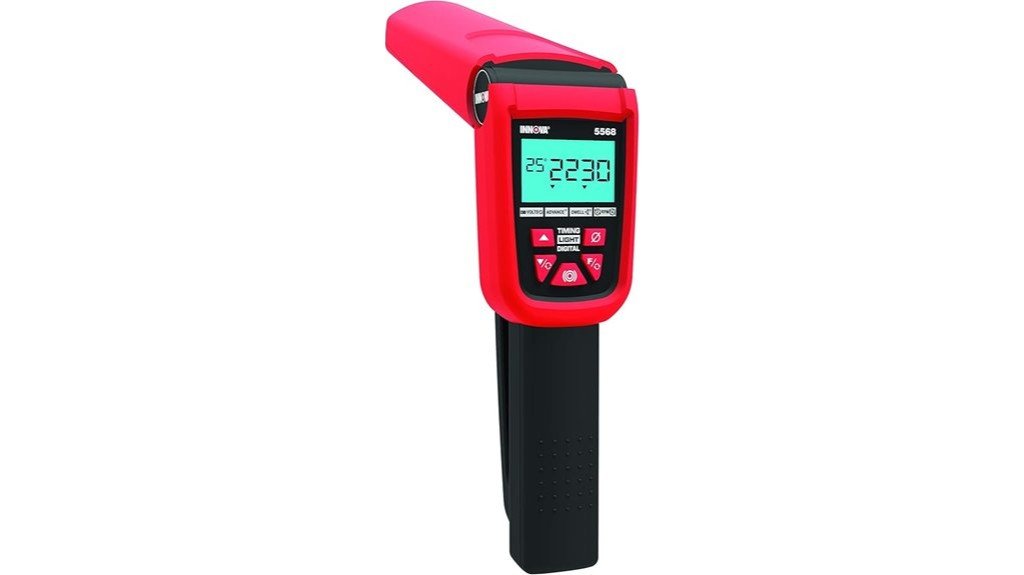
When an older engine idles badly or lacks power, you may need to check ignition timing before changing parts. The Innova 5568 Pro Digital Timing Light lets you read advance, engine RPM, dwell, and voltage from one backlit tool. Its rotating head and detachable 6-foot leads help you reach timing marks, but it cannot read every modern ignition system. This review explains the fit limits, controls, setup, and tradeoffs so you can decide if the 5568 suits your engine.
Quick Verdict
Rating: 8/10
Best For: DIY mechanics and small-shop users who check timing on classic cars, older trucks, and compatible spark-ignition engines with accessible plug wires.
Bottom Line: You get 0° to 90° digital advance, a 249 to 9,990 RPM display, dwell and voltage modes, and replaceable leads. The tradeoff is compatibility: MSD multi-spark systems are excluded, and many coil-on-plug engines lack a direct pickup point.
Key Specifications
| Specification | Detail |
|---|---|
| Brand | Innova |
| Model | 5568 Pro / 5568A (same operation; different colors, per Innova) |
| Product Type | Professional digital inductive timing light |
| Display | Backlit digital LCD for RPM, advance, dwell, and voltage modes |
| Tachometer Range | 249 to 9,990 RPM |
| Advance Range | 0° to 90° for compatible 2-cycle and 4-cycle engines |
| Dwell Range | 0° to 180° for 2 to 12 cylinders |
| Voltage Range | 10 to 16 volts DC (measurement range and operating power) |
| Standard Power Connection | Red and black clips connected to a 12V negative-ground vehicle battery |
| Ignition Compatibility | Conventional breaker-point, electronic, and compatible distributorless ignition systems |
| Unsupported Ignition Type | MSD and other multi-spark ignition systems |
| Engine Types | Compatible 2-cycle and 4-cycle spark-ignition engines; not diesel engines |
| Leads | Detachable, user-replaceable 6-foot lead set with inductive pickup |
| Housing | ABS/polycarbonate housing with rubber-molded protective boots |
| Barrel Design | Xenon strobe and rotating barrel (about 70°) with built-in hand guard |
| Operating Temperature | 32°F to 122°F (0°C to 50°C), per the owner’s manual |
| Control Features | Flash on/off button, function selector, advance adjustment and zero button, cylinder selection |
| Included Storage | Molded plastic storage case |
| Warranty | One-year manufacturer warranty listed by Innova |
How We Reviewed This Product
We checked Innova’s current product specifications and FAQs and the official 5568 owner’s manual for functions, setup, operating limits, and safety. We also compared known alternatives. This is a documentation-based assessment, not a claim of hands-on testing; the Amazon page was unavailable during this refresh, so current listing details need checking before purchase.
Key Takeaways
- The Innova 5568 Pro combines timing, digital advance, tachometer, dwell, and voltage functions in one handheld tool.
- Its tachometer covers 249 to 9,990 RPM, while the digital advance setting covers 0° to 90°.
- The 6-foot detachable leads are user-replaceable and provide useful reach across larger engine bays.
- The backlit LCD, xenon flash, and roughly 70° swiveling head help when timing marks are hard to reach.
- Normal use requires a usable spark-ignition signal and a 12V negative-ground power connection.
- It does not support MSD or other multi-spark ignition systems, and it does not work on diesel engines.
What Is the Innova 5568 Pro Digital Timing Light?
The Innova 5568 Pro is an inductive timing light for testing ignition timing on compatible spark-ignition engines. A xenon flash illuminates timing marks in sync with the number one spark plug signal. The normal setup draws power from a 12V negative-ground battery and uses a clamp around the number one plug wire.
Unlike a fixed-strobe light, this model shows RPM, ignition advance, dwell angle, and battery or charging voltage on a backlit LCD. Its digital advance buttons shift the apparent timing mark so you can read an advance value against the vehicle’s correct reference mark. The displayed number only helps when you follow the engine maker’s test procedure.
Innova now lists the product as the 5568A. Its own guide says the 5568 and 5568A work the same way; the stated difference is color. Check the seller’s photos and model label if the exact exterior matters to you.
Who Should Buy It?
Best For
- DIY mechanics maintaining classic cars, older trucks, carbureted engines, or other vehicles with accessible spark plug wires.
- Shop users who want timing, RPM, dwell, and voltage readings without switching between several basic tools.
- Owners of conventional, electronic, or supported distributorless ignition systems who have a suitable pickup point.
Skip If
- Your vehicle has an MSD or other multi-spark ignition system, which Innova excludes.
- Your engine uses coil-on-plug ignition with no approved access to a compatible secondary signal.
- You only need a low-cost fixed timing light for occasional base-timing checks.
Before You Buy: Confirm your ignition system and a usable number one plug-wire signal before ordering. Conventional, electronic, and some distributorless systems are supported; MSD multi-spark, diesel, and direct use on many coil-on-plug layouts are not. A compatible adapter is not included or guaranteed.
Digital Timing and Advance Performance
The 5568 Pro offers a 0° to 90° digital advance control for compatible 2-cycle and 4-cycle engines. You can use it to compare base timing and mechanical or vacuum advance at the RPM specified by your service manual. This is useful when your pulley has only a basic reference mark instead of a full degree scale.
First check initial timing with the advance display at zero. For an advance test, raise RPM only as directed by the service manual, then adjust the light’s advance buttons until the moving mark realigns with the specified reference. Read the result on the display. The tool does not determine the correct timing value for your engine.
The barrel swivels about 70°, making it easier to aim the xenon flash around hoses or accessories. Even so, clean the pulley and pointer before the test. Rust, an unclear reference mark, an unstable idle, or stray pickup signals can make the result hard to read.
Tachometer, Dwell, and Voltage Functions
Digital Tachometer
Innova’s current product page lists a tachometer range of 249 to 9,990 RPM. The display helps you hold the specific idle or test speed required for an advance check. You can also see RPM beside voltage or advance in the supported modes.
This is especially useful on older cars without a reliable dashboard tachometer. The display is a test aid, not a reason to exceed the engine speed or the operating conditions in the service procedure.
Dwell Meter
Dwell mode covers 0° to 180° and offers cylinder settings from 2 to 12. It is most useful when checking point-type distributors, where dwell affects how long the coil charges. Select the correct cylinder count and compare the result with the engine specification.
The separate green dwell clip connects to the ignition coil’s negative or tach terminal when that connection is specified. Do not attach it to an unknown electronic ignition terminal. Check both the Innova manual and the vehicle wiring diagram first.
Voltage Reading
The voltage display covers 10 to 16 volts DC. With the engine off, it can show battery voltage; when running, the voltage/RPM mode can show charging-system voltage and engine speed together. That makes it convenient to spot a reading that needs a closer look before checking timing.
It is not a full charging-system tester or a replacement for a multimeter. The 10 to 16V display range also limits what you can observe outside normal automotive voltage conditions.
Build Quality and Usability
Innova specifies an ABS/polycarbonate housing with rubber-molded boots. This gives the tool a more protected body than an exposed, unpadded light, although it should still be kept away from impact, liquids, and hot engine parts.
The built-in hand guard provides some separation from the front of the timing light. Its rotating head turns about 70°, so you can point the flash at a low timing pointer without bending the entire handle into the engine bay. The backlit screen helps you read the numbers in dim conditions.
The 6-foot lead set is detachable and user-replaceable. This gives you room to reach the battery and number one plug wire on many engine layouts. Inspect the clamps and insulation before each use, and get the correct replacement lead assembly if damaged.
A molded plastic storage case keeps the light and lead assembly together between tune-ups. Wipe the ferrite contact faces inside the inductive pickup with a soft cloth if they collect grease or dirt. Do not scrape or file those faces, as this can affect the pickup.
Compatibility and Safety
For normal use, the 5568 needs 12V negative-ground power. With the ignition off, attach the red clip to battery positive and the black clip to battery negative or a suitable chassis ground. Connect or disconnect test equipment only with the ignition off.
Do not connect it directly to a positive-ground vehicle. Innova documents a separate external-12V-battery method for certain 6V applications, but that is not the standard hookup. Check the official instructions and your vehicle’s ground system before attempting any nonstandard arrangement.
The pickup must clamp fully around the number one spark plug wire, with its arrow pointing toward the plug. Keep it apart from nearby ignition wires to reduce stray triggering. Dirty ferrite faces, the wrong cylinder wire, or weak ignition parts can cause an erratic flash or reading.
Wear eye protection, secure the vehicle, and work in a well-ventilated area. Keep leads, hands, hair, and clothing away from fans, belts, pulleys, and exhaust. Warning: A flashing timing light can make moving engine parts appear stopped or slower than they are. Never reach toward a moving part because it looks stationary.
This light is not intended for diesel injection timing. Also, some solid-core or specialty racing ignition wires can produce electromagnetic interference that upsets the digital display. Check the ignition manufacturer’s guidance if you see unstable readings.
Setup Tips Before First Use
- Read the service procedure: Confirm the timing specification, engine temperature, idle RPM, and any vacuum or electronic control steps.
- Locate the timing marks: Identify the harmonic-balancer, crankshaft-pulley, flywheel, or flexplate marks before starting the engine.
- Clean the reference area: Remove dirt and use a suitable visible mark if the factory line is difficult to see.
- Route the leads safely: Plan a path that stays clear of fans, belts, pulleys, and exhaust components.
- Connect with ignition off: Attach red to positive and black to negative or approved chassis ground on a suitable 12V negative-ground system.
- Attach the inductive pickup: Clamp it around the number one spark plug wire with the arrow pointing toward the spark plug.
- Set the correct mode: Choose 2-cycle (DIS) or 4-cycle, then the right RPM/voltage, advance, or dwell display. Select cylinder count for dwell readings.
- Take the reading safely: Start and warm the engine as directed, aim the strobe from a clear position, and compare the result with your service manual before changing timing.
Pro Tip: Before adjusting timing, check that RPM and the strobe are steady. If the display freezes, Innova says to switch off the engine and ignition, then disconnect and reconnect the positive battery clip to reset the unit. If the flash is erratic, check pickup direction, clean ferrite faces, wire routing, and plug condition first.
Common Mistakes to Avoid
- Connecting the battery clips with reversed polarity.
- Placing the inductive pickup on a wire other than the number one spark plug wire.
- Installing the pickup with its arrow facing away from the spark plug.
- Letting a lead hang near a fan, belt, pulley, or hot exhaust component.
- Using the wrong 2-cycle or 4-cycle setting.
- Checking timing before the engine reaches the condition specified by the service manual.
- Leaving a vacuum-advance hose or electronic timing connector active when the service procedure says to disconnect it.
- Touching engine parts that appear still under the flashing light but are actually moving.
How It Performs in Real Use
On Classic Cars and Distributor Ignitions
On classic cars with plug wires and an adjustable distributor, you can check base timing first and then compare mechanical advance at the RPM specified by the manual. The 0° to 90° digital setting lets you read advance without relying on a full scale marked on the balancer.
For breaker-point systems, check dwell before timing, as the manufacturer directs. The built-in RPM and dwell readings cut down on tool changes, but you still need the correct dwell and timing figures for that engine.
On Carbureted and Fuel-Injected Engines
The important factor is the ignition system, not whether the engine uses a carburetor or fuel injection. If a fuel-injected engine has an accessible plug wire and a supported timing procedure, the 5568 can still be useful for a timing check.
Many computer-controlled engines have non-adjustable base timing. Seeing a mark through the strobe does not mean you should rotate or alter anything. Follow the factory scan-tool or timing-check procedure instead.
On DIS and Coil-On-Plug Engines
Innova includes compatible distributorless ignition (DIS) systems in its supported applications. But a coil-on-plug engine may have no spark plug cable for the inductive clamp, and different DIS layouts do not all provide the same signal. Check access before you buy.
Do not force the clamp onto a coil, pierce insulation, or improvise high-voltage wiring. An approved adapter or a scan-tool procedure may be needed. The 5568 does not promise direct plug-and-play access on every modern engine.
On 2-Cycle Engines and Small Engines
The 2-cycle and 4-cycle modes can help with a compatible motorcycle, powersports engine, or small spark-ignition engine that has an accessible pickup wire. Use the correct cycle selection, since an incorrect setting can make the RPM reading misleading.
You still need safe 12V power for the light and the correct timing reference. Some small engines use a different electrical system or have no simple timing adjustment, so confirm both the wiring and test method first.
For Rough Idle and Advance Checks
On a rough-running engine, a wandering timing mark or RPM display can show that the timing signal is not steady. It may also reflect a poor clamp connection or electrical interference, not just an engine defect.
A timing light cannot distinguish every cause of rough idle. Fuel, vacuum, sensor, compression, and ignition faults can look similar, so use the 5568 alongside the vehicle’s diagnostic steps rather than as a final diagnosis.
Pros and Cons
Pros
- Four digital modes provide RPM, advance, dwell, and voltage information.
- The 0° to 90° digital advance range supports base and total-advance checks.
- The 249 to 9,990 RPM tachometer covers common automotive testing speeds.
- Replaceable 6-foot leads provide useful reach and easier long-term maintenance.
- The roughly 70° swiveling head, rubber boots, and case make access and storage easier.
Cons
- It does not support MSD or other multi-spark ignition systems.
- Many coil-on-plug layouts have no usable plug wire for the included pickup; a suitable adapter may be needed.
- It needs a 12V supply and the correct ignition signal, so setup is less simple on some motorcycles and older 6V vehicles.
Is It Worth the Price?
The 5568 Pro is a more feature-rich purchase than a basic timing light. You are paying for digital advance, RPM, dwell, voltage, replaceable leads, and a case. That makes sense if you tune older engines often or need several ignition checks from one handheld tool.
If you only confirm base timing once in a while, an entry-level fixed-strobe model or Innova’s analog-advance 3555A may be enough. You may not use the extra dwell and voltage modes often enough to justify the upgrade.
Compatibility matters more than features. The 5568 is worth considering only when you can obtain a clean pickup signal. It is not the right purchase for diesel injection timing or an MSD multi-spark ignition.
How It Compares to Alternatives
The Innova 3555A uses an analog advance dial with a 0° to 60° range. It also has detachable leads and a rotating barrel, so it may suit you if you want advance checks without a multi-mode digital display.
The Innova 3568 provides digital RPM and advance readings but not the 5568’s separate dwell and voltage functions. It is worth comparing if you want a digital timing display but rarely service breaker-point systems.
For an MSD multi-spark system, the MSD 8992 Timing Pro is the more relevant alternative because MSD lists broad ignition compatibility. It does not offer the Innova’s digital RPM, dwell, voltage, and advance display modes.
Frequently Asked Questions
Does the Innova 5568 Pro need separate batteries?
No separate AA batteries are needed. The normal setup powers the light from a 12V negative-ground vehicle battery through its red and black clips.
Does it work on positive-ground or 6V vehicles?
Do not connect it directly to a positive-ground system. Innova documents an external-12V-battery method for certain 6V vehicles, but you should follow the complete official wiring procedure and vehicle manual before trying it.
Can you use it on motorcycles or 2-cycle engines?
Yes, when the spark-ignition engine provides a usable pickup wire. You must also select the right 2-cycle or 4-cycle mode, provide safe 12V power, and follow the engine’s timing procedure.
Does it work with DIS or coil-on-plug ignition?
It supports compatible DIS systems, but many coil-on-plug engines have no accessible spark plug lead. Confirm an approved adapter or another diagnostic method before you buy; direct use is not universal.
Does it support MSD or multi-spark ignition systems?
No. Innova excludes MSD and other multi-spark systems from its timing-light compatibility guidance. Use a timing light rated for that ignition type instead.
Can you use the Innova 5568 Pro on a diesel engine?
No. The inductive pickup depends on spark ignition, which standard diesel injection systems do not provide. Diesel injection timing requires a different test method.
Are the leads and inductive pickup replaceable?
Yes. Innova lists the 6-foot detachable lead assembly as user-replaceable. Keep the contacts clean, inspect damaged insulation, and store the assembly in the molded case.
What warranty comes with the Innova 5568 Pro?
Innova lists a one-year warranty for the 5568A. Check the current manufacturer terms and the seller’s return process before purchasing.
The Bottom Line
The Innova 5568 Pro earns a reviewer assessment of 8/10 for its digital advance, RPM, dwell, and voltage functions, plus its replaceable 6-foot leads. It is a strong fit for classic cars, older trucks, and other spark-ignition engines with an accessible, compatible number one plug-wire signal.
Skip it for MSD multi-spark setups, diesel timing, or a coil-on-plug engine without an approved signal-access method. On supported vehicles, its extra readings make it more useful than a basic strobe light.
Ready to Buy?
Check the latest price, seller terms, and product details before you decide.