Disclosure: As an Amazon Associate, we earn from qualifying purchases. If you click a link on this page and make a purchase, we may receive a small commission at no extra cost to you.
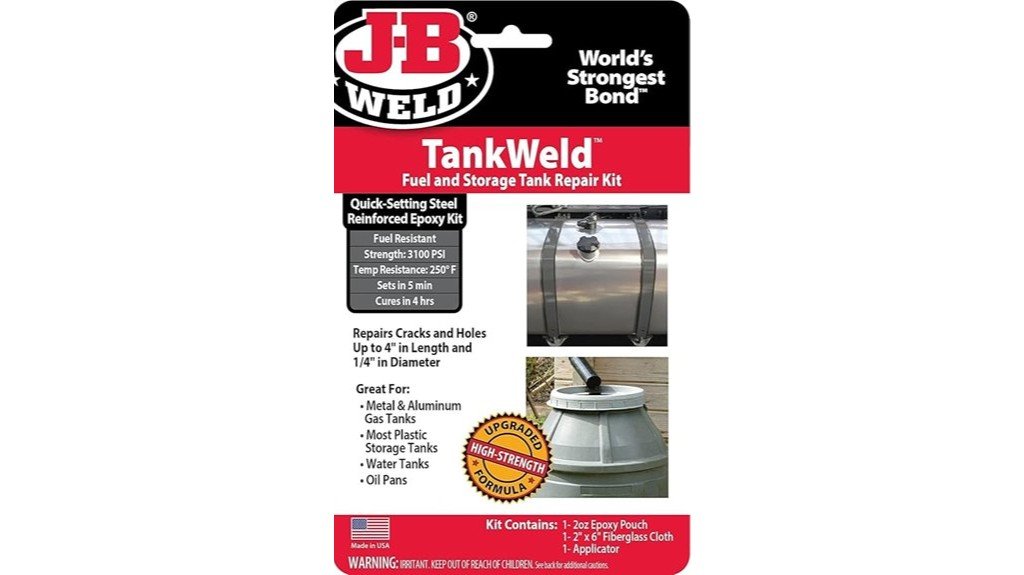
A small leak in a metal fuel tank can turn into a costly repair, but choosing the wrong patch material can make the problem worse. The J-B Weld 2110 Metal Fuel Tank Repair Kit, also sold as the TankWeld Kit, gives you epoxy, fiberglass reinforcement, sandpaper, and an applicator in one package for repairing limited damage in metal fuel and storage tanks. Its biggest strengths are the complete kit format, fuel-resistant repair material, and fast working time, while its main limitation is that the damage must stay within the manufacturer’s stated size range. This review explains what the kit includes, how it is used, where it makes sense, and when you should choose another repair method.
Quick Verdict
Rating: 8/10, Recommended with caveats
Best For: DIY repair of small cracks and holes in compatible metal fuel or storage tanks.
Bottom Line: The J-B Weld 2110 is useful when you want a complete reinforced repair kit instead of buying epoxy and fiberglass separately. You still need careful surface preparation, enough cure time, and damage that falls within the manufacturer’s limits.
Key Specifications
| Specification | Detail |
|---|---|
| Brand | J-B Weld |
| Model | 2110 |
| Product type | TankWeld metal fuel tank repair kit |
| Repair design | Epoxy repair reinforced with fiberglass cloth |
| Maximum crack length | Up to 4 inches |
| Maximum hole size | Up to 1/4 inch diameter based on the current manufacturer specification |
| Set time | About 5 minutes |
| Cure time | About 4 hours under the manufacturer’s stated conditions |
| Published strength | 3,100 PSI in the manufacturer’s technical data for the 2110 repair kit |
| Temperature resistance | Up to 250°F in the manufacturer’s technical data |
| Included components | Repair epoxy, fiberglass cloth, sandpaper, applicator, and instructions |
| Primary use | Limited repairs on compatible metal fuel and storage tanks |
What Is the J-B Weld 2110 Metal Fuel Tank Repair Kit?
The J-B Weld 2110 is a compact repair system made for patching limited leaks in metal fuel and storage tanks. Instead of relying on epoxy alone, the kit uses a layer of fiberglass cloth to reinforce the repair area. That reinforcement matters most when you are bridging a crack or covering a small hole rather than simply filling a shallow surface defect.
The manufacturer describes the 2110 as suitable for permanent or temporary repairs, depending on the condition of the tank and the repair. It is not a substitute for replacing a badly rusted, structurally weakened, or severely damaged tank. You should treat it as a repair product for localized damage that falls within the stated limits.
Before You Buy: Check the size and condition of the damage first. J-B Weld’s current specification limits the TankWeld Kit to cracks of 4 inches or less and holes up to 1/4 inch in diameter. Extensive rust, structural damage, or a larger opening calls for a different repair approach or professional inspection.
Who Should Buy It?
Best For
- DIYers repairing a small localized leak in a compatible metal fuel tank.
- Owners who want epoxy, fiberglass reinforcement, sandpaper, and an applicator in one kit.
- Repairs where the crack or hole stays within the manufacturer’s stated size limits.
Skip If
- Your tank has widespread corrosion, structural failure, or damage larger than the rated repair area.
- You need a repair specifically intended for polyethylene or polypropylene plastic.
- You cannot safely prepare, drain, ventilate, and work around the tank according to the product instructions.
What’s in the Box?
The 2110 is useful because the basic materials needed for the reinforced patch are supplied together. The kit includes the repair epoxy, fiberglass cloth, sandpaper, an applicator, and instructions. You may still need normal safety equipment and cleaning supplies for the job.
The fiberglass is more than an accessory. You apply epoxy to the prepared repair area, place the cut fiberglass over that first layer, and then cover the cloth with the remaining repair material. This creates a reinforced patch rather than relying on an unsupported layer of resin.
Materials and Repair Design
The key feature of this kit is its combination of a fuel-resistant epoxy repair material and fiberglass reinforcement. Once mixed, the epoxy begins setting quickly, so you need to prepare the tank surface and cut any required fiberglass before opening and mixing the repair material.
According to J-B Weld’s technical data for model 2110, the material has a published strength of 3,100 PSI and temperature resistance up to 250°F. Those numbers describe the repair material under the manufacturer’s test conditions. They do not mean the repaired tank becomes structurally equivalent to undamaged metal.
Installation and Surface Preparation
Surface preparation has a major effect on adhesion. The manufacturer’s directions call for removing dirt, grease, fuel residue, debris, and loose contamination before roughening a smooth surface. The repair area should be prepared before you mix the epoxy because the working time becomes short once the components are combined.
1. Prepare the Area
Follow the kit directions for safely emptying or preparing the tank. Clean the damaged area thoroughly and remove loose material that could keep the epoxy from bonding. Roughening the surface gives the repair material a better mechanical grip than a smooth, contaminated surface.
2. Mix the Repair Material
The 2110 kit uses a divided pouch rather than a conventional pair of epoxy tubes. The manufacturer’s technical instructions direct you to break the internal seam and knead the combined components until they are thoroughly mixed.
3. Apply the Epoxy and Fiberglass
Apply part of the mixed epoxy over the damaged area. Cut and place the fiberglass cloth over the first layer, then spread the remaining epoxy over the cloth and its edges so the reinforcement becomes part of the patch.
4. Allow It to Cure
J-B Weld’s technical data lists a set time of about 5 minutes and a cure time of about 4 hours for this kit. Environmental conditions can affect epoxy behavior, so follow the current package directions before putting the repaired tank back into service.
Pro Tip: Complete your cleaning, surface preparation, and fiberglass trimming before mixing the epoxy. With a roughly 5-minute set time, stopping to prepare materials after mixing can leave you with much less usable working time.
Compatibility and Safety
Fuel-tank work deserves more care than an ordinary household epoxy repair. Fuel and fuel vapors can create fire, inhalation, and chemical hazards. Use appropriate protective equipment, work in suitable ventilation, and follow the kit’s current instructions and safety data rather than improvising around a tank that still contains fuel or vapor.
The current J-B Weld product information positions the 2110 primarily as a repair kit for metal fuel and storage containers and specifically warns against certain plastic repairs, including polyethylene and polypropylene. If you have a plastic tank, confirm the exact tank material and use a repair product approved for that material instead of assuming a metal-tank kit will bond correctly.
A patch also cannot restore metal that has become thin across a large rusted area. When corrosion extends well beyond a single crack or hole, a replacement tank or professional repair can be the safer choice.
How It Performs in Real Use
For a Small Metal Fuel-Tank Leak
This is the job that best matches the kit’s design. When the leak comes from localized damage and remains inside the stated size limits, the supplied epoxy and fiberglass give you a reinforced patch without needing to source separate repair materials.
For a Short Crack
The kit can bridge a crack up to 4 inches according to the manufacturer. Fiberglass reinforcement is particularly useful here because it spreads the repair material over an area wider than the crack itself. Correct cleaning and coverage remain critical because contamination can undermine the bond.
For a Small Hole
The current official specification lists holes up to 1/4 inch in diameter. That makes the 2110 suitable for small puncture-type damage, but not for a large opening or missing section of tank wall. Measure the damage rather than estimating it by eye before deciding the kit is appropriate.
For an Older or Rusted Tank
The kit makes less sense when a leak is only one symptom of widespread corrosion. Epoxy can cover a localized opening, but it does not replace solid tank material elsewhere. Check the surrounding metal carefully and seek professional guidance if the area feels weak, flaky, or extensively corroded.
Pros and Cons
Pros
- Includes epoxy, fiberglass reinforcement, sandpaper, and an applicator in one kit.
- Designed specifically for limited repairs on metal fuel and storage tanks.
- Fast approximately 5-minute set time.
- Fiberglass helps reinforce cracks and small holes instead of relying on epoxy alone.
- Manufacturer technical data lists 3,100 PSI strength and resistance up to 250°F.
Cons
- The short set time leaves limited room for delays once you begin mixing.
- Current specifications limit repairs to relatively small holes and cracks.
- It cannot correct widespread rust, structural tank damage, or incompatible plastic surfaces.
Is It Worth the Price?
The main value of the J-B Weld 2110 comes from convenience. You get the epoxy repair material, fiberglass reinforcement, preparation material, and applicator as a matched kit rather than assembling the pieces yourself. That can make it a strong value when you have one small, suitable tank repair and want a straightforward package.
Its value falls quickly if your damage is outside the product’s limits. Spending money on a patch kit does not make sense when the tank has major corrosion, a large opening, or a material that the product is not designed to repair. In those situations, putting the budget toward the correct repair or replacement is more sensible.
How It Compares to Alternatives
J-B Weld TankWeld Epoxy Putty 8217 is a simpler option if you want a hand-mixable steel-reinforced putty rather than the complete fiberglass-reinforced 2110 kit. The 8217 putty has its own specifications and application method, so you should not use its cure time or strength numbers as specifications for the 2110 kit.
The Permatex Fuel Tank Repair Kit 9101 is another complete metal fuel-tank repair system. Permatex specifies cracks up to 4 inches, holes up to 3/8 inch, and a 30-minute cure for that product. The J-B Weld 2110 makes more sense if you specifically want the J-B Weld system, while Permatex is worth comparing if its different repair-size and cure specifications better match your job.
Frequently Asked Questions
How large a hole can the J-B Weld 2110 repair?
J-B Weld’s current product page specifies holes up to 1/4 inch in diameter. Older material has sometimes listed a larger figure, so the current 1/4-inch manufacturer limit is the safer specification to use when deciding whether the kit fits your repair.
How long a crack can the kit repair?
The manufacturer lists cracks of 4 inches or less. Damage beyond that limit, or damage surrounded by weak and heavily corroded metal, should not be treated as a routine patch-kit job.
How quickly does the J-B Weld 2110 set and cure?
J-B Weld’s technical data lists an approximate 5-minute set time and 4-hour cure time for the 2110 repair kit. Always follow the directions supplied with your current package because environmental conditions can influence epoxy curing.
Does the kit include fiberglass cloth?
Yes. The 2110 kit includes fiberglass cloth along with the repair epoxy, sandpaper, and applicator. The cloth is placed over the first layer of epoxy and then covered with the remaining material to reinforce the repair.
Can you use the J-B Weld 2110 on a plastic fuel tank?
Do not assume it will work on your plastic tank. Current J-B Weld information positions the kit for metal fuel and storage containers and warns against incompatible plastics such as polyethylene and polypropylene. Identify the tank material before choosing a repair system.
Do you need to prepare the metal before applying the epoxy?
Yes. The manufacturer’s instructions call for removing fuel residue, grease, dirt, debris, and loose contamination and roughening smooth surfaces. Poor surface preparation can prevent the repair material from bonding properly.
Is the 2110 kit suitable for a badly rusted tank?
Not when corrosion is widespread or has weakened a large area of the tank. The kit is better suited to localized damage on otherwise serviceable material. Extensive corrosion should be inspected before you rely on a surface patch.
What is the most common mistake to avoid?
Starting to mix before the surface and fiberglass are ready can waste much of the short working window. Prepare, clean, roughen, and organize the repair area first, then mix and apply the epoxy according to the package instructions.
The Bottom Line
The J-B Weld 2110 Metal Fuel Tank Repair Kit is worth considering when you have a small, localized repair on a compatible metal fuel or storage tank and want a complete fiberglass-reinforced system. Its supplied components, roughly 5-minute set time, and fuel-oriented design are useful strengths, but its limited repair size and need for careful preparation mean it is not the right solution for major corrosion or structural tank damage.
If your damage falls within the manufacturer’s limits and you can complete the job safely according to the instructions, the 2110 earns our 8/10, Recommended with caveats verdict.