A jogging stroller can help you stay active with your child, but safe running depends on more than choosing a three-wheel stroller. Your baby must be developmentally ready, the stroller must be approved for jogging, and every wheel, strap, brake, and tire must be set up correctly before you run.
Quick Answer
Most babies should not ride during a stroller run until they have strong, steady head and neck control, usually around 6 to 8 months. Your pediatrician and the stroller manual should make the final call. An infant car seat may allow earlier walking, but it does not automatically make jogging safe.
Key Takeaways
- Wait until your baby has steady head and neck control and meets the stroller manufacturer’s jogging requirements.
- Use a stroller specifically approved for running, with a secure 5-point harness, fixed or lockable front wheel, brakes, wrist strap, suitable tires, and stable frame.
- Use the pressure printed on the tire or listed in the manual. Jogging strollers do not share one universal PSI.
- Check wheel attachment, tracking, tire condition, brakes, harness fit, and recalls before running.
- Begin on a smooth, low-traffic route and stop if the stroller shakes, pulls, makes unusual noises, or becomes difficult to control.
At a Glance
| Time Required | About 5 to 10 minutes for a pre-run inspection, plus practice time before your first run. |
| Difficulty | Easy to moderate after you learn the stroller’s steering, braking, folding, and wheel-lock controls. |
| Equipment Needed | Jogging-approved stroller, owner’s manual, properly fitted harness, wrist strap, working brakes, tire gauge or pump if required, and weather protection. |
| Cost | Varies by stroller and accessories. Safety, fit, condition, and manufacturer support matter more than a fixed price tier. |
Understanding Age Guidelines for Jogging Strollers
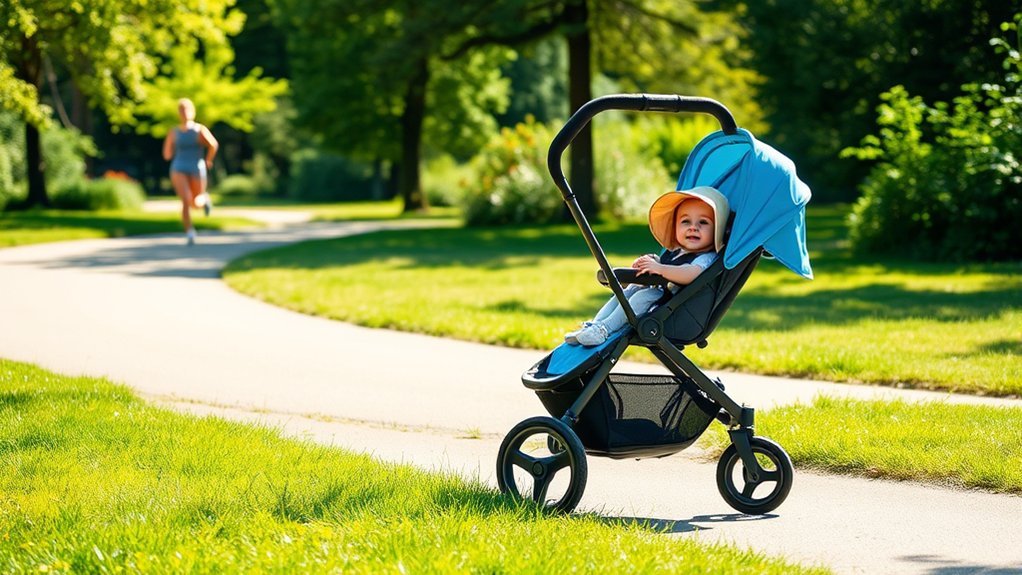
Age is only one part of jogging-stroller readiness. Your baby also needs enough head, neck, and trunk control to stay upright as the stroller moves over small bumps, changes speed, and turns.
Many families begin considering stroller jogging around 6 to 8 months, but development and product rules vary. Some stroller manuals set a higher minimum age for running, and babies born prematurely or living with a medical or developmental condition may need additional time.
Before your first run, ask your pediatrician whether your child is ready and read the stroller manual from start to finish. The American Academy of Pediatrics’ HealthyChildren stroller guidance also emphasizes proper restraint use, brake use, supervision, and following the manufacturer’s instructions.
Jogging Readiness Checklist
- Your baby can hold their head steady without repeated bobbing or flopping.
- Your baby can remain upright in the stroller seat without slumping sideways or sliding down.
- The harness fits securely using the routing and adjustment described in the manual.
- Your child meets the stroller’s minimum age, height, weight, and seat-use rules for jogging.
- Your pediatrician agrees that the motion and duration are appropriate for your child.
Warning: Do not jog with a newborn or a baby who cannot keep their head steady. A car seat adapter may be approved for walking while the baby is younger, but running creates more speed, vibration, and impact. Follow the restrictions in both the stroller and car seat manuals.
Key Features to Look for in a Jogging Stroller
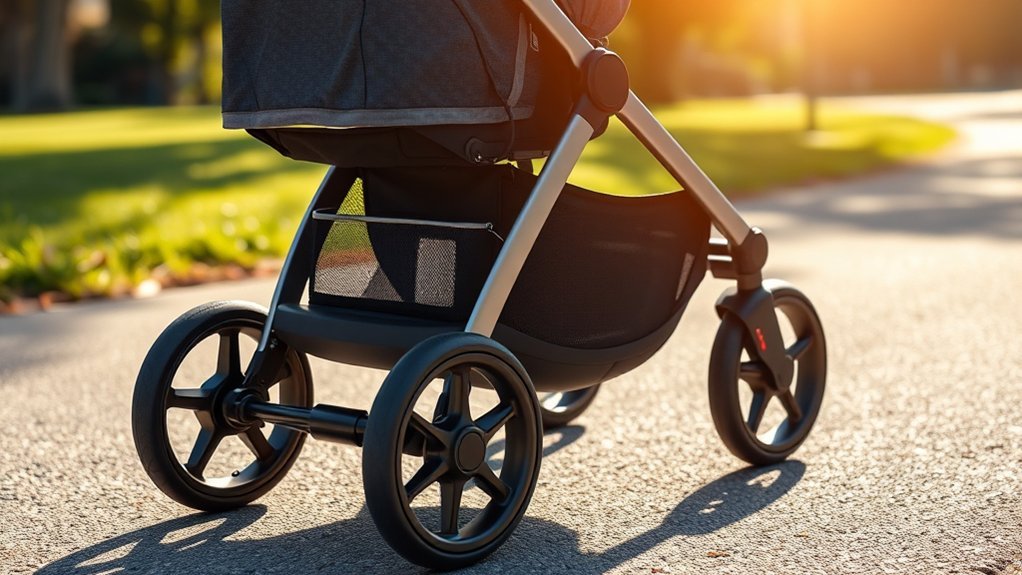
A safe jogging stroller needs more than large wheels. Look for a model designed and labeled for running, then compare its restraint system, wheel design, brakes, frame stability, suspension, tires, handlebar, wrist strap, and manufacturer support.
In the United States, strollers are covered by the federal safety standard in 16 CFR Part 1227. Compliance with a stroller standard does not replace the need to follow the model-specific jogging instructions.
Safety Harness System
Choose a stroller with a 5-point harness that restrains your child at the shoulders, hips, and between the legs. The straps should lie flat, stay snug, and use the shoulder-slot position required by the manual. Do not assume the straps must always sit above the shoulders because routing rules can differ by model.
Check the webbing, buckle, adjusters, and attachment points for fraying, cracks, twisting, or weak engagement. Stop using the stroller if the buckle opens unexpectedly or any restraint component is damaged.
Wheel Locking Mechanism
A jogging stroller normally uses either a fixed front wheel or a swivel wheel that locks into a straight-running position. Engage the approved jogging mode before running. A free-swiveling wheel can wobble or change direction suddenly at speed.
| Feature | Why It Matters | What to Do |
|---|---|---|
| Front-wheel lock | Improves straight-line stability | Engage the manufacturer’s jogging mode |
| Wheel attachment | Prevents wheel separation | Check the axle, lever, bolt, or release system before every run |
| Tracking adjustment | Helps the stroller roll straight | Use the tracking control and instructions in the manual |
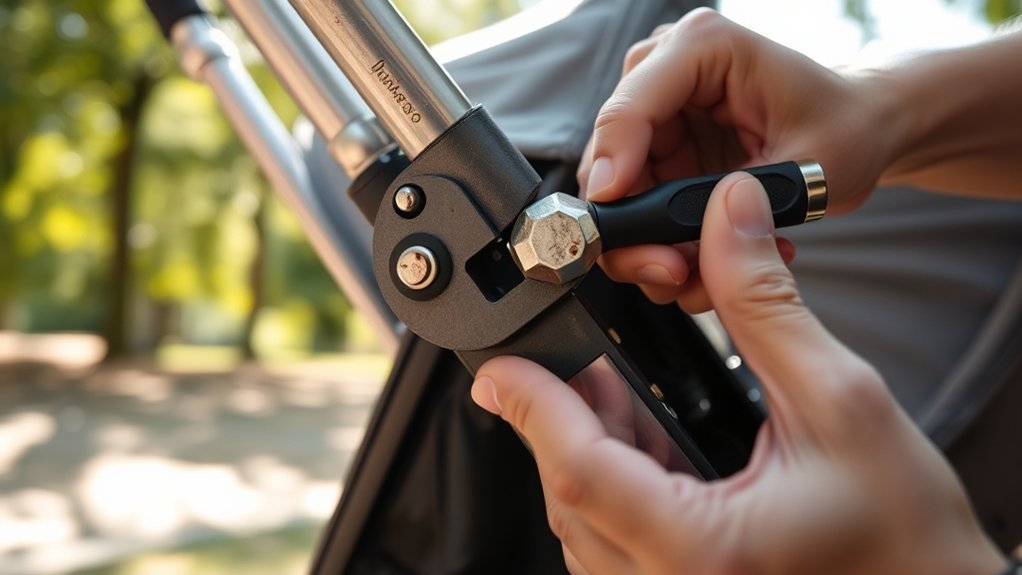
After installing or removing a wheel, pull firmly on it to confirm it is secure. Never run if an axle, quick-release lever, retaining clip, nut, or wheel-lock part is missing or damaged.
Suspension and Tires
Suspension can reduce the amount of vibration reaching the seat, while larger tires roll more smoothly over pavement seams and compact paths. Air-filled tires often provide good cushioning but need regular pressure checks. Foam-filled or airless tires need less inflation maintenance but can feel different on rough ground.
Match the tread and suspension to your normal route. A stroller intended for paved paths may not be suitable for loose gravel, deep sand, roots, or technical trails, even if it is marketed as all-terrain.
Brakes, Handlebar, and Wrist Strap
- Parking brake: Holds the stroller still while you load, unload, or adjust your child.
- Hand brake: Helps manage speed on slopes when the model includes one. It is not a substitute for choosing a safe hill.
- Wrist strap: Keeps the stroller connected to you if your grip slips.
- Adjustable handlebar: Helps you keep a more upright posture and avoid overreaching.
- Reflective details: Improve visibility, but do not make low-light running risk-free.
Pro Tip: Practice with the stroller at walking speed before carrying your child on a run. Learn how it turns with the front wheel locked, how quickly the brakes respond, and how the stroller feels with weight in the seat and basket.
Preparing Your Stroller for a Safe Run

A short inspection before every run can catch loose wheels, low tires, worn straps, brake problems, and overloaded storage before they affect control.
Stroller Inspection Checklist
- Open and lock the frame completely.
- Confirm every wheel is fully attached and rotates without severe wobble or grinding.
- Set the front wheel to the manufacturer’s jogging position.
- Check tire pressure and condition using the tire sidewall or manual.
- Test the parking brake and hand brake, if fitted.
- Inspect the harness, buckle, seat, canopy, and wrist strap.
- Remove excessive weight from the handlebar and stay within basket limits.
- Check for loose fasteners, cracked parts, damaged fabric, or unusual frame movement.
Pre-Run Safety Checklist
- Confirm your child still fits the stroller’s age, height, and weight limits.
- Secure the 5-point harness according to the manual and remove twists or slack.
- Attach the wrist strap before releasing the parking brake.
- Pack water and weather protection without blocking ventilation.
- Choose a smooth route away from traffic, steep drops, stairs, and unsafe crossings.
- Tell someone your route or carry a charged phone when running alone.
Tire Pressure and Tracking Maintenance
Jogging strollers do not have one universal tire pressure. Inflate each tire to the value printed on its sidewall or specified in the owner’s manual, and never exceed the stated maximum. Check pressure when the tires are cool because heat can change the reading.
If the stroller pulls to one side, first confirm that the tires match the recommended pressure and that the wheels are mounted correctly. Then use the model’s tracking adjustment, if provided. Do not intentionally run with unequal tire pressure unless the manufacturer specifically instructs you to do so.
Stop running if you notice persistent wobble, brake drag, a loose wheel, repeated air loss, a bent rim, damaged tread, or a frame that will not lock securely.
Note: Maintenance intervals and lubrication rules vary. Use only manufacturer-approved replacement parts and service methods. Oil or grease in the wrong place can reduce brake performance or attract damaging grit.
Ensuring Your Child’s Safety in the Stroller
Set the parking brake before placing your child in the stroller. Seat them fully against the backrest, route the harness as the manual shows, remove twists, and tighten the straps until they are secure without pressing painfully into the body.
A minimum age alone does not make a baby ready for jogging. Steady head control, correct harness fit, pediatric guidance, and the stroller’s running rules must all agree.
Keep the child seated and buckled whenever the stroller is moving. Do not let a child stand, lean out, or ride in the storage basket, on the footrest, or on an unapproved accessory.
Safe Clothing and Weather Protection
Use thin, weather-appropriate layers that allow the harness to lie close to the child. Bulky coats, blankets, or padding behind the child can interfere with restraint fit.
Use the canopy for shade while keeping airflow open. Avoid fully enclosing the seat in warm weather because temperatures can rise quickly. In cold conditions, remember that your child is sitting still and may feel colder than you do while running.
Check your child’s face, hands, feet, breathing, posture, and comfort during the run. End the outing if your child appears overheated, very cold, distressed, unusually sleepy, or poorly supported.
What Not to Do While Jogging
- Do not jog with a baby who lacks steady head and neck control.
- Do not use a regular stroller or an unlocked swivel wheel for running.
- Do not hang heavy bags from the handlebar because they can affect stability.
- Do not use loud audio that blocks traffic, bicycle, animal, or pedestrian sounds.
- Do not run down stairs, over curbs at speed, across deep sand, or through standing water.
- Do not exceed the stroller’s limits or use unapproved seats, boards, or accessories.
- Do not continue after shaking, pulling, brake failure, wheel noise, or frame damage appears.
Techniques for Running With a Jogging Stroller
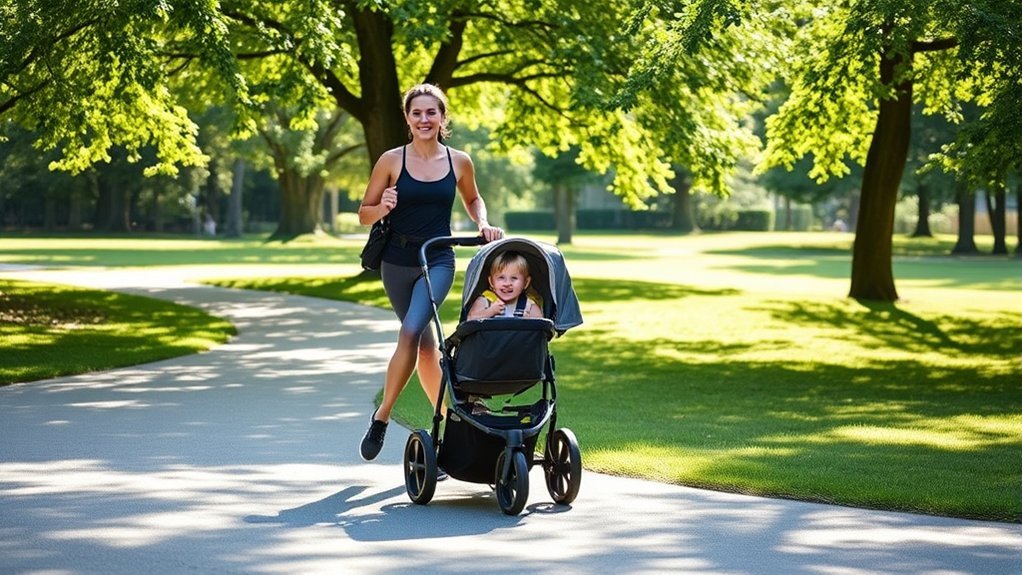
Attach the wrist strap, keep the stroller close, and begin at a pace that gives you plenty of time to steer and stop. Your pace will normally be slower than it is without a stroller.
Best Running Form With a Jogging Stroller
Keep your chest tall, shoulders relaxed, and elbows slightly bent. Avoid leaning your body weight onto the handlebar. Use a light, controlled grip and keep at least one hand ready to guide the stroller.
On smooth, open ground, you may alternate hands if the stroller manual allows it and you remain in control. Use both hands near turns, hills, crossings, crowds, uneven surfaces, and any situation that reduces your stopping distance.
Shorten your stride slightly and avoid kicking the rear axle. If the handlebar cannot be adjusted to a comfortable height, the stroller may not fit your running posture well.
How to Start Slowly
Begin with short walk-jog intervals on a flat, predictable route. You might walk for three minutes, jog gently for one minute, and repeat for 15 to 20 minutes. Increase time gradually only when both you and your child remain comfortable.
If you are returning to exercise after pregnancy, birth, injury, or surgery, follow your own healthcare professional’s guidance as well. Child readiness and parent readiness are separate safety decisions.
Hills, Turns, Curbs, and Crossings
Slow down before turns instead of steering sharply at speed. Avoid steep descents until you have practiced braking with the stroller loaded. Even with a hand brake, choose a pace that does not pull you forward.
Walk across complicated intersections and rough transitions. Approach small curb cuts straight and slowly. Do not tip the stroller onto its rear wheels while running unless the manufacturer specifically teaches that technique.
Recommended Jogging Strollers for Different Budgets
Prices and model availability change, so compare current specifications instead of relying on a fixed dollar amount. The safest choice is the stroller that fits your child, your body, your route, your storage space, and the manufacturer’s intended use.
Budget-Friendly Options
For occasional runs on paved paths, look for a complete jogging stroller with a secure harness, genuine running mode, wrist strap, dependable parking brake, replaceable parts, and clear instructions. The Chicco Activ3 and similar value-oriented joggers may be worth comparing when available in your market.
A low price should not outweigh poor wheel attachment, missing parts, an unclear history, or no access to the manual. A used stroller can be economical only after you confirm its exact model, condition, recall status, and compatibility with current replacement parts.
Premium Choices Available
Frequent runners often pay more for smoother suspension, easier tracking adjustments, better downhill braking, an adjustable handlebar, a stronger fold, and responsive parts support. Models commonly compared in this group include the BOB Gear Wayfinder, BOB Gear Revolution Flex 3.0, and Thule Urban Glide 3.
The Thule Urban Glide 2 is an older generation that may still appear used or in remaining inventory. Compare it with the current Urban Glide 3 and verify the manual, included parts, condition, and recall status before buying.
Feature Comparison Chart
| Runner Type | Features to Prioritize | Examples to Compare |
|---|---|---|
| Occasional paved-path runner | Jogging mode, secure harness, wrist strap, simple fold | Chicco Activ3 and comparable value joggers |
| Frequent road or park runner | Tracking control, suspension, adjustable handlebar, hand brake | BOB Gear Wayfinder, Thule Urban Glide 3 |
| Mixed-surface runner | Tire durability, stable frame, suitable suspension, serviceable parts | BOB Gear Revolution Flex 3.0 and similar all-terrain joggers |
| Multisport family | Approved conversion kits, activity-specific instructions, complete setup | Cybex ZENO or Thule multisport systems |
Multisport products may require separate running, cycling, or skiing kits. Confirm that you are pricing a complete, approved setup rather than a frame or accessory alone.
How to Compare Jogging Strollers Before Buying
| Buying Factor | Why It Matters | What to Check |
|---|---|---|
| Child fit | Supports secure restraint and posture | Age, height, weight, seated shoulder height, harness routing |
| Running surface | Changes tire, suspension, and brake needs | Pavement, park paths, gravel, hills, light trails |
| Parent fit | Affects posture and control | Handlebar range, stride clearance, brake reach |
| Storage and transport | Determines daily practicality | Fold size, weight, removable wheels, trunk fit |
| Support and service | Keeps the stroller maintainable | Manual access, replacement parts, warranty, recall communication |
When to Start Using a Jogging Stroller With Your Baby
Start jogging only when your baby’s development and the stroller’s rules agree. A minimum seat weight does not prove that a young infant can tolerate running motion, and a stroller approved for walking from birth may still prohibit jogging until later.
Walking vs. Jogging With an Infant Car Seat
An approved infant car seat adapter can make a jogging-style stroller useful for walking before a baby is ready for the stroller seat. However, the higher seating position can change the stroller’s balance, and running adds repeated bounce and faster directional changes.
Do not run with an attached infant car seat unless the stroller and car seat manufacturers expressly approve that exact combination for jogging. When the manuals differ, follow the more restrictive rule.
Signs Your Baby May Be Ready
- Your baby holds their head steady throughout normal stroller movement.
- Your baby sits upright in the seat without repeated slumping.
- The harness fits securely and the shoulder straps route correctly.
- Your baby meets every stated jogging limit for the stroller.
- Your pediatrician has no concern about beginning stroller runs.
Signs to Wait Longer
- Your baby’s head flops forward or sideways.
- Your baby cannot maintain a supported upright posture.
- The harness cannot be tightened or routed correctly.
- Your baby becomes distressed with ordinary stroller motion.
- The manual prohibits jogging at your child’s current age or size.
Why Regular Strollers Are Not Suitable for Jogging
Regular strollers are designed mainly for walking, errands, and smooth everyday surfaces. They may have small swivel wheels, limited impact control, different frame geometry, and no jogging instructions.
- A free-swiveling front wheel may wobble or turn suddenly at running speed.
- Small wheels can catch more easily on cracks, stones, and uneven transitions.
- The frame, suspension, wheel retention, and brakes may not be designed for repeated running loads.
- The stroller may lack a wrist strap, tracking adjustment, or speed-control brake.
Use only a stroller whose manufacturer identifies it as suitable for jogging, and follow the approved wheel setting and terrain limits.
Jogging Stroller vs. Regular Stroller
| Feature | Jogging Stroller | Regular Stroller |
|---|---|---|
| Front wheel | Fixed or lockable for running | Often swivels for walking maneuverability |
| Tires | Usually larger and selected for smoother rolling | Often smaller and optimized for everyday surfaces |
| Suspension | Designed for greater movement and impact control | May provide limited shock absorption |
| Braking | Parking brake; some models add a hand brake | Usually a parking brake only |
| Approved use | Jogging when configured as the manual directs | Walking and everyday transport |
Tips for Keeping Your Child Comfortable While Running
Plan the route and duration around your child, not only your workout. Use suitable layers, maintain airflow, provide shade, and check posture and harness fit during breaks.
| Comfort Strategy | Safety Check |
|---|---|
| Dress in thin layers | Keep bulky material out from behind the harness |
| Use the canopy for shade | Maintain airflow and monitor heat |
| Bring age-appropriate water or snacks | Stop before offering anything that could become a choking risk |
| Choose a familiar route | Avoid traffic, steep slopes, broken pavement, and isolated hazards |
Snacks, Hydration, and Breaks
For a child old enough to eat finger foods, stop the stroller before offering snacks. Eating while bouncing can increase choking risk. Use foods appropriate for the child’s age and chewing ability.
Take a break when your child becomes fussy, sweaty, cold, poorly positioned, or unusually quiet. Recheck the harness after clothing changes or a diaper change.
Route and Time of Day
Start with smooth, flat, low-traffic paths. Avoid peak heat, poor visibility, ice, strong wind, flooded paths, loose gravel, and routes that force you close to moving vehicles.
Turn around when conditions worsen. A training goal is never more important than safe stroller control and your child’s comfort.
Additional Resources for Jogging With a Stroller
Keep the manual accessible, register the stroller with the manufacturer, and save the model and serial numbers. Registration can help the manufacturer contact you about safety notices or corrective actions.
- Owner’s manual: Confirms jogging age, wheel mode, tire pressure, maintenance, accessories, and limits.
- Pediatrician: Helps assess developmental readiness, especially after premature birth or with health concerns.
- Manufacturer support: Provides approved parts and model-specific troubleshooting.
- Official recall database: Identifies safety actions affecting a specific model or production period.
Where to Check for Stroller Recalls
Find the brand, model number, manufacture date, and serial number on the frame label. Search those details in the U.S. Consumer Product Safety Commission recall database and on the manufacturer’s support site.
Do not use a recalled stroller until you complete the official remedy. Contact the manufacturer if the stroller has an unknown history, missing labels, improvised repairs, a damaged frame, an incomplete wheel-retention system, or unavailable replacement parts.
Frequently Asked Questions
Can I Jog With a Newborn in a Jogging Stroller?
No. A newborn lacks the head, neck, and trunk control needed for running motion. Some jogging-style strollers accept infant car seats for walking, but that does not mean the setup is approved for jogging.
What Should I Do if My Child Falls Asleep While Jogging?
Slow down and check that the harness remains secure and the child’s head and neck stay supported without slumping. Choose a smooth route, monitor breathing and temperature, and stop if the child’s position becomes unsafe.
How Do I Choose the Right Size Jogging Stroller?
Check the stroller’s age, height, and weight limits, seated shoulder height, harness routing, and seat depth. Also test the handlebar range and stride clearance so you can run without leaning or kicking the axle.
Are Jogging Strollers Suitable for All Terrains?
No. Some models are intended mainly for pavement and compact paths, while others can handle limited uneven terrain. Follow the manual’s surface restrictions and avoid technical trails, deep sand, stairs, ice, and conditions that reduce control.
Can I Use a Jogging Stroller for Walking?
Yes. Most jogging strollers also work for walking. A swivel front wheel may make slow turns easier when walking, but return the wheel to the approved locked or fixed position before running.
Do I Need to Lock the Front Wheel When Running?
Use the front-wheel setting specified for jogging in your manual. For most convertible joggers, that means locking the swivel wheel straight before running. A fixed-wheel stroller is already configured for straight-line stability.
Is a Jogging Stroller Worth It for Casual Runners?
It can be worthwhile if you expect to run, fast-walk, or use outdoor paths regularly. You may not need a premium model, but you still need a stroller approved for jogging with correct child fit, reliable wheel retention, a secure harness, brakes, and manufacturer support.
Can I Jog With an Infant Car Seat Attached?
Only if both manufacturers expressly approve the exact stroller, adapter, and car seat combination for jogging. Many adapters are intended for walking only. Follow the most restrictive instruction in the stroller, adapter, and car seat manuals.
What Should I Do if the Stroller Pulls or Wobbles?
Stop running. Check wheel attachment, tire condition, recommended pressure, frame locks, and front-wheel position. Use the manual’s tracking adjustment if available. Seek manufacturer service if pulling or wobble continues.
Conclusion
The safest time to begin jogging is when your child has steady head and neck control, fits the harness correctly, meets every manufacturer limit, and has pediatric approval. Use a stroller designed for running, configure the front wheel properly, attach the wrist strap, and inspect the wheels, tires, brakes, frame, and harness before every outing.
Start slowly on smooth routes and treat pulling, wobbling, unusual noise, damaged parts, or poor child posture as reasons to stop. With the right stroller, careful setup, and realistic pace, running together can become a comfortable routine for both parent and child.
Sources
- HealthyChildren.org from the American Academy of Pediatrics — stroller restraint, brake, supervision, and general safety guidance.
- U.S. Consumer Product Safety Commission: Strollers — federal stroller safety education and hazard awareness.
- U.S. Consumer Product Safety Commission Recall Database — current model-specific recall and remedy information.
- Electronic Code of Federal Regulations, 16 CFR Part 1227 — the U.S. federal safety standard for carriages and strollers.