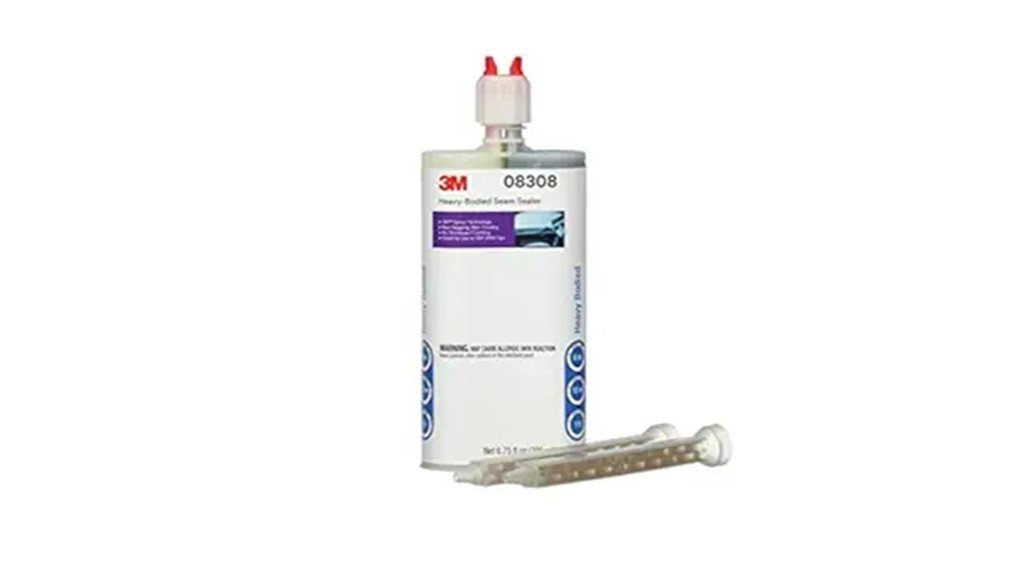
The 3M Heavy-Bodied Seam Sealer is a two-part, 1:1 epoxy for automotive seams, offering a non-sag, heavy paste that holds on vertical joints and door skins. It cures in about one hour at room temperature, dispenses from a dual-syringe cartridge, and tools easily with standard spatulas; expect coverage of roughly 10–12 linear feet per cartridge on 1/8″ bead. What surfaces, prep steps, and tooling choices yield the best OEM-like results?
Key Takeaways
- Heavy-bodied two-part epoxy dispenses from a 200 ml dual-syringe for consistent 1:1 mixing and bead appearance.
- Quick cure: tooling window ~6 minutes, initial handling 1–10 minutes, full cure ~1 hour under typical shop conditions.
- Excellent vertical stability and non-flowing consistency make it ideal for door skins, floor pans, trunk floors, and roof seams.
- Best applied with 3M manual or pneumatic applicators, 3–6 mm bead size, and tooling within six minutes.
- Industrial use requires PPE, ventilation (6–12 air exchanges/hr), surface prep (clean, dry, 80–120 grit), and SDS compliance.
Product Overview and Key Features
The 3M Heavy-Bodied Seam Sealer 08308 is a two-part automotive epoxy supplied in a 200 ml (6.75 fl oz) dual-syringe cartridge, designed for sealing door skins, floor pans, trunk floors, and roof seams.
It offers formulation benefits: non-flowing, heavy-bodied consistency, quick cure (1 hour), and OEM-grade durability.
Who should use it? Professionals seeking reliable seam protection.
For professional technicians and body shops demanding dependable, OEM-quality seam protection and consistent, professional results
What to expect? Consistent bead appearance, vertical stability, and easy tooling.
Application techniques include dispensing controlled beads and tooling to profile.
Practical notes: cartridge volume 200 ml, work time ~6 minutes, paint time ~15 minutes; intended for industrial/occupational use only.
Mixing, Application, and Tools Needed
Following the overview of product features and where 3M Heavy-Bodied Seam Sealer 08308 is best used, attention shifts to how it must be mixed and applied for reliable results.
The reader learns a clear mixing technique: dual-syringe metered system guarantees a 1:1 ratio, self-mixing as dispensed, no manual stirring needed.
Application tips include using 3M Manual Cartridge Applicator 08571 or Pneumatic 09930, dispense bead sizes 3–6 mm for seams, tool within 6 minutes.
Questions answered: What tools? Manual or pneumatic applicators, spatula, disposable nozzles.
Practical considerations: cartridge volume 200 ml, workplace ventilation, PPE required.
Performance: Cure Times and Handling
Expect predictable, job-site-ready cure and handling characteristics that let technicians plan work sequences with confidence.
3M Heavy-Bodied Seam Sealer 08308 reaches an initial handling state rapidly—typically within 1 to 10 minutes depending on bead size, substrate temperature, and ambient humidity—allowing for tooling and repositioning, while achieving full cure in about 1 hour under typical shop conditions.
The product balances cure efficiency with workability; work time is about 6 minutes, paint time ~15 minutes.
Handling tips: keep cartridges at 20°C, avoid drafts, and use recommended applicators for consistent bead control.
- Measure temperature, bead size, humidity.
- Tool within 1–10 minutes.
- Expect full cure ≈1 hour.
Ideal Uses and Surface Compatibility
Having established predictable handling and cure windows, attention shifts to where 3M Heavy‑Bodied Seam Sealer 08308 performs best and what surfaces it bonds to. It suits automotive applications: door skins, floor pans, trunk floors, roof seams. Surface preparation matters: clean, dry, abrade to 80–120 grit, remove oil/contaminants. Practical considerations: 200 ml cartridge, 1 hour cure, 6-minute work time.
| Application | Surface Type | Prep Notes |
|---|---|---|
| Door seams | Steel, galvanized | Abrade, primer optional |
| Floor pans | Bare metal | Degrease, fit test |
| Roof seams | OEM panels | Clamp, tool bead |
| Trunk floors | Patch panels | Clean, position, cure |
Safety and Industrial Use Guidelines
Because the product is formulated for industrial and occupational settings, users must follow strict safety and handling protocols to minimize exposure and guarantee compliant use.
The reviewer notes safety precautions for industrial applications: ventilation, PPE (nitrile gloves, eye protection), and spill control.
What protective measures are required? Air exchanges: 6–12 per hour in work areas; respirator: NIOSH-approved organic vapor cartridge when ventilation is inadequate.
How much material per job? 200 ml cartridges control small seams; larger panels require multiple cartridges.
Practical considerations: disposal per local regs, storage 5–25°C, training records for operators, and regular SDS review.
- Ventilation and PPE
- Cartridge handling
- Training and documentation
Frequently Asked Questions
Can It Be Painted With All Types of Automotive Paints?
Yes. It accepts most automotive topcoats; users should follow application techniques and verify paint compatibility with primers and coatings. Empowered technicians test adhesion, surface prep, and cure to guarantee liberated, durable finishes across diverse paint systems.
Is It Resistant to Road Salt and Long-Term Corrosion?
Yes. It resists road salt and long term corrosion, offering liberated, durable seam protection; users gain confidence in lasting rust prevention, supporting vehicle freedom from deterioration when applied and cured according to industrial guidelines.
How Long Is Shelf Life Unopened and After Opening?
Sealed like a winter vault, unopened shelf life typically reaches 12 months when stored cool and dry; after opening, usable life drops to sealed cartridge guidelines—use within weeks with proper product storage to maintain performance.
Can It Be Used Over Existing Factory Seam Sealer?
Yes. It can be applied over existing factory seam sealer if surfaces are cleaned and abraded; application techniques emphasize proper prep to maximize adhesion properties. The response champions freedom from constraints during restorative work.
Does It Require Special Disposal or Hazardous Waste Handling?
Yes — quietly mindful, waste must be respected. It may require regulated disposal methods; consult local hazardous waste guidance to limit environmental impact. Users seeking liberation should follow proper disposal channels and safety data sheet directions.
Conclusion
In essence, the 3M Heavy‑Bodied Seam Sealer proves to be a dependable, no‑nonsense solution for panel joints, door skins, and floor pans. It cures in about one hour, dispenses from a 1:1 dual syringe, and sets to a non‑sag, toolable bead—practical for vertical seams and quick turnaround. Consider substrate prep, ambient temperature (optimal 60–80°F / 15–27°C), and clamp time; modest precautions yield OEM‑level durability without theatrical effort.