Disclosure: As an Amazon Associate, we earn from qualifying purchases. If you click a link on this page and make a purchase, we may receive a small commission at no extra cost to you.
Fine swirls, polishing haze, and dull reflections can make clean paint look older than it is. Meguiar’s M20508 Mirror Glaze Ultra Finishing Polish is designed for the refinement stage, where you want to remove light defects and improve gloss without using an aggressive compound. This review explains how M205 works, which tools and pads suit it, and where its correction ability stops. It is a strong choice for finishing glossy paint, but it will not replace a heavy-cut compound or a protective wax, sealant, or coating.
Quick Verdict
Rating: 8.8/10
Best For: Detailers and car owners who need a professional finishing polish for fine swirls, light defects, compounding haze, and gloss refinement.
Bottom Line: Meguiar’s M205 offers flexible application, easy residue removal, and a high-gloss finish on glossy automotive paint. Its main limitation is light cutting power, so deeper scratches, severe oxidation, and sanding marks normally require a stronger correction product first.
| Specification | Detail |
|---|---|
| Brand | Meguiar’s |
| Model | M20508 |
| Product type | Mirror Glaze Ultra Finishing Polish |
| Container size | 8 oz liquid |
| Listed item dimensions | 1.63 x 8.25 x 3.6 inches |
| Listed item weight | 0.55 lb |
| Abrasive level | Light, ultra-fine finishing action |
| Abrasive material | Aluminum oxide |
| Listed material type | Polymers and resins |
| Compatible surfaces | Glossy automotive paint, including clear coats |
| Application methods | Hand, dual-action polisher, or rotary buffer |
| Formula classification | Professional-line, body-shop-safe finishing polish |
| Best use | Fine swirls, light defects, post-compounding refinement, and gloss improvement |
| Other official sizes | 32 oz and 1 gallon |
| Package contents | One bottle of finishing polish |
What Is the Meguiar’s M205?
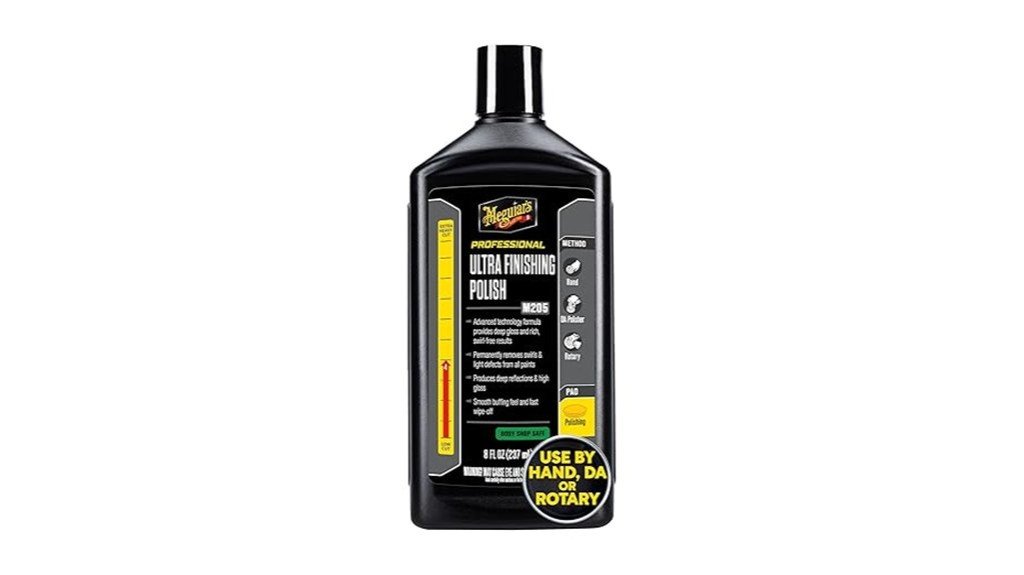
Meguiar’s M20508 Mirror Glaze Ultra Finishing Polish is a professional-line liquid polish for refining glossy automotive paint. Its ultra-fine abrasive action targets fine swirls and other light defects while improving reflection quality and surface gloss.
The formula is suitable for glossy paint and clear coats. You can apply it by hand, with a dual-action polisher, or with a rotary buffer, although each method produces a different level of consistency and correction.
The 8 oz bottle suits spot correction, occasional detailing, and buyers testing the formula before purchasing a larger container. M205 is not a wax, sealant, ceramic coating, or heavy-cut compound. It refines the paint before you apply a separate protective product.
Who Should Buy It?
Best For
- You want to remove fine swirls and light defects from glossy paint while improving clarity.
- You use a DA polisher or rotary buffer and need a finishing step after compounding.
- You need a body-shop-safe polish that can also handle small areas by hand.
Skip If
- You need to remove deep scratches, severe oxidation, etched damage, or sanding marks.
- You want a one-step product that corrects the paint and leaves lasting protection.
- You plan to polish matte paint, textured trim, rubber, or unpainted plastic.
Before You Buy: M205 is a finishing polish with limited cutting ability. Deep scratches, severe oxidation, heavy water-spot etching, and sanding marks may need a dedicated compound or professional correction before the finishing step.
Key Takeaways
- Meguiar’s M20508 is an 8 oz professional finishing polish for glossy automotive paint and clear coats.
- Its ultra-fine abrasive action targets fine swirls and light defects while improving gloss and reflection quality.
- You can apply it by hand, DA polisher, or rotary buffer, although machine application is more consistent across large panels.
- The formula works well as a refinement step after a stronger compound, but it does not replace heavy correction.
- You need a separate wax, sealant, or coating afterward when lasting paint protection is the goal.
Correction Ability and Finish Quality
M205 focuses on light correction and final finish quality. Meguiar’s states that it permanently removes swirls and light defects from glossy paint instead of acting only as a temporary filler or shine enhancer.
The polish is most useful when the paint already has a reasonably sound surface but lacks crisp reflections. It can refine the finish after compounding, remove minor polishing marks, and improve the cloudy appearance caused by fine surface marring.
Its smooth buffing feel and easy wipe-off are practical advantages during multi-panel jobs. Less stubborn residue means you spend less time wiping the paint and reduce the risk of adding towel marks through excessive pressure.
Gloss, Clarity, and Dark-Paint Results
The main reason to choose M205 is the finish it leaves behind. Its fine abrasive action can create deeper reflections and higher gloss when the paint is properly washed, decontaminated, and corrected.
Dark paint often shows haze, micro-marring, and poor wiping technique more clearly than light paint. On black, dark blue, and similar colors, a successful test spot should leave sharper reflections without visible haze under direct inspection lighting.
Lighter colors may show a less dramatic visual change, but improved smoothness and clarity can still become noticeable under sunlight or focused garage lighting. Proper inspection matters because general indoor lighting can hide fine swirls that remain in the finish.
Defect Removal: What It Can and Cannot Fix
M205 is designed for fine swirls and other light paint defects. It also makes sense as the finishing stage after a more aggressive compound has removed deeper damage but left the paint needing additional refinement.
It is not the right first choice for scratches that catch your fingernail, severe oxidation, deep etching, or sanding marks. These defects often extend too far into the paint system for an ultra-fine finishing polish to remove safely or efficiently.
Inspect the panel before polishing and again after your test spot. If the finish gains gloss but the original defect remains clearly visible, repeating the same mild combination may only remove more clear coat without solving the problem.
Pad Choice and Tool Compatibility
Your pad determines how much correction M205 can provide and how cleanly it finishes. A soft foam finishing pad gives the mildest action and focuses on gloss, while a foam polishing pad may provide slightly more defect removal.
A dual-action polisher gives most home detailers the best balance of control and consistency. Rotary buffers can produce excellent results, but they require more experience because pad angle, heat, and movement are less forgiving.
Hand application works for door pillars, areas behind handles, narrow sections, and isolated marks. It is less efficient for an entire vehicle because you cannot maintain the same pressure and movement as consistently as a machine.
Application Methods
| Application Method | Suggested Tool | Best Use | Main Limitation |
|---|---|---|---|
| Hand application | Clean foam applicator | Tight areas and isolated touch-ups | Slow and inconsistent on full panels |
| DA polisher | Foam finishing or polishing pad | Full-panel refinement and light swirl removal | Results still depend on paint hardness and pad choice |
| Rotary buffer | Clean foam finishing pad | Experienced finishing work after compounding | Requires careful heat and machine control |
| Final wipe | Clean, soft microfiber towel | Removing polish residue and inspecting the finish | Dirty or rough towels can add fresh marks |
Pro Tip: Complete one test spot before polishing the full vehicle. Record the pad type, polish amount, number of passes, pressure, and result so you can repeat the successful combination on the remaining panels.
How to Use It Correctly
Wash and dry the vehicle before polishing. Remove bonded contamination when needed, then inspect the paint under strong lighting. Polishing dirt or embedded contamination can create additional scratches.
Shake the bottle well and apply a small amount to a clean pad. Spread the polish over the work area before increasing machine movement or pressure, which helps reduce sling and keeps the product inside the section.
Work a small area at a time. A section around 2 x 2 feet is easier to control than an entire hood or door, especially when you need consistent passes and close inspection.
Wipe the residue away with a clean microfiber towel and inspect the paint. If correction is insufficient, change one variable at a time, such as the pad or number of passes. Adding excessive polish can load the pad and make the process less efficient.
Common Mistakes to Avoid
- Polishing paint that still contains dirt, grit, tar, or bonded contamination.
- Using one saturated pad across an entire vehicle without cleaning or replacing it.
- Working an area so large that the polish dries before you complete the passes.
- Increasing aggression before checking paint thickness, defect depth, and test-spot results.
- Applying wax or sealant before confirming that the polished finish meets your goal.
Material Safety and Surface Compatibility
M205 is intended for glossy automotive paint, including clear-coated finishes. Do not use it on matte or satin paint, textured plastic, unpainted trim, rubber, or another surface unless the product instructions specifically approve that use.
The formula contains an alumina abrasive along with solvents, lubricants, conditioners, and other functional ingredients. Treat it as an automotive chemical and follow the bottle label and current safety information.
Work with suitable ventilation, avoid eye contact, and wash exposed skin if needed. Keep the bottle closed when not in use, store it away from excessive heat, and keep it out of reach of children.
Freshly painted or repaired panels may have specific cure-time and polishing requirements. Follow the paint manufacturer’s or repair shop’s guidance before correcting a recent repaint, even though M205 is described as body-shop safe.
How It Performs in Real Use
For Light Swirls After Washing
M205 suits fine wash marks that become visible in direct sunlight or focused garage lighting. A DA polisher and clean foam pad can improve these light defects while increasing overall clarity.
For Finishing After Compounding
This is one of M205’s strongest use cases. After a cutting compound removes deeper defects, M205 can refine the remaining light marks and improve gloss before you apply paint protection.
For Dark or Sensitive-Looking Paint
Dark finishes expose haze, towel marks, and poor pad maintenance quickly. M205’s fine action can produce a clean result, but you still need a mild test combination, clean towels, and careful inspection between passes.
For Spot Correction and Small Vehicles
The 8 oz bottle is practical for pillars, trunk lids, motorcycle panels, door-handle areas, and occasional spot work. Larger bottles may offer better convenience for full-size trucks, SUVs, multiple vehicles, or frequent professional use.
What Determines Your Results?
Paint hardness has a major effect on correction. A mild pad-and-polish combination may remove visible swirls quickly on soft paint but produce only a gloss improvement on a harder clear coat.
Pad condition matters just as much as machine choice. Polish residue and removed paint collect in the pad during use, which can reduce performance and create an uneven finish. Clean or replace the pad as it becomes loaded.
Your inspection method also changes the outcome. Check the surface with direct light from more than one angle, rather than judging the panel only by how glossy it looks in shade.
Pros and Cons
Pros
- Removes fine swirls and light defects from glossy automotive paint.
- Produces deep reflections and high gloss after proper preparation.
- Works by hand, DA polisher, or rotary buffer.
- Offers smooth buffing and relatively easy residue removal.
- Fits well into a two-step correction process after compounding.
Cons
- Does not provide enough cut for deep scratches, severe oxidation, or sanding marks.
- Requires test-spot work and correct pad selection for consistent results.
- Leaves no dedicated long-term wax, sealant, or coating protection.
Is It Worth the Price?
Meguiar’s M205 offers strong value when you need a dedicated finishing polish instead of a basic shine enhancer. The 8 oz bottle is a sensible size for occasional detailing, small vehicles, spot correction, and testing the formula before moving to a larger container.
You receive more value from it when you already own a DA polisher and suitable foam pads. In that setup, M205 can serve as a repeatable finishing product after washing, decontamination, or a stronger correction stage.
It is less economical when you expect one product to remove severe damage and protect the paint afterward. Buyers seeking a faster one-step process may prefer an all-in-one polish or polishing wax, although those products involve different correction and protection tradeoffs.
How It Compares to Alternatives
Meguiar’s M105 Ultra-Cut Compound is the stronger option for severe swirls, scratches, oxidation, and sanding marks. M205 provides much less cut but is better suited to refining the finish after the heavier correction stage.
Meguiar’s M210 Ultra Pro Finishing Polish is worth comparing when you work frequently on dark or sensitive paint and want a newer professional formula focused on DA haze, rotary swirls, low dust, and a flawless final finish. M205 remains the more accessible choice when you want an established finishing polish in a small 8 oz bottle.
Meguiar’s Ultimate Polish is a more consumer-focused alternative for pre-wax gloss and fine swirl reduction. M205 makes more sense when you want a body-shop-safe professional polish that fits into hand, DA, and rotary workflows.
Frequently Asked Questions
Is Meguiar’s M205 safe for clear-coat finishes?
Yes. Meguiar’s formulates M205 for glossy automotive paint, including clear coats. Complete a test spot first because paint hardness, previous repairs, and remaining clear-coat thickness can affect the result.
Can I apply M205 by hand?
Yes. Use a clean foam applicator for small areas, narrow pillars, or isolated touch-ups. A DA polisher normally gives more even correction and requires less effort across full panels.
Does M205 remove deep scratches?
No. M205 is an ultra-fine finishing polish for light defects. A scratch that catches your fingernail may need a stronger compound, touch-up repair, refinishing, or professional assessment.
Should I use M205 after Meguiar’s M105?
That is a common two-step approach. M105 handles heavier defects, while M205 provides the finer polishing action needed to improve clarity and gloss after compounding.
Do I need to wax or seal the paint after using M205?
Yes, when you want lasting protection. M205 corrects and refines glossy paint, but it is not a dedicated wax, sealant, or ceramic coating.
What pad should I use with M205?
Start with a clean foam finishing or light polishing pad. Choose the least aggressive combination that corrects your test spot, then repeat that combination across the remaining panels.
How long does an 8 oz bottle last?
Usage depends on vehicle size, pad type, paint condition, and how much product you apply. Eight ounces can cover several small jobs, but frequent full-vehicle polishing may justify the 32 oz or 1-gallon size.
Can I use M205 on matte paint or plastic trim?
Do not use it on matte or satin paint because polishing can create uneven gloss. Keep it away from textured or unpainted trim unless the product instructions specifically approve that surface.
The Bottom Line
Meguiar’s M20508 Mirror Glaze Ultra Finishing Polish is a strong choice when you want to remove fine swirls, refine paint after compounding, and improve gloss on glossy automotive finishes. Buy it for controlled light correction with hand, DA, or rotary application, but skip it when you need heavy cutting power or protection from the same product.