Disclosure: As an Amazon Associate, we earn from qualifying purchases. If you click a link on this page and make a purchase, we may receive a small commission at no extra cost to you.
A dead 12V car battery is frustrating when nobody is nearby to give you a jump. The MICHELIN Jump Starter & Portable LED Power Bank (AC533420) puts a 500A peak starter, smart clamps, a 32Wh power bank, and an emergency light in one small kit. Its 1.1 lb body is easy to store, but the 500A output and strict operating limits make it less suited to heavy-duty use. This review explains the verified specifications, safe setup steps, and the situations where it makes sense to buy one.
Quick Verdict
Rating: Recommended with caveats
Best For: Drivers of compatible 12V gasoline cars, light trucks, or small diesel vehicles who need an occasional emergency start and USB charging.
Bottom Line: The verified 1.1 lb design, smart LED connection guide, and 45W USB-C input/output are useful in a roadside kit. Its 500A peak rating is not aimed at repeated fleet starts, and you must follow the manual’s charging and temperature limits.
Key Specifications
| Specification | Verified Detail |
|---|---|
| Brand / model | MICHELIN AC533420 |
| Product type | Portable 12V jump starter and USB power bank |
| Battery | Lithium iron phosphate (LiFePO4), 10,000mAh at 3.2V, 32Wh |
| Peak jump current | Up to 500A for 3 seconds, 12V DC |
| Advertised engine range | Gasoline engines up to 6.0L; diesel engines up to 4.0L |
| Device dimensions | 6.7 × 3.7 × 1.4 inches (169 × 94 × 35 mm) |
| Device weight | 1.1 lb (511 g), according to the official manual |
| USB-C | Up to 45W input and output, with a suitable power source or device |
| USB-A output | 5V/2.4A, 9V/2A, or 12V/1.5A, as supported |
| Recharge time | About 1.5–2 hours with 45W USB-C input; 5–5.5 hours with included 12V car charger |
| Operating temperature | -4°F to 93°F (-20°C to 34°C) |
| Charging temperature | 32°F to 93°F (0°C to 34°C) |
| Storage temperature | -4°F to 104°F (-20°C to 40°C); keep protected from weather |
| Weather protection | IP64 splash resistance only when charging ports are covered; not waterproof |
| Controls and light | Intelli-Step LED jump guide, battery indicators, white/red floodlight, strobe and hazard modes |
| Package | Power bank, Safe & Smart clamp cables, USB-C charging cable, 12V USB car charger, storage case |
| Warranty | One-year limited warranty; manual limits coverage to qualifying North American purchases |
| Application limits | 12V vehicles with internal-combustion engines and a single lead-acid battery system, as described in the manual |
Before You Buy: Confirm that your vehicle uses an approved 12V lead-acid starting system and has accessible jump points. The 6.0L gasoline and 4.0L diesel figures are manufacturer-rated upper limits, not a promise that every engine will start. A 45W wall charger is not included.
Key Takeaways
- The MICHELIN AC533420 uses a 32Wh LiFePO4 battery and delivers up to 500A peak current for brief 12V starting assistance.
- The body measures 6.7 × 3.7 × 1.4 inches and weighs 1.1 lb, far less than the older dimensions and weight listed in the source draft.
- Its Intelli-Step LED prompts and protected clamps guide you through a connection, but they do not replace the product and vehicle manuals.
- USB-C supports up to 45W in or out. A compatible 45W wall adapter is an extra purchase.
- The manual calls for at least 51% pack charge before a jump, no more than three attempts, and recharging every two to three months during storage.
- It is designed for occasional emergency support, not battery maintenance or repeated commercial starts.
What Is the MICHELIN Jump Starter?
The MICHELIN AC533420 is a rechargeable starter pack for certain 12V cars, trucks, motorcycles, and boats with a single lead-acid starting battery. Its job is to help crank an engine when the vehicle battery is too weak. It does not recharge a faulty battery back to health or replace a battery tender.
The main selling point is its mix of 500A starting output, step-by-step LED guidance, USB charging, and emergency lighting. The manufacturer advertises use with gasoline engines up to 6.0L and diesel engines up to 4.0L. Treat those numbers as maximum compatibility guidance because battery condition, cold weather, and engine demands still matter.
How this review was checked: Product details were matched against the official MICHELIN product page, the AC533420 user manual, and the linked Amazon listing. This is a documentation-based editorial review, not a claim of independent hands-on testing.
Who Should Buy It?
Best For
- Drivers who need a lightweight backup for a compatible 12V passenger vehicle.
- People who value guided clamp connections and a clear battery-level display.
- Travelers who want a phone power bank and signaling light alongside a jump starter.
Skip If
- You need repeated daily starts for a workshop, fleet, or large diesel vehicle.
- Your vehicle uses an unsupported voltage or battery configuration.
- You need a charger that maintains a parked vehicle’s battery for weeks.
What’s Inside the MICHELIN 12V Jump Starter Package?
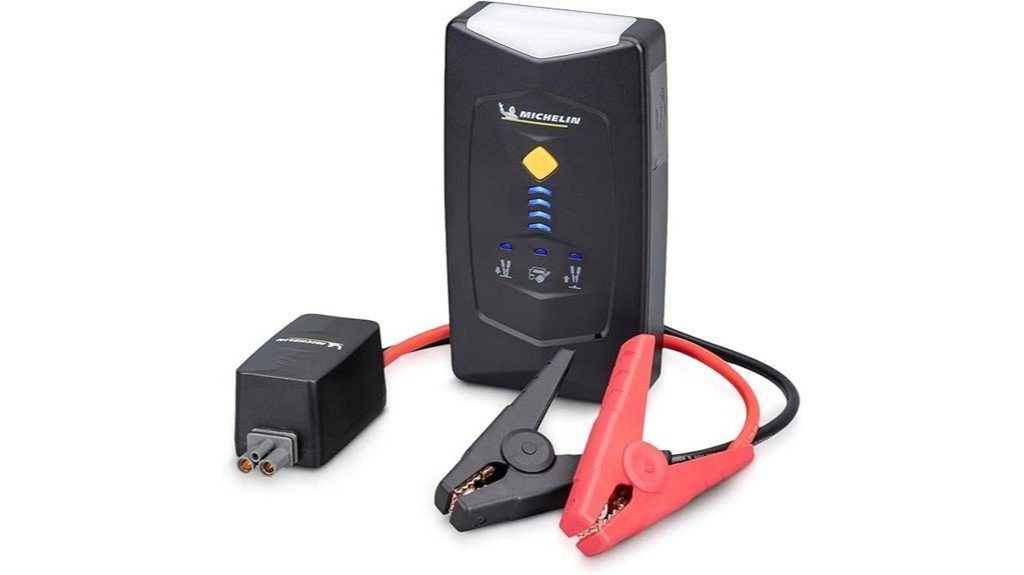
The listed kit includes the jump starter, Safe & Smart clamp cables, USB-C charging cable, 12V USB car charger, and a MICHELIN storage case. The official manual also provides operating and safety instructions. Keeping the cables and pack in one case helps prevent a roadside search for a missing connector.
The included USB charging cable does not mean the box contains a 45W wall adapter. The manual specifies that a suitable wall adapter is not included. Check the current seller’s package list before you order, especially if a third-party listing offers a different bundle.
Design, Portability, and Controls
The verified 6.7 × 3.7 × 1.4-inch body weighs 1.1 lb, so it fits neatly in a small trunk organizer or emergency kit. Those figures describe the device, not necessarily the retail box with its cables and case. The black housing has a power/mode button, battery-level LEDs, a jump-status guide, and separate cable and USB connections.
The Intelli-Step display shows when to connect the clamps and when the unit is ready to start. The polarity protection box uses light and sound signals to flag certain connection faults. It adds useful feedback, but you still need clean approved contacts, the right polarity, and a safe place for the pack during cranking.
MICHELIN lists IP64 splash resistance with the ports covered. That is useful for limited spray exposure, but the manual warns against rain, immersion, and excessive moisture. Do not treat this as a waterproof tool.
Starting Performance and Compatibility
The manual rates jump-start output at up to 500A for three seconds. That is a short starting burst, not a continuous 500A supply. It also limits the application to supported 12V internal-combustion vehicles with a single lead-acid battery system. The advertised 6.0L gas and 4.0L diesel engine limits are useful screening numbers, not guaranteed results.
The source draft referred to a 3.5L V6 starting in under five seconds, but that specific performance result was not confirmed by independent testing or the official manual. Actual results will vary with temperature, engine condition, oil thickness, battery health, and clamp contact. Vehicles with remote jump posts need extra care because the manual warns that some such setups may not work as expected.
USB Charging and Emergency Lighting
The USB-C port can accept and deliver up to 45W when paired with compatible equipment. MICHELIN estimates a 1.5–2 hour recharge with 45W USB-C input, while the included 12V car charger takes about 5–5.5 hours. A separate 45W wall adapter is needed for the faster method. Real charging times also depend on the cable, adapter, and starting charge level.
The USB-A port supports charging older devices, and the manual allows both USB ports to charge two small devices at once. The 32Wh rating is helpful when comparing portable power banks, but it does not tell you an exact number of phone charges because conversion losses and device sizes differ.
The built-in light offers white and red floodlight settings, plus strobe and hazard patterns. It can illuminate a battery area or signal for help during a safe roadside stop. Use the light without distracting traffic, and never stand in an active traffic lane to reach your engine bay.
How It Performs in Real Use
For Routine Roadside Starts
This model is best treated as a backup for an occasional weak 12V battery. The pack must be at least 51% charged before a jump, according to the manual. Once the LED shows the vehicle is ready, you have a 90-second starting window before the unit times out.
For Cold-Weather Use
The specified operating range starts at -4°F (-20°C), but cold reduces available battery power and raises engine starting demands. The device must be at least 32°F (0°C) when charging. If you face severe winters, keep the pack within its stated storage range and do not assume a 500A unit can handle every cold diesel start.
For Multiple Starts
MICHELIN does not promise a fixed count of successful starts per charge. The manual limits you to three start attempts, with a 60-second pause after a failed attempt and clamp reconnection before trying again. If the engine still fails, get the battery, starter, and charging system checked instead of cranking repeatedly.
For Travel and Storage
The storage case keeps the pack and cables together when you move between vehicles. The manual recommends checking the battery level regularly and recharging every two to three months if the pack is unused. Store it indoors, away from extreme heat, water, metal objects, and direct weather exposure.
Pro Tip: Set a calendar reminder every two months to check the jump starter’s charge. Before a long drive, confirm at least three solid battery indicator lights and keep the smart clamps in the same case.
Setup Tips Before First Use
- Read both manuals. Check the jump starter’s instructions and your vehicle’s approved jump points before connecting anything.
- Charge the pack fully. Use an approved adapter and charge only within the specified 32°F–93°F range.
- Check the LED battery level. The manual requires at least three solid indicator lights, meaning 51% or more, before a starting attempt.
- Prepare the vehicle. Park safely, set the parking brake, switch off accessories, and unplug USB charging cables from the pack.
- Inspect the smart cables. Confirm the gray plug fits firmly and the clamps are clean, intact, and free of corrosion.
- Follow the specified clamp sequence. With the pack powered as directed, follow the Intelli-Step prompts and use the approved positive and negative jump points. The MICHELIN manual calls for red positive first, then black negative; follow the vehicle maker’s procedure if its designated connection points differ.
- Watch the indicators. Never crank if the protection box signals a connection fault. The manual provides a 90-second ready window and calls for a 60-second pause before another attempt.
- Remove the clamps promptly. The MICHELIN manual says to disconnect within 30 seconds after a successful start, removing red positive first, then black negative, and finally unplugging the gray connector. Confirm the applicable vehicle procedure and keep the metal clamp ends apart.
Compatibility and Safety
This is not a universal battery booster. Do not use it with 24V systems, unsupported battery types, a swollen or frozen battery, or a leaking or cracked case. Its manual identifies supported applications as 12V combustion-engine vehicles with a single lead-acid battery system. Check your owner’s manual if you have an unusual battery setup or remote jump points.
Wear eye protection when working near a lead-acid battery. Keep flames, cigarettes, loose jewelry, and metal tools away. Do not let clamps touch, lean over the battery, or place the power bank near moving belts or hot parts. Stop if cables are damaged or protection indicators show a fault. A qualified mechanic or roadside professional is a better choice when the battery or vehicle electrical system is damaged.
The pack’s 32Wh rating matters for air travel. Lithium spare batteries and power banks are generally subject to carry-on and terminal-protection rules, but airlines may have stricter policies. Check the airline and regulator guidance before packing this jump starter, and never assume that its capacity alone guarantees approval.
Pros and Cons
Pros
- Verified 1.1 lb device weight makes it easy to carry and store.
- Intelli-Step prompts and smart clamps offer connection feedback.
- 45W USB-C input/output adds useful portable charging.
- White/red floodlight, strobe, and hazard modes support roadside visibility.
- Case, clamps, cable, and 12V car charger are included in the standard package.
Cons
- 500A peak output is a limited choice for large engines or repeated workshop starts.
- 45W wall adapter is not included, despite the fast USB-C charging feature.
- Requires periodic charging, careful temperature management, and correct clamp handling.
Is It Worth the Price?
The MICHELIN unit is worth comparing with mid-range portable jump starters if you want simple LED guidance and a USB-C power bank in one emergency kit. Its small size, included case, and lighting make it convenient for an everyday vehicle rather than a garage full of larger trucks.
Its value drops if you routinely start large diesel engines or need professional repeat-start capacity. You should also allow for a separate 45W wall adapter if fast recharging matters. Check the live price, warranty eligibility, and vehicle compatibility before deciding.
How It Compares to Alternatives
The NOCO Boost Plus GB40 is another compact lithium jump starter worth comparing if you want a model with a higher advertised peak-current rating. The Clore Automotive Jump-N-Carry JNC660 uses a heavier lead-acid format and targets users who value a workshop-style booster with longer cables.
MICHELIN’s AC533420 is a better match when low device weight, a 45W USB-C port, LED connection prompts, and a built-in floodlight matter most. Compare each alternative’s current manual and battery requirements rather than assuming a higher amp label alone guarantees a start.
Frequently Asked Questions
How many times can the MICHELIN AC533420 start a car per charge?
There is no verified fixed number. The amount of power needed changes with engine size, temperature, and battery condition. The manual limits attempts to three before you stop and investigate the problem.
Will it start a completely dead 12V battery?
A deeply discharged battery may not provide the signal the smart-clamp system expects. Do not bypass safety electronics or try an undocumented override. Follow the manual, and call roadside assistance if the battery is damaged or the pack will not indicate a safe connection.
How long does the MICHELIN jump starter take to recharge?
The official manual lists about 1.5–2 hours with a suitable 45W USB-C input, or 5–5.5 hours with the included 12V car charger. The 45W wall adapter is not part of the standard bundle. Charge only within the specified temperature range.
How often should you recharge it during storage?
MICHELIN recommends checking the charge level regularly and recharging every two to three months if you have not used the pack. Also recharge after a jump and before a long trip. Store the pack indoors and below the stated 104°F maximum.
Can you carry the 32Wh jump starter on an airplane?
The manual confirms a 32Wh battery, but airline acceptance still depends on current rules for lithium power banks and protected terminals. Carry-on restrictions commonly apply, and some carriers have additional limits. Confirm with your airline before travel.
Is the MICHELIN jump starter waterproof?
No. The manufacturer lists IP64 splash resistance only when the ports are closed. The manual tells you to protect the unit from rain and excessive moisture, so never immerse it or charge it outdoors in wet weather.
Does the MICHELIN AC533420 have a warranty?
The official manual states a one-year limited warranty for qualifying original purchasers in North America. Proof of purchase and other conditions apply. Check the seller and manufacturer terms if you are buying outside that region.
Can it replace a battery charger, and what if the car still will not start?
It cannot maintain or restore a vehicle battery like a dedicated charger. If your car does not start after the manual’s three-attempt limit, stop and inspect the battery and starting system with a qualified technician. Repeated jump-starts may hide a failing battery or charging fault.
The Bottom Line
The MICHELIN AC533420 is recommended with caveats for drivers who want a light, easy-to-store 12V emergency starter with guided clamps and USB charging. Its verified 1.1 lb body and useful light are clear strengths, while 500A peak output and application limits make it a poor fit for demanding fleet or large-diesel service. Buy it only after confirming your vehicle’s battery system and the current package details.
Ready to Buy?
Check the current price, warranty coverage, package contents, and vehicle compatibility before you decide.