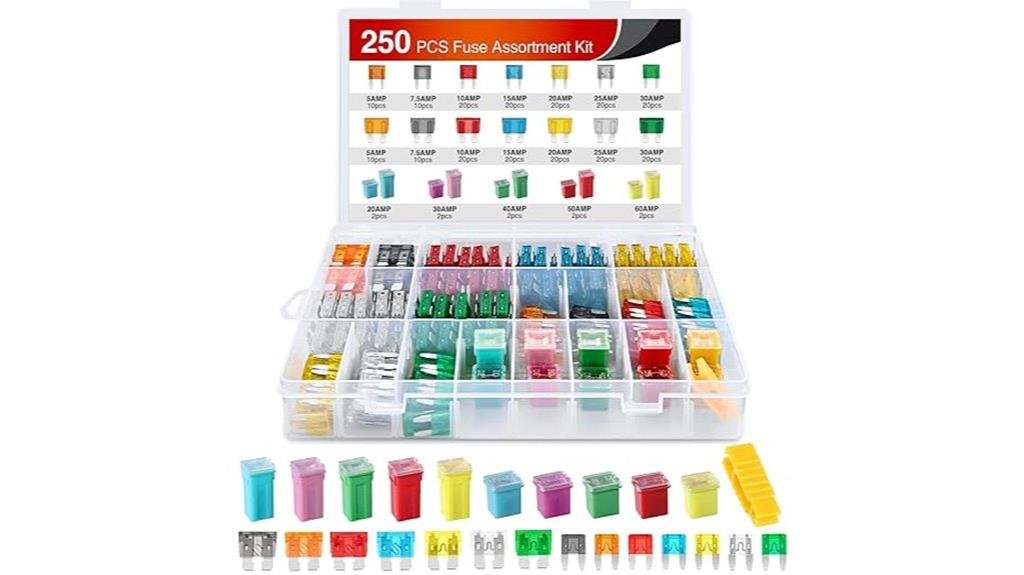
The Nilight Blade Jcase Car Fuse Assortment Kit offers 250 organized fuses for automotive, RV, and ATV use, including standard and mini blade fuses (5–30 A) and low/tall Jcase fuses (20–60 A), all stored in labeled compartments. Materials are zinc and copper alloys, dimensions fit common fuse blocks, and the kit aids quick roadside or shop repairs. How easy is identification, what tools are needed, and which fuses suit your vehicle?
Key Takeaways
- 250-piece kit includes standard blade, mini blade, low- and tall-profile Jcase fuses covering common automotive needs.
- Blades range 5–30A; Jcase fuses cover 20–60A, suitable for most cars, trucks, RVs, and ATVs.
- Color-coded housings and stamped amp values enable quick identification and correct replacement.
- Zinc-alloy blades and copper-alloy elements in fire-resistant Jcase shells offer solid conductivity and durability.
- Lacks fuse puller and limited high-amp quantities, but good value for DIYers and mechanics needing broad coverage.
What’s Included in the Kit
Contents: the Nilight Blade Jcase Car Fuse Assortment Kit supplies 250 fuses organized to cover common automotive needs.
The kit includes standard blade, mini blade, low-profile Jcase, and tall-profile Jcase box fuses, packed in a plastic case with labeled compartments.
What quantities? Multiple counts per rating totalling 250 pieces.
How are they identified? Color-coded housings and stamped amp values aid quick selection.
Practical dimensions: individual blades ≈ 19 mm standard, minis ≈ 11 mm, Jcase bodies ≈ 28×18×9 mm.
Consider storage space, vehicle compatibility, and spare count per fuse rating before purchase.
Fuse Types, Ratings, and Compatibility
Having the organized 250-piece kit on hand makes it easier to match a blown fuse to the correct replacement, but understanding the differences between blade and Jcase styles, amp ratings, and vehicle fitment is the next step.
The kit includes Standard and Mini blade fuses (5–30A, seven ratings) and Low/Tall Jcase box fuses (20–60A, five ratings).
Includes Standard and Mini blade fuses (5–30A) plus Low/Tall Jcase box fuses (20–60A) for varied applications
Which to use? Match form factor and amp value to the vehicle fuse panel; blades fit typical car circuits, Jcase suits high-current loads like amplifiers or starters.
Note color coding, carved amp markings, and verify fitment for Cars, Trucks, RVs, ATVs.
Design, Materials, and Durability
The Nilight Blade Jcase kit balances practical form and rugged materials to meet everyday automotive needs: zinc-alloy fuse blades provide improved conductivity and corrosion resistance, while Jcase box fuses pair a fire-resistant polymer shell with copper-alloy current elements for reliable high-current protection. It offers varied sizes, 250 pieces total, blades 5–30A, Jcase 20–60A, useful for cars and RVs. Construction feels solid; housings resist heat, terminals seat firmly. What about lifespan? Expect years under normal use, replace if corrosion appears. Consider storage: compartmented case, dimensions 220×140×35 mm aids organization.
| Feature | Material | Note |
|---|---|---|
| Blade Blades | Zinc-alloy | 5–30A |
| Jcase Shell | Fire-resistant polymer | 20–60A |
| Contacts | Copper-alloy | High-current use |
How to Identify and Replace Fuses Safely
After establishing the kit’s build quality and storage layout, attention turns to identifying and replacing fuses safely. The reader should confirm vehicle fuse amp rating (5A–60A range in this kit), visually match color-coded housings, and read carved amp numbers.
How to proceed? First, kill ignition and disconnect battery (negative terminal), then remove the fuse with pliers or the included puller. Inspect filament for breakage, compare to spare of identical type and rating.
Replace with same blade or Jcase profile, seat fully, reconnect battery, and test circuit. Keep spares organized by rating, label boxes for quick retrieval.
Pros, Cons, and Who Should Buy
Pros: wide amperage coverage, color-coded housings, zinc and copper alloy construction, fire-proof Jcase shells.
Cons: no carry case dividers, limited high-amp quantities, no fuse puller included.
Who should buy? DIYers, mechanics, RV and off-road owners needing on-hand replacements and 250-piece versatility.
Frequently Asked Questions
Are These Fuses Resettable or One-Time Use?
They are one-time use. The fuses are sacrificial—zinc alloy elements melt to interrupt faults—requiring replacement after a blow. Users must replace blown blade or Jcase fuses with identical type and amp rating to restore protection.
Do They Come With a Storage Case or Organizer?
No — a miniature chaos of colored slivers dumped into a tray, not a tidy vault: the kit lacks a dedicated storage case, offering only loose organized groups; users must provide their own box or rely on included tray.
Are These Fuses Sae/Iso Standard Compliant?
No, the listing does not state SAE/ISO certification; the manufacturer’s description emphasizes materials and ratings but omits formal standard compliance, so the buyer should request certification or verify conformity before assuming SAE/ISO compliance.
Can These Fuses Handle Marine or High-Vibration Environments?
They are not rated specifically for marine or high‑vibration use; the zinc and copper alloys provide good conductivity and corrosion resistance, but dedicated marine‑rated and vibration‑tested fuses are recommended for those harsh environments.
Is There a Warranty or Satisfaction Guarantee Included?
No explicit warranty or satisfaction guarantee is specified; the manufacturer’s standard warranty and seller return policies may apply. The purchaser is advised to check the retailer listing or contact Nilight directly for exact warranty details and returns.
Conclusion
The Nilight Blade Jcase kit proves a practical, well-organized solution for vehicle electrical maintenance. It includes 250 fuses: standard and mini blade fuses (5–30 A), low and tall J-case fuses (20–60 A), all in labeled compartments, zinc and copper alloy construction. How durable is it? Solid for typical automotive, RV, and ATV use; replace using amperage-matched fuses, measure clearances, and note panel fit. As the adage warns, “better safe than sorry.”